

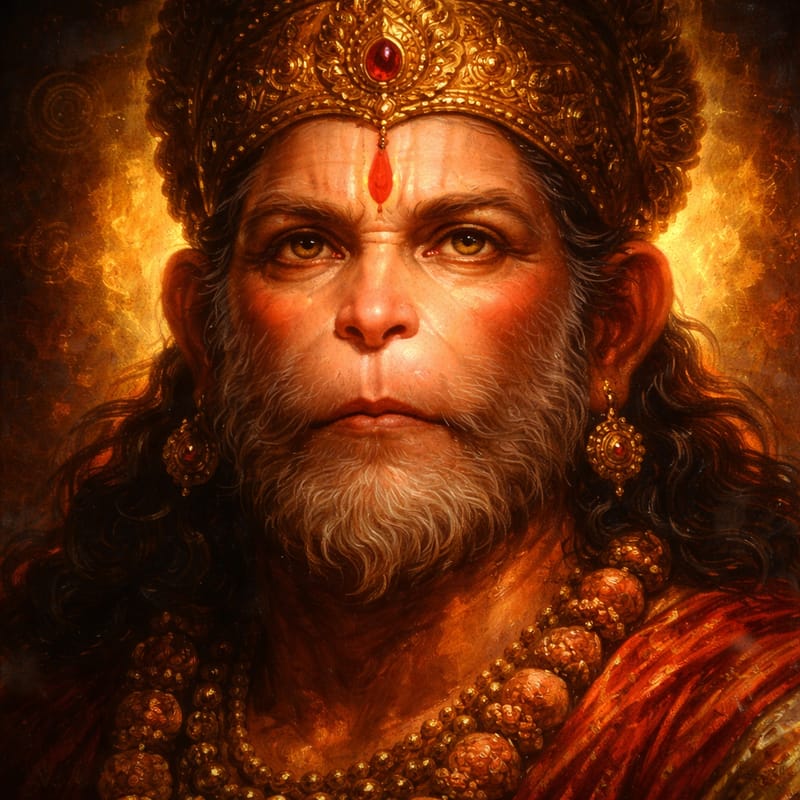
Hanuman Chalisa — Spanish Lyrics
The Hanuman Chalisa is a 40-verse devotional hymn composed by Tulsidas in the 16th century, written in Awadhi-Hindi vernacular with Sanskrit roots. The opening doha (couplet) establishes the spiritual foundation: the poet cleanses the mirror of his mind with the dust of his guru's lotus feet, then narrates the immaculate glory of Rama—who grants the four fruits of life (dharma, artha, kama, moksha). Acknowledging his own ignorance, the poet seeks Hanuman's grace for strength, wisdom, and freedom from afflictions. Each subsequent verse celebrates Hanuman's divine attributes, courage, and role as Rama's eternal messenger.
Hanuman represents the pinnacle of bhakti (devotion), courage, and selfless service in Hindu spirituality. He is the bridge between the human and divine—monkey-born yet supremely enlightened, embodying humility despite incomparable strength. The Chalisa positions him as 'ocean of wisdom,' 'dispeller of evil thoughts,' and 'remover of obstacles.' In the Ramcharitmanas, Tulsidas portrays Hanuman as the ideal devotee: his mind rests eternally in Rama, his intellect serves Rama's purpose, and his body executes Rama's will. For practitioners, Hanuman exemplifies how surrendered action transcends ego and draws out great inner strength—a living gateway to shakti (power) and bhakti (grace) simultaneously.
Chant the Hanuman Chalisa with sincerity, preferably in the early morning (brahma muhurta) or during times of difficulty. Begin by bowing to your guru and Hanuman. Recite all 40 verses slowly, focusing on their meaning rather than speed. Many devotees practice it weekly on Tuesdays or Saturdays (auspicious for Hanuman). Even reciting a single verse with concentrated awareness yields benefit. The mantra works best when paired with intentional living—embodying Hanuman's virtues of courage, loyalty, and service. No special ritual is required; sincere repetition awakens the Hanuman consciousness within.
Curated by The Mahakatha Team · Original Composition: Mahakatha · Lyric: Tulsidas (16th century CE)
Hanuman Chalisa
Hanuman · Preview · 2:00
Preview ended
Ancient sounds for transformation, carried across 3,000 years.
Get the full version — plus 275 more ancient chants. 80% OFF today only.
Get Ancient Chants Bundle — 80% OFF →3000+ happy customers · Lifetime access · All devices
2.2M people trust Mahakatha
Chant daily with reminders — Get the Mahakatha app
दोहा श्रीगुरु चरन सरोज रज, निजमन मुकुरु सुधारि। बरनउं रघुवर बिमल जसु, जो दायकु फल चारि।। बुद्धिहीन तनु जानिके, सुमिरौं पवन-कुमार। बल बुधि बिद्या देहु मोहिं, हरहु कलेस बिकार।।
doha shriguru charana saroja raja, nijamana mukuru sudhari| baranau raghuvara vimala jasu, jo dayaka phala chari|| buddhihina tanu janike, sumirau pavana-kumara| bala budhi bidya dehu mohi, harahu kalesa bikara||
Con el polvo a los pies de loto de Mi Señor, limpio el espejo de mi mente.
Narro la Sagrada Gloria de Sri Raghubar (Sri Rama Chandra), quien Otorga los Cuatro Frutos de la Vida (Dharma, Artha, Kama y Moksha).
Considerándome a mí mismo Ignorante, Medito en Ti, Oh Pavan Kumar (Hanuman).
Otórgame Fuerza, Sabiduría y Conocimiento, y Elimina mis Aflicciones y Defectos.
चौपाई
chaupai
जय हनुमान ज्ञान गुन सागर। जय कपीस तिहुं लोक उजागर।। राम दूत अतुलित बल धामा। अंजनि-पुत्र पवनसुत नामा।।
jaya hanumana gyana guna sagara| jaya kapisa tihu loka ujagara|| rama duta atulita bala dhama| anjani-putra pavanasuta nama||
Victoria a Ti, Oh Hanuman, Quien es el Océano de Sabiduría y Virtud,
Victoria al Señor de los Monos, Quien es el Iluminador de los Tres Mundos.
Tú eres el Mensajero de Sri Rama que posee Fuerza Inconmensurable,
Eres Conocido como Anjani-Putra (hijo de Anjani) y Pavana-Suta (hijo de Pavana, el dios del viento).
महाबीर बिक्रम बजरंगी। कुमति निवार सुमति के संगी।। कंचन बरन बिराज सुवेसा। कानन कुण्डल कुँचित केसा।।
mahabira bikrama bajarangi| kumati nivara sumati ke sangi|| kanchana barana biraja suvesa| kanana kundala kunchita kesa||
Eres un Gran Héroe, extremadamente Valiente, y con cuerpo fuerte como el Rayo,
Eres el Disipador de Pensamientos Malvados y Compañero del Buen Sentido y la Sabiduría.
Posees un Tono Dorado, y estás Pulcramente Vestido,
Llevas Aretes y tienes hermoso Cabello Rizado.
हाथ बज्र अरु ध्वजा बिराजे। कांधे मूंज जनेउ साजे।। संकर स्वयं केसरी नंदन। तेज प्रताप महा जग वंदन।।
hatha bajra aru dhvaja biraje| kandhe munja janeu saje|| shankara suvana kesari nandana| teja pratapa maha jaga vandana||
Sostienes el Rayo y la Bandera en tus Manos.
Llevas el Hilo Sagrado cruzado sobre tu Hombro.
Eres la Encarnación del Señor Shiva e Hijo de Kesari,
Eres Adorado por el mundo entero debido a tu Gran Fuerza y Coraje.
विद्यावान गुनी अति चातुर। राम काज करिबे को आतुर।। प्रभु चरित्र सुनिबे को रसिया। राम लखन सीता मन बसिया।।
vidyavana guni ati chatura| rama kaja karibe ko atura|| prabhu charitra sunive ko rasiya| rama lakhana sita mana basiya||
Eres Erudito, Virtuoso y Extremadamente Inteligente,
Siempre estás Ansioso por hacer las Obras de Sri Rama.
Te Deleitas Escuchando las Glorias de Sri Rama,
Tienes a Sri Rama, Sri Lakshmana y Devi Sita Morando en tu Corazón.
सूक्ष्म रूप धरि सियहिं दिखावा। बिकट रूप धरि लंक जरावा।। भीम रूप धरि असुर संहारे। रामचन्द्र के काज संवारे।।
sukshma rupa dhari siyahi dikhava| bikata rupa dhari lanka jarava|| bhima rupa dhari asura sanghare| ramachandra ke kaja savare||
Apareciste ante Devi Sita Asumiendo una Forma Diminuta (en Lanka),
Asumiste una Forma Imponente y Quemaste Lanka.
Asumiste una Forma Gigantesca y Destruiste a los Demonios,
Cumpliendo así la Tarea de Sri Rama.
लाय सजीवन लखन जियाये। श्री रघुबीर हरषि उर लाये।। रघुपति कीन्ही बहुत बड़ाई। तुम मम प्रिय भरतहि सम भाई।।
laya sajivana lakhana jiyaye| shri raghubira harashi ura laye|| raghupati kinhi bahuta badai| tum mama priya bharatahi sama bhai||
Trajiste la hierba Sanjivana y Reviviste a Sri Lakshmana.
Debido a esto Sri Rama te Abrazó desbordante de Alegría.
Sri Rama te Elogió Grandemente,
Y dijo: "Eres tan querido para mí como mi hermano Bharata".
सहस बदन तुम्हरो जस गावैं। अस कहि श्रीपति कण्ठ लगावैं।। सनकादिक ब्रह्मादि मुनीसा। नारद सारद सहित अहीसा।।
sahasa badana tumharo jasa gavai| asa kahi shripati kantha lagavai|| sanakadika brahmadi munisa| narada sarada sahita ahisa||
"El Seshnag de Mil Cabezas Canta tu Gloria",
Dijo Sri Rama tomándote en su Abrazo.
Sanaka y otros Sabios, el Señor Brahma y otros Dioses,
Narada, Devi Saraswati y Seshnag ...
जम कुबेर दिगपाल जहां ते। कवि कोविद कहि सके कहां ते।। तुम उपकार सुग्रीवहिं कीन्हा। राम मिलाय राज पद दीन्हा।।
jama kubera digapala jahan te| kavi kovida kahi sake kahan te|| tuma upakara sugrivahi kinha| rama milaya raja pada dinha||
Yama (dios de la muerte), Kubera (dios de la riqueza), Digpalas (las deidades guardianas),
Poetas y Eruditos no han podido Describir tus Glorias en su totalidad.
Prestaste una gran Ayuda a Sugriva.
Lo Presentaste a Sri Rama y así le Devolviste su Reino.
तुम्हरो मंत्र बिभीषन माना। लंकेश्वर भए सब जग जाना।। जुग सहस्र जोजन पर भानु। लील्यो ताहि मधुर फल जानू।।
tumharo mantra bibhishana mana| lankeshvara bhaye saba jaga jana|| juga sahastra jojana para bhanu| lilyo tahi madhura phala janu||
Vibhisana Siguió tu Consejo,
Y el Mundo Entero Sabe que se convirtió en el Rey de Lanka.
El Sol que estaba a una distancia de Dieciséis Mil Millas,
Lo Tragaste pensando que era una Fruta Dulce.
प्रभु मुद्रिका मेलि मुख माहीं। जलधि लांघि गये अचरज नाहीं।। दुर्गम काज जगत के जेते। सुगम अनुग्रह तुम्हरे तेते।।
prabhu mudrika meli mukha mahi| jaladhi langhi gaye acharaja nahi|| durgama kaja jagata ke jete| sugama anugraha tumhare tete||
Llevando el Anillo del Señor Sri Rama en tu Boca,
Cruzaste el Océano, no hay Maravilla en eso.
Todas las Tareas Difíciles en este Mundo,
Se Vuelven Fáciles por tu Gracia.
राम दुआरे तुम रखवारे। होत न आज्ञा बिनु पैसारे।। सब सुख लहै तुम्हारी सरना। तुम रक्षक काहू को डर ना।।
rama duare tuma rakhavare| hota na ajna binu paisare|| saba sukha lahai tunhari sarana| tuma rakshaka kahu ko dara na||
Eres el Guardián de la Puerta del Reino de Sri Rama.
Nadie puede Entrar sin Tu Permiso.
Aquellos que se Refugian en Ti disfrutan de toda Felicidad.
Si Tú eres el Protector, ¿qué hay que Temer?
आपन तेज सम्हारो आपै। तीनों लोक हांक तें कांपै।। भूत पिसाच निकट नहिं आवै। महावीर जब नाम सुनावै।।
apana teja samharo apai| tino loka hanka te kapai|| bhuta pisacha nikata nahi avai| mahavira jaba nama sunavai||
Solo tú puedes Controlar tu Gran Energía.
Cuando Ruges, los Tres Mundos Tiemblan.
Fantasmas y Espíritus Malignos No se Acercarán,
Cuando uno Pronuncia el Nombre de Mahavir (Hanuman).
नासै रोग हरे सब पीरा। जपत निरन्तर हनुमत बीरा।। संकट तें हनुमान छुड़ावै। मन क्रम बचन ध्यान जो लावै।।
nasai roga hare saba pira| japata nirantara hanumata bira|| sankata te hanumana chhudavai| mana krama bachana dhyana jo lavai||
Destruyes las Enfermedades y Eliminas todos los Dolores,
Cuando uno Pronuncia tu Nombre Continuamente.
Hanuman Libera a uno de las Dificultades,
Cuando uno Medita en Él con Mente, Acción y Palabras.
सब पर राम राय सिर राजा। तिन के काज सकल तुम साजा।। और मनोरथ जो कोई लावै। सोई अमित जीवन फल पावै।।
saba para rama tapasvi raja| tina ke kaja sakala tuma saja|| aura manoratha jo koi lavai| soi amita jivana phala pavai||
Sri Rama es el Rey de los Tapaswis (devotos dedicados a las penitencias).
Y Tú (Hanuman) Cumples todas las Obras de Sri Rama (como administrador).
Los Devotos que tienen Otros Deseos,
Finalmente obtendrán el Fruto Supremo de la Vida.
चारों जुग परताप तुम्हारा। है परसिद्ध जगत उजियारा।। साधु संत के तुम रखवारे।। असुर निकन्दन राम दुलारे।।
charo juga paratap tumhara| hai parasiddha jagata ujiyara|| sadhu santa ke tum rakhavare|| asura nikandana rama dulare||
Tu Gloria prevalece en las Cuatro Eras.
Y tu Fama Irradia por todo el Mundo.
Eres el Salvador de los Santos y Sabios.
Destruyes a los Demonios, Oh Amado de Sri Rama.
अष्टसिद्धि नौ निधि के दाता। अस बर दीन जानकी माता।। राम रसायन तुम्हरे पासा। सादर हो रघुपति के दासा।।
ashtasiddhi nau nidhi ke data| asa bara dina janaki mata|| rama rasayana tumhare pasa| sada raho raghupati ke dasa||
Puedes Otorgar los Ocho Siddhis (poderes sobrenaturales) y Nueve Nidhis (tipos de devociones).
Madre Janaki (Devi Sita) te dio esta Bendición.
Posees la Esencia de la Devoción a Sri Rama.
Siempre Permaneces como el Servidor de Raghupati (Sri Rama).
तुह्मरे भजन राम को पावै। जनम जनम के दुख बिसरावै।। अंत काल रघुबर पुर जाई। जहां जन्म हरिभक्त कहाई।।
tumhare bhajana rama ko pavai| janama janama ke dukha bisaravai|| anta kala raghubara pura jai| jahan janma haribhakta kahai||
A través de la Devoción a Ti, uno obtiene a Sri Rama,
Liberándose así de los Sufrimientos de Vida tras Vida.
Al Final uno Va a la Morada de Raghupati (Sri Rama).
Donde uno es Conocido como el Devoto de Hari.
और देवता चित्त न धरई। हनुमत सेइ सर्ब सुख करई।। सङ्कट कटै मिटै सब पीरा। जो सुमिरै हनुमत बलबीरा।।
aura devata chitta na dharai| hanumata sei sarba sukha karai|| sankata katai mitai saba pira| jo sumirai hanumata balabira||
Incluso sin Adorar a Otras Deidades,
Uno Obtiene Toda Felicidad quien Adora a Sri Hanuman.
Las Dificultades desaparecen y los Dolores son Eliminados,
Para Aquellos que Contemplan al Poderoso Sri Hanuman.
जय जय जय हनुमान गोसाईं। कृपा करहु गुरुदेव की नाईं।। यह सत बार पाठ कर जोइ। छूटहि बन्दि महा सुख होई।।
jaya jaya jaya hanumana gosai| kripa karahu gurudeva ki nai|| jo sata bara patha kara koi| chhutahi bandi maha sukha hoi||
Victoria, Victoria, Victoria a Ti, Oh Hanuman,
Por favor Otorga tu Gracia como nuestro Gurú Supremo.
Aquellos que Recitan este Hanuman Chalisa cien veces (con devoción),
Serán Liberados de las Ataduras Mundanas y obtendrán Gran Felicidad.
जो यह पढ़ै हनुमान चालीसा। होय सिद्धि साखी गौरीसा।। तुलसीदास सदा हरि चेरा। कीजै नाथ हृदय महं डेरा।।
jo yaha padhai hanumana chalisa| hoya siddhi sakhi gaurisa|| tulasidasa sada hari chera| kijai natha hridaya maham dera||
Aquellos que Leen el Hanuman Chalisa (con devoción),
Se volverán Perfectos, el Señor Shiva es el Testigo.
Tulsidas quien siempre es el Servidor de Hari.
Ruega al Señor que Resida en su Corazón.
दोहा पवनतनय संकट हरन, मंगल मूर्ति रूप। राम लखन सीता सहित, हृदय बसहु सुर भूप।।
doha pavanatanaya sankata harana, mangala murti rupa| rama lakhana sita sahita, hridaya basahu sura bhupa||
Sri Hanuman, quien es el Hijo de Pavana, quien Elimina las Dificultades,
Quien tiene una Forma Auspiciosa,
Con Sri Rama, Sri Lakshmana y Devi Sita,
Por favor Mora en mi Corazón.
How to Chant Hanuman Chalisa
- 1
Find a quiet, clean space
Sit in a comfortable, undisturbed environment. Face east or north if possible. You may light incense or a candle to set a contemplative atmosphere.
- 2
Settle into a comfortable posture
Sit cross-legged on the floor or upright in a chair. Keep the spine erect and place the hands on the knees with palms facing upward.
- 3
Take three cleansing breaths
Inhale slowly through the nose, hold briefly, and exhale completely. Repeat three times to calm the mind and prepare for mantra recitation.
- 4
Begin chanting Hanuman Chalisa
Chant the mantra clearly and with devotion — aloud, in a whisper, or silently. Use a mala (108 beads) to count repetitions. Aim for a consistent, unhurried rhythm throughout the session.
- 5
Rest in stillness
After completing your chanting, sit quietly for two to five minutes. Allow the vibration of the mantra to settle within. Close the practice with a moment of gratitude.
Benefits of Hanuman Chalisa
-
Grants fearlessness and inner courage to face life's obstacles and challenges with equanimity.
Source: Hanuman Chalisa verse 13-14; Traditional devotional practice
-
Removes negative mental patterns, obstacles, and destructive thoughts; protects the practitioner from harm.
Source: Verse 2 (kumati nivara—dispeller of evil thoughts); Ramcharitmanas tradition
-
Strengthens mental clarity, intellectual focus, and wisdom needed for spiritual and worldly success.
Source: Verse 1 (gyana guna sagara—ocean of wisdom); Verse 4 (vidyavana guni—learned and virtuous)
-
Cultivates steady devotion (bhakti) and surrender, aligning the chanter's will with divine purpose.
Source: Verse 16-17; Bhakti yoga tradition as taught in Bhagavad Gita 12.2
-
Devotees chant it for comfort when carrying trauma, emotional hurt, and past suffering, calling on Hanuman's protective grace.
Source: Verse 18 (sankata katai—removes suffering); Traditional healing practice
-
Devotees pray through it for problems to be resolved and, as tradition holds, for liberation from cycles of birth and death.
Source: Verse 20 (chhutahi bandi—liberation from bondage); Verse 17 (janama janama ke dukha bisaravai)
Story & Symbolism
Tradition credits the 16th-century poet-saint Tulsidas with the Hanuman Chalisa. It is a separate work from his Ramcharitmanas (1574–1577 CE), the Awadhi retelling of the Ramayana, although the two share a language and a devotion to Rama. Tulsidas lived much of his life in Varanasi, and devotional stories tell of him receiving darshan (a vision) of Hanuman; these are traditional accounts rather than historical records. Its 40 short verses were open to everyone, whatever their caste or class. The work became central to North Indian Hindu devotion and has been passed on through oral tradition, teachers and, later, printed texts.
Hanuman himself represents the archetypal devotee in Hindu spirituality—embodying the principle that selfless service and unwavering love are the fastest pathways to liberation. In the original Ramayana (Valmiki), Hanuman is portrayed as Rama's perfect instrument: his mind serves only Rama, his intellect is devoted to Rama's purpose, his body executes Rama's will. The Chalisa elevates this further, positioning Hanuman as a cosmic force—not merely a monkey-deity, but the embodiment of shakti (divine power), bhakti (devotion), and jnana (wisdom) unified. Each verse is a meditation on a different facet of transcendent consciousness accessible through surrendered devotion. Tulsidas teaches that Hanuman-consciousness dissolves the ego-knot and reveals the eternal presence of Rama (the Self) within and without.
Today, the Hanuman Chalisa remains the most widely chanted mantra in Hindu tradition, recited daily in temples, homes, meditation centers, and by individuals worldwide. It has been translated into every major language and appears in countless YouTube versions, podcasts, and spiritual apps. What began as Tulsidas's personal devotional experience has become a collective healing and liberation tool for millions. Its durability across 500 years testifies to its spiritual potency—each generation discovers fresh meaning within the same verses, proving that true sacred texts are alive, responsive, and eternally relevant to human consciousness.
How to Use in Daily Life
Morning Sadhana
Chant the full Hanuman Chalisa upon waking, ideally between (pre-dawn). Begin with prostrations and a clear intention. This establishes divine protection and mental clarity for the entire day ahead.
Meditation Practice
Recite the Chalisa slowly during meditation, focusing deeply on each verse's meaning. Visualize Hanuman's golden form, his fearless courage, and his loving devotion to Rama. Let the words dissolve into silence.
Crisis & Challenge
When facing obstacles, ill health, fear, or conflict, chant the Chalisa with sincere invocation. Repeat the line sankata te hanumana chhudavai ("Hanuman frees you from trouble") as a prayer for relief and clarity.
Evening Reflection
Before sleep, chant the Chalisa or listen to a recording. This is a prayer for protection through the night and for sleep free of nightmares, inviting Hanuman's blessing into your dreams.