

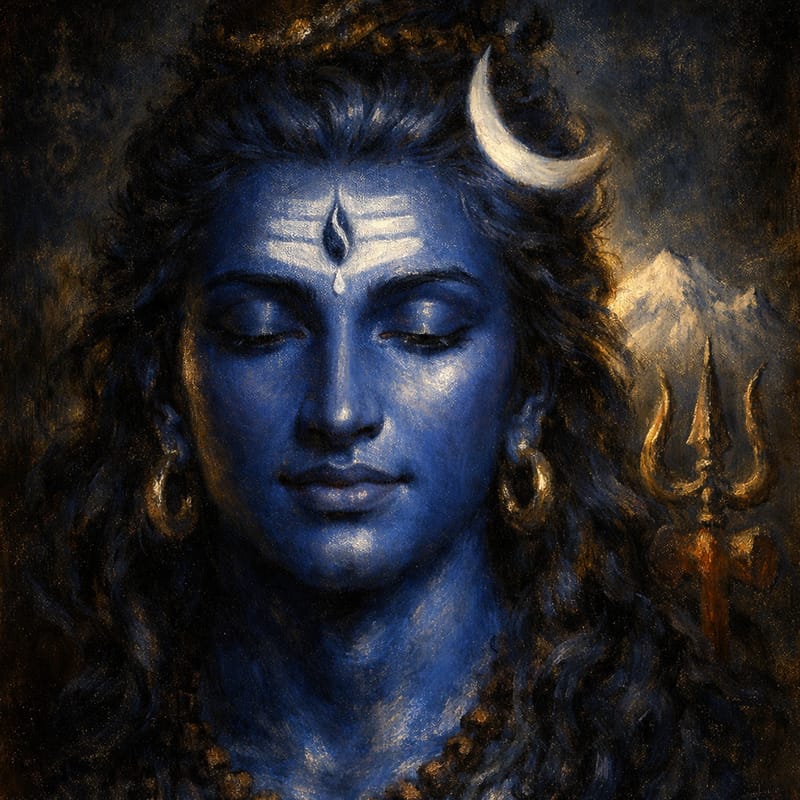
Shivashtakam — Spanish Lyrics
Shivashtakam Mantra is a sacred Sanskrit hymn honoring Shiva that destroys ego and ignorance through transcendent meditation.
Shivashtakam (Shiva + ashtakam = eight verses) is a sacred hymn composed by Adi Shankaracharya, the 8th-century Advaita philosopher and saint. Each of the eight verses describes one of Lord Shiva's divine manifestations and cosmic qualities, concluding with the refrain "Namah Shivaya" (I bow to Shiva). The first verse addresses Shiva as the supreme cause of all existence, with blazing eyes like fire; the second portrays him adorned with the crescent moon and serpents; subsequent verses unveil his ash-covered ascetic form, his fierce Bhairava aspect, his role as destroyer of the ego-bound world, and finally his form as the eternal shepherd of all beings.
Spiritually, Shivashtakam bridges devotion and Advaita philosophy. Adi Shankaracharya composed this not merely as personal prayer but as a philosophical celebration of Shiva as Brahman—the non-dual absolute reality. Each verse employs paradox: Shiva is both fierce destroyer and gentle ascetic, both formless consciousness and embodied deity with serpent crown and tiger skin. The repetition of "Namah Shivaya" anchors the seeker in surrender and recognition that all apparent multiplicity arises from Shiva's eternal consciousness. Chanting this hymn cultivates both bhakti (devotion) and jnana (discriminative wisdom).
Recite Shivashtakam during Shiva puja, on Mondays, and especially during Mahashivaratri (the great night of Shiva). The full eight verses take 8–10 minutes at a meditative pace. Light incense and bilva leaves before beginning. Focus on sound and meaning rather than rushing through words. After completion, rest in silence for 3–5 minutes. Chanting with genuine devotion—allowing each image of Shiva to penetrate consciousness—multiplies the mantra's transformative power.
Curated by The Mahakatha Team · Original Composition: Mahakatha · Lyric: Adi Shankaracharya (8th century CE)
Shivashtakam
Shiva · Preview · 2:00
Preview ended
Ancient sounds for transformation, carried across 3,000 years.
Get the full version — plus 275 more ancient chants. 80% OFF today only.
Get Ancient Chants Bundle — 80% OFF →3000+ happy customers · Lifetime access · All devices
2.2M people trust Mahakatha
Chant daily with reminders — Get the Mahakatha app
तस्मै नमः परम कारण कारणाय। दीप्तोज्ज्वल ज्ज्वलित पिङ्गल लोचनाय। नागेन्द्र हार कृत कुण्डल भूषणाय। ब्रह्मेन्द्र विष्णु वरदाय नमः शिवाय॥
|| tasmai namah paramakaranakaranaya || || diptojjvalajjvalitapingalalochanaya || || nagendraharakritakundalabhushanaya || || brahmendravishnuvaradaya namah shivaya ||
Me inclino ante él, la causa de todas las causas,
La luz resplandeciente de cuyos ojos marrón profundo iluminan el Universo
Sobre cuyo cuerpo la serpiente real descansa graciosamente
Quien bendice al Dios de Toda Creación y Todo Sustento, me rindo ante ese Todopoderoso Shiva
|| श्रीमत्प्रसन्नाशाशिपन्नगभूषणाय || || शैलेन्द्रजवदनाचुम्बितलोचनाय || || कैलाशमन्दरमहेन्द्रनिकेतनया || || लोकत्रयार्थीहरणाय नमः शिवाय ||
|| shrimatprasannashashipannagabhushanaya || || shailendrajavadanachumbitalochanaya || || kailasamandaramahendraniketanaya || || lokatrayartiharanaya namah shivaya ||
Él, cuya cabeza está adornada por la corona de la luna resplandeciente
Cuyos ojos hipnotizantes reflejan puramente a Parvati, la hija de las montañas
Quien reside en la cima de las cordilleras de Kailash, Mandaar y Mahendra
Cuyo poder sanador vence toda pena mundana, me rindo ante ese Todopoderoso Shiva
पद्म अवदात मणिकुण्डल गो वृषाय। कृष्णागरु प्रचुर चन्दन चर्चिताय। भस्मानुशक्त विकचोत्पल मल्लिकाय। नीलाभ कण्ठ सदृशाय नमः शिवाय॥
|| padmavadatamanikundalagovrishaya || || krishnagaruprachurachandanacharchitaya || || bhasmanupaktavikachotpalamallikaya || || nilabjakanthasadrishaya namah shivaya ||
Él, quien adorna la gema Padmaraga resplandeciente en sus orejas
Cuyo cuerpo está untado en pasta divina y aromática de sándalo,
Y adornado con las flores completamente abiertas de Loto y Mallika, que se adhieren a su Ceniza Sagrada,
Cuya garganta azul se asemeja a un loto, me rindo ante ese Todopoderoso Shiva
लम्बत्स पिङ्गल जटा मुकुटोत्कटाय। दंष्ट्र करालविकटोत्कट भैरवाय। व्याघ्राजिन अम्बरधराय मनोहराय। त्रैलोक्य नाथ नमिताय नमः शिवाय॥
|| lambatsapingalajatamukutotkataya || || danshtrakaralavikatotkatabhairavaya || || vyaghrajinambaradharaya manoharaya || || trailokyanathanamitaya namah shivaya ||
Él, quien tiene largos mechones de cabello
quien se convierte en el feroz Bhairava
Quien está envuelto en piel de tigre
Y adorado por los tres mundos, me rindo ante ese Todopoderoso Shiva
दक्ष प्रजापति महा मख नाशनाय। क्षिप्रम् महात्रिपुर दानव घातनाय। ब्रह्मो उर्जितोर्ध्वग करोति निक्रुन्तनाय। योगाय योग नमिताय नमः शिवाय॥
|| dakshaprajapatimahamakhanashanaya || || kshipram mahatripuradanavaghatanaya || || brahmorjitordhvagakarotinikrintanaya || || yogaya yoganamitaya namah shivaya ||
Él, quien interrumpió el Yagya de Daksha Prajapati,
Quien fieramente mató a los Tripurasuras,
Quien se atrevió a cortar la cabeza superior llena de ego de Brahma
Quien es reverenciado y adorado a través del yoga, me rindo ante ese Todopoderoso Shiva
संसार सृष्टि घटना परिवर्तनाय। रक्षः पिशाच गण सिद्ध समाकुलाय। सिद्धोरग ग्रह गणेन्द्र निषेविताय। शार्दूल चर्मवसनाय नमः शिवाय॥
|| sansarasrishtighatanaparivartanaya || || rakshah pishachaganasiddhasamakulaya || || siddhoragagrahaganendranishevitaya || || shardulacharmavasanaya namah shivaya ||
Él, quien destruye y recrea el Universo entero
Quien está protegido por un escudo de espíritus
Quien es servido por todos los seres sublimes
Quien viste la prenda de Piel de Tigre, me rindo ante ese Todopoderoso Shiva
भस्मांग राग कृतरूप मनोहराय। सौम्यावदात वनम् आश्रितम् आश्रिताय। गौरी कटाक्ष नयनार्ध निरीक्षणाय। गो क्षीर धार ध्वलाय नमः शिवाय॥
|| bhasmangaragakritarupamanoharaya || || saumyavadatavanamashritamashritaya || || gaurikatakshanayanardhanirikshanaya || || gokshiradharadhavalaya namah shivaya ||
Él, cuyo cuerpo está cubierto de ceniza sagrada
El Refugio Seguro para las almas puras que meditan
Él, a quien Gauri ve desde la esquina de sus ojos entrecerrados
Quien brilla tan radiante como la leche pura, me rindo ante ese Todopoderoso Shiva
आदित्य सोम वरुणानिल सेविताय। यज्ञाग्निहोत्र वर धूम निकेतनाय। ह्रुक् सामवेद मुनिभिः स्तुति संयुताय। गोपाय गोप नमिताय नमः शिवाय॥
|| adityasomavarunanilasevitaya || || yajnagnihotravaradhumaniketanaya || || rksamavedamunibhih stutisanyutaya || || gopaya gopanamitaya namah shivaya ||
Él, quien es servido por el toro, el Sol, la luna, y los dioses de la lluvia y el fuego
Quien mora en lugares purificados por el humo de los fuegos sacrificiales
Cuyas alabanzas escritas por los sabios llenan los Vedas
Quien es el Protector de Todos, y es adorado por los Protectores, me rindo ante ese Todopoderoso Shiva
॥ शिवाष्टकमिदं पुण्यं यः पठेत् शिवसंनिधौ ॥ ॥ शिवलोकमवाप्नोति शिवेन सह मोदते ॥
|| shivashtakamidam punyam yah pathet shivasannidhau || || shivalokamavapnoti shivena saha modato ||
Aquel que cante este mantra de Shiva con completo enfoque y entrega,
Entrará en el mundo de Shiva y permanecerá gozoso en su guía.
How to Chant Shivashtakam
- 1
Find a quiet, clean space
Sit in a comfortable, undisturbed environment. Face east or north if possible. You may light incense or a candle to set a contemplative atmosphere.
- 2
Settle into a comfortable posture
Sit cross-legged on the floor or upright in a chair. Keep the spine erect and place the hands on the knees with palms facing upward.
- 3
Take three cleansing breaths
Inhale slowly through the nose, hold briefly, and exhale completely. Repeat three times to calm the mind and prepare for mantra recitation.
- 4
Begin chanting Shivashtakam
Chant the mantra clearly and with devotion — aloud, in a whisper, or silently. Use a mala (108 beads) to count repetitions. Aim for a consistent, unhurried rhythm throughout the session.
- 5
Rest in stillness
After completing your chanting, sit quietly for two to five minutes. Allow the vibration of the mantra to settle within. Close the practice with a moment of gratitude.
Benefits of Shivashtakam
-
Destroys ego and ignorance (avidya) by meditating on Shiva's transcendent form beyond all conceptual limitation.
Source: Adi Shankaracharya's Advaita commentaries; Upanishads (Kena, Katha)
-
Invokes Shiva's aspect as Mrityunjaya—conqueror of death—as a prayer for protection in times of sickness, fear, and existential suffering.
Source: Mrityunjaya Mantra tradition; Rudram (Yajurveda)
-
Cultivates vairagya (dispassion) and samadhi (meditative absorption) through contemplating Shiva's absolute detachment.
Source: Traditional Yoga and Tantra practice; Shiva Sutras
-
In yogic tradition, its rhythmic invocation is said to purify the subtle body (nadis and chakras) and stir kundalini shakti.
Source: Tantric tradition; Hatha Yoga Pradipika
-
Removes obstacles to spiritual progress and bestows grace (kripa) through Shiva's role as supreme guru.
Source: Guru Gita; Traditional devotional practice
Story & Symbolism
Adi Shankaracharya (788–820 CE), the towering figure of Hindu philosophy and spirituality, composed Shivashtakam as both a devotional hymn and a philosophical treatise. Shankaracharya revitalized Hinduism during a period of decline, establishing four cardinal monasteries (mathas) and systematizing Advaita Vedanta—the philosophy that recognizes non-duality (Brahman as the sole ultimate reality). Though Shankaracharya is celebrated primarily as a philosopher, he was equally a devotee. He composed numerous hymns and ashtakams (eight-verse liturgies) to Shiva, Devi, Vishnu, and other manifestations of the divine. Shivashtakam stands as his supreme offering to Shiva, weaving philosophical depth with emotional reverence.
Shiva occupies a unique place in Hindu spirituality: he is simultaneously the fierce destroyer of ignorance, the transcendent ascetic beyond all form, and the compassionate guru who grants liberation. Shankaracharya's eight verses unveil these paradoxes, moving from Shiva as supreme cause (Parama Karana) through his fierce forms (Bhairava, Rudra) to his role as eternal protector and guide. Each verse addresses a different facet of Shiva's manifestation—his cosmic eyes, his serpent ornaments, his ash-covered body, his dance of dissolution—while the refrain "Namah Shivaya" anchors the seeker in surrender. Through Shivashtakam, Shankaracharya teaches that worship is not mere external ritual but a pathway to recognizing one's own identity with Shiva-Brahman, the non-dual consciousness.
From Shankaracharya's era to the present day, Shivashtakam has remained a cornerstone of Hindu devotional and monastic practice. It is chanted in temples, ashrams, and homes across India and the global Hindu diaspora. The hymn has been preserved in multiple Sanskrit recensions and remains a living tradition, transmitted from guru to disciple through oral lineage. Today, Shivashtakam continues to guide millions of seekers—both as a meditation on Shiva's transcendent nature and as a practical tool for spiritual awakening.
How to Use in Daily Life
Early Morning Chanting
Chant Shivashtakam during brahma muhurta (pre-dawn), when the mind is naturally calm and the atmosphere is charged with sattvic (pure) energy. This is the optimal time for deepest meditation and spiritual reception.
Meditation Anchor
Use Shivashtakam as an anchor for meditation. Chant slowly, allowing each image of Shiva to dissolve into pure sound and awareness. Let the words and their meanings flow through you without grasping.
Ritual Offering
Recite Shivashtakam before Shiva worship (puja), temple visits, or on Mondays. Light incense, offer bilva leaves or flowers, and chant with full heart. This transforms routine worship into direct communion with Shiva's grace.
Evening Reflection
Chant Shivashtakam in the evening to release the day's tensions and ego-clinging. The hymn's message of detachment (vairagya) helps purify the mind before sleep, inviting peaceful, sattvic dreams.