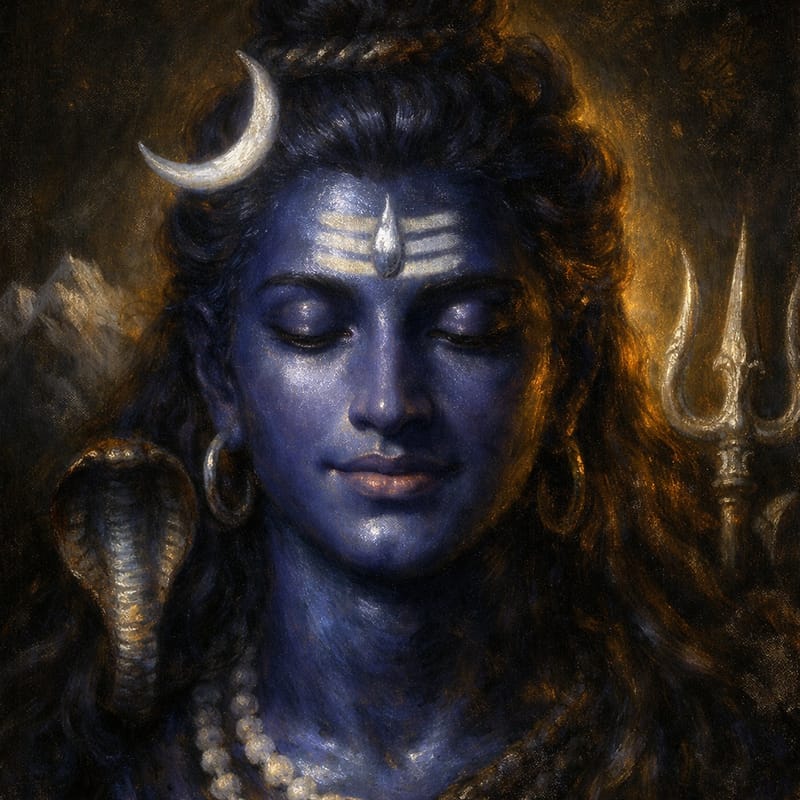


Lord Shiva is one of the great gods of Hindu tradition. Devotees call him Mahadeva, which means the great god. He is the still yogi on Mount Kailash and the dancer who moves the stars. He ends what is old so that new life can begin. In temples he is worshipped as the linga, a simple rounded stone.
Names of Lord Shiva and what they mean
Shiva has more names than almost any god. Each name is a small window into who he is. The word Shiva itself means the auspicious one. Auspicious means full of goodness.
Rudra
His oldest name. It is often read as the roarer. In the Vedas Rudra is the wild god of storms.
Mahadeva
The great god. Devotees shout Har Har Mahadev in temples and on mountain paths.
Shankara
The one who does good and gives peace. The name is loved in the South and in songs everywhere.
Bholenath
The simple-hearted lord. In the North people say he is easy to please. A little water and a leaf of bel are enough for him. Bel is the wood apple tree.
Nilakantha
The one with the blue throat. The name comes from the story of the poison he held in his throat.
Nataraja
The lord of dance. In this form he dances the world into being and out of it again.
Adiyogi
The first yogi. Yoga traditions honour him as the first teacher of the inner path.
Stories of Lord Shiva
Shiva's stories are told in many ways. A village in Tamil Nadu and a town in the Himalayas may tell the same tale differently. Each version keeps something true. Here are five of the best loved.
The blue throat
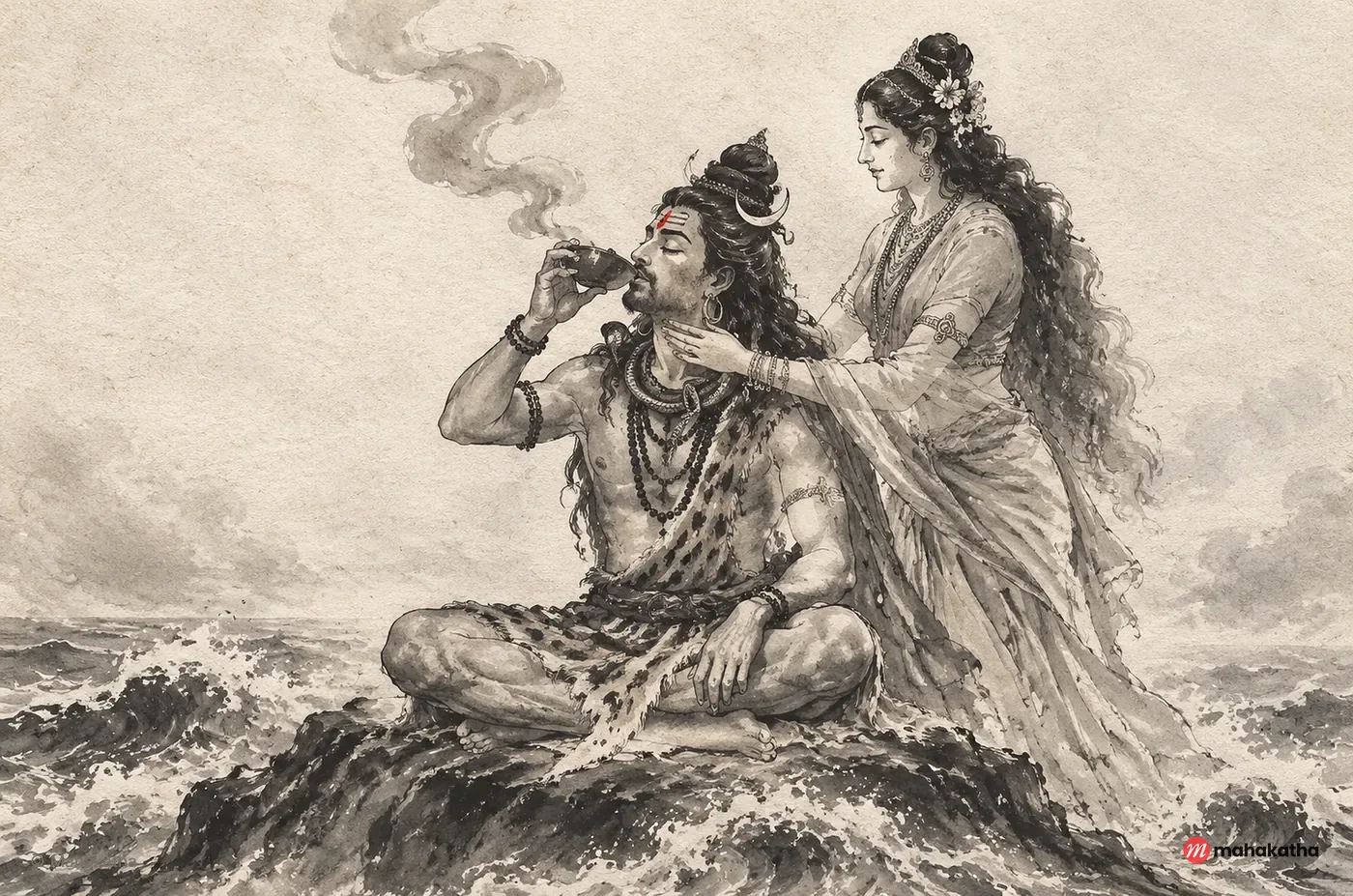
The story says the gods and demons once churned the cosmic ocean for the nectar of life. A deadly poison called halahala rose first. No one could bear its fumes. Shiva drank it to protect the worlds. In one telling Parvati pressed his throat so it would not go down. The poison stayed there and turned his throat blue. Devotees see a god who takes in pain so others can live.
Ganga in his hair
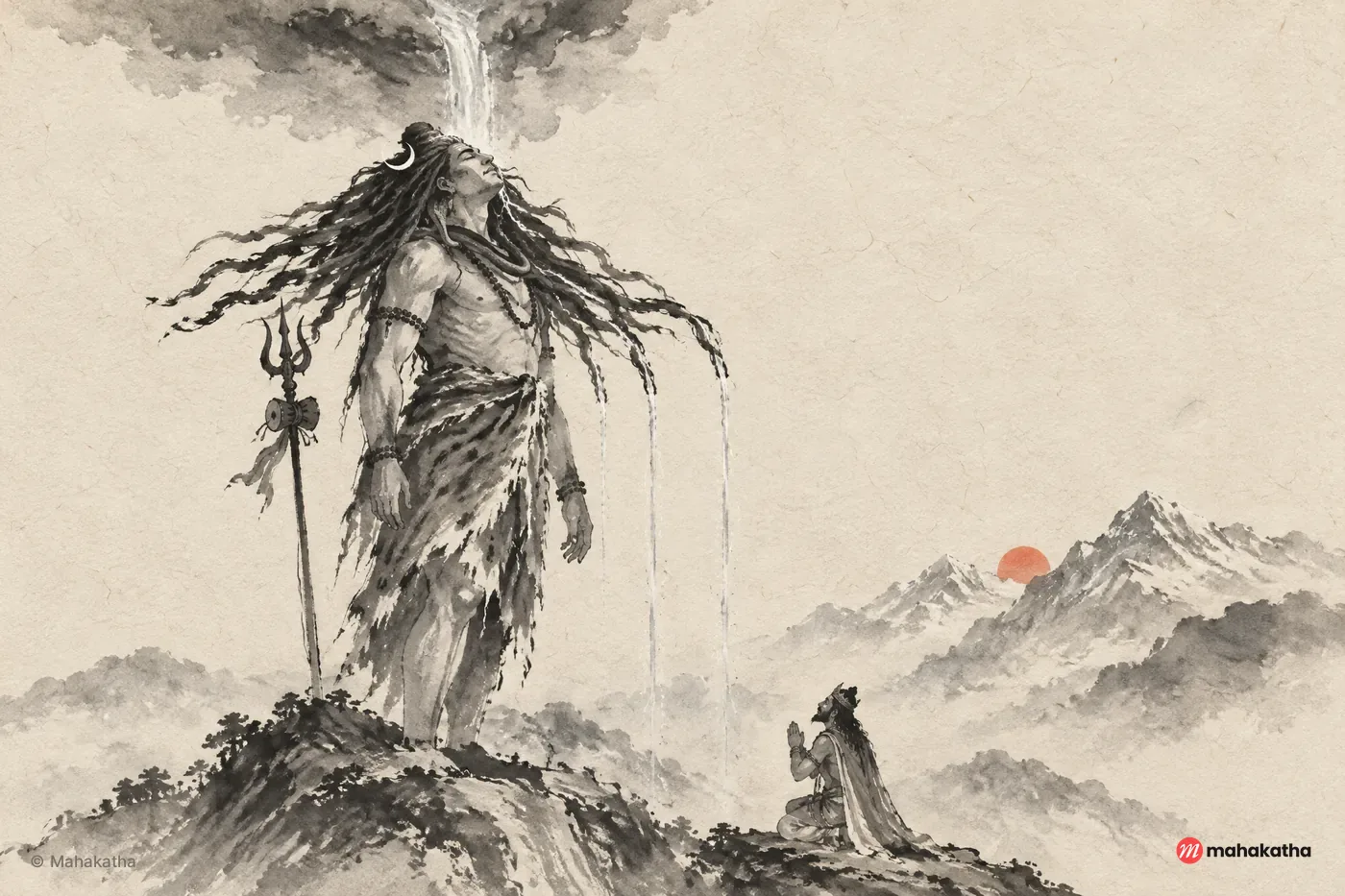
The story says King Bhagiratha prayed for the river Ganga to come down from heaven. Her fall was strong enough to break the earth. Shiva caught her in his matted hair. He let her out in gentle streams. That is why paintings show a small river flowing from his locks. The image speaks of strength that softens a great force.
The pillar of light
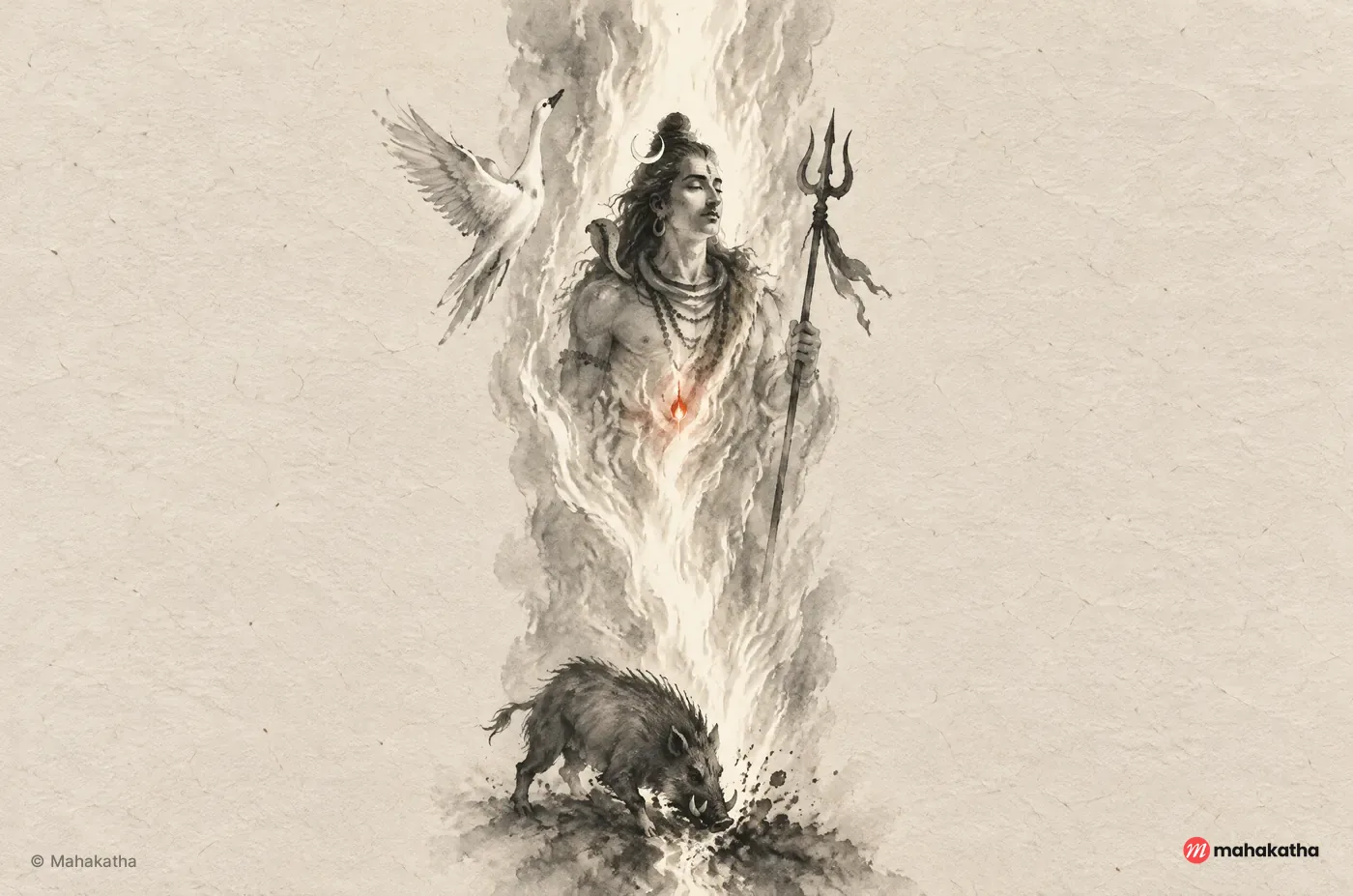
In this story Brahma and Vishnu once argued about who was greater. A pillar of fire appeared between them with no top and no bottom. Brahma flew up as a swan. Vishnu dug down as a boar. Neither found the end. Then Shiva stepped out of the light. In one version Brahma lied that he had seen the top. The story is the root of the linga, a rounded stone that stands for the formless.
Sati and the fire
In the story Shiva's first wife Sati was the daughter of King Daksha. Daksha held a great fire ritual and did not invite Shiva. Sati went anyway and could not bear the insults. She gave up her body in the sacred fire. Shiva's grief shook the world. Tradition holds that pieces of her body fell across the land. Each place became a Shakti Peetha, a seat of the goddess.
Parvati's long wait
Tradition says Sati was born again as Parvati, the daughter of the mountain. She wanted Shiva as her husband. But he sat lost in meditation. Kama the god of desire shot an arrow of flowers at him. Shiva opened his third eye and burned Kama to ash. Parvati did not give up. She did tapas, which means deep and patient self-discipline. Their wedding is still sung in temples.
How the worship of Shiva grew
The story of Shiva's worship is long. It moves from Vedic hymns to stone temples to poems sung in the street. Scholars still debate many dates.
The Vedic hymns
The Vedas are India's oldest sacred hymns. Rudra appears in the Rig Veda as a fierce storm god. People also called on him for healing medicines and for mercy. One hymn calls him the best of physicians. The Yajur Veda carries the Shri Rudram, a long hymn of praise. In it the word Shiva begins to sound like a name.
The Upanishads
The Upanishads are the thinking texts at the close of the Vedas. The Shvetashvatara Upanishad praises Rudra as the one lord behind all things. Here Shiva grows from a storm god into the highest reality.
The epics
Shiva appears often in the Mahabharata. In one well-known episode he meets Arjuna as a hunter in the forest. They fight and Shiva is pleased by Arjuna's courage. He gives him a divine weapon called the Pashupata.
The Puranas
The Puranas are old books of sacred story and worship. The Shiva Purana and the Linga Purana gather many of his tales. Scholars place their writing over many centuries in the first millennium and after. Exact dates are debated.
Temples in stone
By around the 6th century Shiva was being carved into rock. The great Shiva of the Elephanta caves near Mumbai shows three faces. The Kailasa temple at Ellora was cut from a single hill around the 8th century. The Chola kings raised the Brihadeeswara temple at Thanjavur in the early 11th century.
The bhakti poets
Bhakti means loving devotion to God. In Tamil Nadu the Nayanars sang to Shiva from about the 6th century. The Nayanars are the sixty-three Shiva saints of the Tamil land. Their hymns are still sung in temples. In 12th-century Karnataka Basavanna wrote vachanas. These are short sayings in plain speech. In the 14th century the Kashmiri poet Lal Ded sang of Shiva within.
Today
Millions worship Shiva every day. Pilgrims carry Ganga water on foot to his temples in the monsoon month of Shravan. Yoga students around the world honour him as Adiyogi.
Lord Shiva across India
Shiva is loved in every corner of India. Yet each region sees a different face of him.
North
In the North he is Bholenath of the Himalayas. Devotees believe Mount Kailash is his home. Kashi Vishwanath in Varanasi is one of his holiest places. In Shravan the Kanwar pilgrims fill the roads in saffron. Kanwar is the pole on which they carry pots of Ganga water.
South
In the South he is often Nataraja the dancer. Chidambaram in Tamil Nadu is the home of this form. Shaiva Siddhanta grew strong here. It is a school of thought that sees Shiva as the highest lord. Five great temples are each linked with one element. Tiruvannamalai stands for fire and Chidambaram for space.
East
In Bengal Shiva is often a gentle and easy-going householder. Folk songs show him as a poor husband with Parvati at his side. The Gajan festival honours him with music and vows. In Odisha the Lingaraj temple rises over Bhubaneswar. In Jharkhand pilgrims walk long miles to Baidyanath in Deoghar.
West
A Jyotirlinga is a linga of light. Several of the twelve Jyotirlingas stand in the West. In Gujarat the Somnath temple faces the Arabian Sea. In Maharashtra Trimbakeshwar sits near the source of the Godavari river.
Beyond India
In Nepal the Pashupatinath temple in Kathmandu draws pilgrims from far away. In Java the great Prambanan temple has Shiva at its heart.
Shiva temples across India
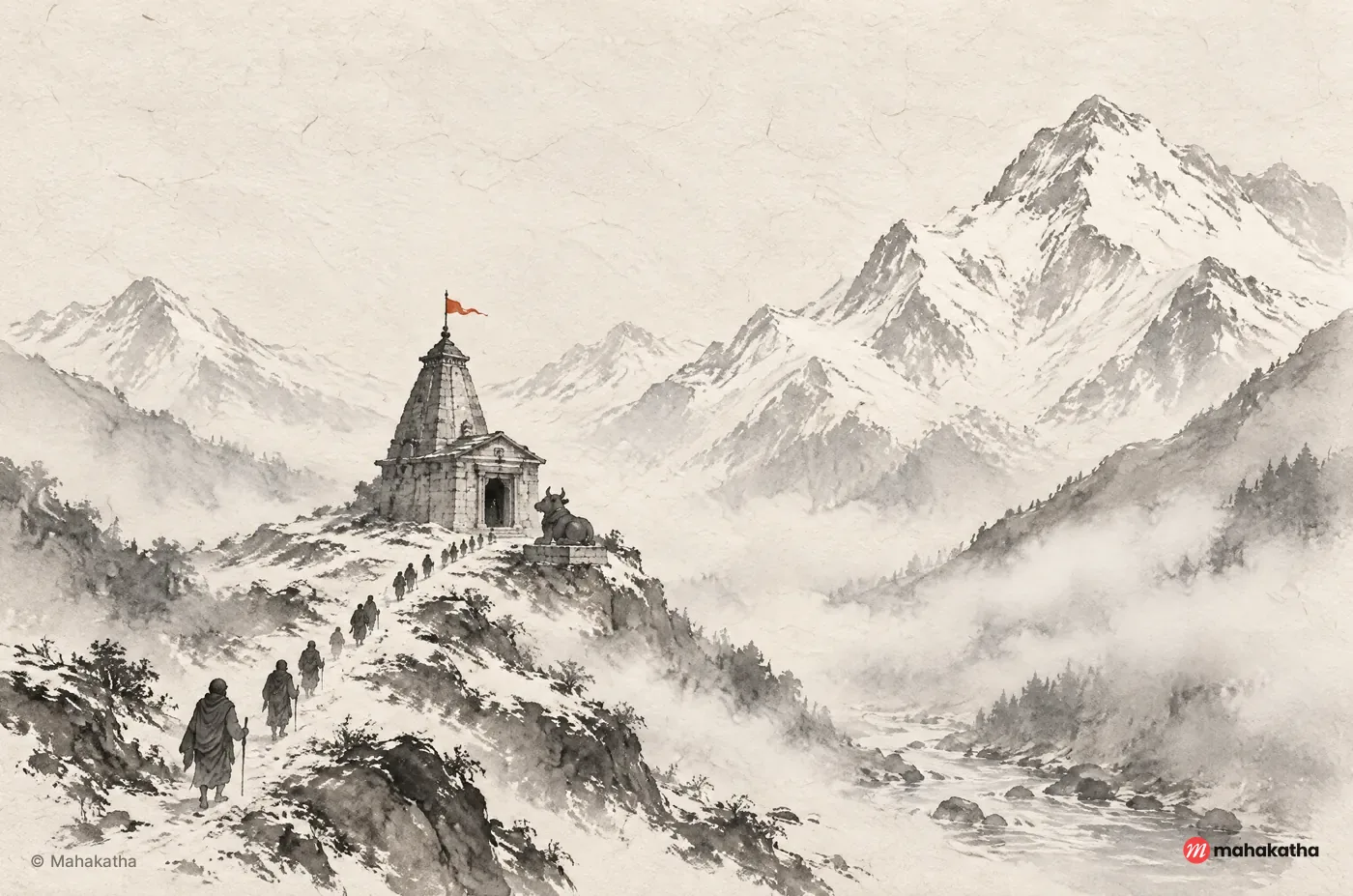
Thousands of temples honour Shiva. These are among the most loved. Twelve of the holiest are counted as Jyotirlingas.
Kashi Vishwanath Temple, Varanasi (Uttar Pradesh)
It stands near the banks of the Ganga. Devotees believe Shiva whispers a mantra of freedom to those who leave this world here. It is one of the twelve Jyotirlingas.
Kedarnath Temple, Kedarnath (Uttarakhand)
A stone temple high in the Himalayas. Pilgrims walk a long mountain path to reach it. It is a Jyotirlinga and one of the Char Dham, the four holy shrines of Uttarakhand.
Somnath Temple, Prabhas Patan (Gujarat)
Tradition counts it first among the Jyotirlingas. It was destroyed and rebuilt many times. The present temple was built after Independence.
Mahakaleshwar Temple, Ujjain (Madhya Pradesh)
Here Shiva is Mahakala, the lord of time. Aarti is the lamp offering. This temple is known for its Bhasma Aarti in the early morning. Bhasma means sacred ash.
Ramanathaswamy Temple, Rameswaram (Tamil Nadu)
The story says Rama worshipped Shiva here. Some tellings place this before he crossed to Lanka. Others place it after the war. The temple is famous for its long pillared corridors.
Nataraja Temple, Chidambaram (Tamil Nadu)
The home of Shiva as the cosmic dancer. In its inner shrine Shiva is also honoured as formless space.
Arunachaleswarar Temple, Tiruvannamalai (Tamil Nadu)
Here the hill itself is seen as Shiva. Pilgrims walk barefoot around the hill on full moon nights. A great lamp is lit on its peak for Karthigai Deepam.
Lingaraj Temple, Bhubaneswar (Odisha)
A towering temple in the old Kalinga style. Here the lord is worshipped as Harihara, Shiva and Vishnu together.
Symbols of Lord Shiva and their meaning
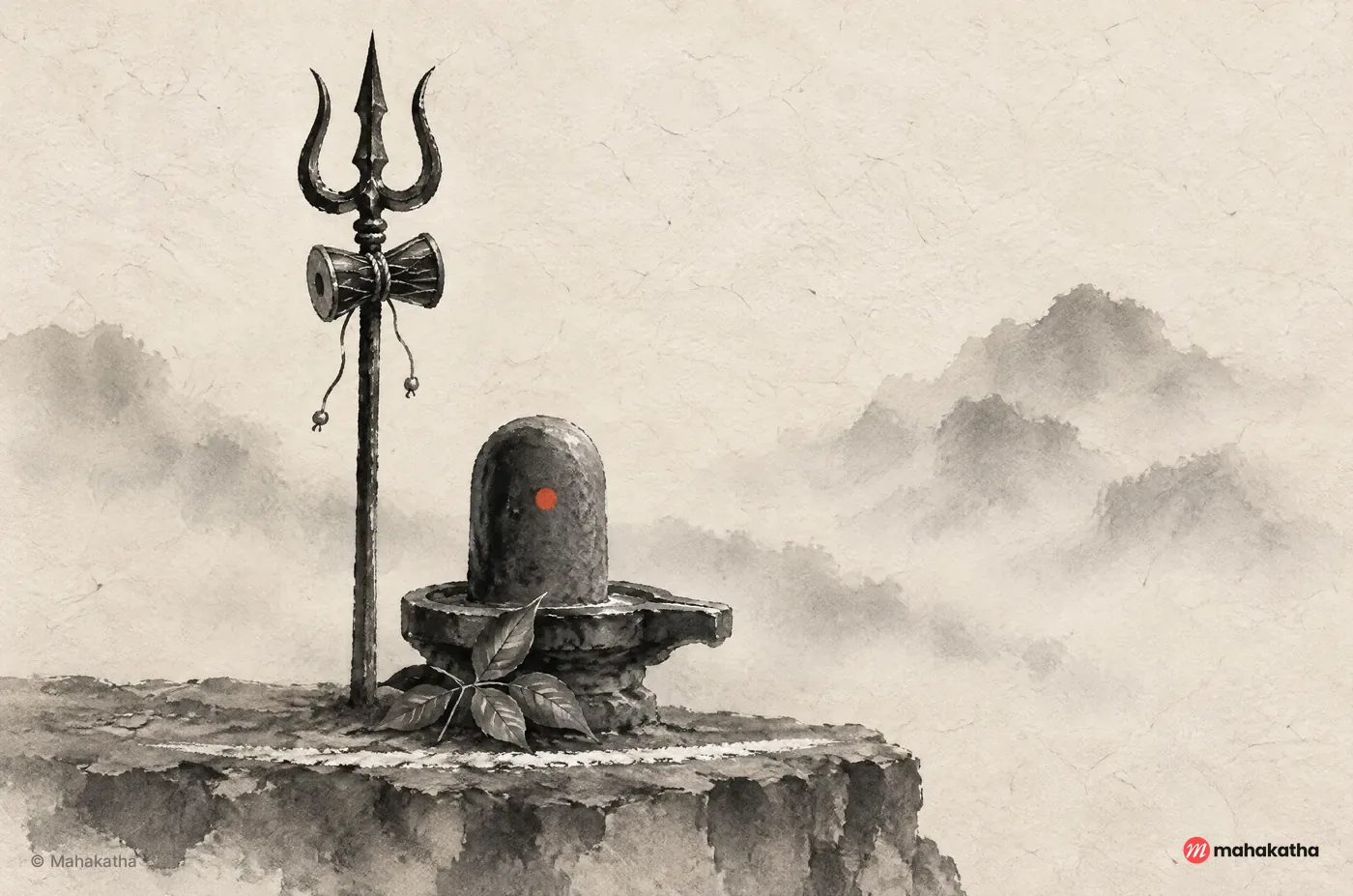
Every part of Shiva's image tells a story. Each one can also speak to our own life.
The third eye
It burned Kama to ash in the story. It stands for a seeing that goes past the surface. For us it can mean looking at life with wisdom and not only with wanting.
The blue throat
He holds the poison without swallowing it. It is an image of patience. We too can hold a hard word without passing it on.
The trident
The trident is called the trishula, which means three spears. It is often read as the three times of past and present and future.
The damaru
A small hand drum shaped like an hourglass. Tradition says the first sounds of language came from its beat. It is the heartbeat of creation.
Vibhuti
Vibhuti is sacred ash. Shiva smears it on his body. Ash is what remains when everything else has burned. It reminds us what lasts.
Nandi
Nandi is the bull who carries Shiva. He sits facing the shrine in Shiva temples. He is the picture of a devotee who waits with patience.
The linga
A rounded stone on a base. It stands for Shiva beyond form. Many see the base as Shakti the goddess. Together they show that the two are one.
Shiva mantras and shlokas
A mantra is a sacred sound or verse that you repeat with feeling. Shiva has more mantras than almost any god. These are good places to begin. Each one links to our page with the full words and meaning.
Om Namah Shivaya
The five-syllable mantra is the heart of Shiva worship. "Om Namah Shivaya" means I bow to Shiva. Om is the sacred first sound. Without Om its five sounds are Na Ma Shi Va Ya. Tradition links them to the five elements.
Maha Mrityunjaya Mantra
It opens with "Om Trayambakam Yajaamahe". The verse comes from the Vedas. It asks the three-eyed lord for freedom from the fear of death. Families often chant it together in hard times.
Karpura Gauram
"Karpura Gauram Karunaavataaram" praises Shiva as pure as camphor and kindness in form. In many homes it is sung as the aarti lamp is waved.
Nirvana Shatakam
Its famous refrain is "Chidananda rupah Shivo’ham Shivo’ham". It means I am consciousness and bliss. I am Shiva. Tradition credits these verses to Adi Shankaracharya.
Lingashtakam
Eight verses in praise of the linga. Each verse ends "tat pranamami sadashivalingam". It means to that eternal linga I bow.
Shiva Tandava Stotram
A thundering hymn to Shiva's dance. It begins "jatatavigalajjalapravahapavitasthale". Tradition says the demon king Ravana composed it.
Festivals of Lord Shiva
Shiva's festivals are often quiet and full of night. Fasting and staying awake are common.
Maha Shivaratri
The great night of Shiva. Devotees fast and keep awake through the night. They pour water and milk over the linga in four watches. This pouring is called abhisheka.
Shravan Mondays
Shravan is a monsoon month held sacred to Shiva. Many fast on its Mondays. Temples fill with bel leaves and pots of water.
Kanwar Yatra
Yatra means a holy journey. Pilgrims carry Ganga water on foot over long distances. They offer it at Shiva temples near home.
Pradosha
Pradosha is the twilight hour on the thirteenth day of each lunar fortnight. Devotees gather in Shiva temples at dusk.
Simple ways to remember Shiva each day
Begin with water
Offer a little water to a Shiva image or linga in the morning. Pour it slowly. Let it be a way of saying thank you.
Chant five syllables
Sit still and chant Om Namah Shivaya eleven or 108 times. Let the breath set the pace.
Sit like the yogi
Close your eyes for five minutes. Watch the breath come and go. This stillness is what Shiva's image points to.
Sing the aarti
In the evening light a lamp and sing Om Jai Shiv Omkara. It is a short song of praise for the whole family.
What Lord Shiva can teach us
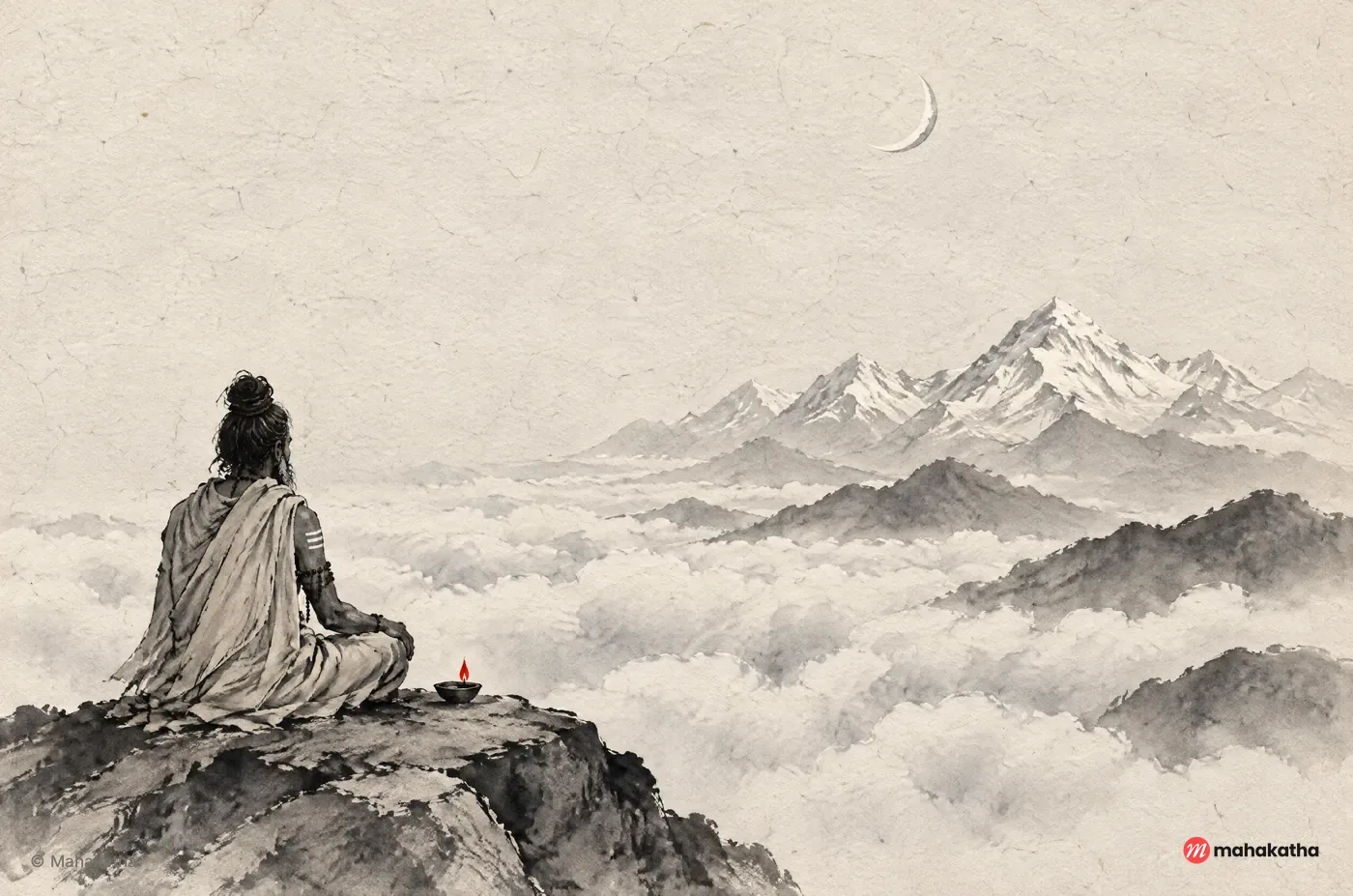
Shiva sits in stillness at the top of the world. Yet he also dances. Deep stillness and joyful movement are not enemies. Both can live in the same heart.
He is called the destroyer. But what he ends is often what we no longer need. Old fears. Tired habits. A pride that keeps us small. When life feels stuck you can think of Shiva. An ending can make room for something new.
The Nirvana Shatakam ends with the words Shivoham Shivoham. It means I am Shiva. The verse points to something in us that is not the body or the busy mind. In the pause between two breaths you may touch it. That still place is already yours.
Questions people ask
Who is Lord Shiva?
Lord Shiva is one of the great gods of Hindu tradition. He is known as Mahadeva, the great god. Devotees see him as the one who ends and renews all things. He is the still yogi of Kailash and the dancer Nataraja. Shaiva traditions worship him as the highest reality.
What is the most powerful Shiva mantra?
Many devotees begin with Om Namah Shivaya. It is short and simple and anyone can chant it. The Maha Mrityunjaya Mantra is also loved in times of worry and loss. Tradition does not rank one above the other. The best mantra is the one you can chant with a full heart.
Which day is for Lord Shiva?
Monday is widely held as Shiva's day. Many devotees fast or visit a Shiva temple on Mondays. The Mondays of Shravan are held especially dear. The twilight hour of Pradosha and the night of Maha Shivaratri are also sacred times for him.
Why is Shiva's throat blue?
The story says the gods and demons churned the cosmic ocean for the nectar of life. A deadly poison rose first and no one could bear it. Shiva drank it to protect the worlds. In one telling Parvati held his throat so the poison stayed there. It turned his throat blue and gave him the name Nilakantha.
What are the 12 Jyotirlingas?
The Jyotirlingas are twelve shrines where Shiva is worshipped as a linga of light. They include Somnath in Gujarat and Mahakaleshwar in Ujjain. Kashi Vishwanath in Varanasi and Kedarnath in the Himalayas are also among them. Lists differ a little. Baidyanath is claimed by Deoghar in Jharkhand and by Parli in Maharashtra.