

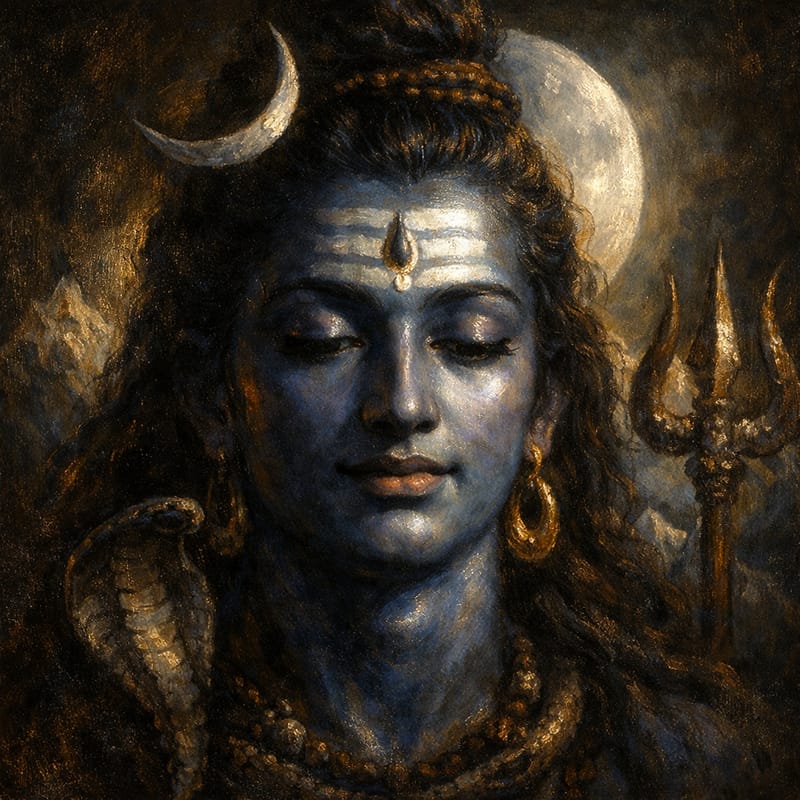
Shiva Tandava Stotram — German Lyrics
Shiva Tandava Stotram is a 14-verse Sanskrit hymn traditionally composed by Ravana, the legendary Asura king, celebrating Lord Shiva's cosmic dance (Tandava). The opening verses paint vivid imagery of Shiva's transcendent form: the sacred Ganges flowing through matted locks (jata), serpents coiled as garlands, ash smeared across his body, and the crescent moon adorning his forehead. The rhythmic damaru (sacred drum) produces the cosmic pulse—represented onomatopoetically as 'damad-damad-damad.' These poetic descriptions blend physical grandeur with spiritual symbolism, rendering Shiva simultaneously fierce, protective, and eternally engaged in the dance sustaining all creation. The stotram reveals Shiva as Mahakala—the destroyer of ignorance and cosmic cycles. His Tandava represents the eternal rhythm underlying existence: the dissolution of old forms enabling renewal, the integration of opposites (fear and fearlessness, asceticism and cosmic play, stillness and dynamic movement). Each verse methodically unfolds Shiva's attributes—his matted locks, serpent ornaments, ash-covered body, the third eye, and his role as destroyer of demons (Gaja, Mahisha, Andha) and delusion itself. By meditating on this form, practitioners recognize Shiva as Paramashiva—the ultimate reality transcending all dualities. The hymn connects the devotee's inner consciousness to the heartbeat of the cosmos. Chant Shiva Tandava Stotram during Brahma Muhurta (early morning (pre-dawn)) or throughout Shiva Ratri observances for optimal spiritual benefit. Recite the complete 14 verses daily, or focus on the verses that speak to your intention. Begin with 40 days of continuous practice to establish momentum. Ideally, chant with reverence and visualize Shiva's dance internally. Even listening to melodic renditions while meditating invokes profound inner transformation and alignment with cosmic consciousness.
Curated by The Mahakatha Team · Original Composition: Mahakatha · Lyric: Ravana (legendary)
Shiva Tandava Stotram
Shiva · Preview · 2:00
Preview ended
Ancient sounds for transformation, carried across 3,000 years.
Get the full version — plus 275 more ancient chants. 80% OFF today only.
Get Ancient Chants Bundle — 80% OFF →3000+ happy customers · Lifetime access · All devices
2.2M people trust Mahakatha
Chant daily with reminders — Get the Mahakatha app
जटाटवीगलज्जलप्रवाहपावितस्थले गलेवलम्ब्य लम्बितां भुजङ्गतुङ्गमालिकाम् । डमड्डमड्डमड्डमन्निनादवड्डमर्वयं चकार चण्डताण्डवं तनोतु नः शिवः शिवम् ॥
jatatavigalajjalapravahapavitasthale galevalambya lambitam bhujangatungamalikam | damaddamaddamaddamanninadavaddamarvayam chakara chandatandavam tanotu nah shivah shivam ||
Mit heiligem Wasser, das durch sein Haar fließt…
Eine Schlange, die seinen Hals schmückt…
Das göttliche Rasseln der Damaru
Lord Shiva führt seinen wilden Tandava auf!
जटाकटाहसम्भ्रमभ्रमन्निलिम्पनिर्झरी विलोलवीचिवल्लरीविराजमानमूर्धनि । धगद्धगद्धगज्वलल्ललाटपट्टपावके किशोरचन्द्रशेखरे रतिः प्रतिक्षणं मम ॥
jatakatahasambhramabhramannilimpanirjari vilolavichivallarivirajamanamurdhani | dhagaddhagaddhagajvalallalatapattapavake kishorachandrashekhare ratih pratikshanam mama ||
Der Ganges, der durch sein Haar fließt,
Bis in die tiefsten seiner Locken reichend,
Ein loderndes Feuer auf seiner Stirn,
Und der Halbmond glänzt wie ein Juwel, ich bin voller Ehrfurcht!
धराधरेन्द्रनन्दिनीविलासबन्धुबन्धुर स्फुरद्दिगन्तसन्ततिप्रमोदमानमानसे । कृपाकटाक्षधोरणीनिरुद्धदुर्धरापदि क्वचिद्दिगम्बरे मनो विनोदमेतु वस्तुनि ॥
dharadharendranandinivilasabandhubandhura sphuraddigantasantatipramodamanamanase | kripakatakshadhoraniniruddhadurdharapadi kvachiddigambare mano vinodametu vastuni ||
Der Bewahrer des Lebens, der Gemahl von Parvati,
Dessen Geist der Ort ist, wo das Universum existiert,
Dessen allsehender Blick alle Härten beendet,
Dessen Gewand der gesamte Kosmos ist, ich finde Freude in diesem Shiva!
जटाभुजङ्गपिङ्गलस्फुरत्फणामणिप्रभा कदम्बकुङ्कुमद्रवप्रलिप्तदिग्वधूमुखे । मदान्धसिन्धुरस्फुरत्त्वगुत्तरीयमेदुरे मनो विनोदद्भुतं बिभुर्त भूतभर्तरि ॥
jatabhujangapingalasphuratphanamaniprabha kadambakunkumadravapraliptadigvadhumukhe | madandhasindhurasphurattvaguttariyamedure mano vinodadbhutam bibhurta bhutabhartari ||
Der Edelstein der Schlange schimmert auf ihm,
Sein roter Schein auf den Gesichtern der Göttinnen der Himmelsrichtungen,
Er trägt einen Mantel aus Elefantenhaut,
Ich bin voller Ehrfurcht vor diesem Gott der mystischen Wesen!
सहस्रलोचनप्रभृत्यशेषलेखशेखर प्रसूनधूलिधोरणी विधूसराङ्घ्रिपीठभूः । भुजङ्गराजमालया निबद्धजाटजूटकः श्रियै चिराय जायतां चकोरबन्धुशेखरः ॥
sahasralochanaprabhrityasheshalekhashekhara prasunadhulidhorani vidhusaranghripithabhuh | bhujangarajamalaya nibaddhajatajutakah shriyai chiraya jayatam chakorabandhushekharah ||
Indra und die anderen Götter in einer Reihe…
Blütenstaub von ihren Häuptern schmückt Shivas Fußstütze
Eine Schlange ziert die verfilzten Locken seines Haares
Gekrönt mit dem Halbmond, möge er uns mit Wohlstand segnen!
ललाटचत्वरज्वलद्धनञ्जयस्फुलिङ्गभा निपीतपञ्चसायकं नमन्निलिम्पनायकम् । सुधामयूखलेखया विराजमानशेखरं महाकपालिसम्पदेशिरोजटालमस्तु नः ॥
lalatachatvarajvaladdhananjayasphulingabha nipitapanchasayakam namannilimpanayakam | sudhamayukhalekhaya virajamanashekharam mahakapalisampadeshirojatalamastu nah ||
Das Feuer auf seiner Stirn verzehrte Kama Deva, den Gott der Begierde,
Die göttlichsten himmlischen Führer verehren ihn zutiefst,
Seine Stirn glänzt mit den kühlenden Strahlen des Mondes,
Möge Überfluss zu uns fließen aus den verworrenen Locken!
करालभालपट्टिकाधगद्धगद्धगज्ज्वलद् धनञ्जयाधरीकृतप्रचण्डपञ्चसायके । धराधरेन्द्रनन्दिनीकुचाग्रचित्रपत्रक प्रकल्पनैकशिल्पिनि… अप्प्रकल्पनैकशिल्पिनि त्रिलोचने रतिर्मम ॥
karalabhalapattikadhagaddhagaddhagajjvalad dhananjayadharikritaprachandapanchasayake | dharadharendranandinikuchagrachitrapatraka prakalpanaikashilpini... (a)prakalpanaikashilpini trilochane ratirmama ||
Seine Stirn brennt mit dem Klang 'dhagad-dhagad',
Er schickte Kama Devas 5 Pfeile ins heilige Feuer,
Seine tanzenden Füße erschaffen Kunst auf der Erde und damit auf Parvatis Körper,
Er ist der einzige solche Künstler, ich bin in Ehrfurcht vor diesem dreiäugigen Shiva!
नवीनमेघमण्डली निरुद्धदुर्धरस्फुरत् कुहूनिशीथनीतमः प्रबन्धकन्धरः । निलिम्पनिर्झरीधरस्तनोतु कृत्तिसिन्धुरः कलानिधानबन्धुरः श्रियं जगंद्धुरंधरः ॥
navinameghamandali niruddhadurdharasphurat kuhunishithanitamah prabaddhabaddhakandharah | nilimpanirjaridharastanotu krittisindhurah kalanidhanabandhurah shriyam jaganddhurandharah ||
Das Pochen seines Tanzes bezwingt die unbezwingbaren Wolken,
Und wickelt die Dunkelheit einer Vollmondnacht um seinen Hals,
O Shiva! Der Träger der Ganga, der Träger der Elefantenhaut,
O Träger der Mondsichel, des ganzen Universums, bitte segne uns mit Wohlstand!
प्रफुल्लनीलपङ्कजप्रपञ्चकालिमप्रभा वलम्बिकण्ठकन्धरारुचिप्रबद्धकन्धरम् । स्मरच्छिदं पुरच्छिदं भवच्छिदं मखच्छिदं गजच्छिदान्धकच्छिदं तमन्तकच्छिदं भजे ॥
praphullanilapankajaprapanchakalimaprabha valambikanthakandhararuchiprabanddhakandharam | smarachchhidam purachchhidam bhavachchhidam makhachchhidam gajachchhidandhakachchhidam tamantakachchhidam bhaje ||
Das Leuchten blühender blauer Lotusblüten strahlt
An seinem Hals, so dunkel wie das Universum selbst
Der Beender von Kama Deva, Tripurasura, weltlichen Täuschungen und Opfern,
Der Beender von Gajasura und Andhaka, der Bezwinger Yamas, ich verehre diesen Herrn Shiva!
अखर्व सर्वमङ्गलाकलाकदम्बमञ्जरी रसप्रवाहमाधुरी विजृम्भणामधुव्रतम् । स्मरान्तकं पुरान्तकं भवान्तकं मुखान्तकं गजान्तकान्धकान्तकं तमन्तकान्तकं भजे ॥
akharva sarvamangalakalakadambamanjari rasapravahamadhuri vijrimbhanamadhuvratam | smarantakam purantakam bhavantakam mukhantakam gajantakandhakantakam tamantakantakam bhaje ||
Die Quelle des Wohlergehens und der Kunst, duftend nach süßen Kadamba-Blüten,
Bienenschwärme anziehend, die um ihn herum fliegen,
Der Beender von Kama Deva, Tripurasura, weltlichen Täuschungen und Opfern,
Der Beender von Gajasura und Andhaka, der Bezwinger Yamas, ich verehre diesen Herrn Shiva!
जयत्वदभ्रविभ्रमभ्रमद्भुजङ्गमस्फुरत धगद्धगद्धद्विनिर्गमत्करालभालहव्यवाट् । धिमिद्धिमिद्धिमिध्वनन्मृदङ्गतुङ्गमङ्गल ध्वनिक्रमप्रवर्तितः प्रचण्डताण्डवः शिवः ॥
jayatvadabhravibhramabhramadbhujangamasphurat dhagaddhagaddhadvinirgamatkaralabhalahavyavat | dhimiddhimiddhimidhvanammridangatungamangala dhvanikramapravartitah prachandatandavah shivah ||
Seine Augenbrauen zeigen seine Herrschaft über die Welten, die Schlangen um seinen Hals speien feurigen Atem,
Sein furchteinflößendes drittes Auge pulsiert und sendet Feuer aus,
Die Mridangam erklingt endlos im 'dhimid-dhimid-dhimi' Rhythmus,
Und Shiva tanzt seinen intensiven Tandava zu diesem Takt!
दृषद्विचित्रतल्पयोर्भुजङ्गमौक्तिकमस्रजोर् गरिष्ठरत्नलोष्ठयोः सुहृद्विपक्षपक्षयोः । तृणारविन्दचक्षुषोः प्रजामहीमहेन्द्रयोः समं प्रवर्तयन्मनः कदा सदाशिवं भजे ॥
drishadvichitratalpayorbhujangamauktikamasrajor garishtharatnaloshthayoh suhridvipakshapakshayoh | trinaravindachakshushoh prajamahimahendrayoh samam pravartayanmanah kada sadashivam bhaje ||
Wann werde ich die Gleichheit in einem weichen Bett und hartem Boden erkennen? In einer Girlande aus Perlen und Schlangen?
In einem Edelstein und einem Klumpen Lehm? In einem Freund und einem Feind?
In der Schönheit eines einfachen Auges und eines lotusgleichen Auges? In der Seele eines Laien und eines Königs?
Wann werde ich wahrhaft würdig sein, Shiva zu verehren?
कदा निलिम्पनिर्झरीनिकुञ्जकोटरे वसन् विमुक्तदुर्मतिः सदा शिरः स्थमञ्जलिं वहन् । विमुक्तलोललोचनो ललामभाललग्नकः शिवेति मंत्रमुच्चरन् कदा सुखी भवाम्यहम् ॥
kada nilimpanirjarinikunjakotare vasan vimuktadurmatih sada shirah sthamanjalim vahan | vimuktalolalochano lalamabhalalagnakah shiveti mantramuchcharan kada sukhi bhavamyaham ||
Wann werde ich in einer Höhle im Wald am Fluss Ganga leben,
für immer frei von Sündhaftigkeit, meine Hände in Andacht an meine Stirn gefaltet,
Frei von Begierden, Shiva verehrend mit einem heiligen Zeichen auf meiner Stirn,
Wann werde ich die reine Freude erlangen, die Mantras Shivas auszusprechen?
इमं हि नित्यमेव मुक्तमुत्तमोत्तम स्तवं पठन्स्मरन बृवन्नरो विशुद्धमेतिसंततम् । हरे गुरौ सुभक्तिमाशु याति नानन्यथा गतिं विमोहनं हि देहिनां सुशङ्करस्य चिंतनम् ॥
imam hi nityameva muktamuttamottama stavam pathansmarana bruvannaro vishuddhametisantatam | hare gurau subhaktimashu yati nananyatha gatim vimohanam hi dehinam sushankarasya chintanam ||
Diejenigen, die diese tiefgründige Hymne lesen und über sie nachdenken
mit reinem Geist und ohne Unterbrechungen
mit tiefer Hingabe an Shiva, den Guru, sie werden ihm näher sein,
Alle Täuschungen werden durch tiefe Meditation über Lord Shiva enden.
How to Chant Shiva Tandava Stotram
- 1
Find a quiet, clean space
Sit in a comfortable, undisturbed environment. Face east or north if possible. You may light incense or a candle to set a contemplative atmosphere.
- 2
Settle into a comfortable posture
Sit cross-legged on the floor or upright in a chair. Keep the spine erect and place the hands on the knees with palms facing upward.
- 3
Take three cleansing breaths
Inhale slowly through the nose, hold briefly, and exhale completely. Repeat three times to calm the mind and prepare for mantra recitation.
- 4
Begin chanting Shiva Tandava Stotram
Chant the mantra clearly and with devotion — aloud, in a whisper, or silently. Use a mala (108 beads) to count repetitions. Aim for a consistent, unhurried rhythm throughout the session.
- 5
Rest in stillness
After completing your chanting, sit quietly for two to five minutes. Allow the vibration of the mantra to settle within. Close the practice with a moment of gratitude.
Benefits of Shiva Tandava Stotram
-
Deepens meditation practice by turning the mind toward Shiva's cosmic dance and its rhythm; yogic tradition also links the hymn with kundalini.
Source: Kundalini Upanishad; Traditional Tantric practice
-
Dissolves fear and ego-based limitations by exposing the illusory nature of separate selfhood through Shiva's universal dance metaphor.
Source: Mandukya Upanishad; Advaita Vedanta philosophy
-
Cultivates fearlessness (Abhaya) and inner resilience by meditating on Shiva as the destroyer of obstacles, ignorance, and demonic patterns.
Source: Shiva Purana; Traditional Shaiva texts
-
Settles and focuses the mind through rhythmic Sanskrit phonetics and the damaru-like beat of the chant's metrical structure.
Source: Yoga Sutras of Patanjali; Nada Brahma (Sound-Consciousness) doctrine
-
Traditionally believed to remove karmic blockages and negative samskaras, invoking Shiva's power to dissolve what no longer serves spiritual growth and liberation.
Source: Karma Yoga Upanishad; Traditional Shaivite practice
Story & Symbolism
Shiva Tandava Stotram originates from Hindu mythology's most dramatic moment: Ravana's profound devotion despite his demonic nature. According to the Ramayana and Shiva Purana, Ravana—a brilliant scholar, musician, and yogi—composed this 14-verse hymn to propitiate Lord Shiva when Shiva pressed down Mount Kailash with his toe after Ravana attempted to uproot it. In that moment of pain and awe, Ravana tore out his own nerves to create a veena and composed this powerful hymn to appease Shiva. Ravana's genius lay in recognizing Shiva's transcendent supremacy beyond moral judgment. His poetic composition became so luminous that Shiva granted him a personal audience. This narrative teaches that sincere Bhakti (devotion) and spiritual insight can transcend any karmic debt; even an Asura king could approach the divine through authentic praise and surrender.
The stotram's deeper meaning reflects non-dual Advaita philosophy: Shiva's Tandava (cosmic dance) represents the eternal cycle of creation, sustenance, and dissolution—the fundamental rhythm underlying all existence. Each verse methodically unfolds Shiva's attributes—matted locks flowing with the Ganges (purification), serpents as garlands (traditionally read as kundalini), ash-covered body (renunciation), third eye (omniscience), and destructive power over ignorance and delusion. The hymn celebrates Shiva not as a distant god but as the ultimate reality (Paramashiva) pervading all consciousness. Spiritually, the Tandava symbolizes the cosmic energy eternally dancing through creation; meditating on this form aligns the individual soul (Atman) with universal consciousness.
Today, Shiva Tandava Stotram remains a cornerstone of Shaivite devotional practice worldwide. Temples, ashrams, and spiritual communities chant it during Shiva Ratri (the Night of Shiva), full moons, and daily sadhana. Modern seekers discovered its transformative power through renewed interest in Vedic wisdom, making it one of the most chanted Sanskrit hymns in contemporary spirituality. Its transmission bridges ancient mythology, poetic excellence, and direct spiritual experience.
How to Use in Daily Life
Dawn Practice
Chant Shiva Tandava Stotram during Brahma Muhurta (pre-dawn) when cosmic consciousness is most accessible. Begin with 3 deep breaths, then recite the full 14 verses or selected verses with reverent focus.
Meditation Anchor
Use the stotram as your meditation mantra. Chant slowly for 15–20 minutes, visualizing Shiva's cosmic dance before your inner eye. Let the rhythmic damaru sounds anchor your awareness in present-moment consciousness.
Devotional Offering
Recite the stotram as an offering before your Shiva altar or sacred space. Light incense, ring a bell, and chant with genuine reverence. This practice transforms your home into a temple and invokes Shiva's blessing.
Evening Reflection
Before sleep, listen to a melodic rendition of Shiva Tandava Stotram. This helps ease the day's tensions and prepares you for restful sleep and a quiet sense of cosmic awareness.