

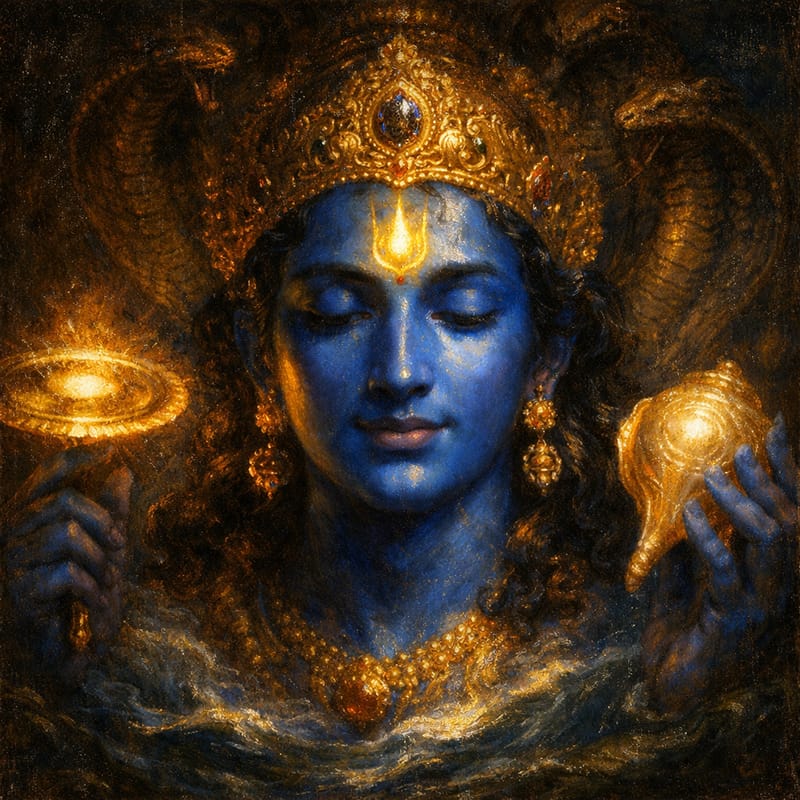
Sudarshanashtakam — German Lyrics
Sudarshanashtakam Mantra is an ancient Sanskrit hymn honoring Vishnu that provides spiritual protection and healing through divine chakra invocation.
Sudarshanashtakam is an eight-verse devotional hymn (ashtakam) praising Sudarshana, Lord Vishnu's divine discus or chakra. The name derives from Sanskrit: su (auspicious) + darshana (vision), literally "auspicious sight." The hymn celebrates the Sudarshana Chakra not as a mere weapon, but as the cosmic wheel of time, the instrument of divine justice, and the spinning vortex of consciousness that upholds universal order (dharma). Each verse builds layers of significance around this sacred symbol, describing its luminous form, its power to destroy evil, and its role as guardian of the cosmos.
In Vaishnava philosophy, Sudarshana embodies the active principle of divine protection and cosmic order. The chakra's twelve spokes represent the twelve zodiac signs and the eternal cycle of time. Vedanta Desika, the 13th-14th century Sri Vaishnava philosopher-saint, composed this ashtakam as one of the most profound prayers in Vaishnavism. Sudarshana functions as both the eye of God—seeing all of creation simultaneously—and the living force that destroys adharma (unrighteousness). The mantra acknowledges Sudarshana as the supreme power that maintains cosmic balance and grants liberation to sincere devotees.
Recite Sudarshanashtakam daily at dawn for maximum protective benefit, especially on Saturdays and during inauspicious planetary transits (Rahu-Ketu, Saturn). The full eight verses create a shield of divine consciousness around the practitioner. Chanting with sincere surrender and visualization of the glowing chakra amplifies results. Devotees believe even a single verse offers protection; the complete recitation daily is traditionally recommended for those facing significant obstacles, ill health, or fear. Traditionally performed in temples and homes during times of need.
Curated by The Mahakatha Team · Original Composition: Mahakatha · Lyric: Adi Shankaracharya (8th century CE)
Sudarshanashtakam
Vishnu · Preview · 2:00
Preview ended
Ancient sounds for transformation, carried across 3,000 years.
Get the full version — plus 275 more ancient chants. 80% OFF today only.
Get Ancient Chants Bundle — 80% OFF →3000+ happy customers · Lifetime access · All devices
2.2M people trust Mahakatha
Chant daily with reminders — Get the Mahakatha app
प्रतिभटश्रेणि भीषण वरगुणस्तोम भूषण जनिभयस्थान तारण जगदवस्थान कारण । निखिलदुष्कर्म कर्शन निगमसद्धर्म दर्शन जय जय श्री सुदर्शन जय जय श्री सुदर्शन ॥
pratibhatashreni bhishana varagunastoma bhushana janibhayasthana tarana jagadavasthana karana | nikhiladushkarma karshana nigamasaddharma darshana jaya jaya shri sudarshana jaya jaya shri sudarshana ||
Derjenige, der der furchtbare Feind derer ist, die seinen Verehrern Unrecht tun
Derjenige, der wie ein Juwel für all jene ist, die gute Taten vollbringen
Derjenige, der dem Menschen hilft, das tiefe und unbeständige Meer des materialistischen Lebens zu überqueren
Der Meister, der das gesamte Universum perfekt stabilisiert
Derjenige, der alle Missetaten und Sünden beseitigt
Derjenige, der uns rechtschaffenes Verhalten lehrt
Heil dem göttlichen Sudarshana, Heil dem göttlichen Sudarshana
शुभजगद्रूप मण्डन सुरगणत्रास खन्डन सतमखब्रह्म वन्दित सतपथब्रह्म नन्दित । प्रथितविद्वत् सपक्षित भजदहिर्बुध्न्य लक्षित जय जय श्री सुदर्शन जय जय श्री सुदर्शन ॥
shubhajagadrupa mandana suraganatrasa khandana satamakhabrahma vandita satapatabrahma nandita | prathitavidvat sapakshita bhajadahirbudhnya lakshita jaya jaya shri sudarshana jaya jaya shri sudarshana ||
Derjenige, der vom Höchsten Meister des Universums geschmückt ist
Derjenige, der die Furcht vor allem Bösen von allem Guten entfernt
Der von dem Schöpfer des Universums, Lord Brahma, und anderen Göttern verehrt wird
Der von allen Weisen, den Brahmanen, verehrt wird
Derjenige, der den Verehrern hilft, diejenigen zu überwinden, die sich ihnen widersetzen
Derjenige, der von Lord Shiva, dem Vernichter allen Übels im gesamten Universum, verehrt und bewundert wird
Heil dem göttlichen Sudarshana, Heil dem göttlichen Sudarshana
स्फुटतटिज्जाल पिञ्जर पृतथुतरज्वाल पञ्जर परिगत प्रत्नविग्रह पतटुतरप्रज्ञ दुर्ग्रह । प्रहरण ग्राम मण्डित परिजन त्राण पण्डित जय जय श्री सुदर्शन जय जय श्री सुदर्शन ॥
sphutatatijjala pinjara prutathutarajvala panjara parigata pratnavigraha patatutaraprajna durgraha | praharana grama mandita parijana trana pandita jaya jaya shri sudarshana jaya jaya shri sudarshana ||
Derjenige, der von einem Heiligenschein aus strahlendem Licht umgeben ist
Derjenige, der von heiligen Inkarnationen Vishnus umgeben ist
Dies bezieht sich auf das Sudarshana-Yantra, das 6 verschiedene Avatare Vishnus um das Hauptsymbol herum darstellt
Derjenige, der so großartig ist, dass selbst die größten Gelehrten stolpern, ihn vollständig zu verstehen
Derjenige, dessen Form 16 mächtige und Segen spendende Waffen hält
Derjenige, der niemals versäumt, diejenigen zu retten, die seinen Schutz suchen
Heil dem göttlichen Sudarshana, Heil dem göttlichen Sudarshana
निजपतप्रीत सद्गण निरुपधिस्फीठ षड्गुण निगम निर्व्यूढ वैभव निजपर व्यूह वैभव । हरि हय द्वेषि दारण हर पुर प्लोष कारण जय जय श्री सुदर्शन जय जय श्री सुदर्शन ॥
nijapataprita sadgana nirupatisphitha shadguna nigama nirvyudha vaibhava nijapara vyuha vaibhava | hari haya dveshi darana hara pura plosha karana jaya jaya shri sudarshana jaya jaya shri sudarshana ||
Derjenige, der für immer bei den Rechtschaffenen ist
Derjenige, der die Heimat der sechs göttlichen Eigenschaften Gottes ist
Diese Eigenschaften sind jñānam (Weisheit), aiśvarya (Reichtum und Schönheit), Śakti (göttliche Kraft), Bala (körperliche Stärke), vīrya (Tapferkeit), Tejas (Ausstrahlung)
Das Sudarshana-Chakra soll dieselben Eigenschaften wie sein Meister Lord Vishnu haben
Derjenige, der der Beschützer von Lord Indra selbst ist, der dich verehrt
दनुज विस्तार कर्तन जनि तमिश्रा विकर्तन धनुजविद्या निकर्तन भजतविद्या निवर्तन । अमर दृष्ट स्व विक्रम समर जुष्ट भ्रमिक्रम जय जय श्री सुदर्शन जय जय श्री सुदर्शन ॥
danuja vistara kartana jani tamishra vikartana dhanujavidya nikartana bhajatavidya nivartana | amara drushta sva vikrama samara jushta bhramikrama jaya jaya shri sudarshana jaya jaya shri sudarshana ||
Derjenige, der die Ausbreitung von Dämonen oder Asuras bis zu ihren Wurzeln zerstört
Derjenige, der die Leiden von Geburt, Altern und Tod wegnimmt
Derjenige, der über die listigsten Täuschungen siegt
Der das falsche Wissen aus den Köpfen der Verehrer entfernt
Dessen Heldentum und Tapferkeit von allen gesegneten himmlischen Wesen gepriesen wurde
Und der sich in jede Richtung, auf jede Weise bewegen kann, um Feinde zu vernichten und Hindernisse zu überwinden
Heil dem göttlichen Sudarshana, Heil dem göttlichen Sudarshana
प्रथिमुखालीढ बन्धुर पृथुमहाहेति दन्तुर विकटमाया बहिष्कृत विविधमाला परिष्कृत । स्थिरमहायन्त्र तन्त्रित दृत दया तन्त्र यन्त्रित जय जय श्री सुदर्शन जय जय श्री सुदर्शन ॥
prathimukhalida bandhura pruthumahaheti dantura vikatamaya bahishkrita vividhamala parishkrita | sthiramahayantra tantrita druta daya tantra yantrita jaya jaya shri sudarshana jaya jaya shri sudarshana ||
Derjenige, der einen schnellen und dynamischen Gang hat
Dessen Bewegungen erfreulich anzusehen sind
Derjenige, der die mächtigsten Waffen in seiner Hand hält
Und der den Gegner in jeder Kriegstaktik überlisten kann
Der mit den schönsten Girlanden geschmückt ist, der voller Barmherzigkeit und Segen für die Verehrer ist
Verehrer, die ihn durch sein Symbol 'Yantra' und heilige Gesänge 'Mantra' verehren
महित सम्पत् सदक्षर विहितसम्पत् षडक्षर षडरचक्र प्रतिष्ठित सकल तत्त्व प्रतिष्ठित । विविध सङ्कल्प कल्पक विबुधसङ्कल्प कल्पक जय जय श्री सुदर्शन जय जय श्री सुदर्शन ॥
mahita sampat sadakshara vihitasampat shadakshara shadarachakra pratishthita sakala tattva pratishthita | vividha sankalpa kalpaka vibudhasankalpa kalpaka jaya jaya shri sudarshana jaya jaya shri sudarshana ||
Derjenige, der dein Mantra singt, wird mit Erlösung gesegnet
Derjenige, der deinen Namen singt, wird mit Reichtum und Wohlstand gesegnet
Derjenige, dessen Symbol sechs heilige Ecken hat
Derjenige, der eine Form ist, die alles Wissen verkörpert
Derjenige, der jede seiner eigenen Absichten manifestiert
Und derjenige, der wie der wundersame wunscherfüllende Baum für seine Verehrer ist
Heil dem göttlichen Sudarshana, Heil dem göttlichen Sudarshana
भुवन नेत्र त्रयीमय सवन तेजस्त्रयीमय निरवधि स्वादु चिन्मय निखिल शक्ते जगन्मय । अमित विश्वक्रियामय समित विश्वग्भयामय जय जय श्री सुदर्शन जय जय श्री सुदर्शन ॥
bhuvana netra trayimaya savana tejastrayimaya niravadhi svadu chinmaya nikhila shakte jaganmaya | amita vishvakriyamaya samita vishvagbhayamaya jaya jaya shri sudarshana jaya jaya shri sudarshana ||
Derjenige, der eine Form der drei Veden ist
Der die Form der drei heiligen Feuer ist
Der wahres, ewiges Wissen ist
Der die Kraft des Universums enthält
Der die schwierigsten edlen Taten vollbringt
Und derjenige, der alle Ängste des Universums beendet
द्विचतुष्कमिदं प्रभूतसारं पठतां वेङ्कटनायक प्रणीतम् । विषमेपि मनोरथः प्रधावन् न विहन्येत रथाङ्ग धुर्य गुप्तः ॥
dvichatushkamidam prabhutasaram pathatam venkatanayaka pranitam | vishamepi manorathah pradhavan na vihanyeta ratanga dhurya guptah ||
Diejenigen, die diesem Sanskrit-Mantra von acht Versen zuhören, begreifen die Tiefe der Kräfte von Lord Sudarshana. Das Anhören erfüllt alle Wünsche und Sehnsüchte
How to Chant Sudarshanashtakam
- 1
Find a quiet, clean space
Sit in a comfortable, undisturbed environment. Face east or north if possible. You may light incense or a candle to set a contemplative atmosphere.
- 2
Settle into a comfortable posture
Sit cross-legged on the floor or upright in a chair. Keep the spine erect and place the hands on the knees with palms facing upward.
- 3
Take three cleansing breaths
Inhale slowly through the nose, hold briefly, and exhale completely. Repeat three times to calm the mind and prepare for mantra recitation.
- 4
Begin chanting Sudarshanashtakam
Chant the mantra clearly and with devotion — aloud, in a whisper, or silently. Use a mala (108 beads) to count repetitions. Aim for a consistent, unhurried rhythm throughout the session.
- 5
Rest in stillness
After completing your chanting, sit quietly for two to five minutes. Allow the vibration of the mantra to settle within. Close the practice with a moment of gratitude.
Benefits of Sudarshanashtakam
-
Traditionally chanted as a prayer for spiritual protection, invoking the guardianship of Sudarshana Chakra.
Source: Traditional Vaishnava practice and temple worship protocols
-
A prayer for good health and strength in times of ill health; it is a devotional practice, not a substitute for a doctor's care.
Source: Traditional practice; Sri Vaishnava devotional tradition
-
In Vedic astrology, it is chanted during difficult planetary periods (graha doshas), particularly Rahu-Ketu periods and Saturn transits, to ask for courage and steadiness.
Source: Vedic Jyotisha (astrology) and Sri Vaishnava remedial practices
-
Devotees chant it to ask forgiveness for past wrongs, honouring the wheel of time as divine consciousness and seeking purity in themselves and their surroundings.
Source: Bhagavata Purana and Vishnu Purana teachings on Sudarshana's cosmic function
-
Grants fearlessness, mental clarity, and steady resolve by attuning consciousness to the unchanging divine principle behind all change.
Source: Sri Vaishnava Upasana (meditation practice) tradition
Story & Symbolism
Sudarshanashtakam emerges from the deep devotional currents of Sri Vaishnavism in South India during the 13th-14th century. Vedanta Desika, acknowledged as one of Hinduism's greatest philosophical minds, composed this ashtakam as a synthesis of Vedic knowledge and personal mystical experience. Historical records suggest Desika composed the hymn during a period of intense meditation at the Thiruvannamalai temple in Tamil Nadu, where he experienced profound communion with Sudarshana's cosmic consciousness. The composition reflects Desika's mastery of Sanskrit prosody and theological depth, embedding layers of meaning within each verse that appeal to scholars, yogis, and humble devotees alike. Unlike purely philosophical treatises, the ashtakam combines precision with devotional warmth.
Sudarshana itself represents one of the oldest Puranic symbols of divine protection. References to the sacred chakra appear throughout the Vedas, Bhagavata Purana, and Vishnu Purana as the cosmic instrument through which Vishnu maintains universal order and destroys adharma. The Puranic tradition describes Sudarshana as possessing boundless power, eternal consciousness, and the ability to manifest countless forms simultaneously. Desika's ashtakam crystallizes these abstract cosmic principles into a living prayer that connects human devotion with divine protection. Each verse systematically addresses different aspects of Sudarshana's cosmic nature—its appearance, destructive power, wisdom, and liberating grace—creating a complete spiritual map for the practitioner.
Following Vedanta Desika's composition, Sudarshanashtakam became central to Sri Vaishnava temple worship and daily devotional practice. Sri Vaishnava gurus transmitted the mantra through unbroken lineages (guru-parampara) across South India and eventually worldwide. By the 16th-17th centuries, the ashtakam had become a standard remedy prescribed by spiritual teachers for health crises, planetary disturbances, and spiritual advancement. Today, millions of Sri Vaishnava devotees and Vishnu worshippers recite this hymn during morning sadhana, keeping it a living presence in Hindu spiritual practice.
How to Use in Daily Life
Dawn Recitation
Chant all eight verses at brahma muhurta (dawn hour, one hour before sunrise) facing east. This primary practice creates a protective shield for the entire day. Best done on empty stomach after washing. Even 15 minutes of sincere chanting yields significant benefits.
Meditation Focus
During chanting, visualize Sudarshana as a glowing, spinning chakra of golden light. Imagine its protective rays surrounding you and your home. Feel the divine presence of the chakra and ask for obstacles to be cleared. This visualization amplifies the mantra's transformative power.
Saturday Practice
Saturday (Shanivar) is especially auspicious for Sudarshanashtakam, as Saturn governs karma and obstacles. Dedicating Saturdays to this practice strengthens protection during planetary transitions. Many temples hold special Sudarshana pujas on Saturdays aligned with this traditional practice.
Evening or Crisis Use
Chant before sleep for peaceful dreams and protection during rest, or during health crises and emergencies. During planetary disturbances (Rahu-Ketu, Saturn transits), increase to three daily recitations: morning, noon, evening. Consistency matters; even one verse daily offers benefit.