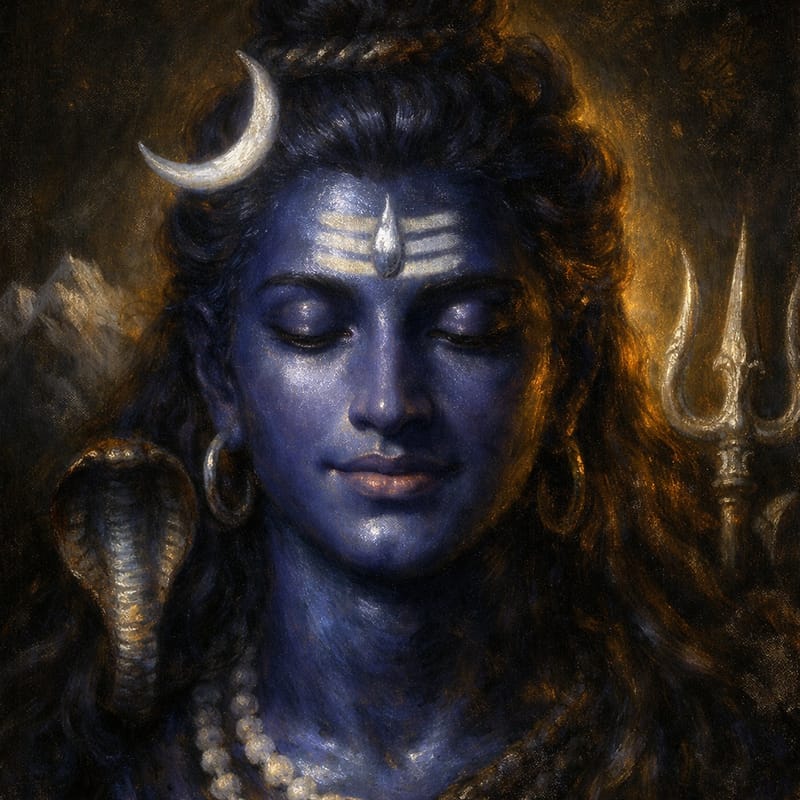


Lord Vishnu is the preserver of the universe in Indian tradition. He keeps the world in balance. Devotees picture him resting on a great serpent on the cosmic ocean. Lakshmi sits at his feet. Whenever the world falls into darkness he comes down as an avatar. An avatar is a form the divine takes on earth.
Who is Lord Vishnu?
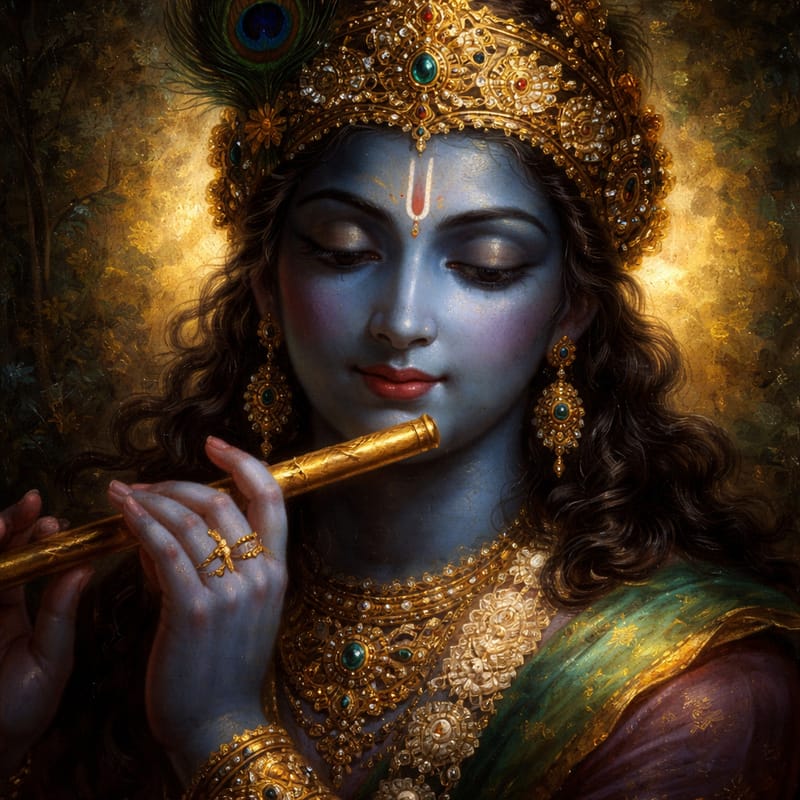
Picture a vast and quiet ocean before time begins. On it floats a great coiled serpent. On the serpent lies a figure the colour of the deep sky. His eyes are half closed. This is Vishnu dreaming the world.
In the trinity Brahma creates, Vishnu preserves and Shiva dissolves. Vishnu's work is to hold things together. He steps in when life loses its balance. Those who worship him as the highest are called Vaishnavas.
The name Vishnu is often read as the one who pervades everything. He has a thousand names in the famous Vishnu Sahasranama. Here are a few that people use every day.
Narayana
Often read as the resting place of all beings. It can also mean the one who rests on the waters.
Hari
The one who takes away. Devotees say he takes away sorrow and fear.
Padmanabha
The one with a lotus at his navel. From that lotus Brahma is born.
Achyuta
The one who never falls. He stays steady when everything else moves.
Venkateswara and Ranganatha
Two great forms of the South. Venkateswara stands on the hills of Tirumala. Ranganatha reclines on the serpent at Srirangam.
Jagannath and Vitthala
Forms of the East and West. Many also see them as Krishna.
Stories of Lord Vishnu and his avatars
The best known list of avatars has ten. It is called the Dashavatara. Matsya the fish saves the first man from a flood. Kurma the tortoise holds up a mountain. Varaha the boar lifts the earth from the sea. Narasimha is half man and half lion.
Vamana is the dwarf. Parashurama is the warrior with an axe. Then come Rama and Krishna. Some lists place Balarama or the Buddha in the ninth place. Kalki is said to come at the end of this age.
Some read the list as a slow story of life rising from water to land. Others read it as a sign that help comes in every age. Here are a few of the stories.
Asleep on the cosmic ocean
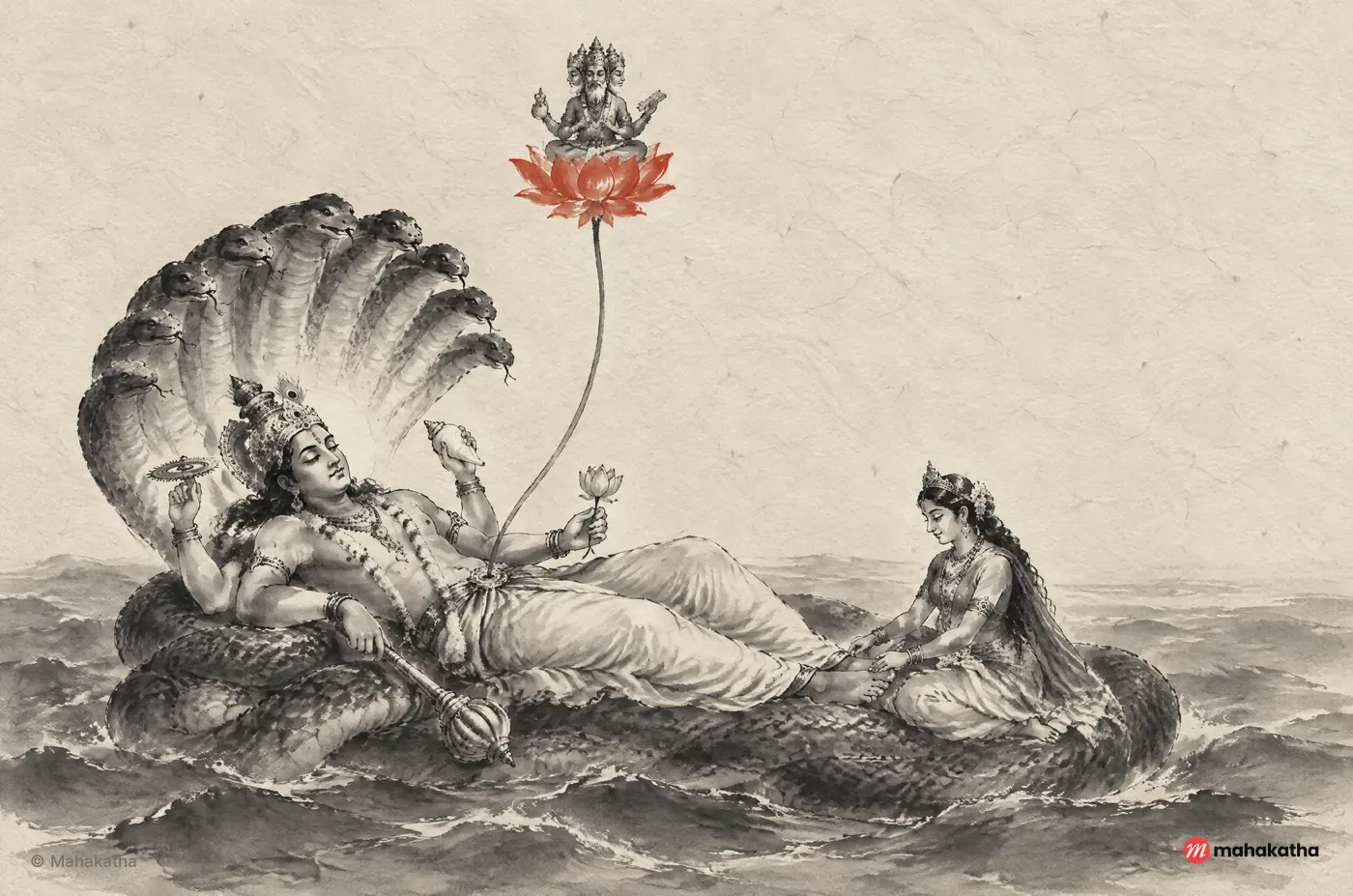
The story says Vishnu sleeps on the serpent Ananta between one world and the next. Ananta means endless. A lotus rises from his navel and Brahma sits on it. Brahma opens his eyes and the world begins again.
The churning of the ocean
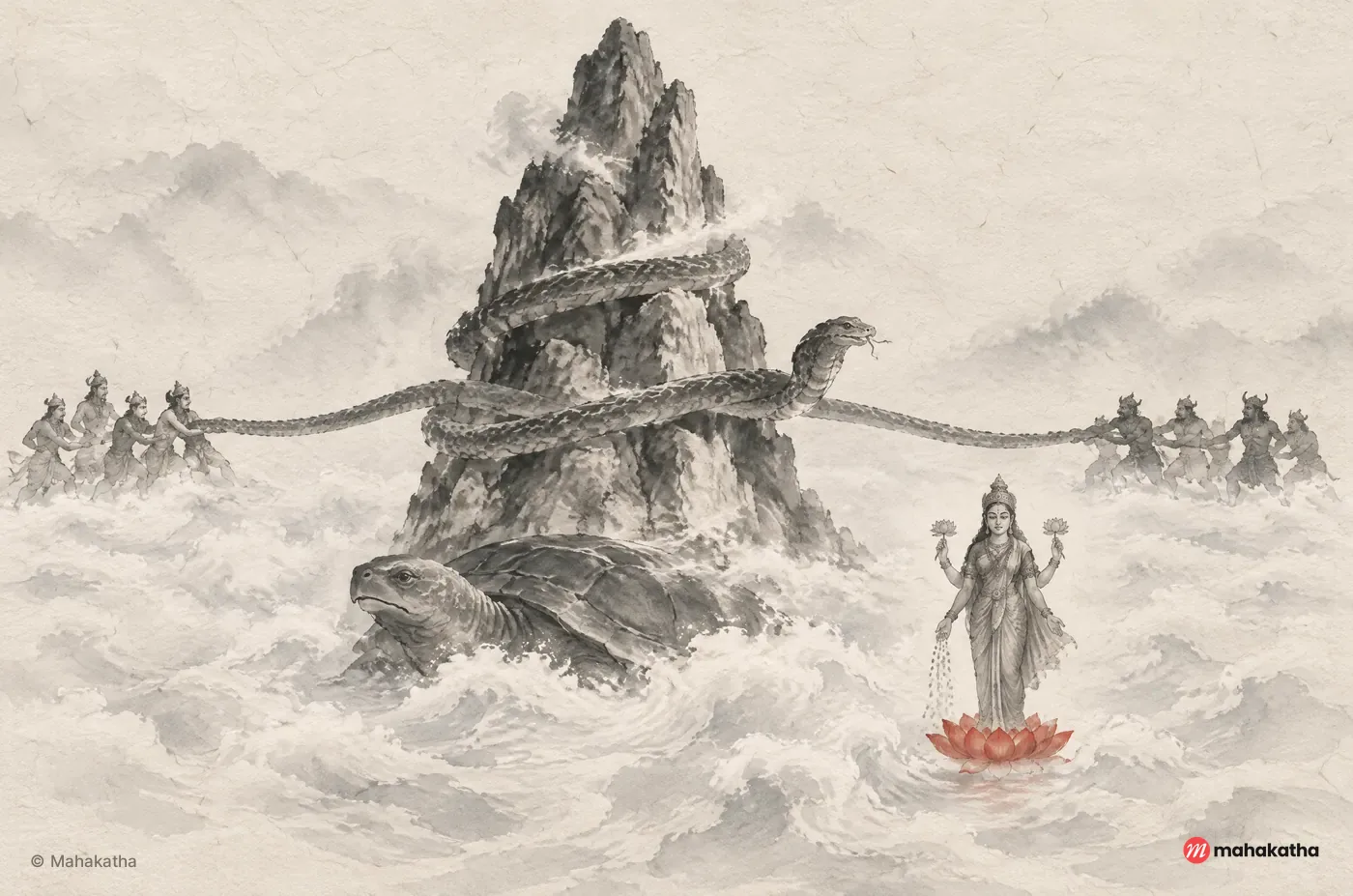
The gods and demons wanted the nectar of immortality. They churned the ocean of milk using a mountain as the rod. The mountain began to sink. Vishnu became Kurma and held it on his back. Lakshmi rose from the waves during the churning.
Narasimha and Prahlada
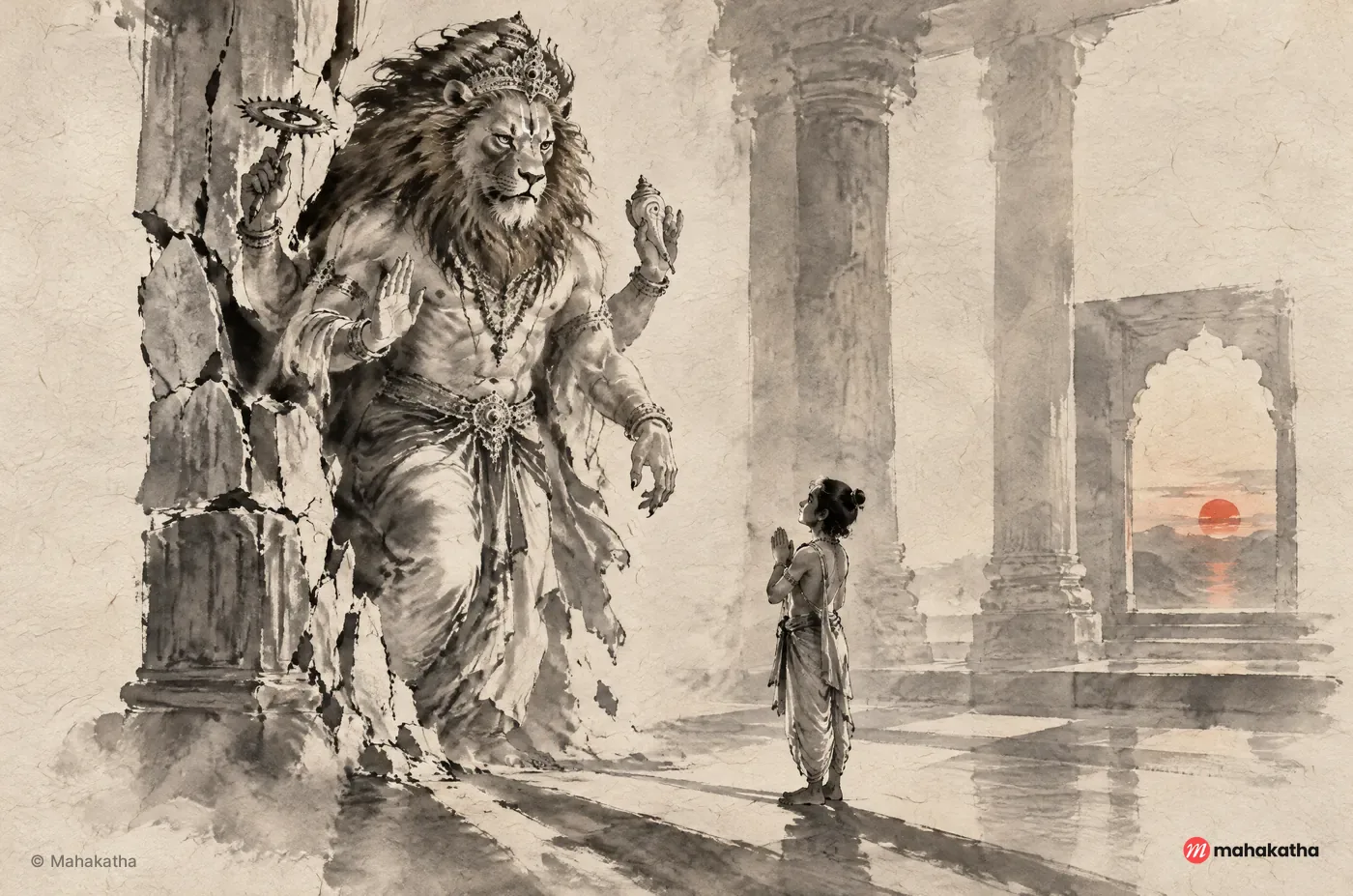
The demon king Hiranyakashipu could not be killed by man or beast. His small son Prahlada loved Vishnu anyway. The king asked where his god was. Prahlada said everywhere. The story says Vishnu burst from a pillar at dusk as Narasimha.
Vamana and the three steps
The generous king Bali ruled all three worlds. A small boy asked him for three steps of land. Bali agreed. The boy grew vast and covered earth and sky in two strides. Bali bowed and offered his own head for the third.
Rama, the seventh avatar
As Rama he lived as a prince who kept his word through exile and war. His life is told in the Ramayana. Read more on our Rama page.
How Vishnu worship grew
Vishnu began as a modest Vedic god and grew into the supreme lord of millions. The growth took more than two thousand years.
The Vedic hymns
In the Rig Veda Vishnu is a smaller god praised for his three great strides. The Rig Veda is often dated to around 1500 to 1200 BCE, and that range is debated. Hymns such as the Vishnu Suktam keep this image.
Later Vedic texts
In later Vedic writings Vishnu is linked with the sacrifice itself. A late Rig Veda hymn called the Purusha Suktam describes a cosmic being with a thousand heads. Vaishnavas later read it as a hymn to Narayana.
The epics
The Mahabharata and the Ramayana grew over many centuries. Scholars often place them in the last few centuries BCE and the first few CE. In them Vishnu, Narayana and Krishna begin to merge into one lord. Read about Krishna on our Krishna page.
The Puranas
The Vishnu Purana and the Bhagavata Purana tell his stories in full. They were composed during the first millennium CE. Their exact dates are debated.
Temples in stone
Under the Gupta kings Vishnu temples rose in stone. The great Varaha panel at Udayagiri dates to the early 5th century. The Dashavatara temple at Deogarh followed.
The bhakti poets
Twelve Tamil saints called the Alvars sang to Vishnu in the early medieval centuries. Their songs fill about four thousand verses. Later Ramanuja taught at Srirangam and Madhva taught at Udupi.
Today
Tirumala is among the most visited holy sites in the world. In many homes a story of Satyanarayana is still read on special days.
Vishnu across India and beyond
Vishnu takes a different face in each region. Each face is loved in its own way.
South
The South is the heartland of Vishnu temples. Tamil Vaishnavas honour 108 holy sites called Divya Desams. Here he is Ranganatha, Venkateswara and Padmanabha. Hymns of the Alvars are still sung in Tamil.
North
In the high Himalaya he is Badrinarayan at Badrinath. In homes the evening aarti Om Jai Jagdish Hare is sung to him. Aarti means waving a lamp before the divine.
East
In Odisha he is Jagannath of Puri. In Assam the saint Sankardev taught devotion through song and drama. His followers gather in prayer halls called namghars.
West
In Maharashtra he is Vitthala of Pandharpur. In Gujarat he is the lord of Dwarka. Many western homes fast on Ekadashi. It is the eleventh day of each half of the lunar month.
Beyond India
Angkor Wat in Cambodia was built for Vishnu. Its walls show the churning of the ocean. In Nepal he sleeps in a stone pool at Budhanilkantha. His eagle Garuda appears on the national emblems of Indonesia and Thailand.
Vishnu temples across India
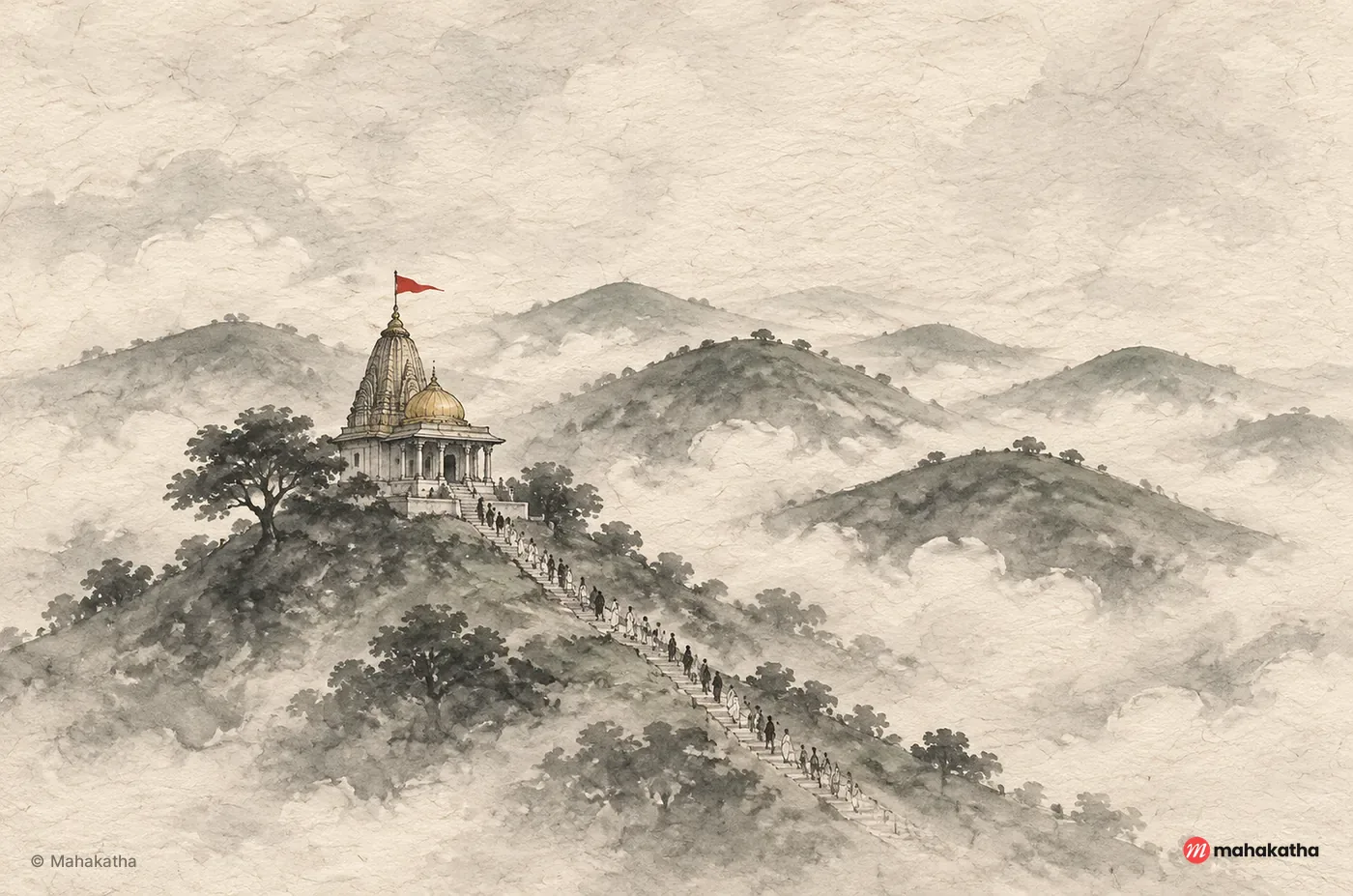
These are some of the best known places of Vishnu worship. Some are busy temples and some are ancient monuments.
Sri Venkateswara Temple, Tirumala (Andhra Pradesh)
The lord of the seven hills. Many pilgrims offer their hair here as a sign of letting go.
Sri Ranganathaswamy Temple, Srirangam (Tamil Nadu)
One of the largest working temple complexes in the world. Vishnu reclines on the serpent here.
Sri Padmanabhaswamy Temple, Thiruvananthapuram (Kerala)
The reclining image is so long that devotees see it through three doors.
Badrinath Temple, Badrinath (Uttarakhand)
A high Himalayan shrine and one of the four great pilgrim seats of India.
Jagannath Temple, Puri (Odisha)
Home of Jagannath and the great chariot festival.
Chennakeshava Temple, Belur (Karnataka)
A Hoysala temple from the 12th century. Its stone carvings are famous for fine detail.
Dashavatara Temple, Deogarh (Uttar Pradesh)
An early Gupta temple. A carving shows Vishnu asleep on the serpent.
Udayagiri Caves, Vidisha (Madhya Pradesh)
Home of a giant carving of Varaha lifting the earth goddess from the sea.
Ahobilam Narasimha Temples, Ahobilam (Andhra Pradesh)
Nine shrines to Narasimha in the hills. Tradition holds this is where he appeared.
Angkor Wat, Siem Reap (Cambodia)
It is often called the largest religious monument in the world. The Khmer king Suryavarman II raised it for Vishnu in the 12th century.
Vishnu's symbols and what they mean
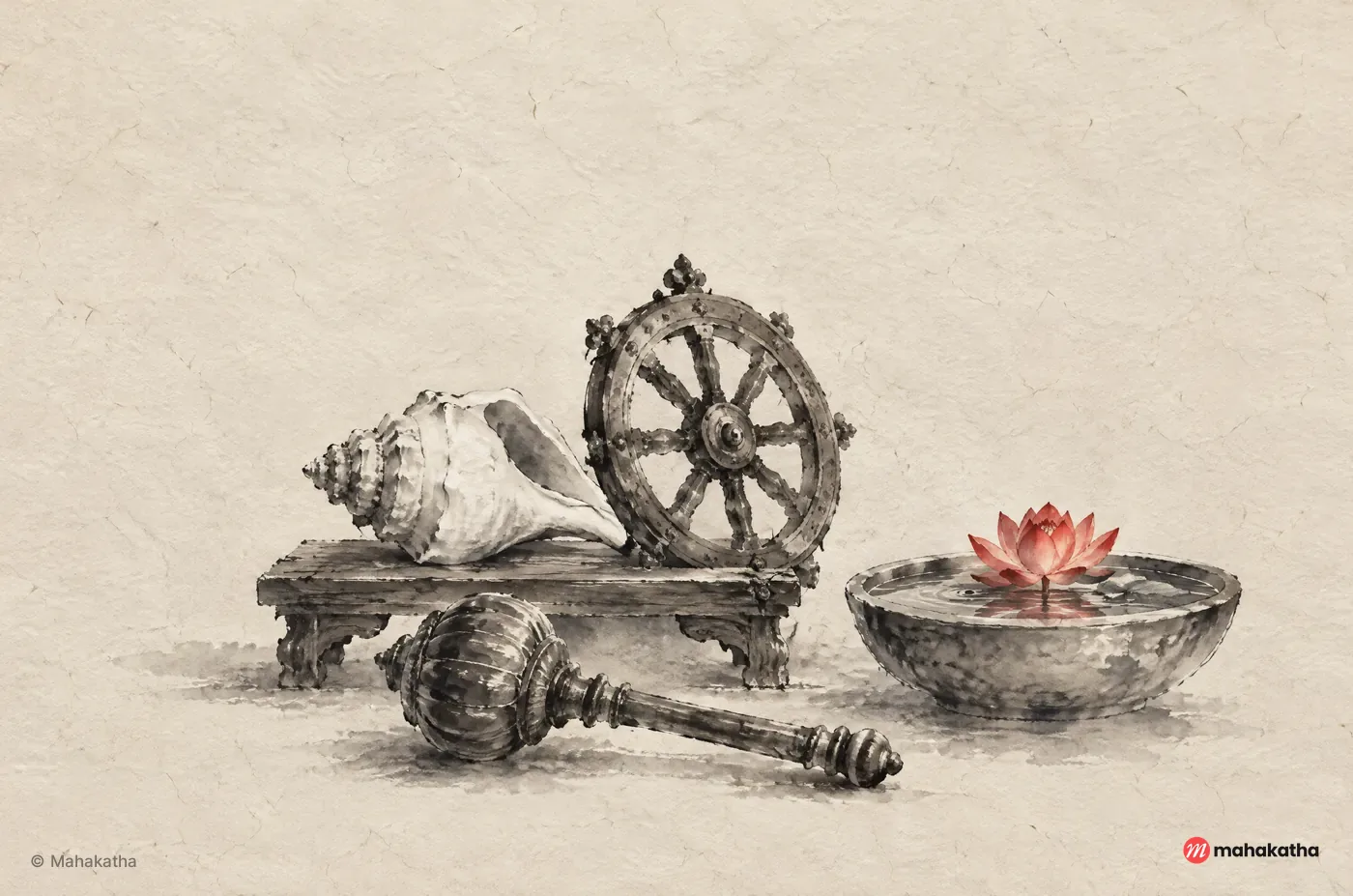
Vishnu is shown with four arms. Each hand holds something that teaches.
The conch
Its sound is like Om rising from the sea. It calls us to wake up and listen.
The discus
The Sudarshana chakra spins without stopping. Sudarshana means beautiful to see. It stands for a mind that cuts through confusion.
The mace
It stands for strength held with restraint. Power is meant to protect.
The lotus
It grows in mud and stays clean. We can live in a messy world and keep a clear heart.
Garuda and the serpent
Garuda the eagle carries him through the sky. The serpent Ananta holds him on the ocean. Together they show the sky above and the depths below.
The sky-blue skin
Like the sky and the sea he has no edge. The colour points to something without limit.
Vishnu mantras and shlokas
These are some of the Vishnu mantras in our library. Each one can be chanted softly at home.
Om Namo Narayanaya
The line is “om namo narayanaya”. It means I bow to Narayana. In the South it is honoured as the eight-syllable mantra.
Vishnu Shantakaram
It begins “Shaantaakaaram Bhujaga Shayanam”. It describes the peaceful one who rests on the serpent. Many recite it at the start of a day.
Shri Hari Stotram
A hymn that ends each verse with “bhajeham bhajeham”. It means I worship him again and again.
Sudarshana Gayatri Mantra
It begins “Om Sudarshanaaya Vidmahe”. It honours the shining discus of Vishnu as a protector.
Hari Har Mantra
The chant is “hari har hari har hari har hari”. It joins Vishnu and Shiva in one breath.
Vishnu Aarti
It opens “jai jagannath deva jai jagannath”. It is sung while waving a lamp.
Guru Yoga Mantra
This verse sees the teacher as Brahma, Vishnu and Shiva. It ends “Tasmai Shri Guravay Namah”.
Vishnu festivals
Vishnu's calendar follows the moon. Many of his holy days fall on Ekadashi.
Vaikuntha Ekadashi
A special gate called the door to Vaikuntha opens in many southern temples. Vaikuntha is Vishnu's heaven. Devotees fast and keep vigil.
Devshayani and Prabodhini Ekadashi
Tradition holds that Vishnu sleeps for four months of the rainy season. These two days mark when he lies down and when he wakes.
Tulsi Vivah
Soon after he wakes many homes celebrate the wedding of the tulsi plant to Vishnu. Tulsi is holy basil.
Brahmotsavam
A grand festival at Tirumala. The lord is carried through the streets on a new carrier each day.
Narasimha Jayanti and Anant Chaturdashi
One honours the lion-man. On the other many tie a thread for Vishnu as Ananta, the endless one.
Simple ways to bring Vishnu into your day
Vishnu is the keeper of balance. Small steady acts are the heart of his worship.
Chant his name
Sit and breathe slowly. Repeat Om Namo Narayanaya in your mind. Let the rhythm settle you.
Keep Thursday
Many devotees keep Thursday for Vishnu. Some wear yellow or eat simple food that day.
Care for a tulsi plant
Water a tulsi plant in the morning. A quiet minute with a plant is a small act of care.
Sing with others
Join a kirtan of his names. Kirtan means singing the divine names together.
Read a stotram
A stotram is a hymn of praise. Read the Narayanashtakam slowly once. Let one line stay with you.
What Vishnu can teach us
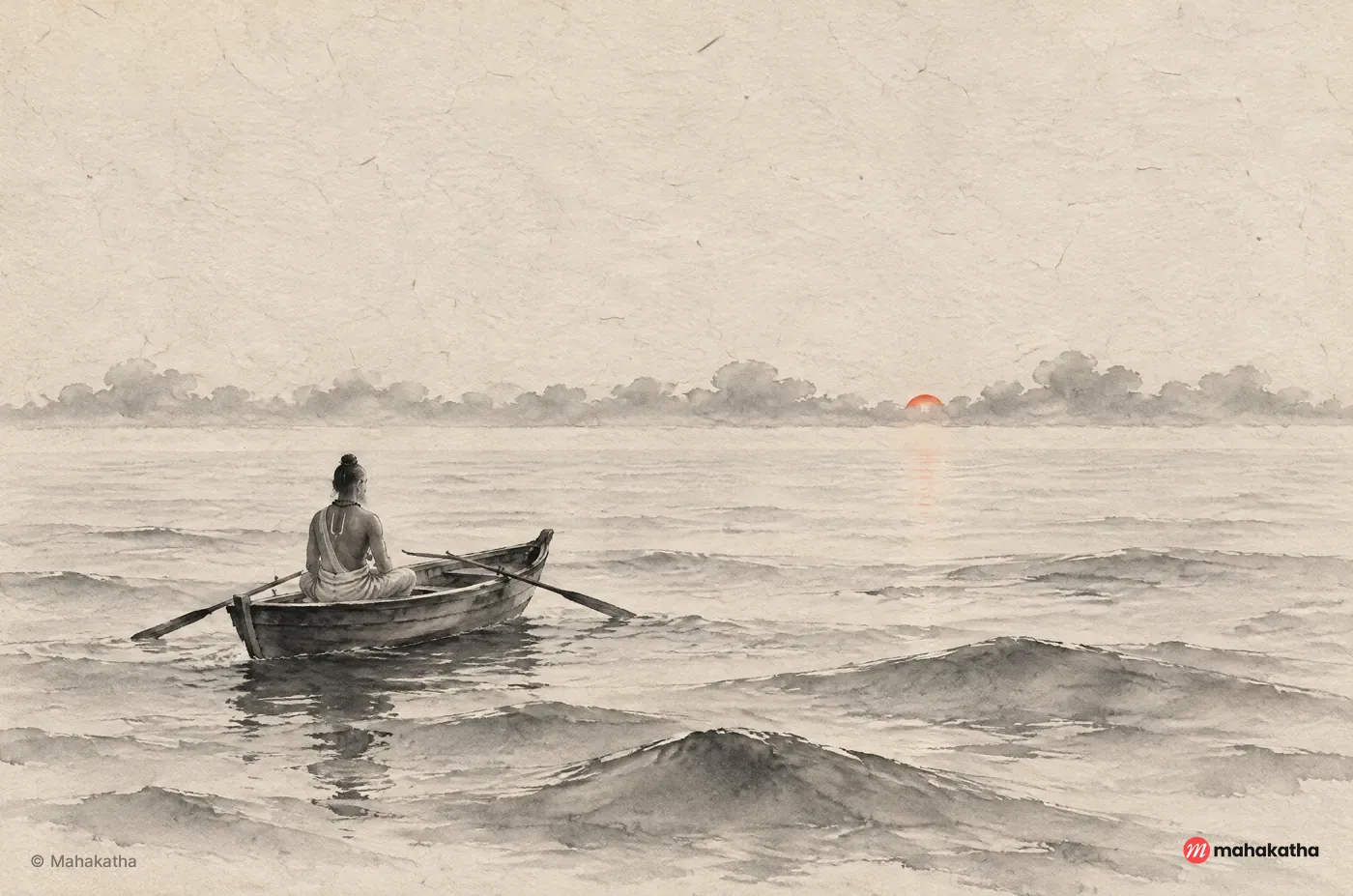
Vishnu rests on an ocean that never stops moving. Yet his face is calm. This is the picture of a steady heart. Life can be stormy and something in you can still be at rest.
He does not destroy and he does not begin. He keeps. There is quiet grace in keeping. A home kept warm and a word kept are small acts of Vishnu.
Each avatar comes in a new shape to meet a new need. When you feel stuck you can change your form too. Be gentle like the fish or patient like the tortoise. Be brave like the lion.
Prahlada said his lord was everywhere. You do not need to search far. Take one breath and notice the stillness under the noise. That stillness is a good place to begin.
Questions people ask
Who is Lord Vishnu?
Lord Vishnu is the preserver in the trinity of Brahma, Vishnu and Shiva. He keeps the universe in balance. Devotees picture him resting on the serpent Ananta on the cosmic ocean with Lakshmi beside him. Vaishnavas worship him as the supreme lord. He is known by many names such as Narayana, Hari and Venkateswara.
What are the ten avatars of Vishnu?
The best known list starts with Matsya the fish and Kurma the tortoise. Then come Varaha the boar and Narasimha the lion-man. Vamana the dwarf and Parashurama follow. Rama and Krishna come next. The ninth is Balarama or the Buddha, depending on the list. Kalki is said to come at the end of this age.
Are Vishnu and Krishna the same?
In most Vaishnava traditions Krishna is an avatar of Vishnu. Vishnu came down to earth as Krishna. Some traditions see it the other way round. For the Gaudiya Vaishnavas of Bengal Krishna is the original form and Vishnu flows from him. Both views are part of living devotion in India.
What is the main mantra of Vishnu?
Om Namo Narayanaya is the best known Vishnu mantra. It is honoured as the eight-syllable mantra in the South. Om Namo Bhagavate Vasudevaya is also widely chanted. Many people recite the Vishnu Sahasranama, his thousand names. Others begin the day with the Shantakaram verse. Choose one and chant it slowly.
Which day is for Lord Vishnu?
Many devotees keep Thursday for Vishnu. Some wear yellow and eat simple food on that day. Ekadashi is also special to him. It is the eleventh day of each half of the lunar month. Many people fast or eat lightly on Ekadashi and chant his names. Local customs vary from home to home.
Who is the wife of Lord Vishnu?
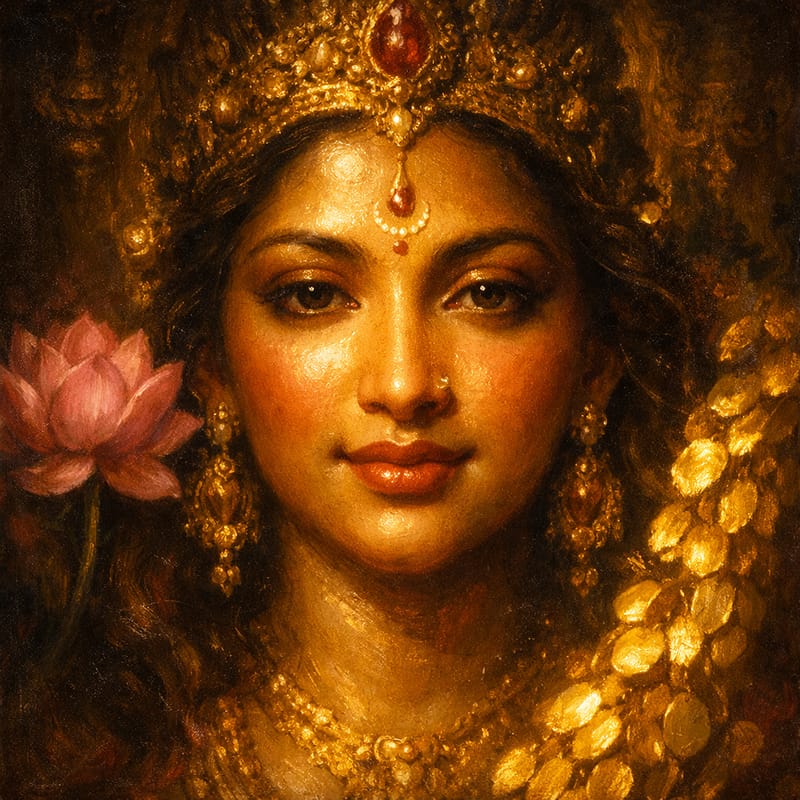
Lakshmi is the consort of Vishnu. She is the goddess of wealth, beauty and good fortune. Tradition holds that she rose from the ocean of milk during the churning. She is shown at his feet or on his chest. In the South the earth goddess Bhudevi is also honoured as his consort.