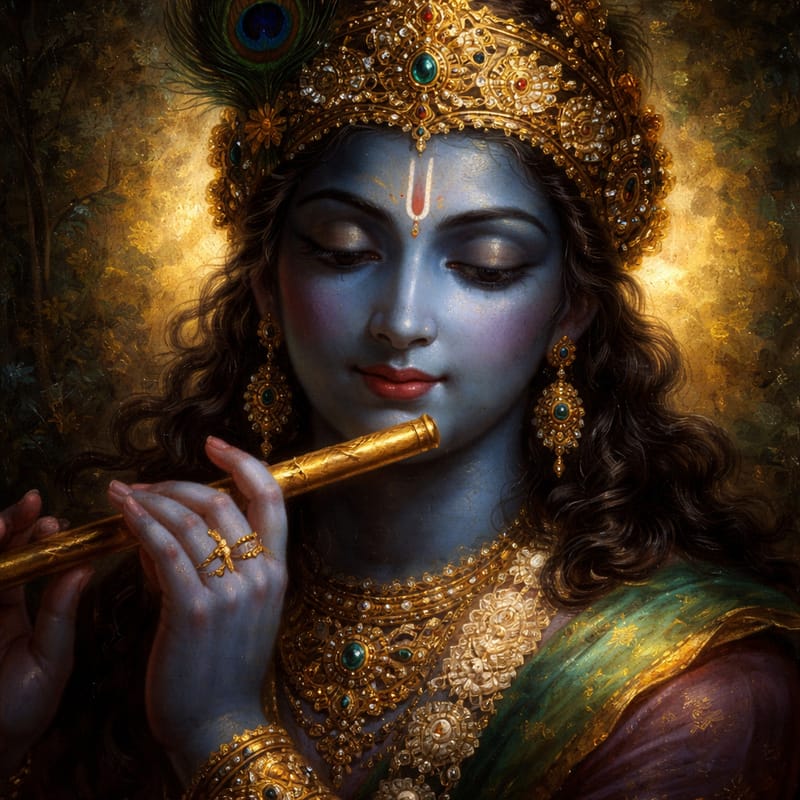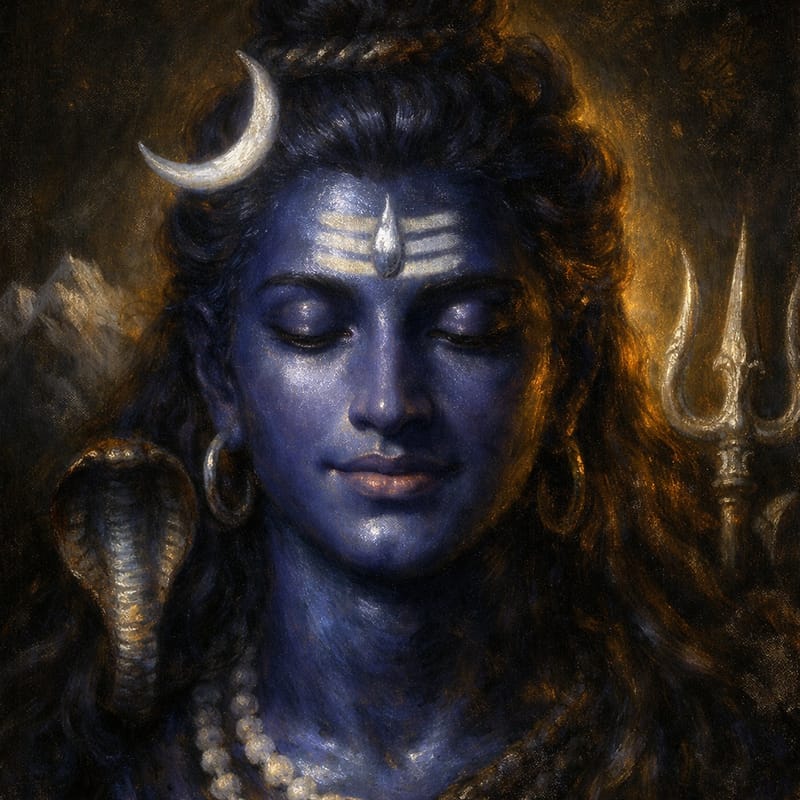


Lord Krishna is one of the most loved faces of the divine in India. Many traditions count him as the eighth avatar of Vishnu. An avatar is a form the divine takes on earth. He is the playful child of Vrindavan and the flute player loved by Radha. He is also the charioteer who speaks the Bhagavad Gita to Arjuna.
Who is Lord Krishna?
Few figures hold so many lives in one story. Krishna is a baby who steals butter and a cowherd boy who dances by the river. He is a prince in Dwarka and a friend who drives a war chariot. In the Bhagavad Gita he becomes the teacher of the whole world.
Many traditions see him as the eighth avatar of Vishnu. Others go further. In the Gaudiya tradition of Bengal and in the Pushti Marg of Gujarat and Rajasthan, Krishna is the source of every form. Both views live side by side in Indian homes.
The name Krishna means the dark one. His skin is painted the blue-black of a rain cloud. Devotees also read the name as the one who draws every heart to himself.
Govinda
The one who cares for the cows. The word go can mean cows. It can also mean the earth or the senses.
Gopala
The young cowherd. Gopala is the child Krishna who grew up among the herders of Gokul.
Madhava and Keshava
Madhava is often read as the beloved of Lakshmi. Keshava is the one with beautiful hair. Both names open many old prayers.
Vasudeva
The son of Vasudeva. This is one of his oldest names and it appears in early inscriptions.
Muralidhara
The one who holds the flute. A murali is a bamboo flute.
Jagannath, Vitthala and Shrinathji
These are regional forms. Jagannath means lord of the world in Puri. Vitthala stands on a brick in Pandharpur. Shrinathji is the child who lifts a hill in Nathdwara.
Stories of Lord Krishna
Krishna's stories are told in the Mahabharata, the Harivamsha and the Bhagavata Purana. Each telling adds colour. Village singers and temple dancers have added more for centuries. These are stories of faith, and devotees read them as lila. Lila means divine play.
Each story also carries an idea. The child who cannot be held. The teacher who speaks in the middle of a war.
Birth in a prison
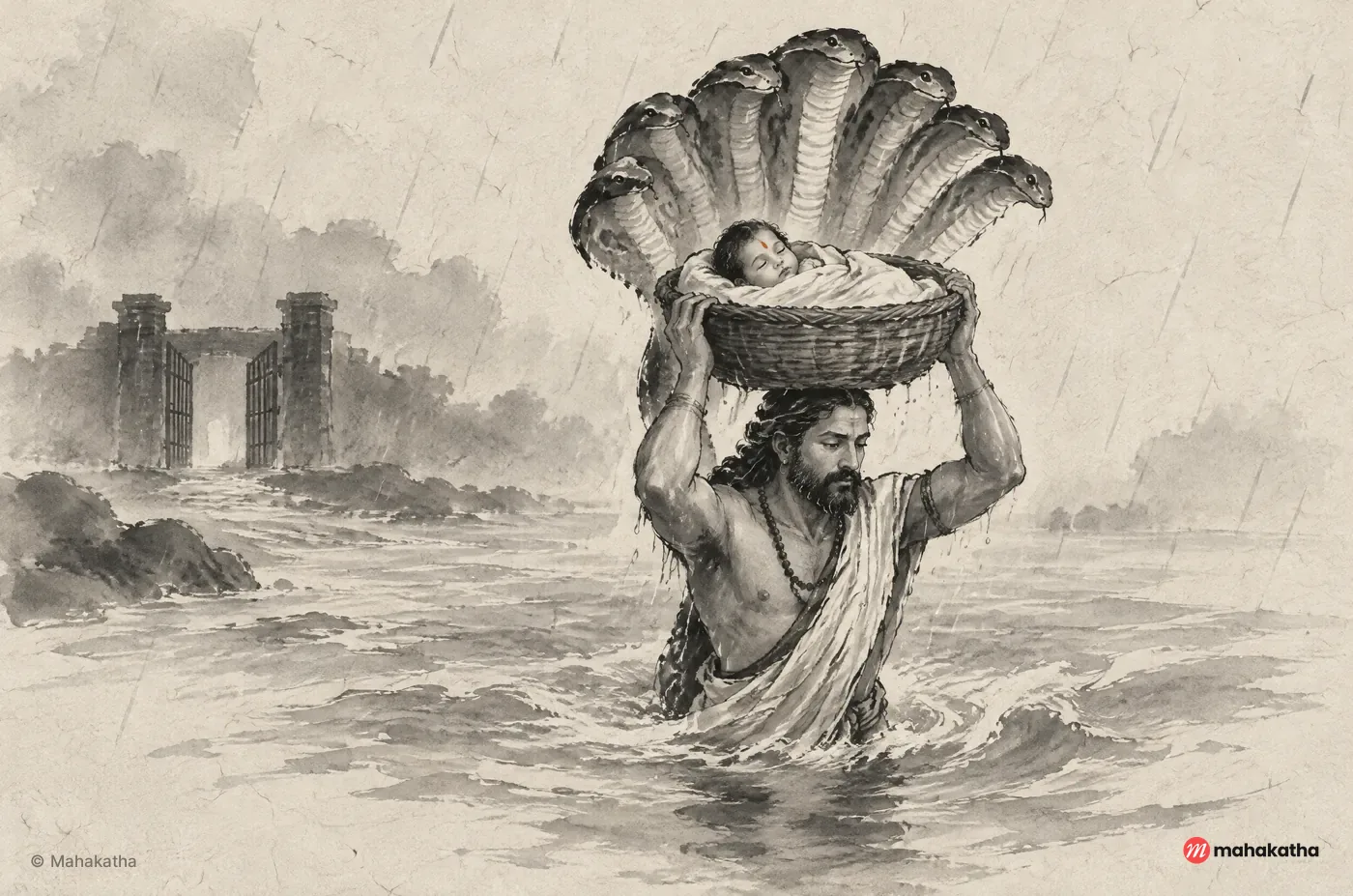
The story says Krishna was born at midnight in a prison cell in Mathura. His uncle Kamsa had locked up his parents Devaki and Vasudeva. That night the guards fell asleep and the doors opened. Vasudeva carried the baby across the flooded Yamuna to Gokul. There Nanda and Yashoda raised him as their own.
The butter thief
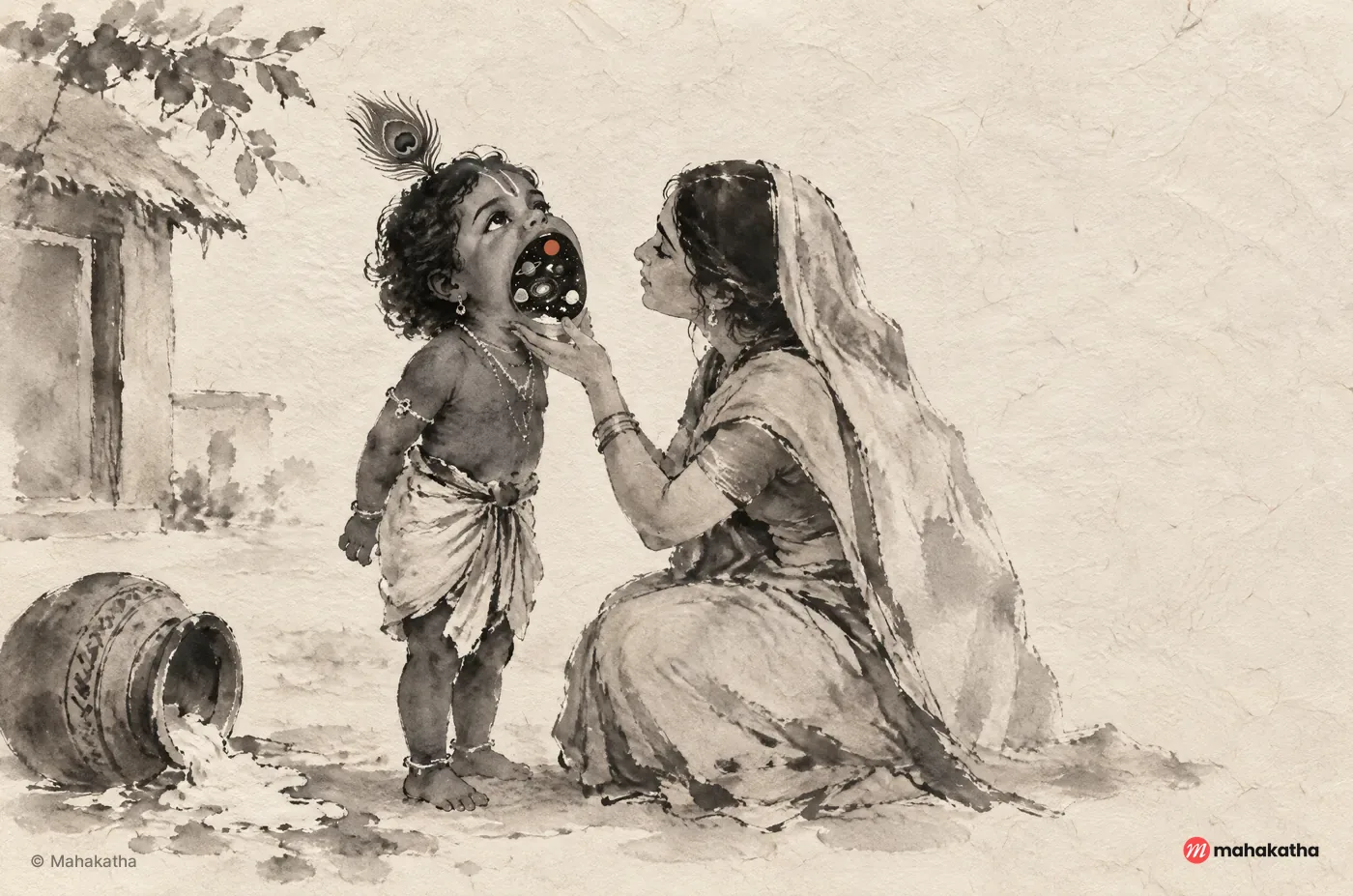
As a child he stole butter from every kitchen in the village. The women complained to Yashoda with laughter in their eyes. Once the other children said he had eaten mud. Yashoda asked him to open his mouth. Tradition holds that she saw the whole universe inside it. Then the vision faded and he was her little boy again.
Lifting Govardhan
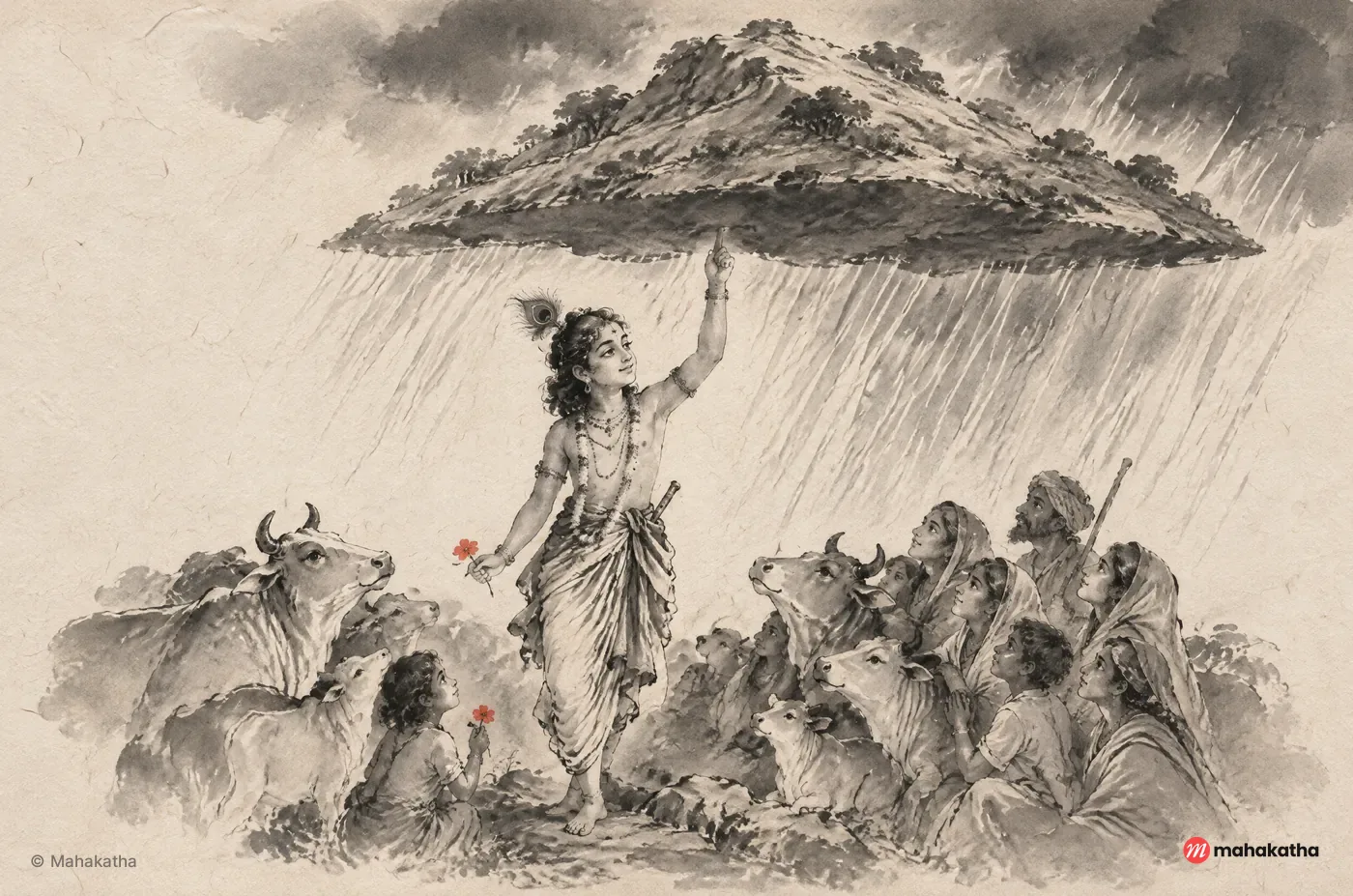
The villagers once made offerings to Indra, the god of rain. Krishna asked them to honour the hill that fed their cows instead. Indra sent a great storm in anger. The story says Krishna lifted Govardhan hill on one finger. The whole village sheltered under it for seven days.
Radha and the dance by the river
The story says that on an autumn full moon night the gopis left their homes to dance with him. Gopis are the cowherd women of Vrindavan. In the rasa dance each one felt Krishna was hers alone. Radha is the dearest of them all. The Bhagavata Purana does not name her. Later poets made her the heart of Krishna devotion.
The song on the battlefield
Years later the Pandava prince Arjuna stood frozen before a war with his own family. Krishna was his charioteer. Between the two armies he spoke the Bhagavad Gita. He taught Arjuna to act with a calm heart and without clinging to results.
How Krishna worship grew
Krishna worship grew slowly from many streams. A hero named Vasudeva and a cowherd god of the Braj country seem to have merged over time. Scholars still debate how and when.
The Vedic hymns
Krishna is not a god of the Rig Veda. Vishnu is there as a smaller god who takes three strides. A Krishna son of Devaki is named once in the Chandogya Upanishad. Scholars do not agree if this is the same figure.
Early worship
A stone pillar at Vidisha in Madhya Pradesh honours Vasudeva. It was raised by a Greek envoy around the 2nd century BCE. It is one of the earliest clear signs of Krishna worship.
The epics
The Mahabharata grew over many centuries. Scholars often place it between about 400 BCE and 400 CE, and the dates are debated. The Gita sits inside it. The Harivamsha came later as an appendix about Krishna's childhood.
The Puranas
The Vishnu Purana and the Bhagavata Purana tell his life in full. Many scholars place the final form of the Bhagavata around the 9th or 10th century CE. Others argue for an earlier date.
The bhakti poets
Bhakti means loving devotion. Tamil saints called the Alvars sang of Krishna in the early medieval centuries. Jayadeva wrote the Gita Govinda in the 12th century. Later came Chaitanya in Bengal and Vallabhacharya in Braj. Surdas sang to him in Braj Bhasha and Mirabai in Rajasthani.
Today
The Hare Krishna movement was founded in New York in 1966. Its kirtan carried Krishna's name to cities across the world. Kirtan means singing the divine names together.
Krishna across India
Every region holds a different Krishna close. Each one is loved fully.
North
In Braj around Mathura and Vrindavan he is a child and a young lover. Radha comes first here. People greet each other with Radhe Radhe. Village troupes act out his life in the raslila plays.
East
In Bengal the saint Chaitanya danced through the streets singing his names. In Odisha he is Jagannath with large round eyes. The Gita Govinda has long been sung in the Puri temple.
West
In Gujarat he is the king of Dwarka by the sea. In Rajasthan he is Shrinathji and the beloved of Mirabai. In Maharashtra he is Vitthala. Pilgrims called Warkaris walk to Pandharpur singing the songs of Tukaram and Namdev.
South
In Kerala he is Guruvayurappan, often loved as a little child. In Karnataka the Udupi Krishna is seen through a small window. In Chennai he is Parthasarathy, the charioteer of Arjuna.
Beyond India
His name is now sung in temples in London, Moscow and Sao Paulo. In Bali and Java the Mahabharata lives on in shadow puppet plays.
Krishna temples across India
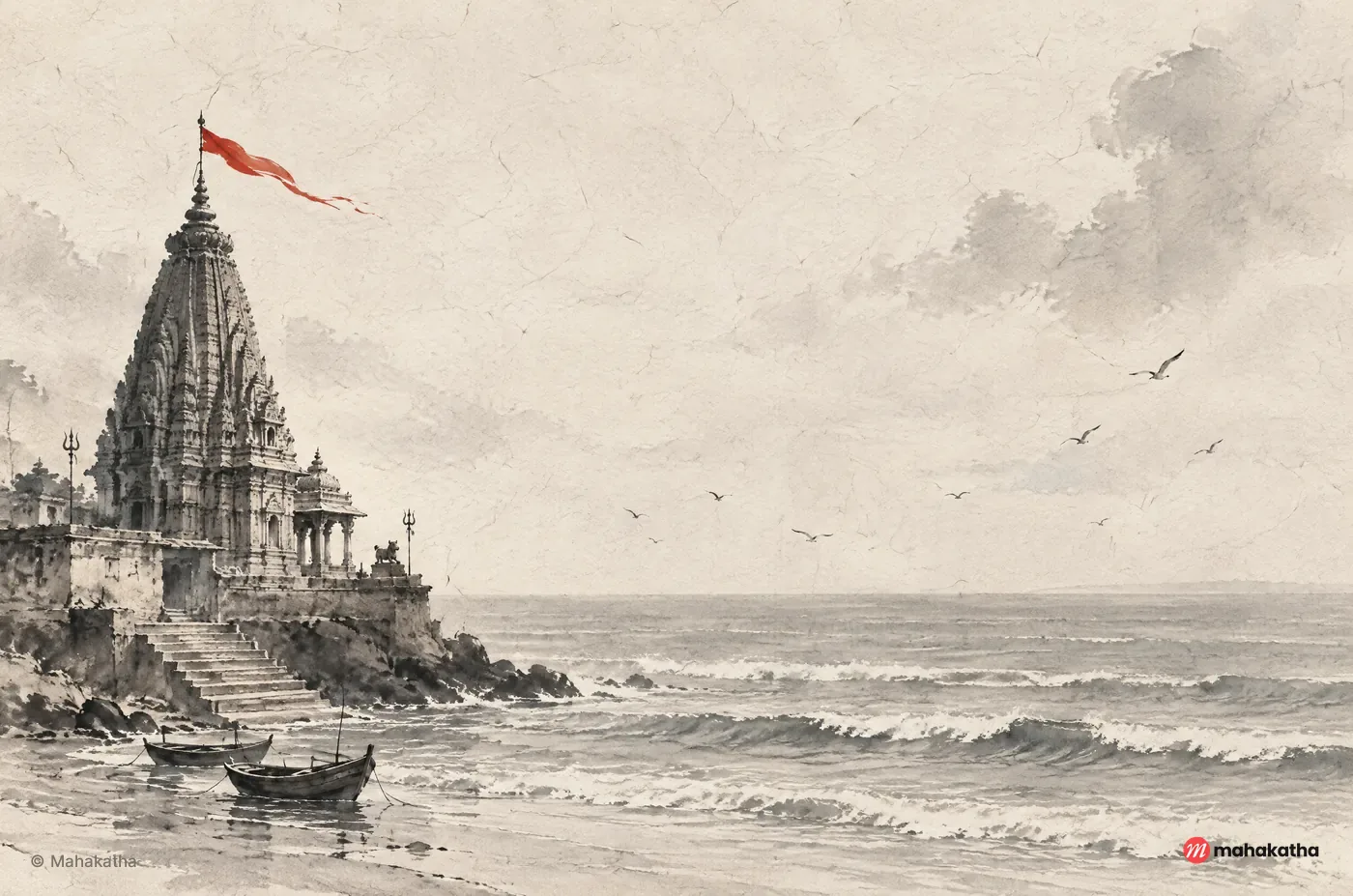
These are some of the best known places of Krishna worship. Each holds its own form of him.
Krishna Janmabhoomi, Mathura (Uttar Pradesh)
Devotees honour this site as his birthplace. Tradition holds that the inner shrine marks the prison cell of the story.
Banke Bihari Temple, Vrindavan (Uttar Pradesh)
Banke means bent, for his pose that bends in three places. A curtain is drawn across the image every few minutes. Devotees believe his gaze is too strong to meet for long.
Dwarkadhish Temple, Dwarka (Gujarat)
Here he is the king of Dwarka. It is one of the four great pilgrim seats of India.
Jagannath Temple, Puri (Odisha)
Krishna stands here as Jagannath with his brother Balabhadra and sister Subhadra. The wooden images are renewed from time to time.
Shrinathji Temple, Nathdwara (Rajasthan)
The child Krishna holds up Govardhan hill. This is the main seat of the Pushti Marg.
Guruvayur Sri Krishna Temple, Guruvayur (Kerala)
One of the most visited temples in the South. Families bring babies here for their first meal of rice.
Sri Krishna Matha, Udupi (Karnataka)
Founded by the teacher Madhvacharya. Devotees see the image through a small carved window.
Parthasarathy Temple, Chennai (Tamil Nadu)
Krishna is the charioteer here. The temple is one of the old Vaishnava holy sites of Tamil Nadu.
Vitthal Rukmini Temple, Pandharpur (Maharashtra)
Vitthala stands on a brick with his hands on his hips. The great Warkari walk ends here.
Krishna's symbols and what they mean
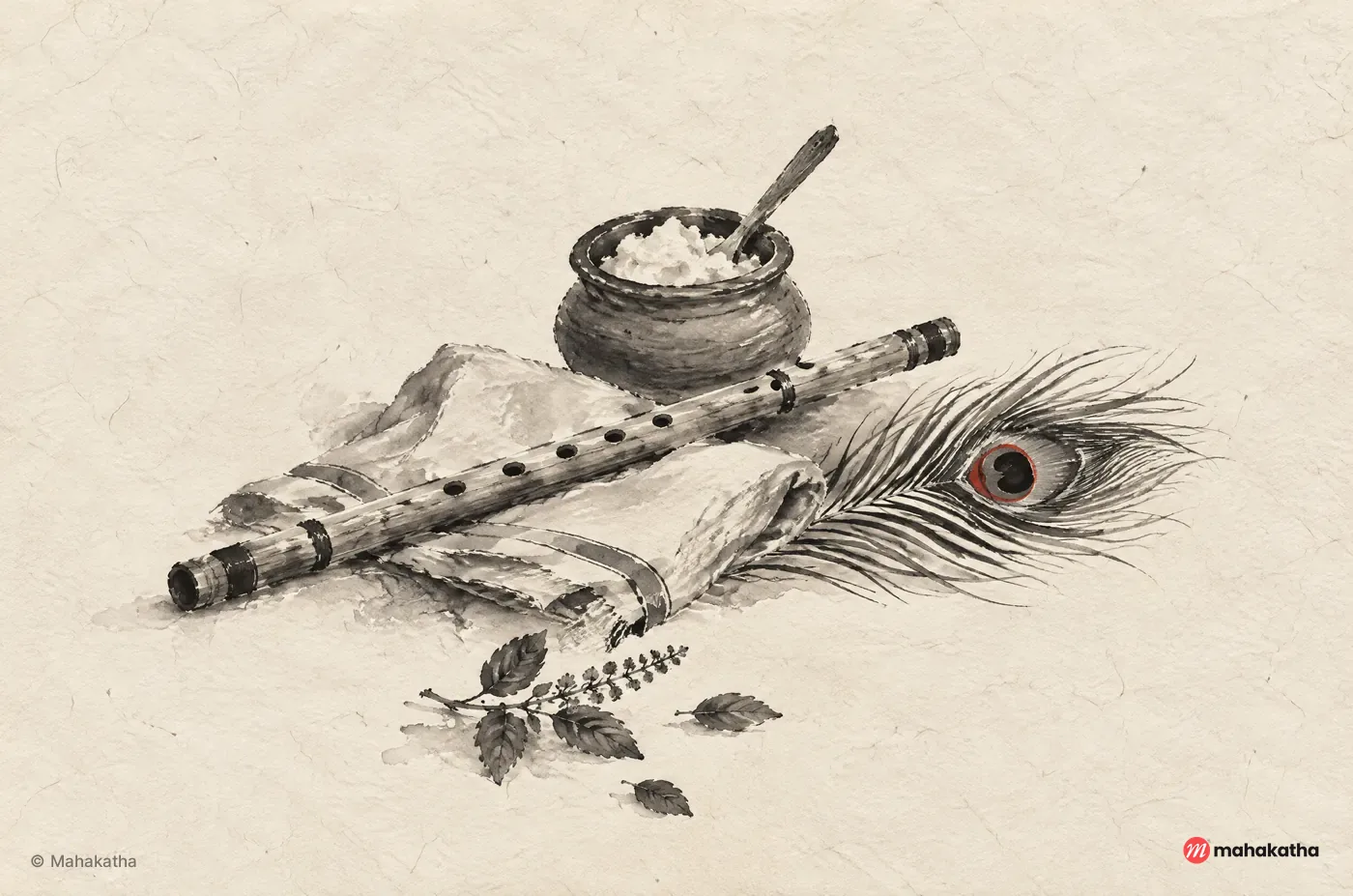
Every part of his image is a small teaching. Look slowly and it begins to speak.
The flute
A hollow reed makes music only when it is empty. Devotees say we can be like that flute. Let go of the noise and something sweet can play through you.
The peacock feather
It sits lightly in his hair. It speaks of beauty and of joy that does not need to show off.
The dark blue skin
It is the colour of the monsoon cloud and the deep sky. Some see in it the boundless and the unknowable.
Butter
Butter is churned out of milk. In the same way a calm heart is churned out of a busy life.
The yellow cloth
He wears pitambara, a bright yellow garment. It is the colour of sunlight and of auspicious beginnings.
Krishna mantras and shlokas
Krishna devotion is full of names and songs. These are some that people chant at home and in temples. You can listen to each one in our library.
Hare Krishna Hare Rama
Sixteen names in four short lines. It opens with “Hare Krishna Hare Krishna” and calls on both Krishna and Rama. It is sung in kirtan and chanted softly on beads.
Om Namo Bhagavate Vasudevaya
The line is “Om Namo Bhagavate Vasudevaya”. It means I bow to the divine Vasudeva. Many Vaishnava homes use it for daily japa. Japa means repeating a name with care.
Krishna Gayatri Mantra
It begins “Om Devaki Nandanaya Vidmahe”. It honours the son of Devaki and asks him to light up the mind.
Madhurashtakam
Eight verses that call every part of Krishna sweet. It opens “adharam madhuram vadanam madhuram”. His lips are sweet and his face is sweet. Tradition credits it to Vallabhacharya.
Achyutashtakam
A hymn of his names. It begins “achyutam keshavam ramanarayanam”. Achyuta means the one who never falls.
Yadaa Yadaa Hi Dharmasya
A famous verse from the fourth chapter of the Gita. It begins “yada yada hi dharmasya glanirbhavati bharata”. Dharma means the right way of living. Krishna says he comes whenever dharma grows weak.
Om Sri Krishna Sharanam Mamah
The words are “Om Shri Krishna Sharanam Mamah”. They mean Krishna is my refuge. It is a mantra of surrender.
Govinda Damodara Bhajan
A simple song of three names. It sings “govinda damodara madhaveti”. Damodara is the child once tied to a heavy mortar by Yashoda.
Krishna festivals
His festivals follow the story of his life. Many are full of music, colour and food.
Janmashtami
His birthday. Many people fast through the day and keep watch until midnight. Then a small cradle is rocked and sweets are shared. It is also called Gokulashtami.
Dahi Handi
In Maharashtra young men build human towers. They reach for a clay pot of curd hung high in the street. It recalls the butter thief.
Holi in Braj
In Barsana and Vrindavan Holi lasts for days. In the Lathmar Holi of Barsana and Nandgaon women playfully chase men with sticks.
Govardhan Puja
The day after Diwali many homes make a small hill of food. It is called Annakut, which means a mountain of food.
Rath Yatra
In Puri Jagannath rides out on a giant wooden chariot. Thousands pull the ropes together.
Gita Jayanti and Vishu
Gita Jayanti honours the day the Gita was spoken. In Kerala the Vishu morning begins with a view of Krishna among fruit, gold and flowers.
Simple ways to bring Krishna into your day
You do not need a temple to begin. Krishna is loved most in small and ordinary moments.
Say one name with the breath
Sit for a minute. Breathe in slowly. As you breathe out say Krishna or Govinda in your mind. Let the name rest there.
Read one verse a day
Open the Bhagavad Gita at any chapter. Read a single verse and carry it with you until evening.
Offer your food first
Before you eat pause for a breath. Offer the meal in your heart. Food offered this way is called prasad.
Sing with others
Join a kirtan or sing the Mahamantra with your family. Singing together softens the heart.
Wave a small lamp
In the evening light a lamp and sing Aarti Kunj Bihari Ki. Aarti is the waving of light before the divine.
What Krishna can teach us
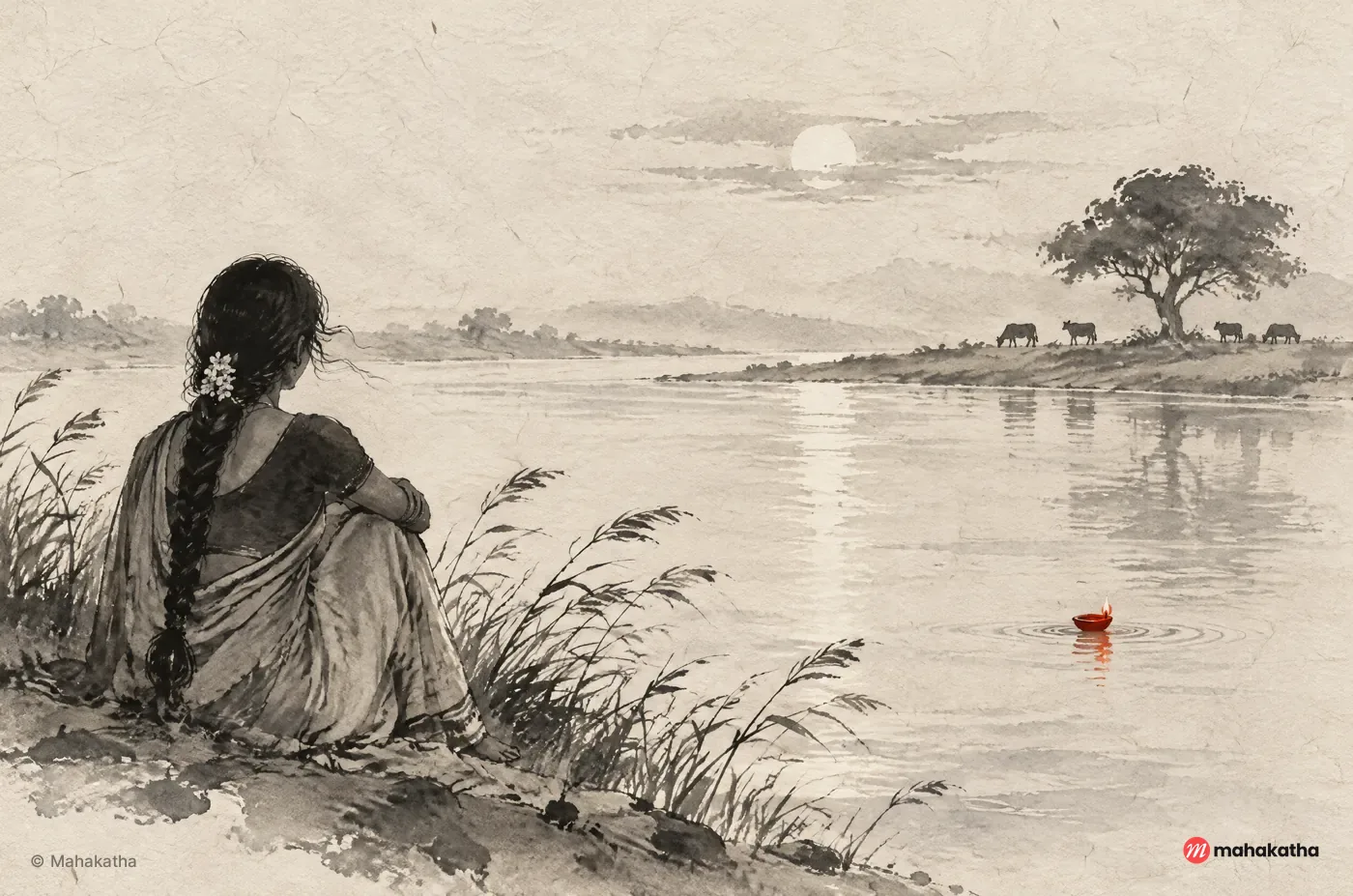
Krishna is joy that does not wait for life to be perfect. He laughs in a prison and plays in a storm. He teaches on a battlefield. When you feel heavy he reminds you that lightness is also your nature.
The Gita asks us to do our work fully and hold the results lightly. This is not giving up. It is putting down a weight you never needed to carry.
The flute is empty and so it can sing. When the mind grows quiet there is room for something gentle to come through. Sit for a few breaths. Listen. The music may already be playing.
Above all Krishna is a friend. He walks beside Arjuna and does not leave. Devotees feel that same nearness in their own lives. You are not alone on your field.
Questions people ask
Who is Lord Krishna?
Lord Krishna is one of the most loved forms of the divine in India. Many traditions see him as the eighth avatar of Vishnu. His stories cover a playful childhood in Vrindavan and his love for Radha. They also tell of his role as Arjuna's charioteer. On that battlefield he speaks the Bhagavad Gita, one of the most read spiritual texts in the world.
Is Krishna an avatar of Vishnu?
In most Vaishnava traditions Krishna is the eighth avatar of Vishnu. Some lists name his brother Balarama as the eighth instead. The Gaudiya tradition of Bengal and the Pushti Marg go further. They see Krishna as the supreme form from whom all avatars come. Both views are honoured in Indian homes.
Who is Radha?
Radha is the cowherd girl of Vrindavan who loves Krishna above all. The Bhagavata Purana does not name her. Poets like Jayadeva made her central from the 12th century on. In the Braj country and in Bengal she is worshipped beside him. Many see her as the soul longing for the divine.
What is the main mantra of Krishna?
There is no single main mantra. The Hare Krishna Mahamantra is the best known around the world. Om Namo Bhagavate Vasudevaya is an old and widely used Vaishnava mantra. Many families also chant simple names like Govinda or Krishna. Choose the one that feels close to your heart and chant it with care.
When was the Bhagavad Gita written?
No one knows for sure. The Gita sits inside the Mahabharata, which grew over many centuries. Many scholars place the Gita around the 2nd century BCE. Estimates run from the 5th century BCE to the 3rd century CE. Devotees hold that Krishna spoke it to Arjuna. Its eighteen chapters are read across the world.
Why is Krishna shown with blue skin?
The name Krishna means dark. Artists show him in the deep blue-black of a rain cloud. Devotees read this colour as the boundless sky or the depth of the ocean. It suggests something too vast for any one shape to hold. It also links him to Vishnu, who is shown in the same colour.