

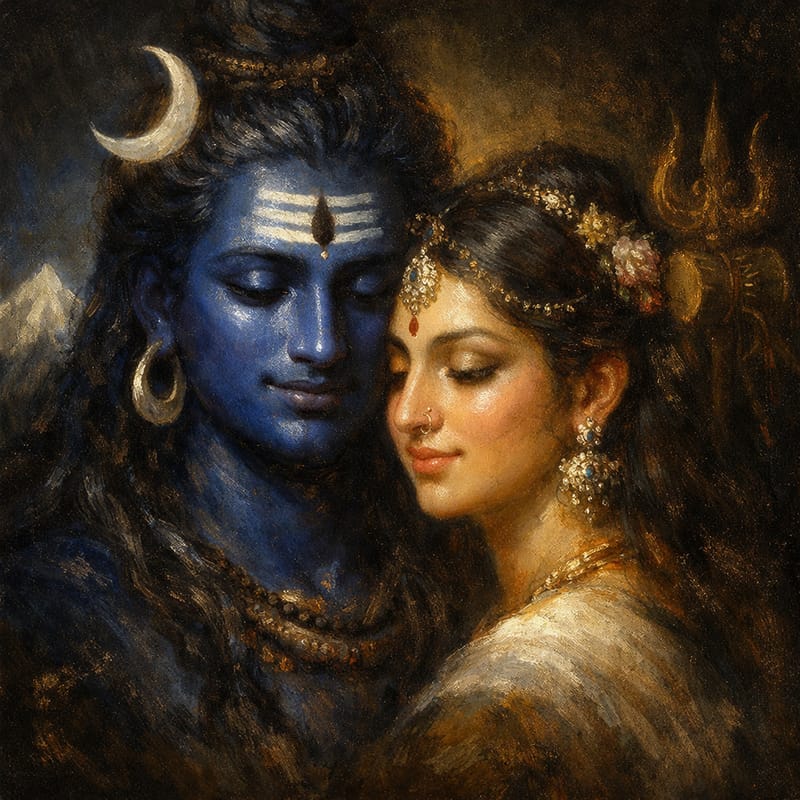
Uma Maheshwara Stotram — Spanish Lyrics
Uma Maheshwara Stotram is a 12-verse Sanskrit hymn devoted to Shiva and Parvati as an inseparable divine couple. Each verse addresses them with specific epithets—eternally youthful, worshipped by the trinity of gods, adorned with ash and sandalwood, seated on Mount Kailash. The stotram celebrates their cosmic roles: Shiva as the destroyer and transformer, Parvati as the creative shakti. The refrain 'namo namah shankaraparvatibhyam' (repeated salutations to Shankara and Parvati) anchors each verse in devotional surrender, emphasizing that their divine union is the source of all creation and cosmic order.
Spiritually, Uma Maheshwara Stotram represents the perfect balance of masculine and feminine divine principles—Shiva's transcendent consciousness paired with Parvati's dynamic creative energy. Their eternal embrace (parasparashlishtavapurdharabhyam) symbolizes how opposing forces—dissolution and creation, stillness and motion—coexist in divine harmony. The mantra invokes their presence across all three worlds and all three functions of existence: srishti (creation), sthiti (sustenance), and samhara (dissolution). Chanting this stotram awakens reverence for the complementary nature of all dualities and the ultimate non-duality underlying existence, as taught in the Shiva Upanishads and Shiva Purana traditions.
Chant Uma Maheshwara Stotram during morning rituals (brahma muhurta) or at sacred times—dawn, dusk, or full moon nights. Ideally recite all 12 verses with focused attention and sincere devotion. Three daily repetitions amplify benefits. This stotram suits practitioners seeking to strengthen relationships, cultivate compassion, or deepen spiritual partnership. It may be chanted individually or in family settings. The concluding verse promises that devotees who recite this 12-verse hymn with faith receive all blessings, long life, and ultimately reach Shiva's celestial realm.
Curated by The Mahakatha Team · Original Composition: Mahakatha · Lyric: Adi Shankaracharya (8th century CE)
Uma Maheshwara Stotram
Shiva · Preview · 2:00
Preview ended
Ancient sounds for transformation, carried across 3,000 years.
Get the full version — plus 275 more ancient chants. 80% OFF today only.
Get Ancient Chants Bundle — 80% OFF →3000+ happy customers · Lifetime access · All devices
2.2M people trust Mahakatha
Chant daily with reminders — Get the Mahakatha app
नमः शिवाभ्यां नवयौवनाभ्यां परस्पराश्लिष्टवपुर्धराभ्याम् । नगेन्द्रकन्यावृषकेतनाभ्यां नमो नमः शङ्करपार्वतीभ्याम् || 1 ||
namah shivabhyam navayauvanabhyam parasparashlishtavapurdharabhyam | agendrakanyavrishaketanabhyam namo namah shankaraparvatibhyam || 1 ||
Me inclino ante Shiva-Parvati, los eternamente jóvenes,
Por siempre en el abrazo afectuoso del uno al otro
La querida hija de las montañas, el Señor cuya bandera lleva el símbolo de un toro,
¡Me inclino ante ti, una y otra vez, oh Shiva y Parvati! || 1 ||
नमः शिवाभ्यां सरसोत्सवाभ्यां नमस्कृताभीष्टवरप्रदाभ्याम् । नारायणेनार्चितपादुकाभ्यां नमो नमः शङ्करपार्वतीभ्याम् || 2 ||
namah shivabhyam sarasotsavabhyam namaskritabhishtavarapradabhyam | narayanenarchitapadukabhyam namo namah shankaraparvatibhyam || 2 ||
Me inclino ante Shiva-Parvati, por quienes se realizan innumerables ceremonias gozosas,
Un solo Namaskara sincero puede obtener sus bendiciones,
Cuyos pies divinos son adorados por el Señor Narayana,
¡Me inclino ante ti, una y otra vez, oh Shiva y Parvati! || 2 ||
नमः शिवाभ्यां वृषवाहनाभ्यां विरिञ्चिविष्ण्विन्द्रसुपूजिताभ्याम् । विभूतिपाटीरविलेपनाभ्यां नमो नमः शङ्करपार्वतीभ्याम् || 3 ||
namah shivabhyam vrishavahanabhyam virinchivishnvindrasupujitabhyam | vibhutipatiravilepanabhyam namo namah shankaraparvatibhyam || 3 ||
Me inclino ante Shiva-Parvati, Quien se mueve sobre su toro sagrado,
Quien es adorado por Brahma, Vishnu e Indra,
Cuyo cuerpo está cubierto de ceniza sagrada y pasta de sándalo
¡Me inclino ante ti, una y otra vez, oh Shiva y Parvati! || 3 ||
नमः शिवाभ्यां जगदीश्वराभ्यां जगत्पतिभ्यां जयविग्रहाभ्याम् । जम्भारिमुख्यैरभिवन्दिताभ्यां नमो नमः शङ्करपार्वतीभ्याम् || 4 ||
namah shivabhyam jagadishvarabhyam jagatpatibhyam jayavigrahabhyam | jambharimukhyairabhivanditabhyam namo namah shankaraparvatibhyam || 4 ||
Me inclino ante Shiva-Parvati, el Señor del universo,
El Guardián de todos los mundos, Quien es la victoria personificada,
Reverenciado por el Dios del Trueno entre otros dioses
¡Me inclino ante ti, una y otra vez, oh Shiva y Parvati! || 4 ||
नमः शिवाभ्यां परमौषधाभ्यां पञ्चाक्षरीपञ्जररञ्जिताभ्याम् । प्रपञ्चसृष्टिस्थितिसंहृताभ्यां नमो नमः शङ्करपार्वतीभ्याम् || 5 ||
namah shivabhyam paramaushadhabhyam panchaksharipanjararanjitabhyam | prapanchasrishtisthitisamhritabhyam namo namah shankaraparvatibhyam || 5 ||
Me inclino ante Shiva-Parvati, la medicina más poderosa de todas,
Que residen en los sonidos y espacios del mantra Panchakshari,
La raíz de la creación, sustento y disolución de este mundo,
¡Me inclino ante ti, una y otra vez, oh Shiva y Parvati! || 5 ||
नमः शिवाभ्यामतिसुन्दराभ्यां अत्यन्तमासक्तहृदम्बुजाभ्याम् । अशेषलोकैकहितङ्कराभ्यां नमो नमः शङ्करपार्वतीभ्याम् || 6 ||
namah shivabhyamatisundarabhyam atyantamasaktahridambujabhyam | asheshalokaikahitamkarabhyam namo namah shankaraparvatibhyam || 6 ||
Me inclino ante Shiva-Parvati, encantadoramente hermosos,
Quienes aman al mundo tiernamente con sus corazones como lotos,
Quienes traen bienestar a las criaturas de todos los mundos,
¡Me inclino ante ustedes, una y otra vez, oh Shiva y Parvati! || 6 ||
नमः शिवाभ्यां कलिनाशनाभ्यां कङ्कालकल्याणवपुर्धराभ्याम् । कैलासशैलस्थितदेवताभ्यां नमो नमः शङ्करपार्वतीभ्याम् || 7 ||
namah shivabhyam kalinashanabhyam kankalakalyanavapurdharabhyam | kailasashailasthitadevatabhyam namo namah shankaraparvatibhyam || 7 ||
Me inclino ante Shiva-Parvati, Quienes terminan los males de esta Kaliyuga,
Uno lleva calaveras, la otra está vestida con hermosas ropas
El gran Dios y Diosa que residen en el Monte Kailash
¡Me inclino ante ustedes, una y otra vez, oh Shiva y Parvati! || 7 ||
नमः शिवाभ्यामशुभापहाभ्यां अशेषलोकैकविशेषिताभ्याम् । अकुण्ठिताभ्यां स्मृतिसम्भृताभ्यां नमो नमः शङ्करपार्वतीभ्याम् || 8 ||
namah shivabhyamashubhapahabhyam asheshalokaikavisheshitabhyam | akunthitabhyam smritisambhritabhyam namo namah shankaraparvatibhyam || 8 ||
Me inclino ante Shiva-Parvati, removedores de lo desfavorable,
Quienes tienen estatura y grandeza incomparables entre todos los mundos y seres
Cuyos poderes son infinitos, quienes pueden ser alcanzados a través de una vida virtuosa
¡Me inclino ante ustedes, una y otra vez, oh Shiva y Parvati! || 8 ||
नमः शिवाभ्यां रथवाहनाभ्यां रवीन्दुवैश्वानरलोचनाभ्याम् । राकाशशाङ्काभमुखाम्बुजाभ्यां नमो नमः शङ्करपार्वतीभ्याम् || 9 ||
namah shivabhyam rathavahanabhyam ravinduvaishvanaralochanabhyam | rakashashankabhamukhambujabhyam namo namah shankaraparvatibhyam || 9 ||
Me inclino ante Shiva-Parvati, sentados en el carruaje divino
Cuyos ojos son el Sol, la Luna y el Fuego
Cuyo rostro de loto resplandece como la luna llena
¡Me inclino ante ustedes, una y otra vez, oh Shiva y Parvati! || 9 ||
नमः शिवाभ्यां जटिलन्धराभ्यां जरामृतिभ्यां च विवर्जिताभ्याम् । जनार्दनाब्जोद्भवपूजिताभ्यां नमो नमः शङ्करपार्वतीभ्याम् || 10 ||
namah shivabhyam jatilandharabhyam jaramrutibhyam cha vivarjitabhyam | janardanabjodbhavapujitabhyam namo namah shankaraparvatibhyam || 10 ||
Me inclino ante Shiva-Parvati, Quienes tienen mechones de cabello enmarañados,
Quienes son inmunes a la vejez y la muerte
Quien es adorado por Vishnu y nació del Loto de Brahma
¡Me inclino ante ustedes, una y otra vez, oh Shiva y Parvati! || 10 ||
नमः शिवाभ्यां विषमेक्षणाभ्यां बिल्वच्छदामल्लिकदामभृद्भ्याम् । शोभावतीशान्तवतीश्वराभ्यां नमो नमः शङ्करपार्वतीभ्याम् || 11 ||
namah shivabhyam vishamekshanabhyam bilvachchhadamallikadamabhridbhyam | shobhavatishantavatishvarabhyam namo namah shankaraparvatibhyam || 11 ||
Me inclino ante Shiva-Parvati, nuestro consuelo en tiempos difíciles,
Adornados con guirnaldas de hojas de Bilva y flores de Mallika
La Diosa Resplandeciente y su Resplandeciente Consorte
¡Me inclino ante ustedes, una y otra vez, oh Shiva y Parvati! || 11 ||
नमः शिवाभ्यां पशुपालकाभ्यां जगत्रयीरक्षणबद्धहृद्भ्याम् । समस्तदेवासुरपूजिताभ्यां नमो नमः शङ्करपार्वतीभ्याम् || 12 ||
namah shivabhyam pashupalakabhyam jagatrayirakshanabaddhahridbhyam | samastadevasurapujitabhyam namo namah shankaraparvatibhyam || 12 ||
Me inclino ante Shiva-Parvati, los guardianes de todos los seres
Quienes están consagrados a la protección de los tres mundos
Adorados por todos los Devas y Asuras
¡Me inclino ante ustedes, una y otra vez, oh Shiva y Parvati! || 12 ||
स्तोत्रं त्रिसन्ध्यं शिवपार्वतीभ्यां भक्त्या पठेद्द्वादशकं नरो यः । स सर्वसौभाग्यफलानि भुङ्क्ते शतायुरान्ते शिवलोकमेति || 13 ||
stotram trisandhyam shivaparvatibhyam bhaktya patheddvadashakam naro yah | sa sarvasaubhagyaphalani bhunkte shatayurante shivalokameti || 13 ||
Los devotos que reciten este stotram de Shiva Parvati de 12 versos tres veces al día
Serán bendecidos con todas las formas de abundancia
Y después de una larga vida, alcanzarán un hogar eterno en el mundo de Shiva y Parvati. || 13 ||
|| इति श्री शङ्कराचार्य कृत उमामहेश्वर स्तोत्रम सम्पूर्णम् ||
|| iti shri shankaracharya krita umamaheshvara stotram sampurnam ||
Así concluye el Uma Maheshwara Stotram creado por Shri Shankaracharya.
How to Chant Uma Maheshwara Stotram
- 1
Find a quiet, clean space
Sit in a comfortable, undisturbed environment. Face east or north if possible. You may light incense or a candle to set a contemplative atmosphere.
- 2
Settle into a comfortable posture
Sit cross-legged on the floor or upright in a chair. Keep the spine erect and place the hands on the knees with palms facing upward.
- 3
Take three cleansing breaths
Inhale slowly through the nose, hold briefly, and exhale completely. Repeat three times to calm the mind and prepare for mantra recitation.
- 4
Begin chanting Uma Maheshwara Stotram
Chant the mantra clearly and with devotion — aloud, in a whisper, or silently. Use a mala (108 beads) to count repetitions. Aim for a consistent, unhurried rhythm throughout the session.
- 5
Rest in stillness
After completing your chanting, sit quietly for two to five minutes. Allow the vibration of the mantra to settle within. Close the practice with a moment of gratitude.
Benefits of Uma Maheshwara Stotram
-
Harmonizes relationships and deepens bonds through the model of divine complementarity that Shiva and Parvati embody.
Source: Shiva Purana — tradition of Uma Maheshwara worship
-
Cultivates compassion and emotional resilience by invoking Parvati's merciful nature and Shiva's protective power.
Source: Traditional practice and Tantric devotional texts
-
Aligns consciousness with cosmic order (rita) by acknowledging the eternal creative-destructive cycle they govern.
Source: Upanishadic philosophy of Shiva as Mahadeva
-
Removes spiritual obstacles and bestows protection, prosperity, and longevity to sincere practitioners.
Source: Concluding verse of Uma Maheshwara Stotram (Verse 12)
-
Brings the Panchakshari mantra (Om Namah Shivaya) into the heart, and is traditionally said to purify the mind and subtle channels.
Source: Shiva Agama texts and Mantra Yoga tradition
Story & Symbolism
The Uma Maheshwara Stotram is traditionally attributed to the great Adi Shankaracharya, one of the most revered seers in Hindu tradition, though scholars suggest the hymn likely emerged during the medieval period when devotional poetry flourished across India. The mantra celebrates the divine union of Uma, the compassionate goddess also known as Parvati, and Maheshwara, the supreme lord Shiva. This stotram belongs to a rich lineage of devotional hymns that seek to invoke the blessings of this cosmic couple, whose interplay represents the dance between divine masculine consciousness and feminine creative energy. The text draws deeply from Puranic tradition, particularly stories found in the Shiva Purana and other sacred texts that narrate the love story of Shiva and Parvati as an embodiment of ultimate spiritual truth.
The spiritual significance of this mantra lies in its recognition that Shiva cannot be fully understood without Uma, just as the transcendent consciousness cannot manifest without creative power. Shiva represents the eternal, unchanging reality—the witness consciousness beyond all form—while Uma embodies the dynamic, nurturing aspect of the divine that sustains and nourishes all creation. By reciting the Uma Maheshwara Stotram, devotees invoke not just individual deities but the principle of complementary wholeness, the recognition that unity encompasses both stillness and movement, silence and expression. This mantra is particularly significant for those seeking harmony in relationships, spiritual awakening, and liberation, as it teaches that the divine dwells in balance and in the sacred bond between complementary forces.
Practitioners traditionally chant this stotram during meditation and worship to cultivate devotion, invoke divine protection, and deepen their understanding of non-dual spirituality. The hymn's poetic beauty and profound philosophical depth have made it a cornerstone of Shaivite practice across centuries, passed down through oral tradition and sacred texts. Whether recited in temples, homes, or during personal sadhana, the Uma Maheshwara Stotram continues to serve as a bridge between the seeker and the divine, a reminder that spiritual realization emerges when we honor both the transcendent stillness of Shiva and the compassionate presence of Uma within ourselves and in all existence.
How to Use in Daily Life
Dawn Chanting
Recite Uma Maheshwara Stotram during brahma muhurta (early morning) when mind is calm and receptive. Light a lamp, sit facing east, and chant all 12 verses mindfully. This creates a protective spiritual atmosphere for your day.
Meditation Anchor
Use the stotram as a meditation focus. After each verse, pause and contemplate its meaning. Visualize Shiva and Parvati in divine embrace, radiating light and compassion. This deepens concentration and emotional openness.
Relationship Healing
Chant Uma Maheshwara Stotram when facing relationship challenges. Their eternal harmony models compassion and balance. Recite with intention for the other person's wellbeing. Three repetitions strengthen emotional bonds and mutual understanding.
Evening Reflection
Close your day with one quiet recitation before sleep. This invokes Shiva-Parvati's protection and blessing as you sleep, fostering peaceful rest and quiet reflection on the day's experiences.