

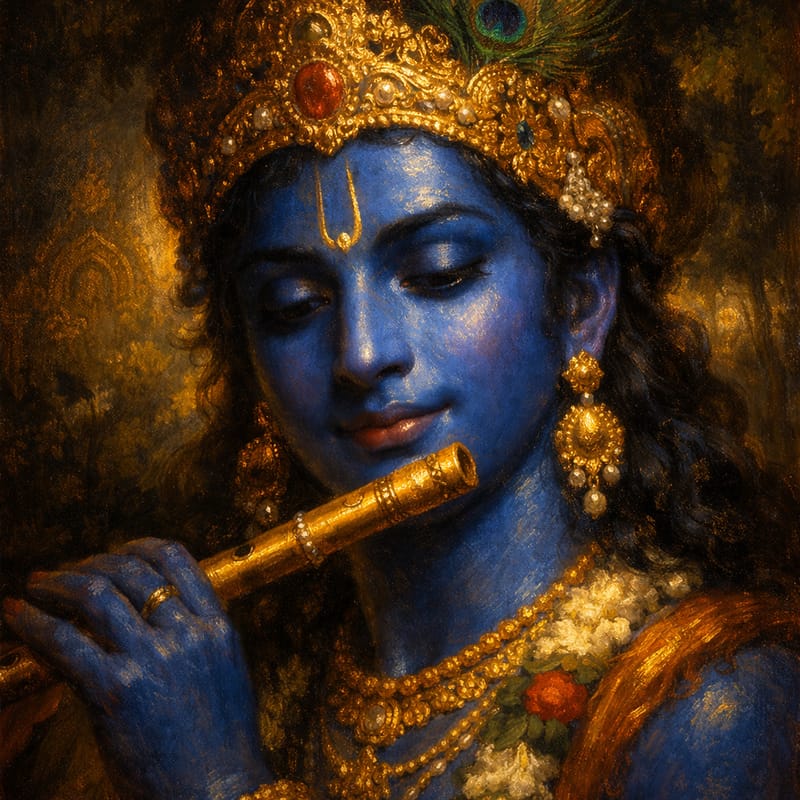
108 Names of Shri Krishna Chant — German Lyrics
The 108 Names of Shri Krishna is a sacred enumeration of Krishna's divine attributes, epithets, and roles across Vedic literature and Puranic tradition. Each name encodes a specific aspect of Krishna's cosmic nature—from 'Krishnaya' (the dark one, symbolic of the infinite) to 'Parabrahmane' (the supreme absolute reality). These names span his incarnation stories: his birth as Devaki's son, his childhood exploits in Brindavan, his role as charioteer in the Bhagavad Gita, and his divine governance as Dwarka's king. Chanting them systematically creates a complete spiritual portrait of the deity.
Krishna represents the divine play (leela) of the Absolute—the reconciliation of transcendence and immanence. In Bhagavata Purana and Brahma Samhita, Krishna is recognized as Param Brahman (ultimate reality) who freely descends into human form to guide humanity. His 108 names reflect both his cosmic grandeur ('Ananta'—infinite, 'Kotisuryasamaprabhaya'—brilliant as a billion suns) and his intimate accessibility ('Yashodavatsalaya'—beloved of Yashoda, 'Govinda'—nourisher of cows). This duality—supreme power expressed through personal devotion—makes Krishna worship uniquely transformative across Hindu spiritual traditions.
Chant the 108 Names daily, ideally after sunrise or during evening meditation, as part of your sadhana (spiritual practice). Each repetition opens deeper layers of Krishna consciousness. Begin with 3 rounds and gradually increase to 27 or 108 repetitions. Use mala beads for counting. The practice works best with sincere devotion (bhakti) rather than mechanical recitation. Many traditions recommend pairing the chant with Krishna's image or deity for enhanced focus. Morning chanting energizes your day with divine grace; evening practice purifies the mind before sleep.
Curated by The Mahakatha Team · Original Composition: Mahakatha · Lyric: Traditional / Vaishnava
108 Names of Shri Krishna Chant
Krishna · Preview · 2:00
Preview ended
Ancient sounds for transformation, carried across 3,000 years.
Get the full version — plus 275 more ancient chants. 80% OFF today only.
Get Ancient Chants Bundle — 80% OFF →3000+ happy customers · Lifetime access · All devices
2.2M people trust Mahakatha
Chant daily with reminders — Get the Mahakatha app
ॐ कृष्णाय नमः। ॐ कमलानाथाय नमः। ॐ वासुदेवाय नमः। ॐ सनातनाय नमः।
om krishnaya namah| om kamalanathaya namah| om vasudevaya namah| om sanatanaya namah|
Der Eine mit dunklem Teint
Der Gemahl der Göttin Lakshmi
Der Sohn von Vasudeva
Die göttliche Gegenwart in allen drei Zeitaltern
ॐ वसुदेवात्मजाय नमः। ॐ पुण्याय नमः। ॐ लीलामानुषविग्रहाय नमः। ॐ श्रीवत्सकौस्तुभधराय नमः।
om vasudevatmajaya namah| om punyaya namah| om lilamanushavigrahaya namah| om shrivatsakaustubhadharaya namah|
Der Sohn von Vasudeva
Der höchst Tugendhafte
Der Eine, der menschliche Gestalt annahm, um sein göttliches Spiel zu zeigen
Der Eine, der die Edelsteine Shrivatsa und Kaustubha trägt
ॐ यशोदावत्सलाय नमः। ॐ हरिये नमः। ॐ चतुर्भुजात्तचक्रासिगदा नमः। ॐ सङ्खाम्बुजायुदायुधाय नमः।
om yashodavatsalaya namah| om hariye namah| om chaturbhujattachakrasigada namah| om shankhambujayudayudhaya namah|
Der geliebte Sohn von Yashoda
Der Herr der Natur
Dessen vier Arme göttliche Waffen wie den Diskus, das Schwert tragen,
Die Keule und die Muschel
ॐ देवकीनन्दनाय नमः। ॐ श्रीशाय नमः। ॐ नन्दगोपप्रियात्मजाय नमः। ॐ यमुनावेगसंहारिणे नमः।
om devakinandanaya namah| om shriyaya namah| om nandagopapriyatmajaya namah| om yamunavegasamharine namah|
Der Sohn von Devaki
Der Gemahl der Göttin Lakshmi
Der geliebte Sohn von König Nanda
Der Bezwinger des Flusses Yamuna
ॐ बलभद्रप्रियानुजाय नमः। ॐ पूतनाजीवितहराय नमः। ॐ शकटासुरभञ्जनाय नमः। ॐ नन्दव्रजजनानन्दिने नमः।
om balabhadrapriyanujaya namah| om putanajivitaharaya namah| om shakatasurabhanjanaya namah| om nandavrajajananandine namah|
Der jüngere Bruder von Balarama
Der Eine, der der Dämonin Putana das Leben entzieht
Der Zerstörer des Dämons Shakatasura
Die Freude von Nanda und den Menschen von Braja
ॐ सच्चिदानन्दविग्रहाय नमः। ॐ नवनीतविलिप्ताङ्गाय नमः। ॐ नवनीतनटाय नमः। ॐ मुचुकुन्दप्रसादकाय नमः।
om sachchidanandavigrahaya namah| om navanitaviliptangaya namah| om navanitanatanaya namah| om muchukundaprasadakaya namah|
Der Ewige, Unsterbliche und Unzerstörbare
Der Eine mit einem butterverschmierten Körper
Der Eine, der vor Freude über Butter tanzt
Der Segnende von König Muchukunda
ॐ षोडशस्त्रीसहस्रेशाय नमः। ॐ त्रिभङ्गिने नमः। ॐ मधुराकृतये नमः। ॐ शुकवागमृताब्धीन्दवे नमः।
om shodashastrisahasreshaya namah| om tribhangine namah| om madhurakritaye namah| om shukavagamritabdhindave namah|
Der Herr von sechzehntausend Frauen
Der Eine mit drei schönen Kurven
Der Eine mit bezaubernder Gestalt
Der 'Ozean des Nektars' in den Worten des Weisen Shuka
ॐ गोविन्दाय नमः। ॐ योगिनां पतये नमः। ॐ वत्सवाटचराय नमः। ॐ अनन्ताय नमः।
om govindaya namah| om yoginam pataye namah| om vatsavatacharaya namah| om anantaya namah|
Der Geliebte der Kühe
Der Herr der Yogis
Der liebevolle Hüter der Kälber
Der Unendliche
ॐ धेनुकासुरभञ्जनाय नमः। ॐ तृणीकृततृणावर्ताय नमः। ॐ यमलार्जुनभञ्जनाय नमः। ॐ उत्तलोत्तालभेत्रे नमः।
om dhenukasurabhanjanaya namah| om trinikritatrinavartaya namah| om yamalarjunabhanjanaya namah| om uttalottalabhetre namah|
Der Bezwinger des Dämons Dhenuka
Der Bezwinger des Dämons Trinivarta
Der Eine, der Yamala und Arjuna, die verfluchten Zwillingsbäume, zerbrach
Der Zerstörer der hochragenden Tala-Bäume
ॐ तमालश्यामलाकृतिये नमः। ॐ गोपगोपीश्वराय नमः। ॐ योगिने नमः। ॐ कोटिसूर्यसमप्रभाय नमः।
om tamalashyamalakritiye namah| om gopagopishvaraya namah| om yogine namah| om kotisuryasamaprabhaya namah|
Der Eine, so dunkelhäutig wie der Tamala-Baum
Der Herr aller Kuhhirten und Kuhhirtinnen
Der höchste Yogi
Der Eine, der wie Millionen von Sonnen strahlt
ॐ इलापतये नमः। ॐ परंज्योतिषे नमः। ॐ यादवेन्द्राय नमः। ॐ यदूद्वहाय नमः।
om ilapataye namah| om paramjyotishe namah| om yadavendraya namah| om yadudvahaya namah|
Der Meister des Wissens
Die höchste Quelle des Lichts
Der Herr der Yadavas
Der Anführer der Yadus
ॐ वनमालिने नमः। ॐ पीतवसने नमः। ॐ पारिजातापहारकाय नमः। ॐ गोवर्धनाचलोद्धर्त्रे नमः।
om vanamaline namah| om pitavasane namah| om parijatapaharakaya namah| om govarthanachaloddhartre namah|
Der Eine, der eine Girlande aus Wildblumen trägt
Der Eine, gehüllt in leuchtend gelbe Gewänder
Der Eine, der einen Parijata-Baum stahl
Der Eine, der den Govardhana-Hügel anhob
ॐ गोपालाय नमः। ॐ सर्वपालकाय नमः। ॐ अजाय नमः। ॐ निरञ्जनाय नमः।
om gopalaya namah| om sarvapalakaya namah| om ajaya namah| om niranjanaya namah|
Der Hüter der Kühe
Der Beschützer des Universums
Der Eine, der jenseits der Geburt ist
Der Eine, der makellos ist
ॐ कामजनकाय नमः। ॐ कञ्जलोचनाय नमः। ॐ मधुघ्ने नमः। ॐ मथुरानाथाय नमः।
om kamajanakaya namah| om kanjalochanaya namah| om madhughne namah| om mathuranathaya namah|
Der Eine, der Wünsche im Geist erschafft
Der Eine mit Lotusaugen
Der Bezwinger des Dämons Madhu
Der Herr von Mathura
ॐ द्वारकानायकाय नमः। ॐ बलिने नमः। ॐ बृन्दावनान्तसञ्चारिणे नमः। ॐ तुलसीदामभूषणाय नमः।
om dvarakanayakaya namah| om baline namah| om brindavanantasancharine namah| om tulasidamabhushanaya namah|
Der Held von Dwaraka
Der Mächtigste von allen
Der Eine, der durch Vrindavana wandelt
Der Eine, der eine Girlande aus Tulsi-Blättern trägt
ॐ स्यमन्तकमणेर्हर्त्रे नमः। ॐ नरनारायणात्मकाय नमः। ॐ कुब्जाकृष्णाम्बरधराय नमः। ॐ मायिने नमः।
om syamantakamanerhartre namah| om naranarayanatmakaya namah| om kubjakrishnambaradharaya namah| om mayine namah|
Der Eine, der den Syamantaka-Edelstein stahl
Der Eine, der Mensch und Gott ist
Der Eine, den Kubja mit Sandelholz bestrich
Der Eine, der schwer zu erfassen ist
ॐ परमपूरुषाय नमः। ॐ मुष्टिकासुरचाणूरमल्लयुद्धविशारदाय नमः। ॐ संसारवैरिणे नमः। ॐ कंसारये नमः।
om paramapurushaya namah| om mushtikasurachanuramallayuddhavisharadaya namah| om sansaravairine namah| om kansaraye namah|
Das höchste Wesen
Der tapfere Bezwinger der Dämonen Mushtika und Chanura
Der Feind weltlicher Beschränkungen
Der Feind von König Kamsa
ॐ मुरारये नमः। ॐ नाराकान्तकाय नमः। ॐ अनादिब्रह्मचारिणे नमः। ॐ कृष्णाव्यसनकर्षकाय नमः।
om muraraye namah| om narakantakaya namah| om anadibrahmacharine namah| om krishnavyasanakarshakaya namah|
Der Bezwinger des Dämons Mura
Der Vernichter des Dämons Naraka
Der ewige Zölibatär
Der Retter von Draupadi
ॐ शिशुपालशिरश्छेत्रे नमः। ॐ दुर्योधनकुलान्तकाय नमः। ॐ विदुराक्रूरवरदाय नमः। ॐ विश्वरूपप्रदर्शकाय नमः।
om shishupalashirashchhetre namah| om duryodhanakulantakaya namah| om vidurakruravaradaya namah| om vishvarupapradarshakaya namah|
Der Eine, der Shishupala enthauptete
Der Vernichter von Duryodhanas Dynastie
Der Gewährer von Segnungen für Vidura und Akrura
Der Eine, der seine kosmische Form offenbart
ॐ सत्यवाचे नमः। ॐ सत्यसङ्कल्पाय नमः। ॐ सत्यभामारताय नमः। ॐ जयिने नमः।
om satyavache namah| om satyasankalpaya namah| om satyabhamarataya namah| om jayine namah|
Der Sprecher der Wahrheit
Der Eine mit wahrhafter Entschlossenheit
Der Geliebte von Satyabhama
Der stets Siegreiche
ॐ सुभद्रापूर्वजाय नमः। ॐ विष्णवे नमः। ॐ भीष्ममुक्तिप्रदायकाय नमः। ॐ जगद्गुरवे नमः।
om subhadrapurvajaya namah| om vishnave namah| om bhishmamuktipradayakaya namah| om jagadgurave namah|
Der Bruder von Subhadra
Der Meister des Universums
Der Eine, der Bhishma befreite
Der Guru des Universums
ॐ जगन्नाथाय नमः। ॐ वेणुनाद विशारदाय नमः। ॐ वृषभासुरविध्वंसिने नमः। ॐ बाणासुरकरान्तकाय नमः।
om jagannathaya namah| om venunada visharadaya namah| om vrishabhasuravidhvansine namah| om banasurakarantakaya namah|
Der Herr des gesamten Universums
Der göttliche Flötenmeister
Der Zerstörer des Dämons Vrishabha
Der Zerstörer von Banasura
ॐ युधिष्ठिरप्रतिष्ठात्रे नमः। ॐ बर्हिबर्हावतंसकाय नमः। ॐ पार्थसारथये नमः। ॐ अव्यक्ताय नमः।
om yudhishthirapratishthatre namah| om barhibarhavatamsakaya namah| om parthasarathaye namah| om avyaktaya namah|
Der Königsmacher von Yudhishthira
Der Eine, der Pfauenfedern schmückt
Der Eine, der Arjunas Streitwagen lenkt
Der Formlose
ॐ गीतामृतमहोदधये नमः। ॐ कालीयफणिमाणिक्यरञ्जितश्रीपदाम्बुजाय नमः। ॐ दामोदराय नमः। ॐ यज्ञभोक्त्रे नमः।
om gitamritamahodadhaye namah| om kaliyaphanimanikyaranjitashripadambujaya namah| om damodaraya namah| om yajnabhoktre namah|
Der Ozean der Bhagavad Gita Weisheit
Der Eine, dessen Lotusfüße die Edelsteine der Schlange Kaliya tragen
Der Eine, der nicht eingedämmt werden kann
Der Annehmer und Segnende heiliger Opfergaben
ॐ दानवेन्द्रविनाशकाय नमः। ॐ नारायणाय नमः। ॐ परब्रह्मणे नमः। ॐ पन्नगाशनवाहनाय नमः।
om danavendravinashakaya namah| om narayanaya namah| om parabrahmane namah| om pannagashanavahanaya namah|
Der Bezwinger des Herrn der Dämonen
Die höchste Seele
Der höchste Gott
Der Eine, der Garuda als Reittier hat
ॐ तीर्थकृते नमः। ॐ जलक्रीडा समासक्त गॊपीवस्त्रापहाराकाय नमः। ॐ पुण्यश्लोकाय नमः ॐ वॆदवॆद्याय नमः।
om tirthakrite namah| om jalakrida samasakta gopivastrapaharakaya namah| om punyashlokaya namah om vedavedyaya namah|
Der Schöpfer aller heiligen Orte
Der Schelmische, der die Kleider der Gopis versteckt, während sie im Fluss baden
Der Eine, dessen Gesänge Segnungen bringen
Der Eine, der in den Veden verehrt wird
ॐ दयानिधये नमः। ॐ सर्वभूतात्मकाय नमः। ॐ सर्वग्रहरूपिणे नमः। ॐ परात्पराय नमः।
om dayanidhaye namah| om sarvabhutatmakaya namah| om sarvagraharupine namah| om paratparaya namah|
Der Ozean des Mitgefühls
Der Ursprung jedes Pilgerortes
Der Alles-Verkörpernde
Der Allerhöchste
॥ इति श्रीकृष्ण अष्टोत्तरशतनामावलिः सम्पूर्णा ॥
|| iti shrikrishna ashtottarashatanamavalih sampurna ||
So endet das Singen der 108 Namen von Krishna.
How to Chant 108 Names of Shri Krishna Chant
- 1
Find a quiet, clean space
Sit in a comfortable, undisturbed environment. Face east or north if possible. You may light incense or a candle to set a contemplative atmosphere.
- 2
Settle into a comfortable posture
Sit cross-legged on the floor or upright in a chair. Keep the spine erect and place the hands on the knees with palms facing upward.
- 3
Take three cleansing breaths
Inhale slowly through the nose, hold briefly, and exhale completely. Repeat three times to calm the mind and prepare for mantra recitation.
- 4
Begin chanting 108 Names of Shri Krishna Chant
Chant the mantra clearly and with devotion — aloud, in a whisper, or silently. Use a mala (108 beads) to count repetitions. Aim for a consistent, unhurried rhythm throughout the session.
- 5
Rest in stillness
After completing your chanting, sit quietly for two to five minutes. Allow the vibration of the mantra to settle within. Close the practice with a moment of gratitude.
Benefits of 108 Names of Shri Krishna Chant
-
Awakens divine love (bhakti) and emotional connection to Krishna consciousness, transforming the chanter's heart toward devotion and surrender.
Source: Bhagavata Purana, Book 10
-
Removes fear and negative thought patterns by invoking Krishna's constant protection and cosmic oversight of all beings.
Source: Bhagavad Gita 18.66 — Traditional interpretation
-
Traditionally chanted to purify the mind and intellect (sattva guna), easing mental agitation and bringing a sense of inner peace.
Source: Upanishads & Mantra Shastra traditions
-
Attracts divine grace (prasada) and blessings by aligning personal consciousness with Krishna's omniscient presence.
Source: Traditional practice across Vaishnavism
-
Deepens meditation and concentration by anchoring the mind on Krishna's 108 divine names and cosmic roles.
Source: Yoga Sutras & devotional sadhana texts
Story & Symbolism
The 108 Names of Shri Krishna crystallize across multiple layers of Vedic and Puranic literature, with roots stretching back to the Upanishads and Bhagavata Purana. While the Bhagavata Purana (10th Book) narrates Krishna's life in exquisite detail, generating the basis for these epithets, the formal enumeration of 108 sacred names developed through medieval Vaishnavite theology and devotional literature. Scholars and saints like Adi Shankara, Ramanuja, and later bhakti poets systematized these names, drawing from Krishna's diverse roles: the dark infinite ('Krishnaya'), the butter-thief of Brindavan ('Navanitanatha'), the cosmic charioteer ('Parthasarathaye'), and the supreme absolute ('Parabrahmane'). This systematic organization reflects a comprehensive spiritual map of Krishna consciousness.
Krishna himself embodies the paradox of transcendence and immanence—simultaneously the supreme, formless Brahman and the intimate, playful deity accessible to all seekers. The Brahma Samhita explicitly declares Krishna as Param Brahman, the ultimate source of all existence. The 108 names honor this duality by encompassing both cosmic grandeur (his dominion over infinite universes, his four-armed divine form) and tender intimacy (his love for Radha, his childhood pranks, his protection of Arjuna). Each name functions as a meditation gateway, inviting the chanter to contemplate one facet of divine reality. The number 108 itself amplifies this spiritual intention: 1 represents existence, 0 symbolizes the infinite void and potential, and 8 denotes infinity and cosmic cycles. Together, 108 encodes the complete spiritual journey from individual consciousness to cosmic unity.
Over centuries, the 108 Names practice became standardized across Vaishnavite traditions—from Gaudiya Vaishnavism emphasizing Krishna's rasa lila (divine play) to Sri Vaishnavism focusing on his role as Narayana. Today, this chant remains a cornerstone of Hindu devotional practice globally, appearing in temples, ashrams, and homes as both a worship ritual and a meditation tool for spiritual transformation.
How to Use in Daily Life
Morning Devotion
Chant the 108 Names immediately after sunrise while facing east, ideally before sunrise meditation. This energizes your day with Krishna's protective grace and aligns your consciousness with divine intelligence for 24 hours of clarity and compassion.
Meditation Practice
Use the chant as your primary meditation anchor, sitting quietly with mala beads. Focus intently on each name's meaning and Krishna's presence. This deepens mental focus, purifies chakras, and opens intuitive channels for spiritual insight and self-realization.
Evening Gratitude
Recite the names during evening prayer, reflecting on Krishna's presence throughout your day. This practice purifies mental impressions, transforms negativity into devotion, and prepares your consciousness for restful sleep infused with divine grace.
Before Sleep
Chant softly 3-7 times before bed to calm your mind and invoke Krishna's protective presence during sleep. This practice can help you feel calmer before sleep and keeps your last thoughts of the day on Krishna.