

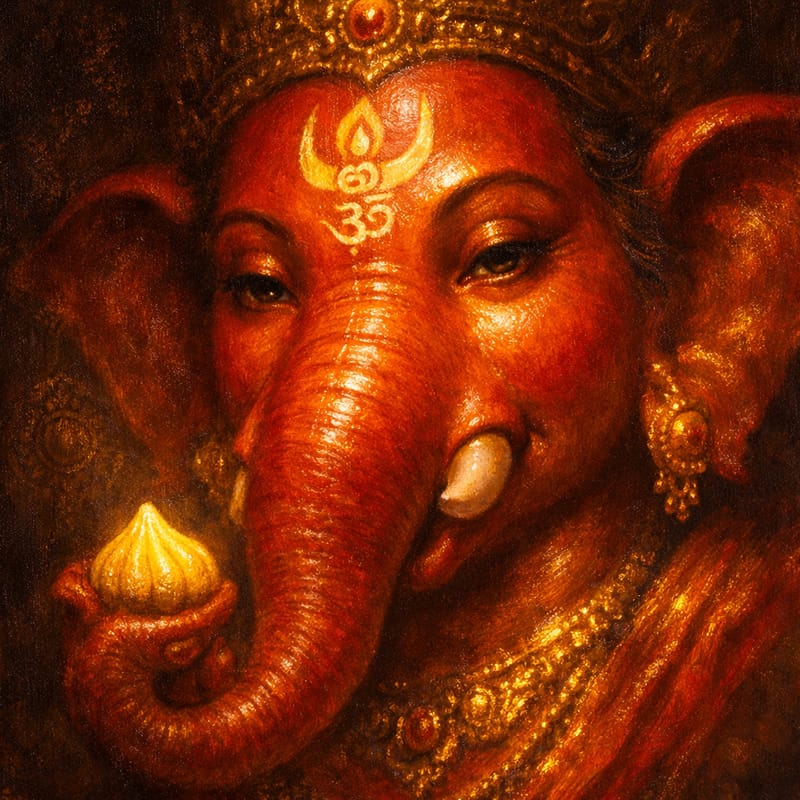
Ganesha Atharvashirsha Mantra — German Lyrics
The Ganesha Atharvashirsha is a sacred Upanishad that declares Lord Ganesha as the supreme reality — the creator, sustainer, and destroyer of the universe. It begins with a Shanti mantra praying for auspiciousness, then systematically reveals Ganesha as identical with Brahman (absolute reality), the source of all creation, beyond the three qualities and three states of being. The text describes Ganesha's mantra form (the syllable "Gam"), contains his Gayatri verse, a meditation verse describing his physical form, and concludes with the benefits it ascribes to reciting this text — from destroying sins to attaining the highest knowledge.
This is not a simple prayer but a philosophical treatise declaring that the elephant-headed deity is the ultimate truth behind all existence.
Curated by The Mahakatha Team · Original Composition: Mahakatha · Lyric: Traditional / Vedic (Atharva Veda)
Chant daily with reminders — Get the Mahakatha app
ॐ भद्रं कर्णेभिः शृणुयाम देवाः । भद्रं पश्येमाक्षभिर्यजत्राः । स्थिरैरङ्गैस्तुष्टुवाग्ँसस्तनूभिः । व्यशेम देवहितं यदायूः ।
om bhadram karnebhih shrinuyama devah | bhadram pashyemakshabhiryajatrah | sthirairangaistushtuvagnsastanubhih | vyashema devahitam yadayuh |
Lieber Gott, mögen unsere Ohren hören, was segensreich ist
Mögen unsere Augen sehen, was segensreich ist.
Mit festen Armen und Körpern preisen und danken wir dir für dieses Leben.
Mögen wir es in Freude verbringen, und mögen unsere Taten dem Göttlichen gefallen.
ॐ स्वस्ति न इन्द्रो वृद्धश्रवाः । स्वस्ति नः पूषा विश्ववेदाः । स्वस्ति नस्तार्क्ष्यो अरिष्टनेमिः । स्वस्ति नो बृहस्पतिर्दधातु ॥ ॐ शान्तिः शान्तिः शान्तिः ॥
om svasti na indro vriddhashravah | svasti nah pusha vishvavedah | svasti nastarkshyo arishtanemih | svasti no brihaspatirdadhatu || om tanmamavatu tad vaktaramavatu avatu mam avatu vaktaram om shantih | shantih || shantih|||
Möge der mächtige Herr Indra uns mit Wohlergehen segnen.
Möge der allwissende Herr Pushana uns mit Wohlergehen segnen.
Möge Herr Tarksya mit den gewaltigen Rädern uns mit Wohlergehen segnen.
Möge derweise Herr Brihaspati uns mit Wohlergehen segnen.
हरि ॐ ||
hari om
नमस्ते गणपतये ॥ त्वमेव प्रत्यक्षं तत्त्वमसि ॥ त्वमेव केवलं कर्तासि ॥ त्वमेव केवलं धर्तासि ॥ त्वमेव केवलं हर्तासि ॥ त्वमेव सर्वं खल्विदं ब्रम्हासि ॥ त्वं साक्षादात्मासि नित्यम् ॥ १ ॥
namaste ganapataye tvameva pratyaksham tattvamasi tvameva kevalam kartasi tvameva kevalam dhartasi tvameva kevalam hartasi tvameva sarvam khalvidam bramhasi tvam sakshadatmasi nityam || 1 ||
Om, ich verneige mich vor dir, O Herr Ganesha.
Du allein verkörperst die höchste Wahrheit.
Du allein bist der Schöpfer.
Du allein bist der Erhalter.
Du allein bist der Zerstörer.
Du bist alles, und alles ist Brahman.
Du bist das ewige Sein. || 1 ||
ऋतं वच्मि ॥ सत्यं वच्मि ॥ २ ॥
ritam vachmi satyam vachmi || 2 ||
Ich spreche die universelle Ordnung.
Ich spreche die Wahrheit. || 2 ||
अव त्वं माम् ॥ अव वक्तारम् ॥ अव श्रोतारम् ॥ अव दातारम् ॥ अव धातारम् ॥ अवानूचानमव शिष्यम् ॥ अव पश्चात्तात् ॥ अव पुरस्तात् ॥ अवोत्तरात्तात् ॥ अव दक्षिणात्तात् ॥ अव चोर्ध्वात्तात् ॥ अवाधरात्तात् ॥ सर्वतो मां पाहि पाहि समंतात् ॥ ३ ॥
ava tvam mam ava vaktaram ava shrotaram ava dataram ava dhataram avanuchanamava shishyam ava pashchattat ava purastat avottarattat ava dakshinattat ava chordhvattat avadharattat sarvato mam pahi pahi samantat || 3 ||
Bitte beschütze mich.
Beschütze den Sprechenden.
Beschütze den Zuhörenden.
Beschütze den Unterstützenden, den Lehrer und den Schüler.
Beschütze uns von hinten.
Beschütze uns von vorne.
Beschütze uns aus dem Norden.
Beschütze uns aus dem Süden.
Beschütze uns von oben.
Beschütze uns von unten.
Beschütze mich aus jeder Richtung gleichermaßen. || 3 ||
त्वं वाग्ड़मयस्त्वं चिन्मयः ॥ त्वं आनंदमयस्त्वं ब्रम्हमयः ॥ त्वं सच्चिदानंदाद्वितीयोसि ॥ त्वं प्रत्यक्षं ब्रम्हासि ॥ त्वं ज्ञानमयो विज्ञानमयोसि ॥ ४ ॥
tvam vangmayastvam chinmayah tvam anandamayastvam bramhamayah tvam sachchidanandadvitiyosi tvam pratyaksham bramhasi tvam jnanamayo vijnanamayosi || 4 ||
Du bist Sprache, Du bist Bewusstsein.
Du bist Freude, Du bist Schöpfung.
Du bist Sein, Bewusstsein, ewige Glückseligkeit.
Du bist Brahman und das, was es erfährt.
Du bist der Inbegriff von Wissen und Wissenschaft. || 4 ||
सर्वं जगदिदं त्वत्तो जायते ॥ सर्वं जगदिदं त्वत्तस्तिष्ठति ॥ सर्वं जगदिदं त्वयि लयमेष्यति ॥ सर्वं जगदिदं त्वयि प्रत्येति ॥ त्वं भूमिरापो नलो निलो नभः ॥ त्वं चत्वारि वाक्पदानि ॥ ५ ॥
sarvam jagadidam tvatto jayate sarvam jagadidam tvattastishthati sarvam jagadidam tvayi layameshyati sarvam jagadidam tvayi pratyeti tvam bhumirapo nalo nilo nabhah tvam chatvari vakpadani || 5 ||
Das gesamte Universum entspringt aus Dir.
Das gesamte Universum besteht in Dir.
Das gesamte Universum wird sich in Dir auflösen.
Du bist Erde, Wasser, Feuer, Luft und Raum.
Das gesamte Universum kehrt in Dich zurück.
Du bist die vier Arten der Sprache. || 5 ||
त्वं गुणत्रयातीतः ॥ त्वमवस्थात्रयातीतः || त्वं देहत्रयातीतः ॥ त्वं कालत्रयातीतः ॥ त्वं मूलाधारः स्थितोसि नित्यम॥ त्वं शक्ति त्रयात्मकः ॥ त्वां योगिनो ध्यायन्ती नित्यम ॥
tvam gunatrayatitah tvam avasthatrayatitah tvam dehatrayatitah tvam kalatrayatitah tvam muladhara: sthitosi nityam tvam shakti trayatmakah tvam yogino dhyayanti nityam
Du bist über den drei Eigenschaften der Natur erhaben.
Du bist über den drei Bewusstseinszuständen erhaben.
Du bist über den drei Daseinsformen erhaben.
Du bist über den drei Zeitperioden erhaben.
Du thronst im Muladhara-Chakra.
Du bist die drei göttlichen Kräfte.
Du bist das Objekt der ewigen Meditation der Yogis.
त्वं ब्रम्हास्त्वंविष्णुस्त्वंरुद्रस्त्वंइंद्रस्त्वंअग्निस्त्वंवायुस्त्वंसूर्यस्त्वंचंद्रमास्त्वं ब्रम्हभूर्भुवस्वरोम् ॥ ६ ॥
tvam bramha tvamvishnustvamrudrastvamindrastvamagnistvamvayustvamsuryastvamchandramastvam bramhabhurbhuvasvarom || 6 ||
Du bist Brahma, Vishnu, Rudra, Indra, Feuer, Luft, Sonne, Mond und die Essenz der drei Welten. || 6 ||
गणादिं पूर्वमुच्चार्यं वर्णादिं तदनंतरम् ॥ अनुस्वारः परतरः ॥ अर्धेंदुलसितम् ॥ तारेण ऋध्दम् ॥ एतत्तव मनुस्वरुपम् ॥ गकारः पूर्वरुपम् ॥ अकारो मध्यमरुपम् ॥ अनुस्वारश्चान्त्यरुपम् ॥ बिन्दुरुत्तररुपम् ॥ नादःसंधानम् ॥ संहितासंधीः ॥ सैषा गणेश विद्या ॥ गणकऋषिः निछॄद् गायत्री छंदः ॥ गणपतीर्देवता ॥ ॐ गं गणपतये नमः ॥ ७ ॥
ganadim purvamuchcharyam varnadim tadanantaram anusvarah paratarah ardhendulasitam tarena ridhdam etattava manusvarupam gakarah purvarupam akaro madhyamarupam anusvarashchantyarupam binduruttararupam nadahsandhanam samhitasandhi: saisha ganesha vidya ganakarishi: nichhrid gayatri chhandah ganapatirdevata om gam ganapataye namah || 7 ||
Zuerst sprich den Laut 'G' aus, dann den Vokal 'a.'
Der nasale Klangpunkt (Anusvara) ist bedeutsam.
Füge dem Punkt eine Halbmondform hinzu, um ihm seinen vollen Nasalklang zu verleihen.
Verstärke ihn mit dem 'Tara'-Klang, dem Klang des Om.
Dies ist Deine Form, Deine Mantra-Swarupa, ausgedrückt in Klang.
'Ga' ist Deine erste Form, 'A' ist Deine mittlere Form.
Der Punkt ist Deine obere Form.
Diese werden durch Klang verbunden.
Diese Zusammensetzung von Klängen ist die Weisheit Ganeshas.
Der Weise ist Weise Ganaka, das Versmaß ist Nichrud Gayatri.
Die Gottheit ist Lord Ganesha.
Mit dem Klang 'Gam' verneigen wir uns vor Lord Ganesha. || 7 ||
एकदंताय विद्महे वक्रतुंडाय धीमहि ॥ तन्नो दंतिः प्रचोदयात् ॥ ८ ॥
ekadantaya vidmahe vakratundaya dhimahi tanno danti: prachodayat || 8 ||
Ich meditiere über den einzahnigen Ganesha
Ich visualisiere den mit dem gebogenen Rüssel
Möge er mich erleuchten. || 8 ||
एकदंतं चतुर्हस्तं पाशमंकुशधारिणम् ॥ रदं च वरदं हस्तै बिभ्राणं मूषकध्वजम् ॥ रक्तं लंबोदरं शूर्पकर्णकं रक्तवाससम् ॥ रक्तगंधानुलिप्तांगं रक्तपुष्पैः सुपूजितम् ॥ भक्तानुकंपिनं देवं जगत्कारणमच्युतम् ॥ आविर्भूतं च सृष्ट्यादो प्रकॄतेः पुरुषात्परम् ॥ एवं ध्यायति यो नित्यम् स योगी योगिनां वरः ॥ ९ ॥
ekadantam chaturhastam pashamankushadharinam radam cha varadam hastai bibhranam mushakadhvajam raktam lambodaram shurpakarnakam raktavasasam raktagandhanuliptangam raktapushpai: supujitam bhaktanukampina devam jagatkaranamachyutam avirbhutam cha srishtyado prakrite: purushatparam evam dhyayati yo nityam sa yogi yoginam varah || 9 ||
Der Herr mit einem Stoßzahn und vier Händen
Eine Schlinge und einen Elefantenstachel haltend
Seinen Stoßzahn als Symbol des Segens haltend
Eine Fahne tragend, die eine Maus zeigt
Seine Farbe ist tiefrot, sein Bauch ist gewaltig
Seine Ohren sind groß, und er ist in tiefes Rot gehüllt
Sein Körper ist mit roter Sandelholzpaste eingerieben
Er wird mit roten Blumen verehrt.
Der Gott, der Mitgefühl schenkt
Die unvergängliche Ursache des Universums
Der Anfang aller Schöpfung
Jenseits aller Natur und allen Bewusstseins
Derjenige, der ihn verehrt, ist der gesegnetste aller Yogis. || 9 ||
नमो व्रातपतये । नमो गणपतये । नमः प्रमथपतये । नमस्ते अस्तु लंबोदराय एकदंताय ॥ विघ्ननाशिने शिवसुताय ॥ श्री वरदमूर्तये नमः ॥ १० ॥
namo vratapataye namo ganapataye namah pramathapataye namaste astu lambodaraya ekadantaya vighnanashine shivasutaya shri varadamurtaye namah || 10 ||
Ehrerbietung dem Herrn aller Wesen,
Ehrerbietung dem Herrn der Halbgötter,
Ehrerbietung dem Herrn der Geister,
Ehrerbietung Dir, O Großbäuchiger, O Einzahniger, O Beseitiger der Hindernisse, O Sohn Shivas.
Ehrerbietung, immer wieder, dem Gewährer von Gaben und Segen. || 10 ||
एतदथर्वशीर्षं योऽधीते स ब्रह्मभूयाय कल्पते । स सर्वविघ्नैर्न बाध्यते । स सर्वत्र सुखमेधते । स पञ्चमहापापात्प्रमुच्यते ।
etadatharvashirsham yo'dhite sa brahmabhuyaya kalpate sa sarvavighnairna badhyate sa sarvatra sukhamedhate sa panchamahapapatpramuchyate
Wer das Atharvashirsha liest, wird würdig, die Wahrheit zu erlangen,
Er ist frei von Hindernissen und empfängt Glück aus allen Richtungen.
सायमधीयानो दिवसकृतं पापं नाशयति । प्रातरधीयानो रात्रिकृतं पापं नाशयति । सायं प्रातः प्रयुञ्जानो अपापो भवति । सर्वत्राधीयानोऽपविघ्नो भवति । धर्मार्थकाममोक्षं च विन्दति ॥
sayamadhiyano divasakritam papam nashayati prataradhiyano ratrikritam papam nashayati sayam pratah prayunjano papo'papo bhavati sarvatradhiyano'pavighno bhavati dharmarthakamamoksham cha vindati
Das Rezitieren am Abend wäscht die Sünden des Tages weg.
Das Rezitieren am Morgen wäscht die Sünden der Nacht weg.
Das Rezitieren zu beiden Zeiten führt das Leben weg von der Sünde.
Wer dies überall rezitiert, ist frei von Hindernissen.
Sie empfangen die Gaben der Rechtschaffenheit, des Wohlstands, der Freude und der Erlösung. || 11 ||
इदमथर्वशीर्षमशिष्याय न देयम् । यो यदि मोहाद्दास्यति स पापीयान् भवति । सहस्रावर्तनाद्यं यं काममधीते तं तमनेन साधयेत् ॥११॥
idamatharvashirshamashishyaya na deyam yo yadi mohaddasyati sa papiyan bhavati sahasravartanadyam yam kamamadhite tam tamanena sadhayet ||11||
Dieses Atharvasirsha sollte nicht jenen gegeben werden, die nicht spirituell bereit sind
Es so zu geben, wird als sündhaft betrachtet.
Wenn dieser Text mit tiefer und aufrichtiger Hingabe rezitiert wird, werden alle Wünsche erfüllt.
अनेन गणपतिमभिषिञ्चति स वाग्मी भवति । चतुर्थ्यामनश्नन् जपति स विद्यावान् भवति । इत्यथर्वणवाक्यम् । ब्रह्माद्यावरणं विद्यान्न बिभेति कदाचनेति ॥१२॥
anena ganapatimabhishinchati sa vagmi bhavati chaturthyamanashnan japati sa vidyavan bhavati ityatharvanavakyam brahmadyavaranam vidyanna bibheti kadachaneti ||12||
Wer dieses Ritual Herrn Ganesha darbringt, wird mit Beredsamkeit gesegnet.
Wer dies rezitiert und an Chaturthi fastet, wird mit Wissen gesegnet.
Dies ist das göttliche Wort des Rishi Atharvana
Wer dies praktiziert, erlangt wahres Wissen über das Universum und wird von Furcht befreit. || 12 ||
यो दूर्वाङ्कुरैर्यजति स वैश्रवणोपमो भवति । यो लाजैर्यजति स यशोवान् भवति । स मेधावान् भवति । यो मोदकसहस्रेण यजति स वाञ्छितफलमवाप्नोति । यः साज्यसमिद्भिर्यजति स सर्वं लभते स सर्वं लभते ॥१३॥
yo durvankurairyajati sa vaishravanopamo bhavati yo lajairyajati sa yashovan bhavati sa medhavan bhavati yo modakasahasrena yajati sa vanchhitaphalamavapnoti yassajyasamidbhiryajati sa sarvam labhate sa sarvam labhate ||13||
Wer Herrn Ganesha zartes Durva-Gras darbringt, wird so wohlhabend wie Kubera
Wer Ihm Reis darbringt, wird Ruhm und geistige Stärke erlangen
Wer Ihm tausend Modaks darbringt, wird das gewünschte Ergebnis erlangen
Wer Ihm in Ghee getauchte Zweige darbringt, wird alles erlangen, er wird alles erlangen! || 13 ||
अष्टौ ब्राह्मणान् सम्यग् ग्राहयित्वा सूर्यवर्चस्वी भवति । सूर्यग्रहेमहानद्यां प्रतिमासन्निधौ वा जप्त्वा सिद्धमन्त्रो भवति महाविघ्नात् प्रमुच्यते । महादोषात् प्रमुच्यते । महापापात् प्रमुच्यते । स सर्वविद् भवति स सर्वविद् भवति । य एवं वेद । इत्युपनिषत् ॥
ashtau brahmanan samyag grahayitva suryavarchasvi bhavati suryagrahemahanadyam pratimasannidhau va japtva siddhamantro bhavati mahavighnat pramuchyate mahadoshat pramuchyate mahapaprat pramuchyate sa sarvavid bhavati sa sarvavid bhavati ya evam veda ityupanishat
Wer dieses Mantra mit acht Brahmanen rezitiert, wird so strahlend wie die Sonne,
Wer es während der Sonnenfinsternis rezitiert, erreicht tieferes Bewusstsein
Sie werden von Hindernissen befreit
Sie werden von Lastern befreit
Sie werden von Sünden befreit
Sie empfangen ultimatives Wissen
Dies ist die Aussage der Veda.
So endet die Upanishad. ||
ॐ सहनाववतु सह नौ भुनक्तु सह वीर्यं करवावहै तेजस्वि नावधीतमस्तु मा विद्विषावहै ॐ शान्तिश्शान्तिश्शान्तिः ॥
om saha navavatu | saha nau bhunaktu | saha viryam karavavahai | tejasvi navadhitamastu ma vidvishavahai | om shantih shantih shantih ||
Frieden, Frieden, Frieden.
How to Chant Ganesha Atharvashirsha Mantra
- 1
Prepare the Space
Place a Ganesha murti or image on a clean surface. Offer Durva grass (21 blades), modaks or sweets, and red flowers. Light a ghee lamp and incense. Sit comfortably facing east or north.
- 2
Begin with Shanti Mantra
Start with "Om Bhadram Karnebhih Shrinuyama Devah" — the opening peace invocation. This prayer for auspiciousness in hearing, seeing, and living sets the sacred space for the recitation.
- 3
Recite with Understanding
Move through each section slowly. The Atharvashirsha is a philosophical text — it is meant to be contemplated, not rushed through. Pause at each verse number and let the meaning sink in before continuing.
- 4
Chant Om Gam Ganapataye Namah
When you reach verse 7, chant "Om Gam Ganapataye Namah" three times separately. This is Ganesha's bija mantra, and the Atharvashirsha has just revealed how it was constructed from his very essence.
- 5
Close with Triple Shanti
End with "Om Shantih Shantih Shantih" — peace for body, mind, and spirit. Sit in silence for 2-3 minutes. The post-recitation silence is when the text's transformative power integrates into your consciousness.
Benefits of Ganesha Atharvashirsha Mantra
-
Chanted to ask for obstacles and barriers to be cleared in all endeavors, for smooth progress toward goals
Source: Ganesha Atharvashirsha: 'sa sarvatra vighnairna badhyate' (protected from all obstacles)
-
Grants wisdom, intellectual clarity, and mastery of knowledge; enhances memory and learning capacity
Source: Ganesha Atharvashirsha, Verse 12: 'chaturthyamanashnan japati sa vidyavan bhavati' (becomes learned through dedicated practice)
-
Invokes divine protection from all directions and from spiritual harm, as the text itself asks
Source: Ganesha Atharvashirsha, Verse 3: 'sarvato mam pahi pahi samantat' (protect me from all directions)
-
A prayer for prosperity, abundance, and auspicious timing, and for good outcomes and fulfillment
Source: Ganesha Atharvashirsha, Verse 12: 'yo modakasahasrena yajati sa vanchhitaphalamavapnoti' (obtains desired fruits)
-
Traditionally believed to purify past wrongs and their effects; devotees chant it to ask forgiveness and freedom from sin
Source: Ganesha Atharvashirsha, Verse 11: 'sa panchamahapapatpramuchyate' (freed from great sins)
-
Develops eloquence, right speech, and persuasive communication; enhances vocal and written expression
Source: Ganesha Atharvashirsha, Verse 12: 'anena ganapatimabhishinchati sa vagmi bhavati' (becomes eloquent)
-
Facilitates spiritual awakening and direct experience of Brahman; leads to liberation and self-realization
Source: Ganesha Atharvashirsha, Verse 11: 'yo'dhite sa brahmabhuyaya kalpate' (becomes fit for Brahman)
-
Purifies the mind from negative patterns; dissolves mental obstacles and anxiety
Source: Traditional practice: Daily recitation purifies the antahkarana (inner instrument)
Story & Symbolism
The Ganesha Atharvashirsha belongs to the Atharvaveda, the fourth Veda, and is classified as a minor Upanishad — a philosophical text that reveals the nature of ultimate reality. Unlike devotional hymns, Upanishads are instruments of knowledge (upa = near, ni = down, shad = sit — "sitting near the teacher to receive wisdom"). This text sits the devotee near Ganesha to receive the highest truth: that Ganesha IS the absolute reality.
The text is structured as a systematic philosophical argument. It begins with a Shanti mantra, then declares Ganesha identical with Brahman (verses 1-2), asks for his protection from all directions (verse 3), describes his nature as consciousness and bliss (verses 4-5), identifies him with all gods and cosmic elements (verse 6), reveals his mantra form (verse 7), provides his Gayatri verse (verse 8), describes his meditation form (verse 9), offers salutations (verse 10), and concludes with the benefits and rules of recitation (verses 11-13).
The Ganapatya sect — worshippers who consider Ganesha the supreme deity — regard this text as their primary scripture. Even within the broader Hindu tradition, the Atharvashirsha holds a special place because it bridges the gap between popular devotion (Ganesha as the friendly obstacle-remover) and the highest philosophy (Ganesha as Brahman, the absolute truth). It is recited millions of times during Ganesh Chaturthi celebrations across India.
How to Use in Daily Life
Morning-Evening Recitation
Recite the complete Atharvashirsha once in the morning and once in the evening. The text itself promises that morning recitation destroys sins of the night, and evening recitation destroys sins of the day.
Chaturthi Observance
On Ganesh Chaturthi (4th day of each lunar fortnight, twice monthly), recite the Atharvashirsha while fasting. Verse 12 specifically states that fasting and chanting on Chaturthi brings knowledge and eloquence.
Durva Grass Offering
Offer 21 blades of Durva grass to a Ganesha image while reciting. Verse 13 promises that one who offers Durva becomes as prosperous as Kubera, the god of wealth. Durva grass is Ganesha's most beloved offering.
Deep Study Practice
Once a week, read the Atharvashirsha slowly with its meaning, contemplating each philosophical declaration. This is not just recitation but "adhyayana" (study) — the deeper practice that leads to "sarvavid" (complete knowledge) as promised in the text.