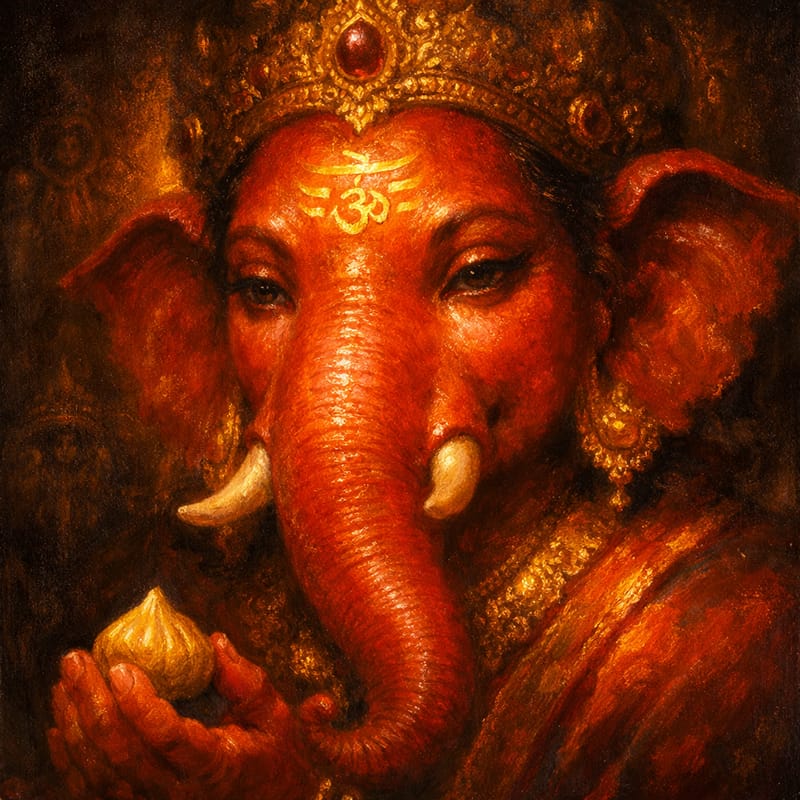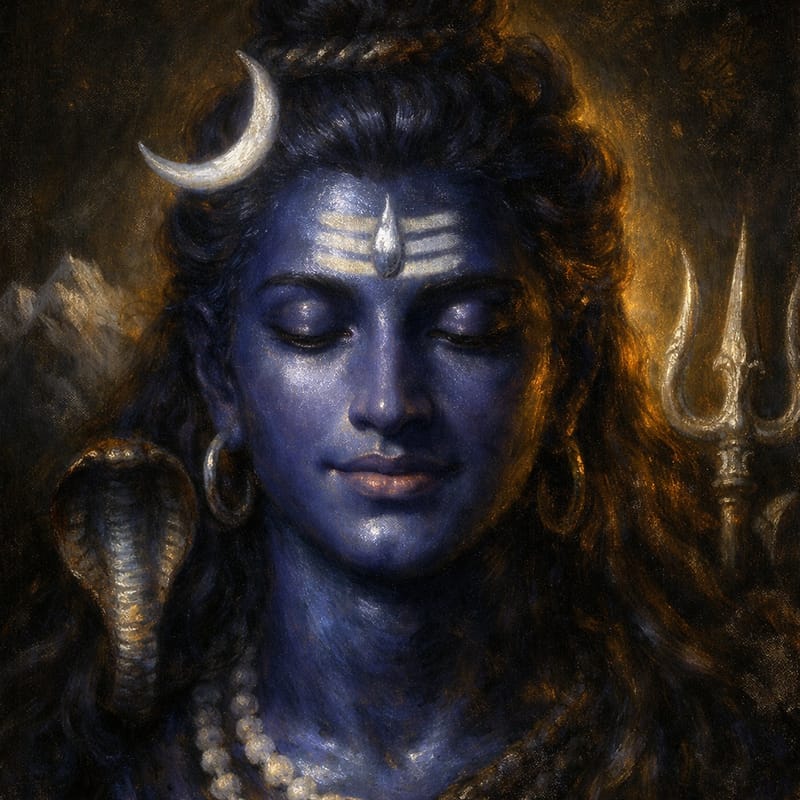


Lord Ganesha is the elephant-headed god of beginnings in Hindu tradition. He is the son of Shiva and Parvati. Devotees call on him first before any new task. They know him as the lord of obstacles and the patron of learning. His big ears and gentle trunk invite us to listen and go slowly.
Names of Lord Ganesha and what they mean
Ganesha has many names. Tradition gives him 108 and some lists give a thousand. Each one shows a side of his nature.
Ganesha and Ganapati
Both mean lord of the ganas. The ganas are the band of beings who follow Shiva. So the name says he leads them all.
Vinayaka
Often read as the great leader. It is the name most used in the South.
Vighneshvara
The lord of obstacles. Vighna means an obstacle. Devotees believe he can place obstacles and also clear them from our path.
Ekadanta
The one with a single tusk. The other tusk was broken in a story told in many ways.
Vakratunda
The one with the curved trunk. It is the first word of one of his best-loved verses.
Lambodara
The one with a large belly. Tradition says the whole world rests inside it.
Pillaiyar
His Tamil name. It means the noble child.
Ganpati Bappa
In Marathi Bappa means father. In Maharashtra crowds call to him with love as Ganpati Bappa Morya.
Stories of Lord Ganesha
Ganesha's stories are playful and wise. A Purana is an old book of sacred stories. His tales change from one Purana to another. Each version keeps a lesson worth hearing.
How he got his elephant head
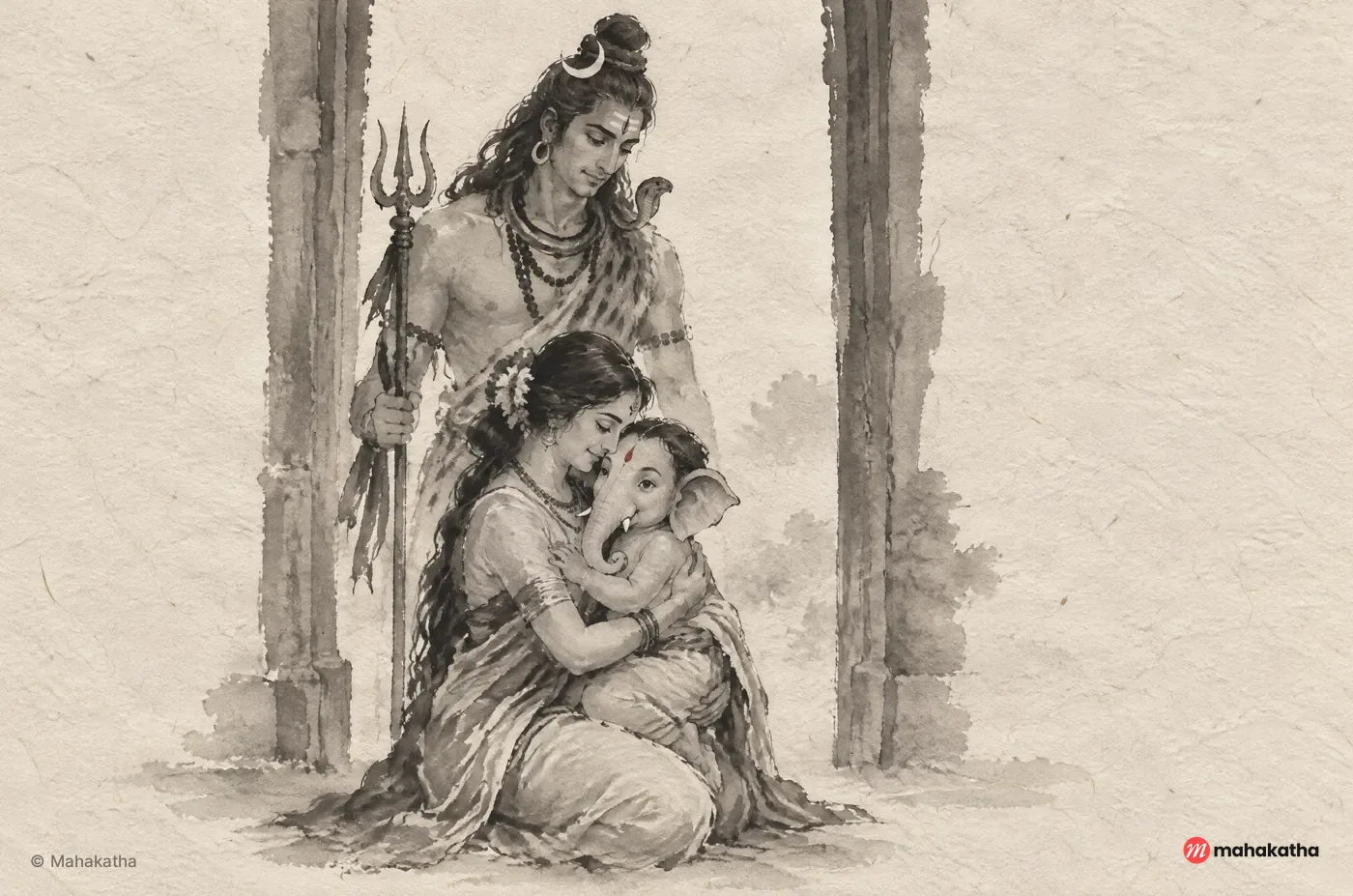
The story says Parvati shaped a boy from the turmeric paste on her skin. She asked him to guard her door while she bathed. Shiva came home and the boy would not let him in. In anger Shiva cut off his head. Parvati's grief was so great that Shiva vowed to restore the child. He placed the head of an elephant on the boy's body. Then he made him leader of the ganas.
Another telling
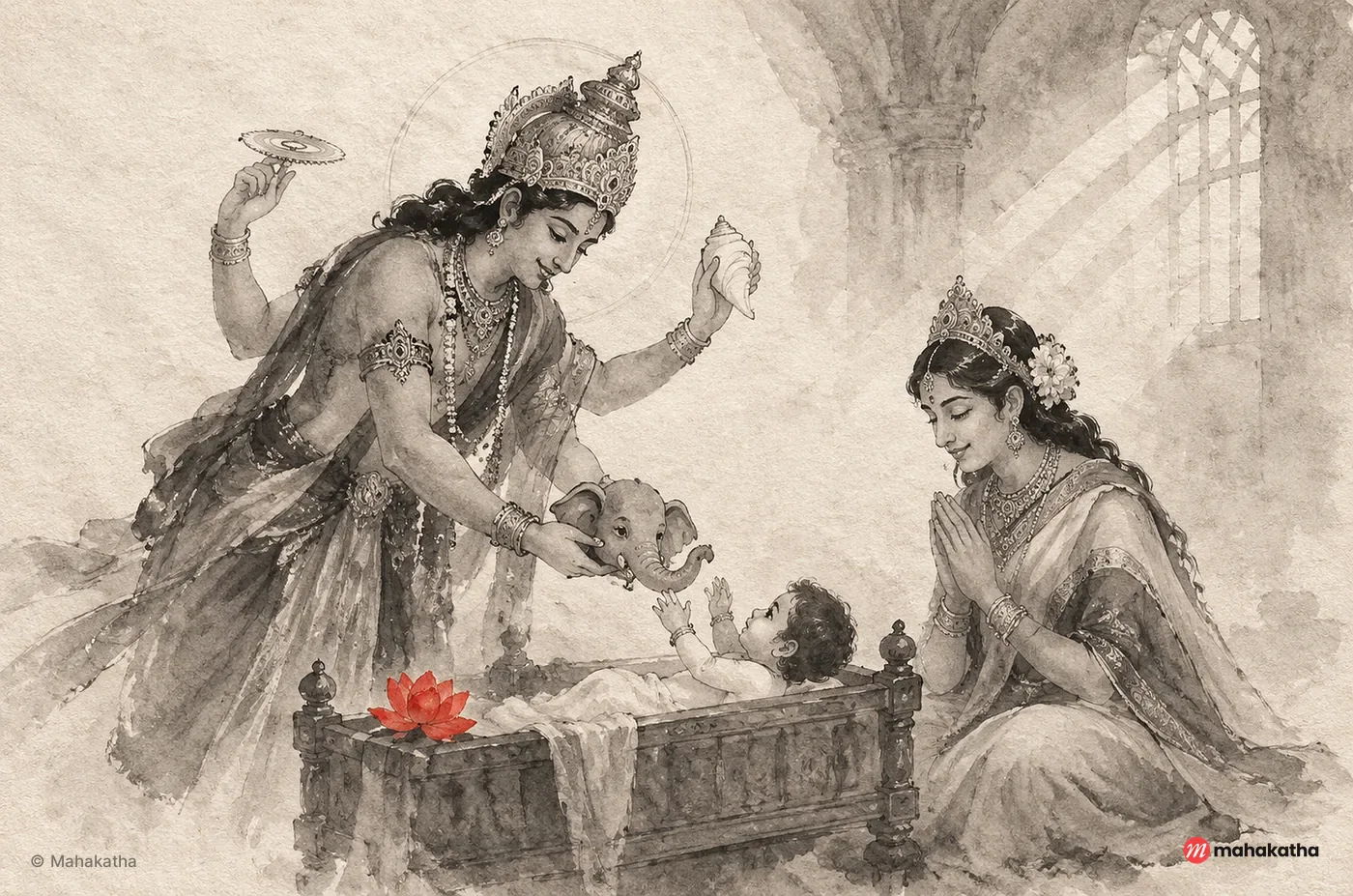
In the Brahma Vaivarta Purana the head is lost another way. The god Shani was asked to look at the newborn child. Shani's gaze was said to cause harm. The baby's head fell away. Vishnu brought back the head of an elephant. Both stories end in the same place. A child who was lost becomes the god who is worshipped first.
Around the world
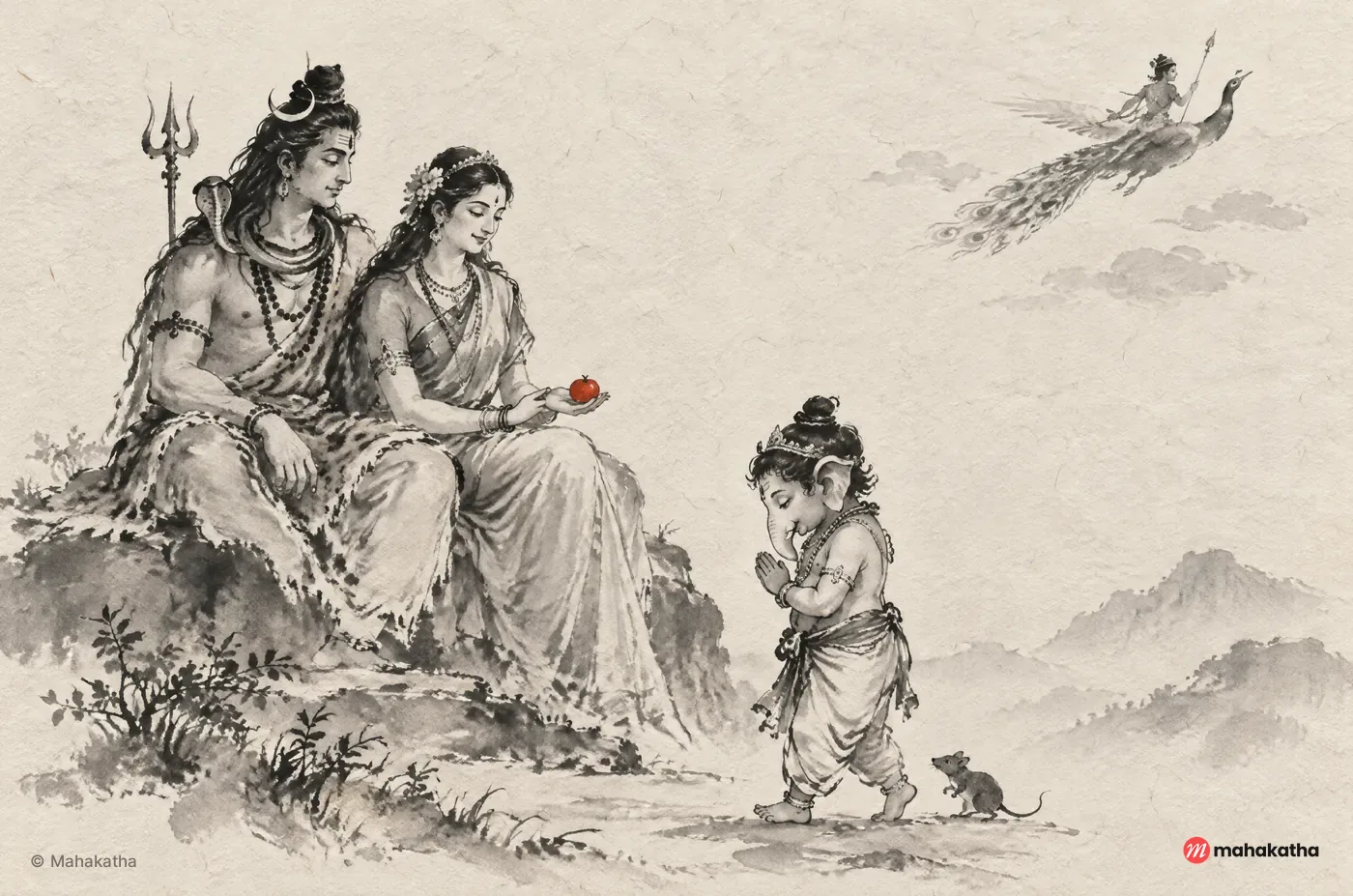
The story says Shiva and Parvati once offered a fruit to whichever son first went around the world. His brother Kartikeya set off at once on his peacock. Ganesha simply walked around his parents. He said they were his whole world. He won the fruit. In Tamil Nadu they say the hurt Kartikeya went to live on the hill of Palani.
The broken tusk
Tradition holds that the sage Vyasa needed a scribe for the Mahabharata. Ganesha agreed if Vyasa would never pause. Vyasa asked in turn that Ganesha understand every verse before he wrote it. When his pen broke Ganesha snapped off his own tusk and kept writing. Other stories say the tusk broke in a fight. Either way it is a sign of giving for the sake of learning.
The moon who laughed
The story says that one night Ganesha rode home on his mouse after a great feast. The mouse tripped on a snake and Ganesha tumbled. The moon saw and laughed. Ganesha cursed the moon. Many still avoid looking at the moon on the night of Ganesh Chaturthi. The story is a gentle warning about mocking others.
How the worship of Ganesha grew
Ganesha's worship grew slowly and then spread everywhere. Scholars still debate many details. These are the broad steps.
The Vedic hymns
The Rig Veda has a hymn that calls on Ganapati, the lord of hosts. It was first sung to Brahmanaspati, the lord of prayer. Later devotees took the same words for Ganesha. It is still chanted at the start of rituals.
Early images
The elephant-headed Ganesha appears clearly in art from around the 4th and 5th centuries. This was the time of the Gupta kings. Some early images show him holding a bowl of sweets.
The Puranas
Many Puranas tell his stories. Two are given to him alone. They are the Ganesha Purana and the Mudgala Purana. Scholars place them in later medieval times. A tradition called the Ganapatya grew up around them. It worships Ganesha as the highest god.
Temples in stone
Ganesha shrines began to stand at the doors of other temples. He guards the way in. In Maharashtra the eight Ashtavinayak temples became a famous pilgrimage. The Peshwa rulers of Pune were great devotees in the 18th century.
The bhakti poets
Bhakti means loving devotion to God. In Maharashtra the saint poets sang of Ganesha. Tradition credits the aarti Sukhakarta Dukhaharta to Samarth Ramdas in the 17th century. An aarti is a song sung while a lamp is waved. In the South many Carnatic music concerts still open with a song to Ganesha.
Today
In the 1890s Lokmanya Tilak turned Ganesh Chaturthi into a great public festival in Pune. It brought people together during the freedom movement. Today it fills whole cities with music. Many families now choose clay images that melt gently into water.
Lord Ganesha across India
Ganesha belongs to everyone. But each region greets him in its own way.
West
Maharashtra is Ganesha's heartland. Huge public images rise in Mumbai and Pune for Ganesh Chaturthi. At the end crowds carry him to the sea or river with songs. They shout Ganpati Bappa Morya and ask him to come early next year.
South
In Tamil Nadu small Pillaiyar shrines sit under peepal trees and at street corners. In Kerala many temples begin the day with a Ganapati homa. Homa means a fire offering. In Andhra Pradesh and Telangana his festival is Vinayaka Chavithi.
North
In the North Ganesha is honoured beside Lakshmi at Diwali. He is the first guest invited to a wedding. In Rajasthan many families send wedding cards to the Ranthambore Ganesh temple. Many homes paint him above the front door.
East
In Bengal Ganesha stands beside his mother Durga during Durga Puja. Next to him is a banana plant dressed as a bride called Kola Bou. At Puri in Odisha Lord Jagannath takes a yearly ritual bath. That same evening he is dressed as Ganesha in an elephant form.
Beyond India
Ganesha travelled far with traders and monks. In Japan he is known as Kangiten. In Thailand Phra Phikanet is honoured as a patron of the arts. Old Ganesha images are found across Java and Bali.
Ganesha temples across India
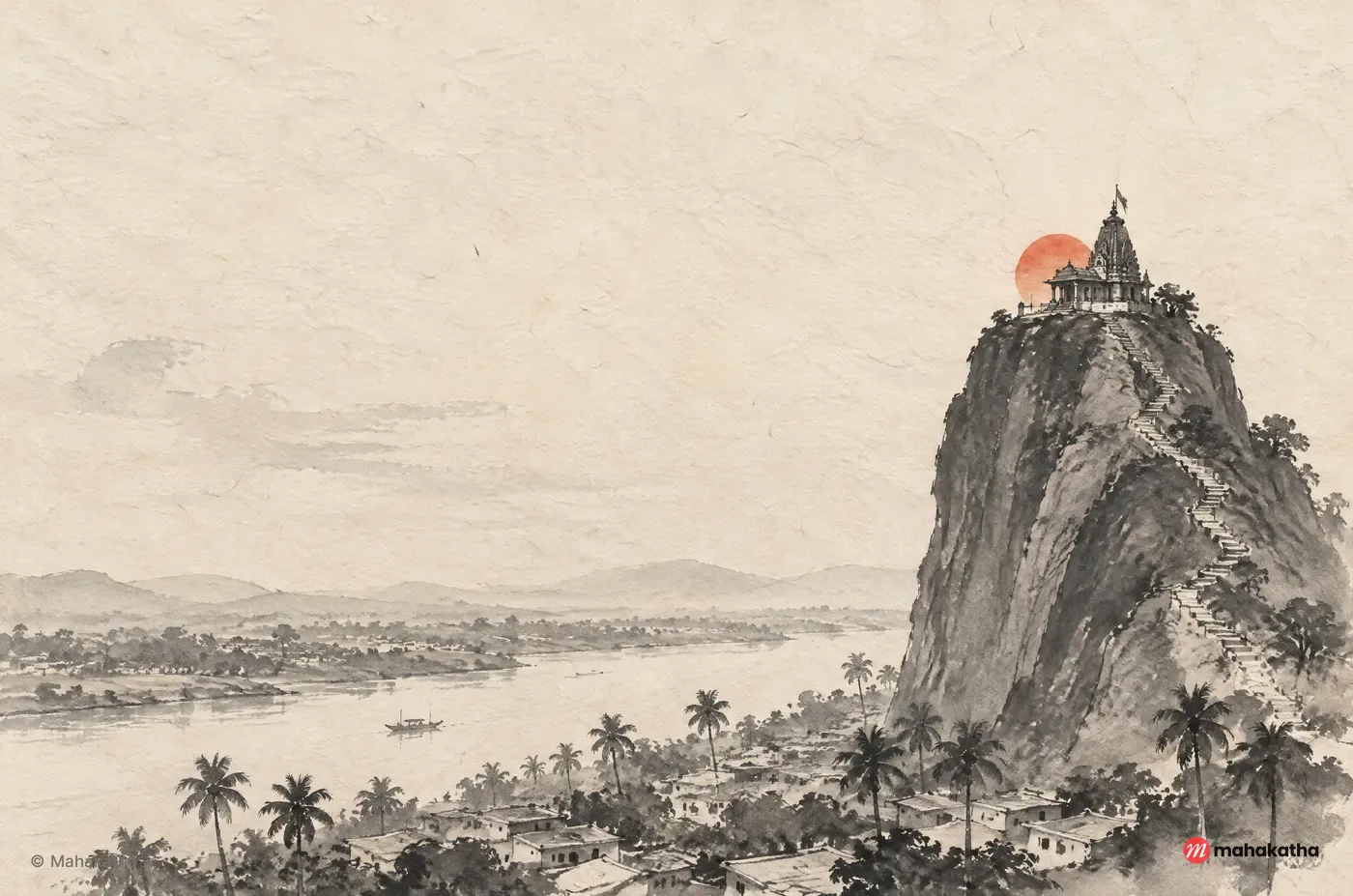
There are Ganesha shrines everywhere. These temples draw the largest crowds and the deepest love.
Siddhivinayak Temple, Mumbai (Maharashtra)
One of the busiest temples in Mumbai. People of every background come here before a new venture.
Shrimant Dagdusheth Halwai Ganpati Temple, Pune (Maharashtra)
A much-loved city temple. Its golden image is at the heart of Pune's Ganesh festival.
Mayureshwar Temple, Morgaon (Maharashtra)
The first of the eight Ashtavinayak temples. Pilgrims usually begin and end the circuit here.
Ucchi Pillayar Temple, Tiruchirappalli (Tamil Nadu)
It sits on top of the Rock Fort high above the city. Pilgrims climb hundreds of rock-cut steps to reach it.
Karpaga Vinayagar Temple, Pillaiyarpatti (Tamil Nadu)
A cave temple with an old rock-cut image of Ganesha. Here his trunk curls to the right. That is why locals call him Valampuri Vinayagar.
Varasiddhi Vinayaka Temple, Kanipakam (Andhra Pradesh)
A famous temple near Chittoor. People have long come here to take solemn oaths of truth before the deity.
Trinetra Ganesh Temple, Ranthambore (Rajasthan)
It stands inside the old Ranthambore fort. Here Ganesha is shown with three eyes. Families post wedding invitations to him.
Moti Dungri Ganesh Temple, Jaipur (Rajasthan)
A small hill temple in the heart of Jaipur. New vehicles are often brought here for a blessing.
Madhur Temple, Madhur (Kerala)
A temple near Kasaragod. It is dedicated to Shiva but Ganesha draws most devotees. It is known for the Moodappam offering. In this rite the image is covered in sweet appam.
Symbols of Lord Ganesha and their meaning
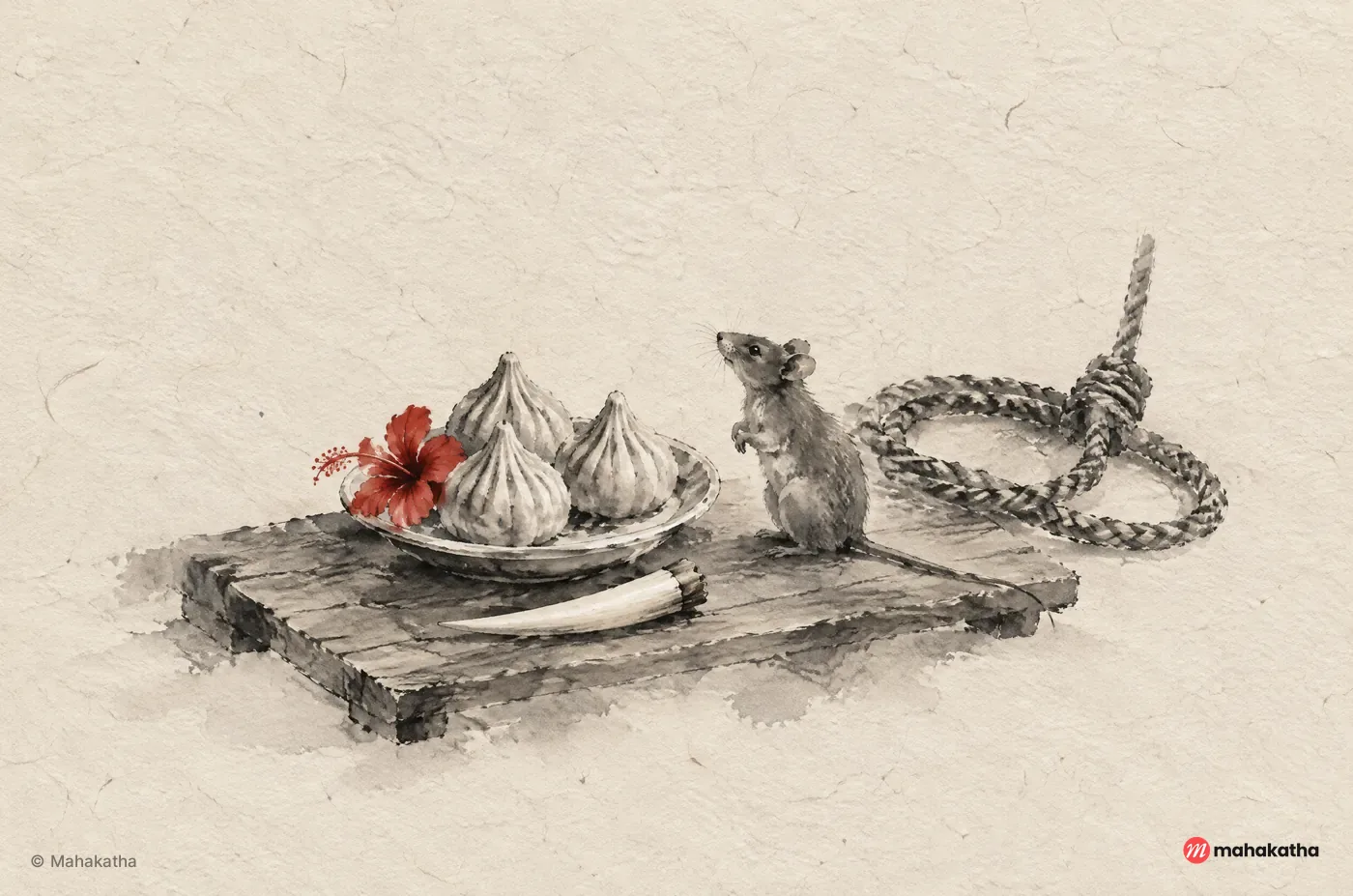
Every part of Ganesha's form teaches something. Children love his shape. Elders find depth in it.
The elephant head
The elephant is wise and gentle and strong. It clears a path through thick forest. The head reminds us to think big and move with care.
The large ears
Big ears to listen well. They remind us to hear more than we speak.
The curved trunk
The trunk can lift a tree or pick up a single grain. It shows strength that can also be gentle.
The single tusk
One tusk is whole and one is broken. Life is rarely perfect. We can still offer what we have.
The big belly
Tradition says the universe rests within it. It can mean taking in the sweet and the bitter of life with calm.
The mouse
His vehicle is a tiny mouse called Mushika. A mouse slips into every corner. It can stand for the restless mind that Ganesha guides.
The modak
A modak is a sweet dumpling he loves. It stands for the sweetness that comes from inner effort.
The goad and the noose
In his hands he holds a goad and a noose. The goad urges us forward. The noose draws us close to what matters.
Ganesha mantras and shlokas
A mantra is a sacred sound or verse that you repeat with feeling. Most worship begins with a word to Ganesha. These verses are a gentle way to start your day or a new task. Each one links to our page with the full words and meaning.
Vakratunda Mahakaya
It opens with "Vakratunda Mahakaya". It praises the curved trunk and great body of the lord. Then it asks him to keep our work free of obstacles. Many say it before starting anything new.
Ganesha Gayatri Mantra
"Aum Ekadantaaya Vidmahe" begins this prayer to the single-tusked lord. It asks him to guide the mind toward wisdom.
Om Ganaanaam Tvaa
"Om Ganaanaam Tvaa Ganapatim Havaamahe" comes from the Rig Veda. It is often chanted at the opening of big rituals.
Ganesha Atharvashirsha
A hymn of inner wisdom in praise of Ganesha. Our page opens with the peace verse "om bhadram karnebhih shrinuyama devah". It asks that our ears hear only what is good.
Ganesha Beeja Mantra
The seed sound "Gam". A beeja is a one-syllable seed mantra. Many repeat it quietly with the breath.
Om Shree Ganeshaaya Namah
"Om Shree Ganeshaaya Namah" simply means I bow to Lord Ganesha. Children often learn it first.
Pranamya Shirasa Devam
This verse bows to "Gauriputram Vinayakam". Gauri is another name for Parvati. So it honours Ganesha as her son.
Sukhakarta Dukhaharta
The best-loved Marathi aarti. It opens "sukhakarta dukhaharta varta vighnachi". It calls him the giver of joy who takes away sorrow.
Festivals of Lord Ganesha
Ganesha's festivals are joyful and loud. They are full of sweets and music.
Ganesh Chaturthi
His great birthday festival. Chaturthi is the fourth day of the moon. Families bring home a clay image and worship it for a few days. Then it is carried to water with songs.
Vinayaka Chavithi
The same festival in Andhra Pradesh and Telangana. Families offer many kinds of sacred leaves.
Gowri Ganesha
In Karnataka women first honour his mother Gowri. Ganesha is welcomed the next day.
Sankashti Chaturthi
A monthly fast on the fourth day after the full moon. Devotees break the fast after the moon rises. When it falls on a Tuesday it is called Angaraki.
Diwali
Homes worship Ganesha and Lakshmi together on the night of Lakshmi Puja. He is honoured first.
Simple ways to remember Ganesha each day
Begin with him
Before a new task say "Om Shree Ganeshaaya Namah" once. It is a small pause that gathers the mind.
Offer something sweet
A modak or a piece of jaggery is a simple offering. Share it with others afterwards.
Offer durva grass
Durva is a sacred grass loved by Ganesha. A few blades with a flower are enough.
Listen first
Remember his big ears. In one talk today try to listen more than you speak.
Sing the aarti
In the evening light a lamp and sing Jai Ganesh Jai Ganesh Deva. Children love its simple tune.
What Lord Ganesha can teach us
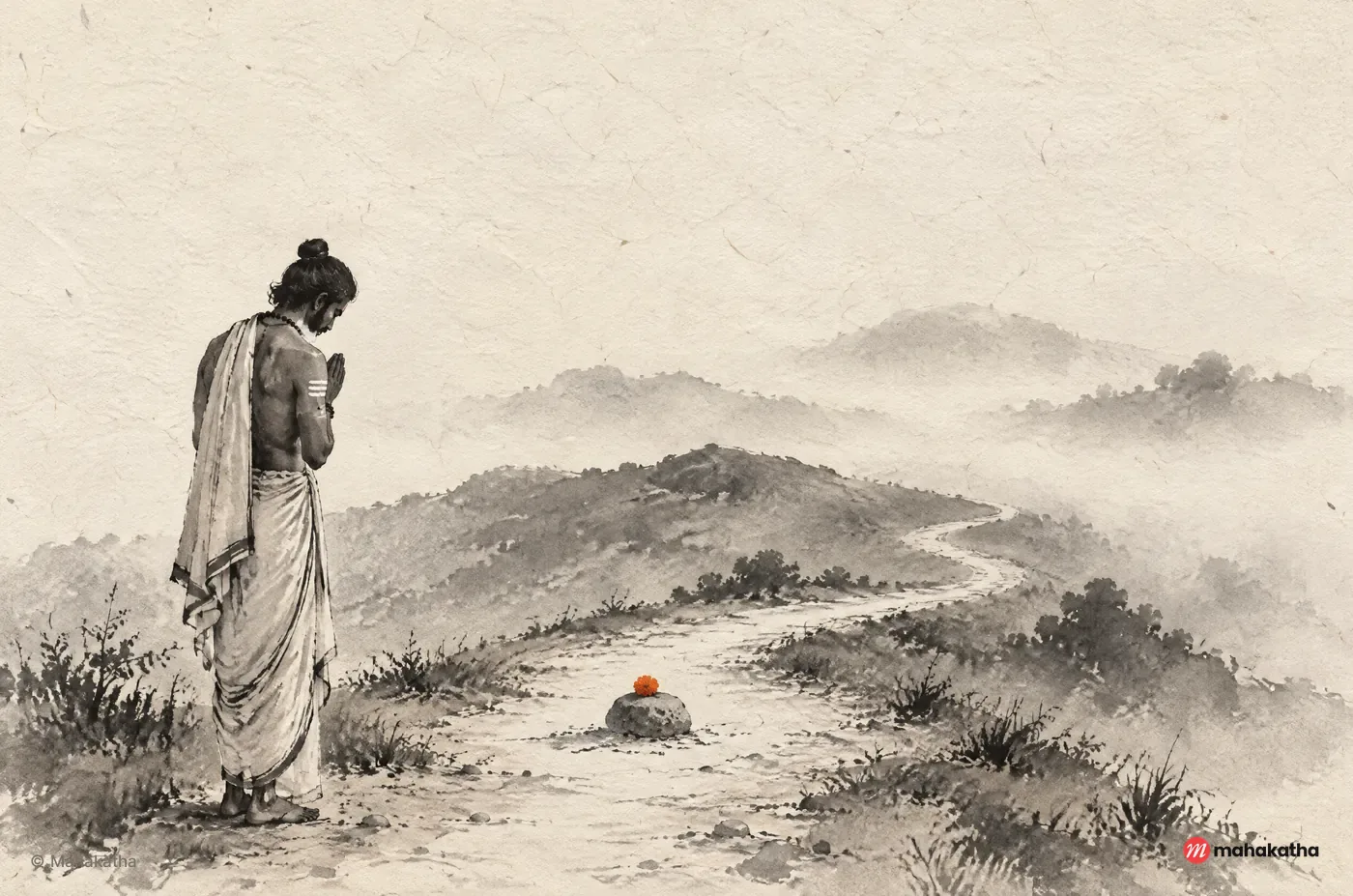
Ganesha has the head of an elephant and rides a mouse. The great and the small sit together in him. Nothing in life is too big or too small for care.
He is the lord of obstacles. We often think of obstacles as enemies. Yet the old stories say he sometimes places them on purpose. A blocked path can make us slow down and look again.
When you feel stuck before something new take one breath. Bow your head a little. Begin with one small step. That is how every beginning starts.
His broken tusk may be the kindest symbol of all. He gave up a part of himself to finish a good work. We too can offer what we have when it is not perfect.
Questions people ask
Who is Lord Ganesha?
Lord Ganesha is the elephant-headed son of Shiva and Parvati. He is the god of beginnings and the lord of obstacles. Devotees worship him first at the start of any prayer or new task. He is also loved as the patron of learning and the arts. His festival Ganesh Chaturthi is one of the biggest in India.
Why does Ganesha have an elephant head?
The best-known story says Shiva cut off the head of a boy guarding Parvati's door. To ease her grief Shiva gave the boy an elephant's head. Another Purana says the god Shani's gaze made the head fall away. Both stories end with a child reborn as the god worshipped first. Many see the elephant as a sign of wisdom.
Which day is for Lord Ganesha?
Wednesday is widely kept as Ganesha's day. Tuesday is also special when it falls on Sankashti Chaturthi. This is called Angaraki Chaturthi. Yet Ganesha is remembered at the start of every task. So any day is a good day to begin with him.
Why is Ganesha worshipped first?
Shiva made Ganesha the leader of the ganas and blessed him to be honoured first. Many also tell the story of the race around the world. Ganesha won by circling his parents. Since then most rituals begin with a prayer to him. Devotees ask him to keep the way clear before they start.
What is Ganesha's favourite food?
Tradition says Ganesha loves modak. It is a sweet dumpling filled with coconut and jaggery. Many families make 21 modaks for Ganesh Chaturthi. Laddoos and bananas are also common offerings. Durva grass and red flowers are loved too. The best offering is the one made with a happy heart.
Why does Ganesha ride a mouse?
His vehicle is a mouse called Mushika. A mouse can reach any hidden corner. Many read it as the restless mind that Ganesha calms and guides. Others see a lesson in the pairing. The mighty elephant and the tiny mouse travel together. Nothing is too small to matter to him.