

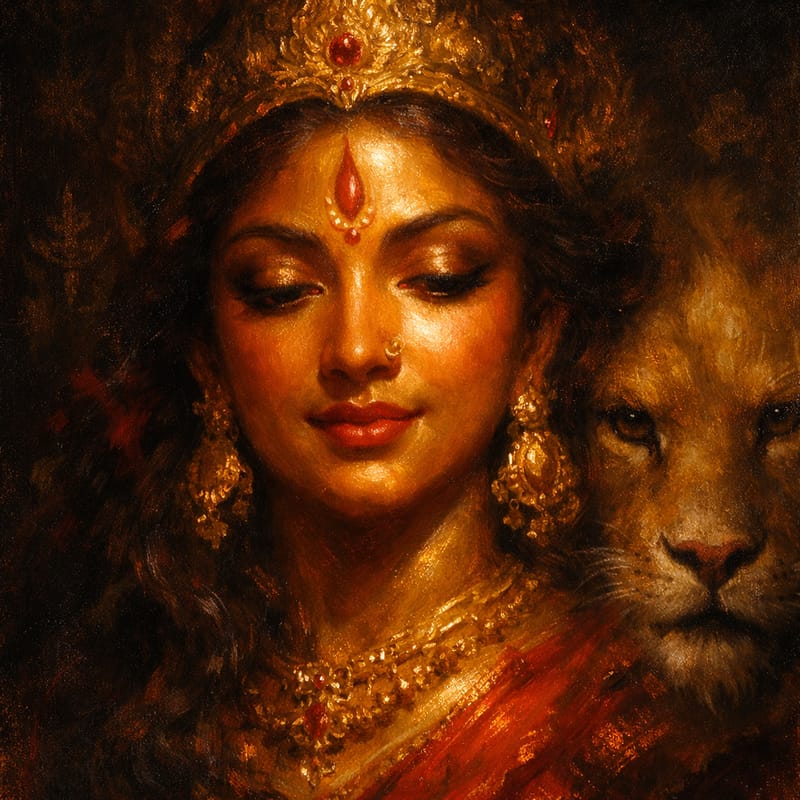
Aigiri Nandini – Mahishasura Mardini Stotram — German Lyrics
The Mahishasura Mardini Mantra is a 21-verse hymn composed by the 8th-century Sanskrit poet Adi Shankaracharya, invoking Goddess Durga. Each verse addresses the Divine Mother through her multiple names and cosmic functions—from her role as daughter of the Himalayas to her manifestation as destroyer of demons. The mantra progresses from invocations of her transcendent power (Shakti) through detailed descriptions of her divine beauty, martial prowess, and boundless compassion. The refrain "Jaya Jaya He Mahishasuramardini" (Victory to the Slayer of Mahishasura) anchors each verse, celebrating her triumph over the buffalo demon and all forces of ignorance.
Durga in this mantra embodies Prakriti (cosmic creative force) manifesting as both the gentle nurturer of the universe and the fierce warrior who destroys ego and illusion. The text draws from the Devi Mahatmya (Markandeya Purana), where Durga defeats Mahishasura—a demon symbolizing tamas (inertia) and ahamkara (ego). Each verse reveals layers of her divinity: her dwelling in the Vindhyas, her enchanting beauty that subdues even celestial beings, her cosmic dance (Tandava), and her ultimate transcendence as the substratum of reality. The mantra celebrates not merely a deity but the inner divine principle that devotees see as overcoming obstacles, making her both accessible to devotional worship and supreme beyond form.
This mantra is traditionally chanted during Navratri (the nine nights of Durga worship), especially on Vijayadashami—the day celebrating victory over Mahishasura. Practitioners begin with one complete recitation daily, progressing to 11 or 108 repetitions for deeper spiritual transformation. Ideally chant in morning hours after meditation or before bed to invoke protection and courage. The mantra works synergistically with visualization of Durga's fierce and compassionate forms, strengthening intention to overcome inner obstacles. Devotees report heightened clarity, emotional resilience, and a sense of divine protection when practicing with sincere devotion.
Curated by The Mahakatha Team · Original Composition: Mahakatha · Lyric: Traditional / Shakta
Aigiri Nandini – Mahishasura Mardini Stotram
Durga · Preview · 2:00
Preview ended
Ancient sounds for transformation, carried across 3,000 years.
Get the full version — plus 275 more ancient chants. 80% OFF today only.
Get Ancient Chants Bundle — 80% OFF →3000+ happy customers · Lifetime access · All devices
2.2M people trust Mahakatha
Chant daily with reminders — Get the Mahakatha app
अयि गिरि नन्दिनी नन्दितमेदिनि विश्वविनोदिनि नंदनुते गिरिवर विन्ध्यशिरोधिनिवासिनी विष्णुविलासिनि जिष्णुनुते । भगवति हे शितिकण्ठकुटुम्बिनि भूरिकुटुम्बिनि भूरिकृते जय जय हे महिषासुरमर्दिनि रम्यकपर्दिनि शैलसुते ॥१॥
ayi giri nandini nanditamedini vishvavinodini nandanute girivara vindhyashirodhinivasini vishnuvilasini jishnunute | bhagavati he shitikanthakutumbini bhurikutumbini bhurikrite jaya jaya he mahishasuramardini ramyakapardini shailasute ||1||
O Tochter des Berges; Quelle der Freude für das Universum, gepriesen von Nanda,
Wohnend auf der Krone der Vindhyas, bist Du die Freude von Lord Vishnu und die Hingabe von Lord Indra.
O Bhagavati, Shivas göttliche Partnerin, die Mutter des Universums, die Schöpferin des Überflusses,
Sieg sei Dir, O Bezwingerin des Mahishasura; O Tochter des Berges mit wunderschönen Haarlocken.
सुरवर वर्षिणि दुर्धर धर्षिणि दुर्मुख मर्षिणि हर्षरते त्रिभुवनपोषिणि शङ्करतोषिणि किल्बिष मोषिणि घोषरते। दनुजनिरोषिणि दितिसुतरोषिणि दुर्मदशोषिणि सिन्धुसुते जय जय हे महिषासुरमर्दिनि रम्यकपर्दिनि शैलसुते ॥२॥
suravara varshini durdhara dharshini durmukha marshini harsharate tribhuvanaposhini shankaratoshini kilbisha moshini ghosharate| danujaniroshini ditisutaroshini durmadashoshini sindhusute jaya jaya he mahishasuramardini ramyakapardini shailasute ||2||
O Gewährerin von Segnungen für die Götter, Bezwingerin des Dämons Durdhara, Bezwingerin des Dämons Durmukha, O ewig Glückselige,
O Nährerin der drei Welten, Quelle von Shivas Freude, Tilgerin der Sünde und all ihrer üblen Auswirkungen,
Die die Danavas beruhigt, Zorn gegen die Daityas hat, das Ego der Dämonen tötet, O Tochter des Königs der Ozeane,
Sieg sei Dir, O Bezwingerin des Mahishasura; O Tochter des Berges mit wunderschönen Haarlocken.
अयि जगदम्ब मदम्ब कदम्ब वनप्रिय वासिनि हासरते शिखरि शिरोमणि तुङ्गहिमालय शृङ्गनिजालय मध्यगते। मधुमधुरेमधुकैटभ गञ्जिनि कैटभ भञ्जिनि रासरते जय जय हे महिषासुरमर्दिनि रम्यकपर्दिनि शैलसुते ॥३॥
ayi jagadamba madamba kadamba vanapriya vasini hasarate shikhari shiromani tungahimalaya shringanijalaya madhyagate| madhumadhure madhukaitabha ganjini kaitabha bhanjini rasarate jaya jaya he mahishasuramardini ramyakapardini shailasute ||3||
O Mutter des Universums, Mutter aller Seelen, freudig wohnend inmitten von Wäldern dichter Kadamba-Bäume,
Du wohnst auf der ragenden Krone der Himalaya-Berge,
Süß wie Honig, hast Du das Ego der Dämonen Madhu und Kaitabha zerstört, versunken in Wonne,
Sieg sei Dir, O Bezwingerin des Mahishasura; O Tochter des Berges mit wunderschönen Haarlocken.
अयि शतखण्ड विखण्डित रुण्ड वितुण्डित शुंड गजाधिपते रिपुगजगण्ड विदारणचण्ड पराक्रमशुण्ड मृगाधिपते। निजभुजदण्ड निपातितखण्ड विपातितमुण्ड भटाधिपते जय जय हे महिषासुरमर्दिनि रम्यकपर्दिनि शैलसुते ॥४॥
ayi shatakhanda vikhandita runda vitundita shunda gajadhipate ripugajaganda vidaranachanda parakramashunda mrigadhipate| nijabhujadanda nipatitakhanda vipatitamunda bhatadhipate jaya jaya he mahishasuramardini ramyakapardini shailasute ||4||
Du hast Deine Feinde in tausend Stücke zerschmettert, sie enthauptet, die Rüssel ihrer Elefanten abgerissen,
Du hast die Gesichter ihrer wildesten Bestien zerrissen,
Besiegerin der Dämonen Chanda und Munda, Eroberin ihrer Krieger,
Sieg sei Dir, O Bezwingerin des Mahishasura; O Tochter des Berges mit wunderschönen Haarlocken.
अयि रणदुर्मद शत्रुवधोदित दुर्धरनिर्जर शक्तिभृते चतुरविचार धुरीणमहाशिव दूतकृत प्रमथाधिपते। दुरितदुरीह दुराशयदुर्मति दानवदूत कृतान्तमते जय जय हे महिषासुरमर्दिनि रम्यकपर्दिनि शैलसुते ॥५॥
ayi ranadurmada shatruvadhodita durdharanirjara shaktibhrite chaturavichara dhurinamahashiva dutakrita pramathadhipate| duritaduriha durashayadurmati danavaduta kritantamate jaya jaya he mahishasuramardini ramyakapardini shailasute ||5||
O Göttliche Göttin, tapfer aus dem Schlachtfeld hervorgehend, grenzenlose, ewige Macht besitzend,
Die Gesandte von Lord Shiva, Immerweise, Shiva erwählte Dich zur Anführerin seiner Ganas,
Du beseitigst alle Sünde, die Bosheit Deiner Feinde, erschlägst ihre Boten, Dein Wille ist absolut,
Sieg sei Dir, O Bezwingerin des Mahishasura; O Tochter des Berges mit wunderschönen Haarlocken.
अयि शरणागत वैरिवधुवर वीरवराभय दायकरे त्रिभुवनमस्तक शुलविरोधि शिरोधिकृतामल शुलकरे। दुमिदुमितामर धुन्दुभिनाद महोमुखरीकृत दिङ्मकरे जय जय हे महिषासुरमर्दिनि रम्यकपर्दिनि शैलसुते ॥६॥
ayi sharanagata vairivadhuvara viravarabhaya dayakare tribhuvanamastaka shulavirodhi shirodhikritamala shulakare| dumidumitamara dhundubhinada mahomukharikrita dinmakare jaya jaya he mahishasuramardini ramyakapardini shailasute ||6||
O Göttliche Mutter, die Du Schutz gewährst denen, die Zuflucht suchen, selbst unter den Geliebten der Feinde.
Der reine Dreizack auf Deiner Stirn besiegt Herrscher, die sich Deiner göttlichen Macht widersetzen.
Dein Gebrüll ist der Klang donnernder Trommeln, laut und wild, während Du Feinde angreifst
Sieg Dir, o Bezwingerin des Mahishasura; o Tochter des Berges mit schönen Haarlocken.
अयि निजहुङ्कृति मात्रनिराकृत धूम्रविलोचन धूम्रशते समरविशोषित शोणितबीज समुद्भव शोणित बीजलते। शिवशिवशुम्भ निशुम्भमहाहव तर्पितभूत पिशाचरते जय जय हे महिषासुरमर्दिनि रम्यकपर्दिनि शैलसुते ॥७॥
ayi nijahunkriti matranirakrita dhumravilochana dhumrashate samaravishoshita shonitabija samudbhava shonita bijalate| shivashivashumbha nishumbhamahahava tarpitabhuta pishacharate jaya jaya he mahishasuramardini ramyakapardini shailasute ||7||
O Göttliche Mutter, die Du den Dämon Dhumralochana mit einem bloßen Gebrüll zu Rauch verwandelt hast
Du hast dem Dämon Raktabeeja ein Ende bereitet und seinen Klonen, die aus den gefallenen Tropfen seines Blutes entstanden,
Du hast die Seelen von Shumbha und Nishumbha in der Schlacht befreit und sie davor bewahrt, Geister zu werden
Sieg Dir, o Bezwingerin des Mahishasura; o Tochter des Berges mit schönen Haarlocken.
धनुरनुषङ्ग रणक्षणसङ्ग परिस्फुरदङ्ग नटत्कटके कनकपिशङ्ग पृषत्कनिषङ्ग रसद्भटशृङ्ग हतावटुके। कृतचतुरङ्ग बलक्षितिरङ्ग घटद्बहुरङ्ग रटद्बटुके जय जय हे महिषासुरमर्दिनि रम्यकपर्दिनि शैलसुते ॥८॥
dhanuranushanga ranakshanasanga parisphuradanga natatkatake kanakapishanga prishatkanishanga rasadbhatashringa hatabatuke| kritachaturanga balakshitiranga ghatadbahuranga ratadbatuke jaya jaya he mahishasuramardini ramyakapardini shailasute ||8||
Deine Armreifen schimmern, während sie zur Bewegung Deines Bogens und Pfeils im Krieg tanzen.
Mit Deinen goldenen Pfeilen greifst Du mit Anmut an und schlägst Feinde nieder,
Du hast allein gegen vier Armeen gekämpft, Shakti strahlte von Dir aus, schwächte und besiegte sie,
Sieg Dir, o Bezwingerin des Mahishasura; o Tochter des Berges mit schönen Haarlocken.
सुरललना ततथेयि तथेयि कृताभिनयोदर नृत्यरते कृत कुकुथः कुकुथो गडदादिकताल कुतूहल गानरते। धुधुकुट धुक्कुट धिंधिमित ध्वनि धीर मृदंग निनादरते जय जय हे महिषासुरमर्दिनि रम्यकपर्दिनि शैलसुते॥९॥
suralalana tatatheyi tatheyi kritabhinayodara nrityarate krita kukuthah kukutho gadadadikatala kutuhala ganarate| dhudhukuta dhukkuta dhindhimita dhvani dhira mridanga ninadarate jaya jaya he mahishasuramardini ramyakapardini shailasute||9||
Göttliche Mutter, Du erfreust Dich an den wilden rhythmischen Tanzaufführungen himmlischer Schönheiten,
Und genießt den göttlichen Gesang und das Schlagzeug, dargeboten von himmlischen Musikern,
Die tiefen Klänge der Trommeln begleiten Deinen Triumph und das Ende des Krieges
Sieg Dir, o Bezwingerin des Mahishasura; o Tochter des Berges mit schönen Haarlocken.
जय जय जप्य जयेजयशब्द परस्तुति तत्परविश्वनुते भणभण भिंजिमि भिंगृती नूपुर शिञ्जितमोहित भूतपते। नटित नटार्ध नटी नट नायक नाटितनाट्य सुगानरते जय जय हे महिषासुरमर्दिनि रम्यकपर्दिनि शैलसुते ॥१०॥
jaya jaya japya jayejayashabda parastuti tatparavishvanute jhanajhanajhinjhimi jhinkrita nupura shinjitamohita bhutapate| natita natardha nati nata nayaka natitanatya suganarate jaya jaya he mahishasuramardini ramyakapardini shailasute ||10||
Göttliche Mutter, Anhänger singen und rufen Deinen Namen und sind geblendet von Deiner Energie und Deinem Tanz
Das Klingen Deiner Fußreifen fesselt Lord Shiva, den mystischen Herrn der Wesen
Du tanzt als Shivas Hälfte, ein Fuß auf der Erde, der andere zum Himmel gerichtet, umgeben von Tänzern in Ehrfurcht,
Sieg Dir, o Bezwingerin des Mahishasura; o Tochter des Berges mit schönen Haarlocken.
अयि सुमनःसुमनःसुमनः सुमनःसुमनोहरकान्तियुते श्रितरजनी रजनीरजनी रजनीरजनी करवक्त्रवृते। सुनयनविभ्रमर भ्रमरभ्रमर भ्रमरभ्रमर भ्रमराधिपते जय जय हे महिषासुरमर्दिनि रम्यकपर्दिनि शैलसुते ॥११॥
ayi sumanahsumanahsumanah sumanahsumanoharakantiyute shritarajani rajanirajani rajanirajani karavaktravrite| sunayanavibhramara bhramarabhramara bhramarabhramara bhramaradhipate jaya jaya he mahishasuramardini ramyakapardini shailasute ||11||
O Göttliche Mutter, deren schöner Geist in Harmonie mit deiner bezaubernden Gestalt ist
Dein strahlendes Antlitz übertrifft das Mondlicht mit seiner Brillanz
Deine Augen übertreffen die Schönheit der Bienen mit ihrer fesselnden Anmut
Sieg sei Dir, o Bezwingerin des Mahishasura; o Tochter des Berges mit schönen Haarlocken.
सहितमहाहव मल्लमतल्लिक मल्लितरल्लक मल्लरते विरचितवल्लिक पल्लिकमल्लिक भिल्लिकभिल्लिक वर्गवृते। शितकृतफुल्ल समुल्लसितारुण तल्लजपल्लव सल्ललिते जय जय हे महिषासुरमर्दिनि रम्यकपर्दिनि शैलसुते ॥१२॥
sahitamahahava mallamatallika mallitarallaka mallarate virachitavallika pallikamallika jhillikabhillika vargavrite| shitakritaphulla samullasitaruna tallajapallava sallalite jaya jaya he mahishasuramardini ramyakapardini shailasute ||12||
O Göttliche Mutter, du genießt das Spiel einer Schlacht gegen geschickte Feinde
Du liebst es, inmitten blühender Wildnis zu leben, um den Baum der Weisheit herum,
Du liebst es, zwischen Ranken und Pflanzen zu wandeln und ihre Knospen erblühen zu lassen
Sieg sei Dir, o Bezwingerin des Mahishasura; o Tochter des Berges mit schönen Haarlocken.
अविरलगण्ड गलन्मदमेदुर मत्तमतङ्ग जराजपते त्रिभुवनभूषण भूतकलानिधि रूपपयोनिधि राजसुते। अयि सुदतीजन लालसमानस मोहन मन्मथराजसुते जय जय हे महिषासुरमर्दिनि रम्यकपर्दिनि शैलसुते ॥ १३॥
aviralaganda galanmadamedura mattamatanga jarajapate tribhuvanabhushana bhutakalanidhi rupapayonidhi rajasute| ayi sudatijana lalasamanasa mohana manmatharajasute jaya jaya he mahishasuramardini ramyakapardini shailasute || 13||
Göttliche Mutter, du berauschst mächtige Elefanten, indem du den Fluss von 'Mada' zwischen ihren Augen auslöst
Du bist das Juwel der drei Welten, ein Schatz der Künste, ein Ozean der Schönheit, die Tochter des Königs
Wie Manmatha, der Gott der Liebe, verzauberst du und entfachst Verlangen in den Herzen der Menschen
Sieg sei Dir, o Bezwingerin des Mahishasura; o Tochter des Berges mit schönen Haarlocken.
कमलदलामल कोमलकान्ति कलाकलितामल भाललते सकलविलास कलानिलयक्रम केलिचलत्कल हंसकुले। अलिकुलसङ्कुल कुवलयमण्डल मौलिमिलद्बकुलालिकुले जय जय हे महिषासुरमर्दिनि रम्यकपर्दिनि शैलसुते ॥ १४॥
kamaladalamala komalakanti kalakalitamala bhalalate sakalavilasa kalanilayakrama kelichalatkala hansakule| alikulasankula kuvalayamandala maulimiladbakulalikule jaya jaya he mahishasuramardini ramyakapardini shailasute || 14||
O Göttliche Mutter, deren Stirn mit der zarten Schönheit eines makellosen Lotusblattes erstrahlt
Du inspirierst alle Formen der Kunst, und deine Bewegung inspiriert die Bewegung der Schwäne,
Dein geflochtenes Haar trägt die Schönheit und Süße von Seerosen und Bakula-Blüten
Sieg sei Dir, o Bezwingerin des Mahishasura; o Tochter des Berges mit schönen Haarlocken.
करमुरलीरव वीजितकूजित लज्जितकोकिल मञ्जुमते मिलितपुलिन्द मनोहरगुञ्जित रञ्जितशैल निकुञ्जगते। निजगुणभूत महाशबरीगण सद्गुणसम्भृत केलितले जय जय हे महिषासुरमर्दिनि रम्यकपर्दिनि शैलसुते ॥ १५॥
karamuralirava vijitakujita lajjitakokila manjumate militapulinda manoharagunjita ranjitashaila nikunjagate| nijaganabhuta mahashabarigana sadgunasambhrita kelitale jaya jaya he mahishasuramardini ramyakapardini shailasute || 15||
O Göttliche Mutter, deren Stimme die Flöte übertrifft und den Kuckuck in seiner Süße beschämt
Du summst bezaubernde Lieder, während du durch leuchtend bunte Berghaine wandelst
Du spielst freudig mit den tugendhaften Stammesangehörigen in deiner Begleitung
Sieg sei Dir, o Bezwingerin des Mahishasura; o Tochter des Berges mit schönen Haarlocken.
कटितटपीत दुकूलविचित्र मयुखतिरस्कृत चन्द्ररुचे प्रणतसुरासुर मौलिमणिस्फुर दंशुलसन्नख चन्द्ररुचे। जितकनकाचल मौलिपदोर्जित निर्भरकुञ्जर कुम्भकुचे जय जय हे महिषासुरमर्दिनि रम्यकपर्दिनि शैलसुते ॥ १६॥
katitatapita dukulavichitra mayukhatiraskrita chandraruche pranatasurasura maulimanisphura danshulasannakha chandraruche| jitakanakachala maulimadorjita nirbharakunjara kumbhakuche jaya jaya he mahishasuramardini ramyakapardini shailasute || 16||
O Göttliche Mutter, deine Hüften sind in Seidengewänder gehüllt, deren Farben den Mond überstrahlen
Deine strahlenden Zehennägel reflektieren den Glanz, der von den Kronen der Götter und Asuras ausgeht,
Dein Busen leuchtet wie goldene Berggipfel und die Krone auf der Stirn eines mächtigen Elefanten,
Sieg sei Dir, o Bezwingerin des Mahishasura; o Tochter des Berges mit schönen Haarlocken.
विजितसहस्रकरैक सहस्रकरैक सहस्रकरैकनुते कृतसुरतारक सङ्गरतारक सङ्गरतारक सूनुसुते। सुरथसमाधि समानसमाधि समाधिसमाधि सुजातरते जय जय हे महिषासुरमर्दिनि रम्यकपर्दिनि शैलसुते ॥ १७॥
vijitasahasrakaraika sahasrakaraika sahasrakaraikanute kritasurataraka sangarataraka sangarataraka sunusute| surathasamadhi samanasamadhi samadhisamadhi sujatarate jaya jaya he mahishasuramardini ramyakapardini shailasute || 17||
O Göttliche Mutter, du besiegst Feinde mit tausend Händen, du hast tausend Sonnenstrahlen überstrahlt,
Du hast Kartikeya erschaffen, um die Devas zu retten, und hast Ihn gedrängt, Tarkasura zu bekämpfen
Du hast die ergebenen Herzen von König Suratha und dem Kaufmann Samadhi von allem weltlichen Leid befreit
Sieg sei Dir, o Bezwingerin des Mahishasura; o Tochter des Berges mit schönen Haarlocken.
पदकमलं करुणानिलये वरिवस्यति योनुदिनं सुशिवे अयि कमले कमलानिलये कमलानिलयः स कथं न भवेत्। तव पदमेव परम्पदमित्यनुशीलयतो मम किं न शिवे जय जय हे महिषासुरमर्दिनि रम्यकपर्दिनि शैलसुते ॥ १८॥
padakamalam karunanilaye varivasyati yonudinam sushive ayi kamale kamalanilaye kamalanilayah sa katham na bhavet| tava padameva parampadamityanushilayato mama kim na shive jaya jaya he mahishasuramardini ramyakapardini shailasute || 18||
Gesegnet sind jene, die jeden Tag zu deinen mitfühlenden Lotusfüßen beten,
Sie dienen der lotusgleichen Göttin des Wohlstands, wie sollten sie nicht selbst mit Wohlstand gesegnet werden?
Ich suche Zuflucht zu deinen Füßen, der höchsten Zuflucht, was brauche ich mehr?
Sieg sei Dir, o Bezwingerin des Mahishasura; o Tochter des Berges mit schönen Haarlocken.
कनकलसत्कल सिन्धुजलैरनु षिञ्चति ते गुण रङ्गभुवम् भजति स किं न शचीकुचकुम्भ तटीपरिरम्भ सुखानुभवम्। तव चरणं शरणं करवाणि नतामरवाणि निवासि शिवम् जय जय हे महिषासुरमर्दिनि रम्यकपर्दिनि शैलसुते ॥ १९॥
kanakalasatkala sindhujalairanu shinchati te guna rangabhuvam bhajati sa kim na shachikuchakumbha tatiparirambha sukhanubhavam| tava charanam sharanam karavani natamaravani nivasi shivam jaya jaya he mahishasuramardini ramyakapardini shailasute || 19||
Göttliche Mutter, jeder, der dir Meerwasser in einem goldenen Gefäß darbringt und mit Hingabe singt,
Wird die Segnungen aus deinem Goldenen Gefäß empfangen - deine Weisheit und deinen Mut und deine Freude
Ich verneige mich zu Deinen ewigen Füßen, o Mahasaraswati, die Quelle aller Glückseligkeit
Sieg sei Dir, o Bezwingerin des Mahishasura; o Tochter des Berges mit schönen Haarlocken.
तव विमलेन्दुकुलं वदनेन्दुमलं सकलं ननु कूलयते किमु पुरुहूतपुरीन्दुमुखी सुमुखीभिरसौ विमुखीक्रियते। मम तु मतं शिवनामधने भवती कृपया किमुत क्रियते जय जय हे महिषासुरमर्दिनि रम्यकपर्दिनि शैलसुते ॥ २०॥
tava vimalendukulam vadanendumalam sakalam nanu kulayate kimu puruhutapurindumukhi sumukhibhirasau vimukhikriyate| mama tu matam shivanamadhane bhavati kripaya kimuta kriyate jaya jaya he mahishasuramardini ramyakapardini shailasute || 20||
Göttliche Mutter, wie kann jemand, der von deinem mondgleichen reinen Antlitz angezogen ist, jemals zu einem anderen hingezogen werden?
Deine Gnade zieht den Geist von weltlichen Verlockungen fort, selbst von den schönsten Schönheiten aus Indras Reich.
Ohne Deine Gnade, wie kann man den Schatz von Shivas Namen erschließen?
Sieg sei Dir, o Bezwingerin des Mahishasura; o Tochter des Berges mit schönen Haarlocken.
अयि मयि दीन दयालुतया कृपयैव त्वया भवितव्यमुमे अयि जगतो जननी कृपयासि यथासि तथानुमितासिरते। यदुचितमत्र भवत्युररी कुरुतादुरुतापमपाकुरुते जय जय हे महिषासुरमर्दिनि रम्यकपर्दिनि शैलसुते ॥ २१॥
ayi mayi dina dayalutaya kripayaiva tvaya bhavitavyamume ayi jagato janani kripayasi yathasi tathanumitasirate| yaduchitamatra bhavatyurari kurutadurutapamapakurute jaya jaya he mahishasuramardini ramyakapardini shailasute || 21||
O Göttliche Mutter, mitfühlend zu den Bedrängten und Beschützerin aller
Geburtsmutter des Kosmos, der Regen deiner Gnade ist genauso mächtig wie der Regen deiner Pfeile.
O Mutter, entferne die Sorgen und Schmerzen, die unerträglich geworden sind
Sieg dir, O Bezwingerin des Mahishasura; O Tochter des Berges mit wunderschönen Haarlocken.
How to Chant Aigiri Nandini – Mahishasura Mardini Stotram
- 1
Find a quiet, clean space
Sit in a comfortable, undisturbed environment. Face east or north if possible. You may light incense or a candle to set a contemplative atmosphere.
- 2
Settle into a comfortable posture
Sit cross-legged on the floor or upright in a chair. Keep the spine erect and place the hands on the knees with palms facing upward.
- 3
Take three cleansing breaths
Inhale slowly through the nose, hold briefly, and exhale completely. Repeat three times to calm the mind and prepare for mantra recitation.
- 4
Begin chanting Aigiri Nandini – Mahishasura Mardini Stotram
Chant the mantra clearly and with devotion — aloud, in a whisper, or silently. Use a mala (108 beads) to count repetitions. Aim for a consistent, unhurried rhythm throughout the session.
- 5
Rest in stillness
After completing your chanting, sit quietly for two to five minutes. Allow the vibration of the mantra to settle within. Close the practice with a moment of gratitude.
Benefits of Aigiri Nandini – Mahishasura Mardini Stotram
-
Cultivates inner strength and courage to overcome obstacles, fears, and self-limiting beliefs.
Source: Devi Mahatmya (Markandeya Purana) — battle of Durga with Mahishasura symbolizes victory over ignorance
-
Traditionally chanted as a prayer for protection from harm, and for a sense of being held safe by the Divine Mother.
Source: Traditional practice — devotees report feeling safer and more grounded
-
Helps devotees let go of ego patterns and inner obstacles through invocation of divine feminine wisdom (Shakti).
Source: Shakta Tantra philosophy and Upanishadic teachings on Brahman-Shakti unity
-
Activates divine compassion and unconditional love by connecting with Durga's nurturing aspect.
Source: Devi Bhagavata Purana — Durga as universal mother (Jagad-Amba)
-
Supports steady spiritual progress through sustained devotional practice.
Story & Symbolism
The Mahishasura Mardini Mantra originates from two profound scriptural sources: the Devi Mahatmya (800 BCE, embedded in the Markandeya Purana) and the 8th-century poetic genius of Adi Shankaracharya. The Devi Mahatmya recounts how Mahishasura—a buffalo-demon granted invincibility against gods and men—ravaged the cosmos. Celestial beings approached Brahma, Vishnu, and Shiva in desperation. From their combined divine radiance emerged Durga, the supreme Shakti, who engaged the buffalo-demon in a legendary nine-day battle. On the tenth day (Vijayadashami), she vanquished Mahishasura, restoring cosmic order. This mythological narrative encodes psychological truth: Mahishasura symbolizes ego-driven illusion (ahamkara), and Durga embodies the transcendent consciousness that dissolves it.
Adi Shankaracharya, the non-dual philosopher who established the Advaita school, recognized that devotion to the Divine Mother (Shakti) and knowledge of Brahman are not opposed but complementary paths. He composed the Mahishasura Mardini Mantra as a supreme devotional tool that simultaneously honors Durga's myth and teaches her transcendent identity. Each of the 21 verses functions on three levels: literal praise of the goddess's cosmic actions, mystical invocation of divine power within the practitioner, and philosophical instruction on the nature of ultimate reality. The mantra became the liturgical heart of Shakta worship, particularly in Tantra and Bhakti traditions.
Today, this mantra forms the centerpiece of Navratri celebrations across India—especially in Bengal, where Durga Puja is the grandest festival. Millions of devotees chant it during the nine nights, with climax on Vijayadashami. The mantra has been passed through unbroken lineages of gurus, recorded in texts, and preserved in oral tradition (Shruti Parampara). Its modern transmission includes both temple recitations and individual sadhana, making it accessible to seekers worldwide seeking both spiritual protection and divine grace.
How to Use in Daily Life
Dawn Invocation
Chant one complete round at sunrise (Brahma Muhurta, (pre-dawn)) to invoke Durga's protective energy for the day ahead. This timing aligns with natural prana flow and prepares your mind for clarity and courage.
Meditation Focus
After your meditation practice, chant slowly with eyes closed, visualizing Durga's fierce golden radiance dissolving your inner obstacles and fears. Let the Sanskrit sounds settle in your heart as you chant.
Navratri Sadhana
During the nine nights of Durga worship, complete 9 full recitations (one per night) or 108 repetitions on Vijayadashami. This intensive practice is traditionally undertaken for spiritual transformation and karmic resolution.
Evening Protection
Chant before bed to invoke divine protection during sleep and let go of the day's worries and unease. This creates a shield of Shakti energy around you through the night.