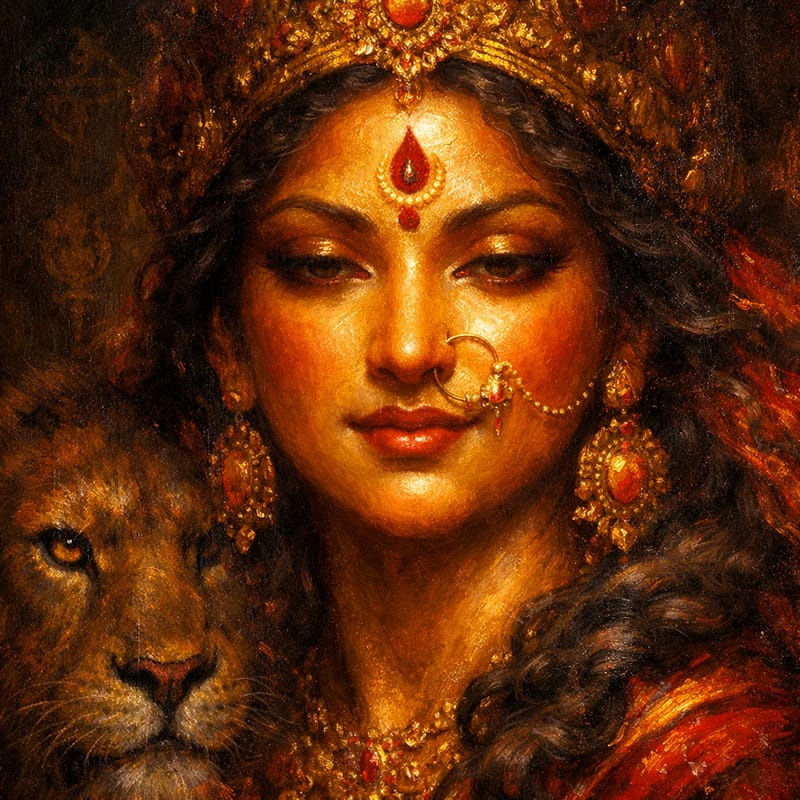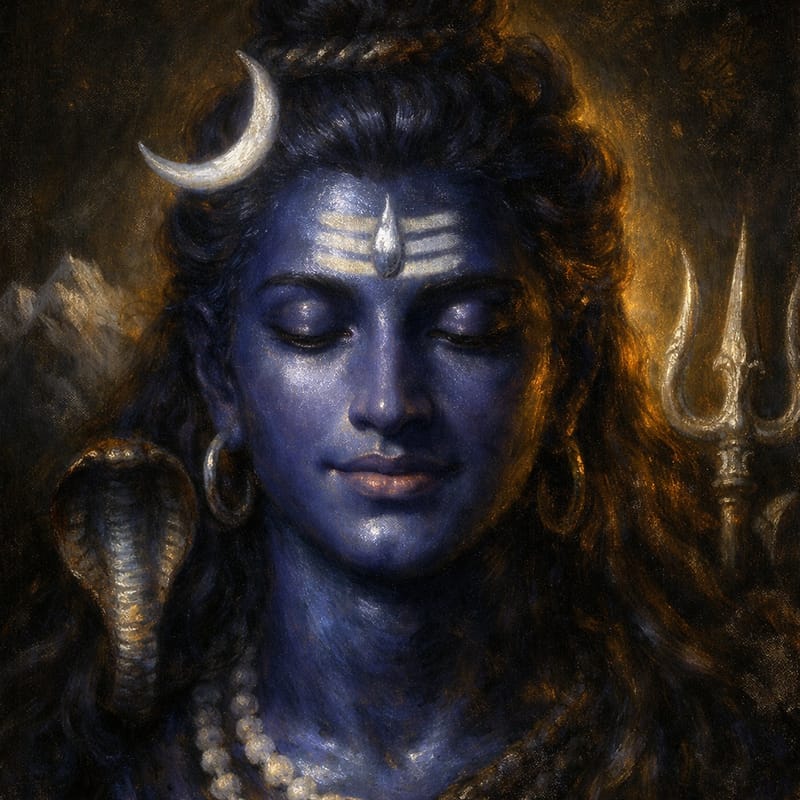


Goddess Durga is the warrior form of the Divine Mother. The Devi Mahatmya tells how she rose from the light of all the gods. She defeated the buffalo demon Mahishasura. She rides a lion and holds a weapon in each hand. Devotees turn to her for courage and protection. Her great festival is Navratri.
Who is Goddess Durga?
Durga is the Mother who fights for her children. Her name comes from durga, a fort or a place hard to cross. Many read it as the one who carries us through hard places.
She is Shakti. Shakti means the power that moves all life. In the goddess traditions she is not only a god's wife. She is the highest power itself.
Devi
Simply the Goddess. Many devotees use this one word for her.
Amba and Ambe
Both mean Mother. The North sings Jai Ambe in homes and temples every evening.
Bhavani
The giver of life. Bhavani is loved most of all in Maharashtra.
Chandika
The fierce one. Her great text is often called the Chandi Path.
Mahishasuramardini
The slayer of the buffalo demon Mahisha. This is the form shown in most images.
Sherawali
The lion rider. It is a loving Punjabi and North Indian name for her.
Stories of Goddess Durga
Her main stories live in the Devi Mahatmya. Bengal and the South add their own. Each telling shows strength joined with love.
Born from the light of the gods
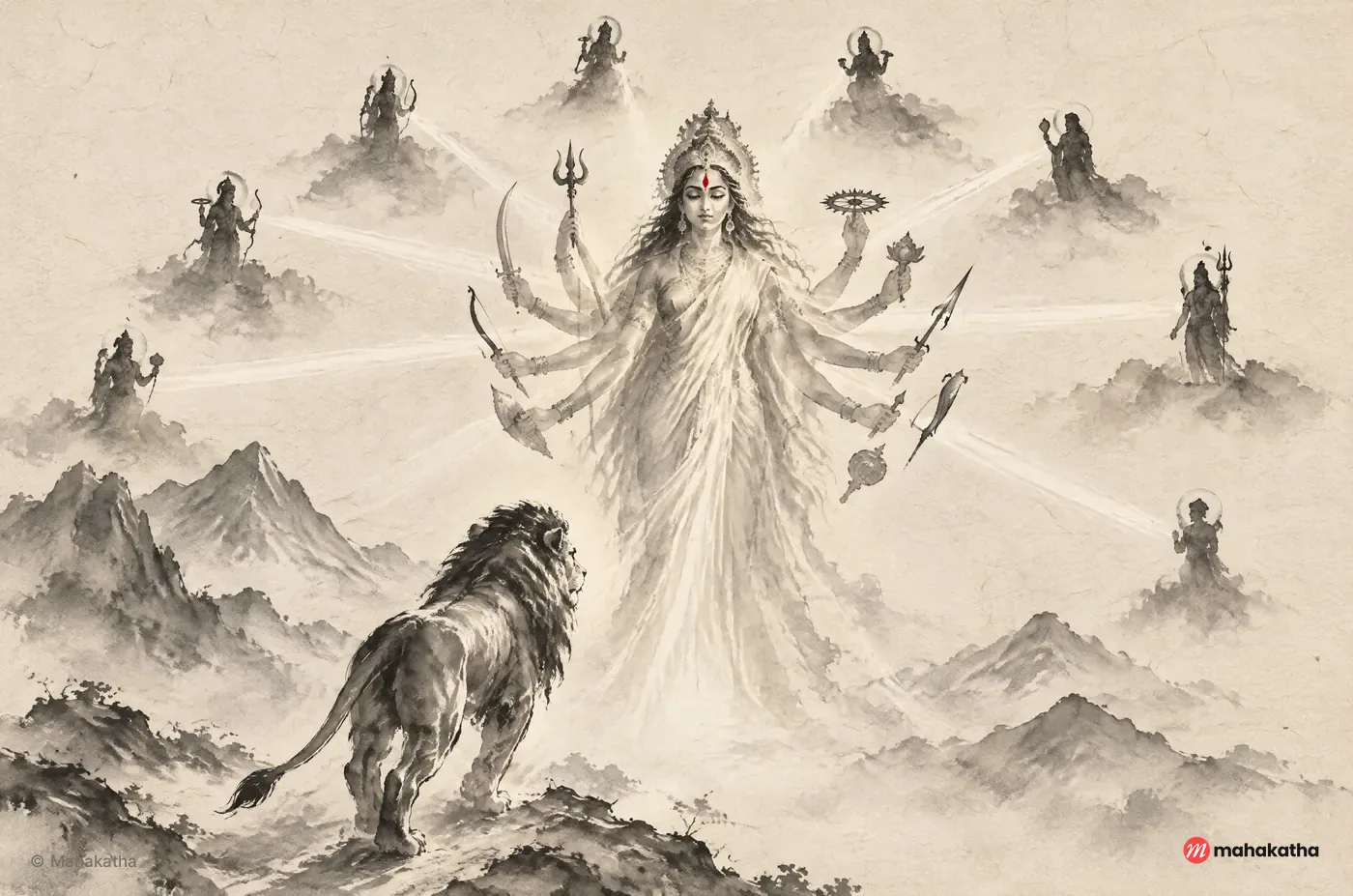
The story says the buffalo demon Mahishasura drove the gods out of heaven. Later tellings add a boon that no man or god could defeat him. Their anger blazed out as light. The light gathered into one shining woman. Each god gave her a weapon. Shiva gave his trident and Vishnu gave his discus. The mountain Himalaya gave her a lion.
The battle with Mahishasura
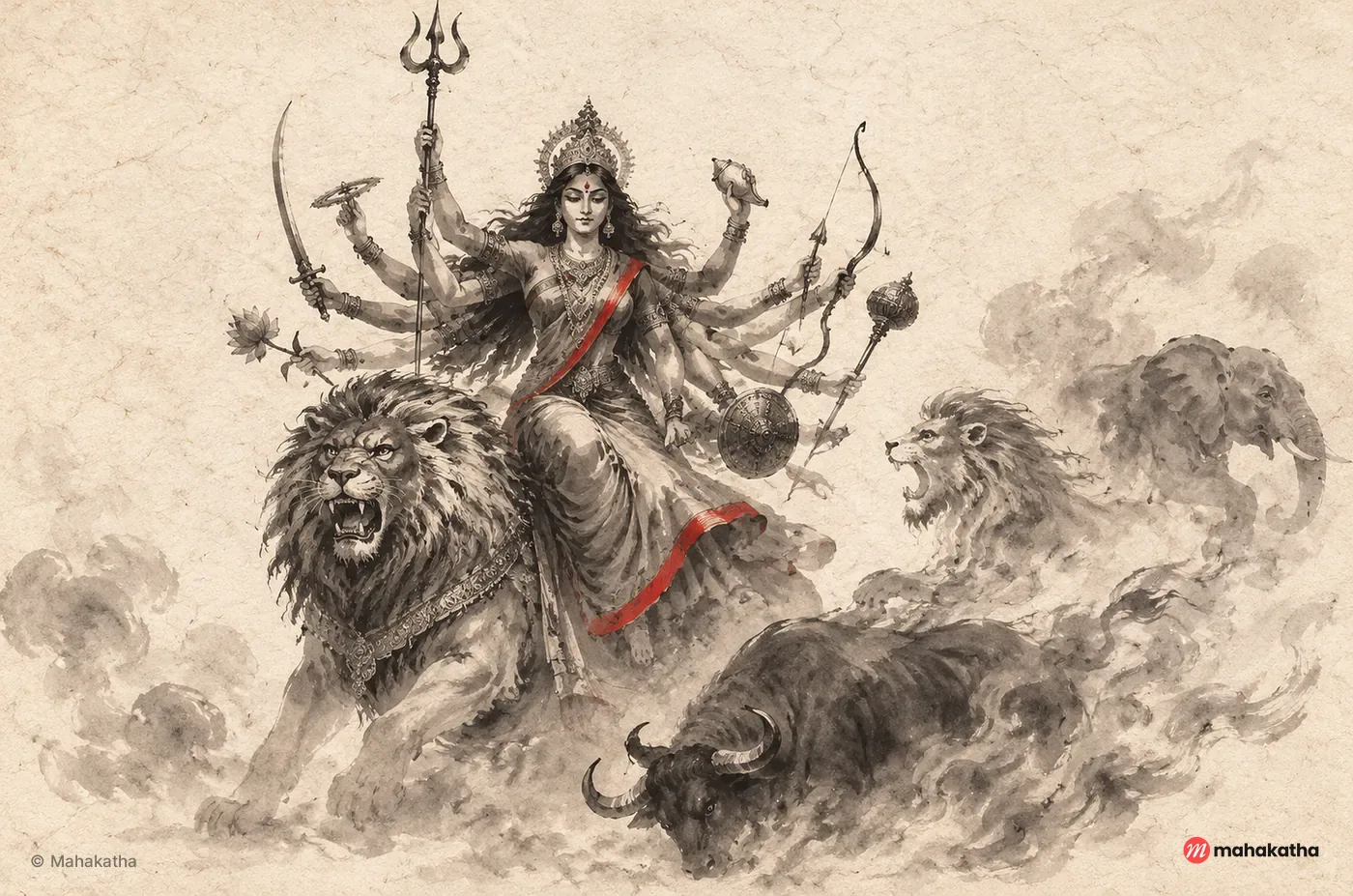
Mahisha changed shape again and again. He became a lion and then a man with a sword. He became an elephant and then a buffalo once more. The goddess pinned him under her foot and struck him down. The gods sang her praise. A later hymn of praise is the Aigiri Nandini.
Chanda, Munda and Raktabija
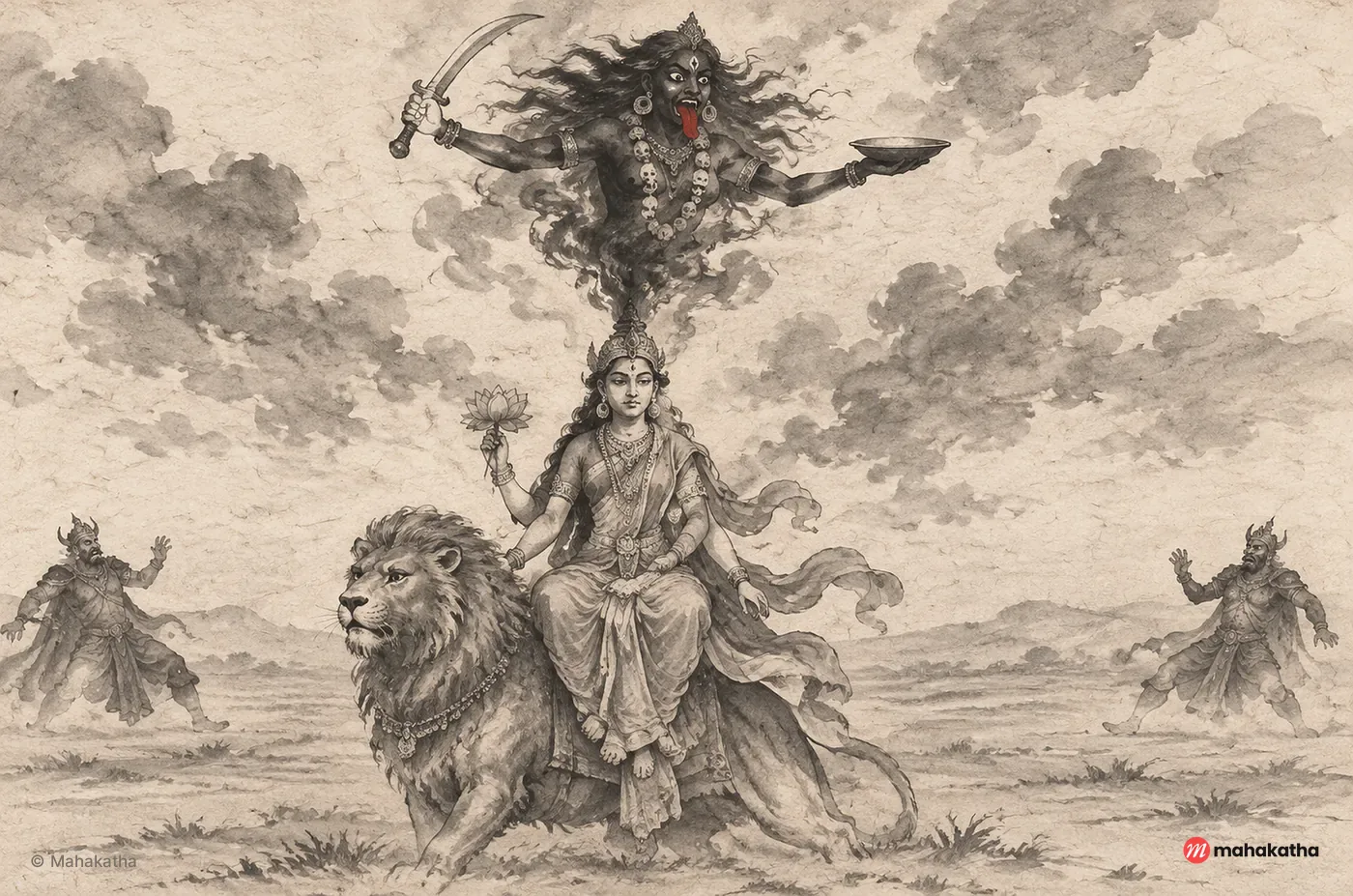
In the third story two demon brothers named Shumbha and Nishumbha rule the worlds. Their generals Chanda and Munda attack the goddess. Kali springs from her brow and defeats them. So she is called Chamunda. Raktabija makes a new demon from every drop of his blood that falls. Kali catches each drop before it lands.
Rama's untimely prayer
The Bengali Ramayana of Krittivas tells that Rama prayed to Durga before his battle with Ravana. This story is not in Valmiki's Ramayana. It was autumn and not her usual season. So Bengal calls the autumn puja akal bodhan. It means the untimely awakening. Rama offered 108 blue lotuses. One was missing. He was ready to offer his own lotus-like eye. Then the goddess appeared and blessed him.
Uma comes home
In Bengal Durga is also Uma, the daughter of the mountains. Each autumn she visits her parents with her four children. Agamani songs welcome her home. Vijaya songs say goodbye. For Bengalis the whole festival feels like a daughter's homecoming.
How the worship of Durga grew
Durga worship grew over many centuries. Here are the broad steps that scholars agree on.
The Vedic hymns
The Rig Veda has a hymn in which Vak speaks. Vak is the goddess of speech. She says that she moves all the gods. Many see this as an early seed of goddess worship. The short Durga Suktam is still chanted in temples today.
The epics
Many versions of the Mahabharata carry hymns to Durga. In one of them Arjuna prays to her before the great war. Many scholars see these hymns as later additions.
The Devi Mahatmya
This text of 700 verses sits inside the Markandeya Purana. Scholars often place it around the 5th or 6th century. Dates are debated. It is also called the Durga Saptashati. Saptashati means seven hundred.
Temples in stone
Pallava sculptors at Mamallapuram in Tamil Nadu carved her battle with Mahisha in a cave temple. The panel is usually dated to the 7th century. Many other cave temples show the same scene.
The later Puranas
Later texts like the Devi Bhagavata Purana praise the goddess as the source of all. Shakta means devoted to the goddess as the highest power. The Shakta traditions grew strong in Bengal and Assam.
Today
Grand Durga Pujas were first held by wealthy Bengali families. Later whole neighbourhoods joined together for public pujas. UNESCO has listed Durga Puja in Kolkata as part of the world's living heritage.
Durga and Navratri across India
Navratri means nine nights. The whole country keeps it. Yet each region sings to the goddess in its own voice.
North
In the North she is Sherawali Maa. Pilgrims climb to Vaishno Devi calling Jai Mata Di. Many families fast through the nine nights. On the eighth or ninth day they feed young girls as forms of the goddess. This is kanya puja. Ramlila plays end with Ravana's effigy burning on Dussehra.
East
Bengal's Durga Puja is a festival of art and homecoming. Clay images are shaped at Kumartuli in Kolkata. They stand in pandals, halls built for a few days. Drummers play the dhak and devotees dance with smoking clay incense pots. On the last day married women smear sindoor on the goddess and on each other. This is sindoor khela. Then she is carried to the river.
West
Gujarat dances garba through the nine nights. Women circle a clay pot with a lamp inside. The pot is called the garbo. It stands for the womb that holds all life. Later in the night come the dandiya sticks. In Maharashtra devotees flock to Tulja Bhavani.
South
In Tamil Nadu and Karnataka families set up Golu. Golu is a display of dolls on rows of steps. Women visit each other's homes and share sundal, a spiced lentil snack. Mysuru holds Dasara for Chamundeshwari with a great procession. Kerala keeps the last days for Saraswati. Children there write their first letters on the tenth day.
Beyond India
Nepal celebrates Dashain as its biggest festival. Elders place red tika on the foreheads of the young. Bangladesh and Bengali families around the world hold Durga Puja too.
Durga temples and Shakti Peethas
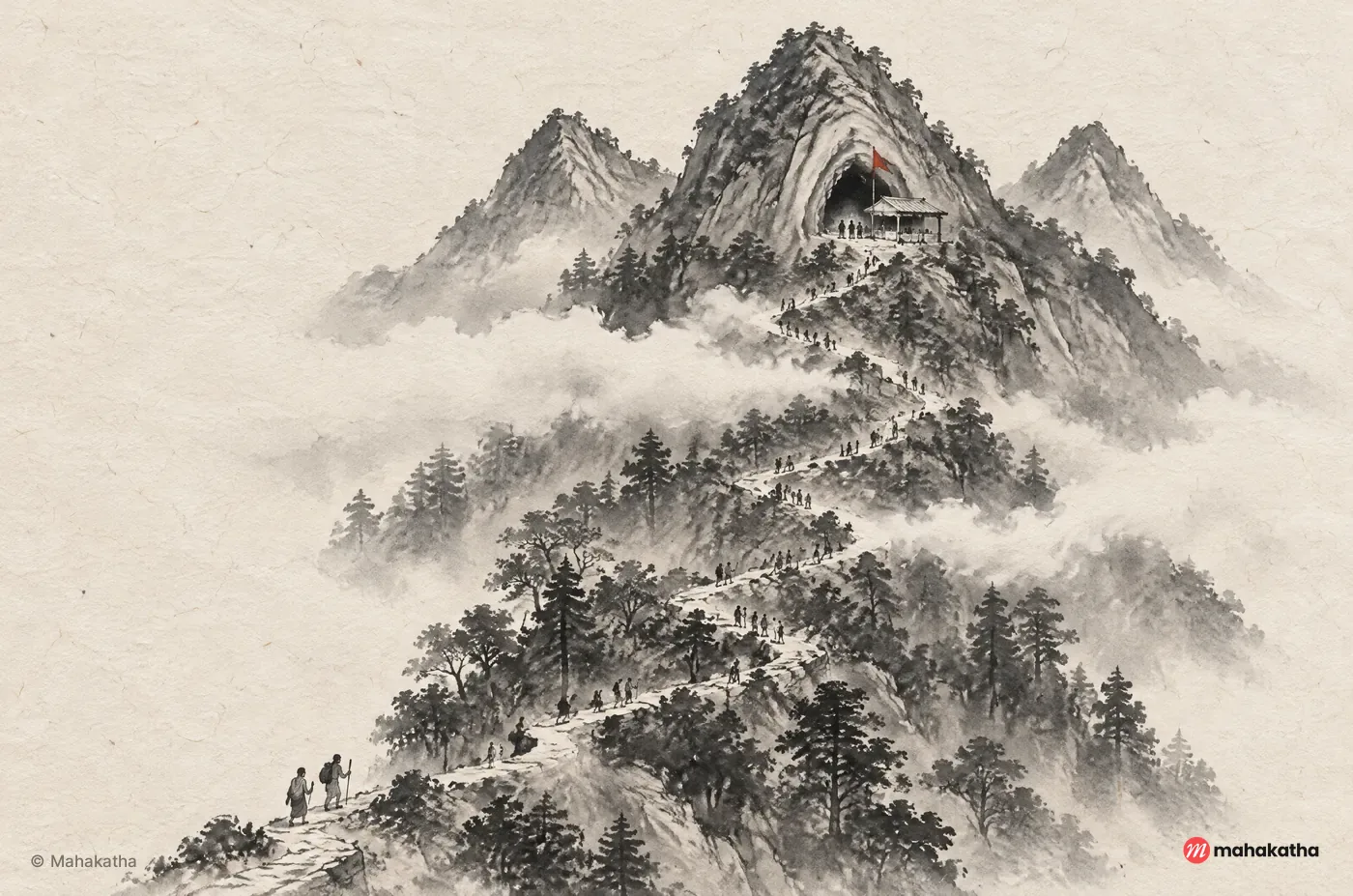
Many of her greatest shrines are Shakti Peethas. The story says Sati gave up her life at her father Daksha's fire ritual. Grieving Shiva carried her body across the world. Vishnu's discus parted it. Each place where a part fell became holy. The lists differ from text to text. Some name only four or eighteen great seats. The best-known lists count 51 or 52.
Vaishno Devi, Katra (Jammu and Kashmir)
A cave shrine high in the Trikuta hills. The goddess is seen in three natural rock forms called pindis. Pilgrims walk a long mountain path to reach her.
Kamakhya Temple, Guwahati (Assam)
A great Shakti Peetha on Nilachal hill. Tradition holds that Sati's womb fell here. The Ambubachi Mela draws pilgrims from across India.
Jwalamukhi Temple, Kangra (Himachal Pradesh)
There is no image here. The goddess is worshipped as small flames that rise from the rock.
Naina Devi Temple, Bilaspur (Himachal Pradesh)
A hilltop shrine that tradition links to the eyes of Sati.
Ambaji Temple, Banaskantha (Gujarat)
A major Shakti Peetha near the Rajasthan border. The inner shrine holds a sacred yantra instead of an image. A yantra is a holy diagram.
Kanaka Durga Temple, Vijayawada (Andhra Pradesh)
It stands on Indrakeeladri hill above the Krishna river. Dasara here draws huge crowds.
Chamundeshwari Temple, Mysuru (Karnataka)
It sits on Chamundi Hills above the city. Tradition holds that the goddess defeated Mahishasura here. Many link the name Mysuru to him.
Tulja Bhavani Temple, Tuljapur (Maharashtra)
The family goddess of many Maratha families. Shivaji is remembered as her devotee.
Mookambika Temple, Kollur (Karnataka)
A forest temple at the foot of the Kodachadri hills. Families from Kerala and Karnataka bring children here to begin their learning.
Symbols of Durga and what they mean
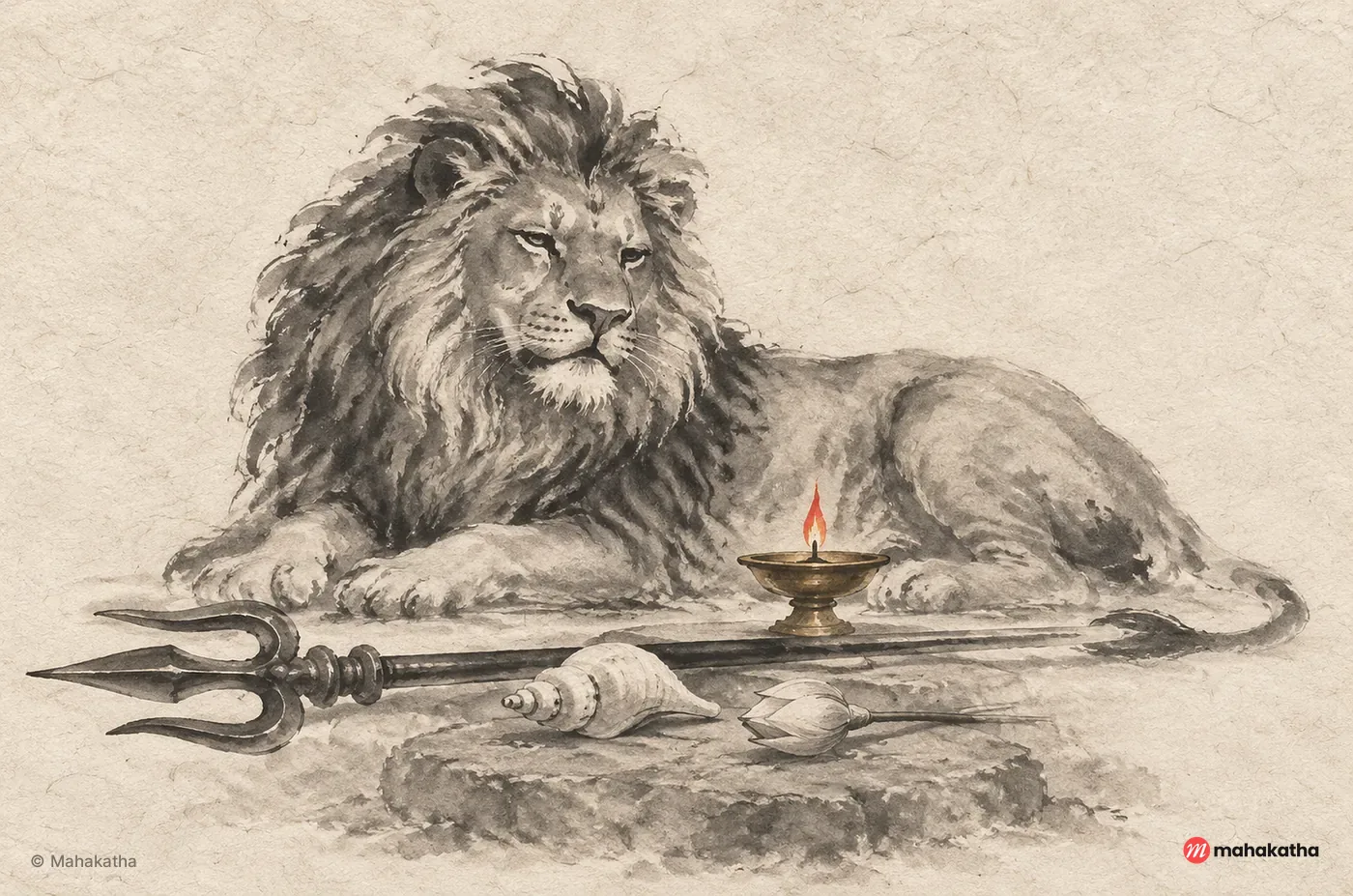
Durga's picture is full of signs. Each one points to a strength we can find in ourselves.
The lion
Her mount is a lion in most images and a tiger in some. It shows courage that is under control. Our own fire can carry us when it is guided.
Many arms
She often has eight or ten arms. They show a mother who meets every side of life at once.
The weapons
Each weapon was a gift from a god. Read inwardly they are tools to cut through fear and confusion.
The buffalo demon
Mahisha keeps changing shape. Many read him as the ego that hides in new forms. Dullness and pride were his nature.
A calm face
Look at her face in the old images. It stays calm in the middle of battle. Her strength comes from a still centre.
The raised hand
One hand often shows abhaya mudra. Abhaya means fearlessness. The gesture says do not be afraid.
Durga mantras and hymns
These lines come from our own recordings. Chant slowly. Let each line land before the next.
Ya Devi Sarva Bhuteshu
Lines from the hymn of praise in the Devi Mahatmya. “Yaa Devi Sarva Bhuteshu” is followed by “Maatru Roopena Sansthita”. It bows to the goddess who lives in all beings as the mother.
Durga Gayatri Mantra
It begins “Om Mahaadevyai Cha Vidhmahe” and ends “Thanno Devi Prachodayaat”. It asks the great goddess to light up the mind.
Durge Smrita Harasi
The verse opens “Durge Smrita Harasi Bheetim Ashesha Janthoho”. It says that when beings remember Durga she takes away their fear.
Aigiri Nandini
A rolling hymn sung across India. Its refrain is “jaya jaya he mahishasuramardini ramyakapardini shailasute ||1||” which hails her as the slayer of Mahisha.
Durga Chalisa
Forty verses in simple Hindi. A chalisa is a song of forty verses. It opens “namo namo durge sukha karani | namo namo ambe duhkha harani ||” and bows to the giver of joy.
Shailaputri Devi Mantra
For the first night of Navratri. Shailaputri means daughter of the mountain. The chant is “Om Shaam Sheem Shoom Shailaputryai Me Shubham Kuru Kuru Swaha”.
Kaalaratri Devi Mantra
For the seventh night. Kalaratri is the dark and fearless form. The chant is “Om Aim Hreem Kleem Kaalaratryai Namah”.
Durga festivals
Durga's festivals are loud with drums and soft with lamps. Each one honours the Mother's victory.
Sharad Navratri
The great autumn Navratri. Each of the nine nights honours one of the Navadurga. Navadurga means the nine Durgas.
Chaitra Navratri
A spring Navratri. In the North it often ends with Rama Navami.
Durga Puja
Bengal's great festival in the last days of the autumn Navratri. It is kept with pandals and drums. Families share food and new clothes.
Vijaya Dashami
The tenth day marks victory. The goddess wins over Mahisha. In the North Rama wins over Ravana.
Ways to bring Durga into your day
Durga is close at hand in small daily acts. Try one of these.
One line in the morning
Say Ya Devi Sarva Bhuteshu once as you light a lamp. Picture the Mother in every person you will meet.
Breathe like her lion
When fear rises sit tall. Breathe in slowly and breathe out slower. Feel steady and awake.
A little of the Chandi Path
Some families read a chapter a day in Navratri. You can begin with a single verse.
Honour the women around you
Kanya puja honours girls as the goddess. In daily life thank a mother or a teacher or a friend.
Sing the evening aarti
Jai Ambe Gauri is sung in countless homes at dusk. Sing it with the family.
A prayer for protection
The Devi Kavacham asks the goddess to guard each part of the body. Kavacham means armour.
What Durga can teach us
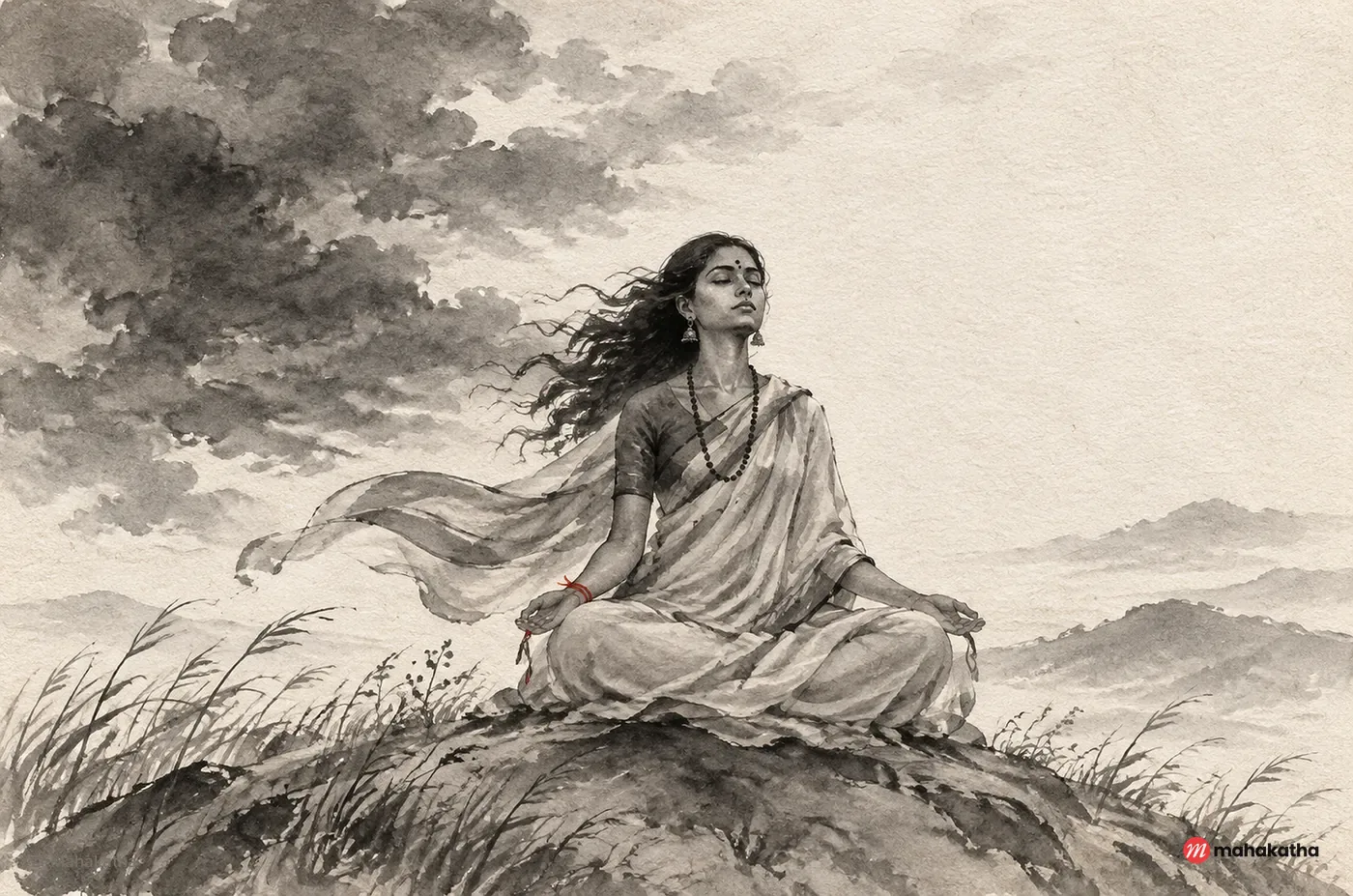
Durga is born when the gods are at their weakest. Their shared pain becomes one shining strength. When you feel defeated her story says strength can gather from many small places.
Mahisha keeps changing shape. Our fears do the same. One day it is a worry about money and the next it is a worry about family. Durga does not run from any form. She meets each one with a calm face.
The yogis say the battle is also inside us. The lion is the breath held steady. The weapons are clear seeing and kindness. Each time you pause before reacting you stand with her.
She is not only a warrior. In Bengal she is a daughter coming home. Strength and tenderness live in the same goddess. They can live in you too.
Questions people ask
Who is Goddess Durga?
Durga is the warrior form of the Divine Mother. The Devi Mahatmya tells how the light of all the gods became one goddess. She defeated the buffalo demon Mahishasura. She rides a lion and holds the weapons of the gods. Devotees pray to her for courage and protection. Her main festival is Navratri.
What is the story of Durga and Mahishasura?
The Devi Mahatmya tells that Mahishasura drove the gods from heaven. Later tellings add a boon that no man or god could defeat him. Their anger became light and the light became Durga. Each god gave her a weapon. Mahisha changed shape many times during the battle. At last she defeated him as a buffalo.
Why is Navratri celebrated for nine nights?
Navratri means nine nights. Each night honours one form of the goddess called the Navadurga. Many tellings say her battle with Mahisha lasted nine days. The tenth day is Vijaya Dashami, the day of victory. Bengal holds Durga Puja and Gujarat dances garba. The South sets up Golu dolls.
What are the nine forms of Durga?
The nine forms are called the Navadurga. They are Shailaputri and Brahmacharini. Then come Chandraghanta and Kushmanda. Skandamata and Katyayani follow. Kalaratri comes on the seventh night. Mahagauri and Siddhidatri close the nine. Each form has her own night and her own mantra in Navratri.
Which day of the week is for Goddess Durga?
Many devotees keep Tuesday for Durga. Others keep Friday for the goddess in all her forms. Customs differ from region to region and family to family. Navratri is her most important time of the year. Any day you light a lamp for her is a good day.
What is the difference between Durga and Kali?
In the Devi Mahatmya Kali springs from Durga's brow during battle. Durga is the calm warrior on a lion. Kali is her fierce dark form who rises when the fight is hardest. Many devotees see them as one Mother. They are two faces of the same power.