

Mahakatha
80% OFF
M Mahakatha
Mantras
276 sacred chants
Bhagavad Gita
701 verses with audio
Blog
Guides & stories
Get 80% OFF
Panchakshari Mantra

Panchakshari Mantra — Bengali Lyrics

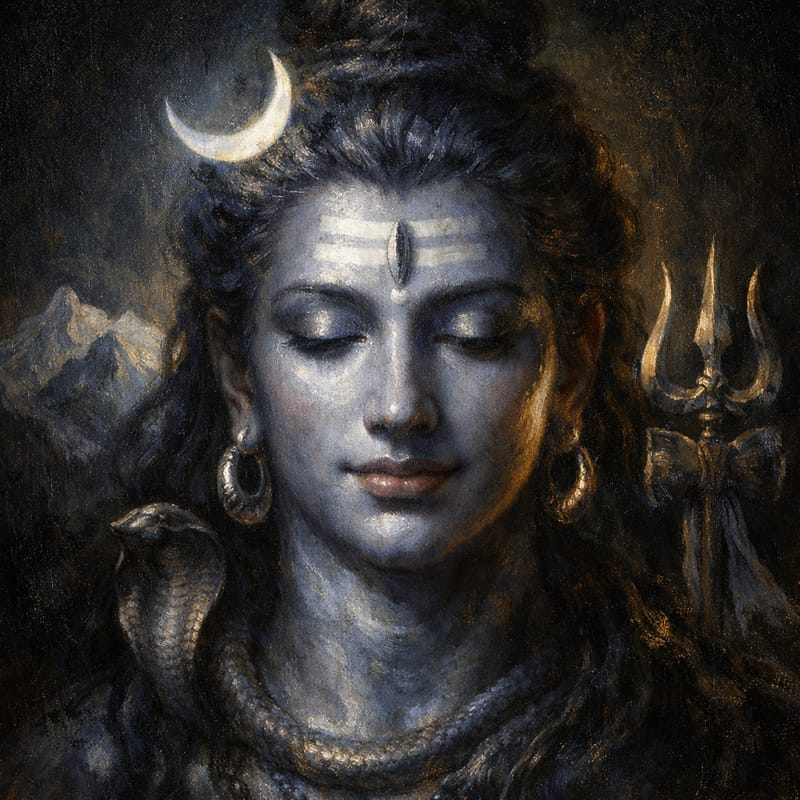
Panchakshari Mantra is an ancient Sanskrit mantra honoring Shiva that activates and balances the five elemental energies within the subtle body.

The Panchakshari Mantra—'Na-Ma-Shi-Va-Ya'—is a five-syllable invocation to Lord Shiva, the supreme deity of Hindu philosophy. Each verse addresses Shiva through different epithets and cosmic functions. The first praises Him as the eternal serpent-bearer with three divine eyes, body adorned in sacred ash. The second celebrates His connection to sacred rivers and celestial flowers. The third honors His role as the auspicious destroyer of evil and embodiment of cosmic consciousness. The fourth acknowledges the great sages who worship Him. The fifth recognizes Him as the eternal, all-pervading reality underlying all existence.

Spiritually, this mantra encodes the five elemental principles of creation (Pancha Tattva): Na (earth), Ma (water), Shi (fire), Va (air), and Ya (ether). Each syllable corresponds to a cosmic force and activates corresponding energy centers within the subtle body. Shiva, as the 'Eternal Transformer,' governs the dissolution and renewal of all existence. Chanting this mantra aligns the practitioner with these primal energies, facilitating profound inner transformation. According to Tantric traditions, the Panchakshari is among the most potent Shiva mantras, capable of awakening kundalini energy and dissolving karmic impediments when practiced with sincere devotion.

Practitioners traditionally chant the Panchakshari during early morning (brahma muhurta) or during meditation on Shiva. Begin with 108 repetitions using a mala (prayer beads), gradually increasing to 1,008 for deeper results. Chant slowly, synchronizing each syllable with breath—inhale on 'Na-Ma-Shi-Va,' exhale on 'Ya.' Maintain a clear, meditative focus on Shiva's form, the five elements, or the chakras. This mantra is suitable for beginners and advanced practitioners alike, requiring no special prerequisites beyond sincere intention.

Curated by The Mahakatha Team · Original Composition: Mahakatha · Lyric: Traditional / Shaivite

Panchakshari Mantra

Shiva · Preview · 2:00

2:00
1

नगेन्द्रहराय त्रिलोचनाय भस्मांगरागाय महेश्वराय नित्याय शुद्धाय दिगम्बराय तस्मै 'न' कराय नमः शिवाय

নগেন্দ্রহরায় ত্রিলোচনায় ভস্মাঙ্গরাগায় মহেশ্বরায় নিত্যায় শুদ্ধায় দিগম্বরায় তস্মৈ 'ন' করায় নমঃ শিবায়

যিনি পর্বতরাজকে ধারণ করেন এবং তিনটি চক্ষু বিশিষ্ট, ভস্মে রাগিত ও মহান ঈশ্বর, তাঁর কাছে 'ন' অক্ষর সহ শিবায় নমস্কার।


2

मन्दाकिनी सलिल चन्दन चर्चिताय नन्दीश्वर प्रमथनाथ महेश्वराय मन्दार पुष्प बहुपुष्प सुपूजिताय तस्मै 'म' कराय नमः शिवाय

মন্দাকিনী সলিল চন্দন চর্চিতায় নন্দীশ্বর প্রমথনাথ মহেশ্বরায় মন্দার পুষ্প বহুপুষ্প সুপূজিতায় তস্মৈ 'ম' করায় নমঃ শিবায়

যিনি মন্দাকিনীর জল এবং চন্দন দ্বারা সেবিত, নন্দী এবং গণদের প্রভু, মন্দার ফুল দ্বারা পূজিত, তাঁর কাছে 'ম' অক্ষর সহ নমস্কার।


3

शिवाय गौरी वन्दनाब्ज ब्रुन्द सूर्याय दक्षध्वर नसकाय श्री निलकण्ठाय वृषभध्वजाय तस्मै 'शि' कराय नमः शिवाय

শিবায় গৌরী বন্দনাব্জ ব্রুন্দ সূর্যায় দক্ষধ্বর নসকায় শ্রী নিলকণ্ঠায় বৃষভধ্বজায় তস্মৈ 'শি' করায় নমঃ শিবায়

যিনি গৌরীর পূজার ফুল, সূর্য এবং অগ্নির মতো, নীল গলাযুক্ত এবং বৃষ বাহনের প্রভু, তাঁর কাছে 'শি' অক্ষর সহ নমস্কার।


4

वसिष्ठ कुम्भोद्भव गौतमार्य मुनीन्द्र देवार्चित सेखराय चन्द्रार्क वैश्वनर लोचनाय तस्मै 'व' कराय नमः शिवाय

বসিষ্ঠ কুম্ভোদ্ভব গৌতমার্য মুনীন্দ্র দেবার্চিত সেখরায় চন্দ্রার্ক বৈশ্বনর লোচনায় তস্মৈ 'ব' করায় নমঃ শিবায়

যিনি বসিষ্ঠ, কুম্ভোদ্ভব এবং গৌতমদের দ্বারা পূজিত, দেবতা ও মুনিদের দ্বারা সেবিত, চন্দ্র ও সূর্যের চক্ষু বিশিষ্ট, তাঁর কাছে 'ব' অক্ষর সহ নমস্কার।


5

यज्ञ स्वरूपाय जटाधराय पिनाक हस्ताय सनातनाय दिव्य देवाय दिगम्बराय तस्मै 'य' कराय नमः शिवाय

যজ্ঞ স্বরূপায় জটাধরায় পিনাক হস্তায় সনাতনায় দিব্য দেবায় দিগম্বরায় তস্মৈ 'য' করায় নমঃ শিবায়

যজ্ঞের স্বরূপ, জটা ধারণকারী, পিনাক ধনুক হাতে বহনকারী, চিরন্তন এবং দিগম্বর দেবতা, তাঁর কাছে 'য' অক্ষর সহ নমস্কার।

Word-by-Word Meaning

Sanskrit Meaning
Nagendraharaya The one who wears the serpent king (Vasuki) as a garland; from naga (serpent) + indra (king) + hara (wearer).
Trilochanaya The three-eyed one; from tri (three) + lochan (eyes), referring to Shiva's three eyes.
Bhasmangaragaya The one who is adorned with or fond of ash; from bhasma (ash) + anga (body) + rag (color/paste).
Maheshwaraya The great lord; from maha (great) + ishwar (lord), a supreme epithet of Shiva.
Nityaya The eternal one; from nitya (eternal/perpetual), referring to timeless existence.
Suddhaya The pure one; from suddha (pure/clean), denoting spiritual purity.
Digambaraya The one clothed in space/directions; from dig (space/directions) + ambara (cloth), meaning sky-clad or unclothed ascetic.
Tasmai To him/that one; dative case of 'tat' (that), indicating the recipient of worship.
Na Not; a negation particle or prefix used in Sanskrit to negate or complement meaning.
Karaya To the maker/doer; dative form of kara (hand/maker), from kar (to do/make).
Namah I bow/salutation; from nam (to bow), expressing reverent submission.
Shivaya To Shiva/the auspicious one; dative form of Shiva, from shiv (auspicious/benevolent).
Mandakini The slow-flowing river; one of the sacred rivers, from manda (slow) + akini (flowing).
Salila Water; the liquid element, often used to denote sacred waters.
Chandana Sandalwood; a fragrant wood used in worship and adornment, from chanda (cooling).
Charchitaya The one who is smeared/anointed; from charchi (to smear/anoint), describing ritual application.
Nandishwara The lord of joy/Nandi; referring to Shiva's sacred bull companion, from nandi (joy) + ishwar (lord).
Pramathanatha The lord of the attendants/goblins; from pramatha (attendant spirits) + natha (lord).
Maheswaraya The great lord; from maha (great) + ishwar (lord), identical to Maheshwaraya.
Mandara The celestial tree of paradise; the divine wishing tree in Hindu cosmology.
Pushpa Flower; a sacred offering in worship rituals.
Bahupushpa Many flowers; from bahu (many) + pushpa (flower), indicating abundant floral offerings.
Supujitaya The one who is well-worshipped; from su (good/well) + puja (worship) + ita (past participle).
Ma Not/me; can mean negation or the first person, context-dependent.
Gauri The golden/fair one; a name of Shiva's consort Parvati, from gaur (fair/golden).
Suryaya The sun; to the sun, used as a simile for luminous divine nature.
Sri Radiance/prosperity; an auspicious prefix or title of reverence.
Nilakanthaya The blue-throated one; from nila (blue) + kantha (throat), referring to Shiva drinking poison.
Vrshabhadhvajaya The one whose banner is the bull; from vrshabha (bull) + dhvaja (banner/flag).
Vasishta The richest/most excellent; a revered sage name, from vasu (wealth) + ishta (desired).
Kumbhodbhava Born from a pot; referring to the sage Agastya, from kumbha (pot) + udbhava (born).
Munindra Lord of sages; from muni (sage) + indra (king/chief).
Devarchita Worshipped by the gods; from deva (god) + archita (worshipped).
Sekharaya The one with a crest/crown; from sekhar (crest/crown), referring to ornamental headpiece.
Chandrarka Moon and sun; from chandra (moon) + arka (sun), indicating cosmic duality.
Vaishwanara The universal fire/Agni; from vishwa (universal) + nara (fire/man).
Lochanaya To the one with eyes; from lochan (eyes), dative form.
Yagya Sacrifice/ritual; a sacred ceremony or worship offering, from yaj (to worship/sacrifice).
Svarupaya The true form/essential nature; from sva (own/self) + rupa (form).
Jatadharaya The one who wears matted locks; from jata (matted hair) + dhara (wearer).
Pinaka The bow of Shiva; his celestial weapon, also called Pinakasana.
Hastaya To the one with a hand/to the hand; from hasta (hand), dative form.
Sanatanaya The eternal one; from sanatan (eternal/primordial), dative form.
Divaya The divine/shining one; from div (to shine/divine), dative form.
Devaya The god/divine being; dative form of deva (god).

How to Chant Panchakshari Mantra

  1. 1

    Find a quiet, clean space

    Sit in a comfortable, undisturbed environment. Face east or north if possible. You may light incense or a candle to set a contemplative atmosphere.

  2. 2

    Settle into a comfortable posture

    Sit cross-legged on the floor or upright in a chair. Keep the spine erect and place the hands on the knees with palms facing upward.

  3. 3

    Take three cleansing breaths

    Inhale slowly through the nose, hold briefly, and exhale completely. Repeat three times to calm the mind and prepare for mantra recitation.

  4. 4

    Begin chanting Panchakshari Mantra

    Chant the mantra clearly and with devotion — aloud, in a whisper, or silently. Use a mala (108 beads) to count repetitions. Aim for a consistent, unhurried rhythm throughout the session.

  5. 5

    Rest in stillness

    After completing your chanting, sit quietly for two to five minutes. Allow the vibration of the mantra to settle within. Close the practice with a moment of gratitude.

Benefits of Panchakshari Mantra

  • Activates and balances the five elemental energies (earth, water, fire, air, ether) within the subtle body, creating integrated awareness across all dimensions of self.

    Source: Shiva Samhita, Tantric traditions

  • Dissolves mental fatigue and psychosomatic stress by harmonizing the nervous system and restoring energetic equilibrium through rhythmic vibration.

    Source: Traditional practice, Yoga philosophy

  • Awakens kundalini energy and purifies the chakra system, particularly activating the throat and heart centers associated with divine expression and compassion.

    Source: Kundalini Tantra, Kula Arnava Tantra

  • Facilitates liberation (moksha) by attenuating ego-centered consciousness and aligning individual awareness with Shiva's transcendent, unchanging nature.

    Source: Upanishadic philosophy, Advaita Vedanta

  • Protects against negative influences and obstacles by invoking Shiva's destructive power directed toward removal of ignorance and karmic impediments.

    Source: Traditional practice, Puranic literature

Deity Shiva
Composition Mahakatha (Original) · Traditional / Shaivite (Lyric)
Also called Panchakshari Mantra · Namah Shivaya Mantra · Shiva Panchakshari · Shiva Mantra · Panchakshari Stotram · Namah Shivaya Chant
Shiva also known as Mahadeva · Maheshwara · Shankar · Bholenath · Nataraja

Story & Symbolism

The Panchakshari Mantra, consisting of the five sacred syllables "Na-Ma-Shi-Va-Ya," is traditionally attributed to the ancient sage Lakulisha, though some Shaiva texts suggest its origins trace even deeper into the pre-Vedic traditions of Shaivism. According to Puranic tradition, this mantra emerged as the distilled essence of Shiva's infinite nature, captured in five syllables that correspond to the five cosmic elements: earth, water, fire, air, and ether. The mantra appears prominently in classical texts like the Shiva Purana and various Upanishads, where it is presented not merely as a prayer, but as a direct pathway to understanding the fundamental reality of existence. Scholars suggest that its systematic organization into five distinct sounds reflects the sophisticated metaphysical philosophy developed within Shaivism, where everything in the universe can be understood through the lens of these elemental principles.

Spiritually, the Panchakshari Mantra holds extraordinary significance because each syllable is believed to carry the vibration of Shiva's cosmic consciousness. When practitioners chant "Na-Ma-Shi-Va-Ya," they are not simply invoking a deity; they are aligning themselves with the universal principle of transformation, dissolution, and renewal that Shiva represents. The mantra is understood as a meditation on the eternal cycle of creation and destruction, on consciousness itself. For devotees, recitation of this mantra is said to purify the mind, dissolve the ego, and gradually reveal the eternal, unchanging reality that underlies all phenomenal experience.

What makes the Panchakshari Mantra particularly accessible and beloved across Hindu traditions is its perfect balance of simplicity and depth. Whether whispered silently during meditation, chanted aloud in ritual settings, or simply held in the heart throughout daily life, the mantra serves as both a spiritual tool and a philosophical statement. It reminds practitioners that the Divine is not distant or abstract, but present in every breath, every moment of awareness, woven into the very fabric of existence itself.

How to Use in Daily Life

🌅

Dawn Practice

Chant 108 repetitions during Brahma Muhurta (pre-sunrise hours) when cosmic energies are most conducive to spiritual work. Face east or north, sit with spine erect, and begin with three conscious breaths before starting.

🧘

Meditation Focus

Use the Panchakshari as your primary mantra during seated meditation. Synchronize each syllable with breath, visualizing Shiva's form or focusing on the heart chakra. Allow the mantra to flow naturally, becoming one with your inner rhythm.

🙏

Devotional Ritual

Incorporate into daily puja (worship) or evening practice with a mala. Chant 324 repetitions slowly and reverently, dedicating the practice to spiritual awakening or specific intentions aligned with Shiva's grace.

💤

Sleep Integration

Chant softly before sleep to calm the mind and purify consciousness during dreams. This deepens rest quality and accelerates inner transformation at the subconscious level. Use 27–54 repetitions gently.

Frequently Asked Questions

What is the Panchakshari Mantra and why is it sacred to Shiva?
The Panchakshari Mantra, meaning 'five-syllable mantra,' is the sacred invocation 'Namah Shivaya.' Each syllable carries profound spiritual significance: 'Na' represents earth, 'Ma' represents water, 'Shi' represents fire, 'Va' represents air, and 'Ya' represents ether. Together, these five elements unite in the invocation of Lord Shiva, the supreme consciousness. According to Hindu philosophy, Shiva embodies the infinite cosmic energy and serves as the destroyer and transformer in the divine trinity. This mantra is considered one of the most powerful and accessible mantras in Hinduism, traditionally believed to invoke Shiva's grace and protective energy. The simplicity of its five syllables makes it universally adaptable across different spiritual traditions and meditation practices. Scholars suggest that the Panchakshari Mantra represents the dissolution of ego and the merger of individual consciousness with the universal divine consciousness. It is revered in both Shaivite and broader Hindu practices as a gateway to spiritual awakening and inner transformation.
What are the spiritual and practical benefits of chanting the Panchakshari Mantra?
Practitioners traditionally believe that consistent chanting of the Panchakshari Mantra brings numerous spiritual and practical benefits. Spiritually, it is said to elevate consciousness, deepen meditation, and facilitate connection with Shiva's transcendent energy. Many devotees report experiencing inner peace, mental clarity, and emotional stability through regular practice. According to Shaivite traditions, the mantra purifies the mind of negative thoughts and karmic imprints, creating space for divine grace. On a practical level, chanting is believed to reduce stress and anxiety, improve concentration, and enhance overall well-being. The rhythmic repetition engages the mind in a focused manner, naturally quieting mental chatter. Traditionally, it is said to protect practitioners from negative influences and obstacles in life. Some practitioners report improved sleep quality and greater emotional resilience. The mantra is also believed to strengthen one's connection to the present moment and foster a sense of spiritual purpose. Many traditions suggest that regular chanting creates a vibrational alignment with Shiva's cosmic consciousness, fostering personal transformation and spiritual growth over time.
How should I chant the Panchakshari Mantra for maximum benefit?
For effective practice of the Panchakshari Mantra, begin by finding a clean, quiet space where you can sit comfortably in a meditative posture. Traditional practice suggests chanting during Brahma Muhurta (early morning hours) or in the evening, though any time with sincere intention is beneficial. Start by taking several deep breaths to center yourself. Chant 'Namah Shivaya' aloud or mentally, pronouncing each syllable clearly: Na-mah Shi-va-ya. Maintain a steady rhythm and allow the sound to resonate within your being. Many practitioners use prayer beads (mala) to count repetitions, traditionally performing 108 repetitions or multiples thereof. You may chant continuously for 5-30 minutes depending on your practice level. Focus your attention on the sound and its vibration, allowing thoughts to pass without engagement. Some traditions suggest visualizing Lord Shiva or blue light while chanting. Maintain consistency by establishing a regular daily practice, even if brief. It is traditionally believed that sincere intention and devotion matter more than perfect pronunciation. As you progress, the mantra may flow naturally during daily activities, deepening its transformative effect.
What is the historical and scriptural origin of the Panchakshari Mantra?
The Panchakshari Mantra, 'Namah Shivaya,' originates from ancient Vedic and Puranic traditions of Hinduism. According to Shaivite scriptures and philosophical texts, this mantra represents the fundamental principle of existence and divine consciousness. The Shiva Purana and various Upanishads reference this sacred invocation, though scholars suggest its oral transmission predates written documentation by centuries. The mantra gained significant prominence during the Shaivite revival in South India, particularly during the medieval period when great saints like Adi Shankara and other Shaivite philosophers elevated its spiritual significance. Traditional accounts suggest that the mantra embodies eternal wisdom passed down through generations of enlightened masters and yogis. The five syllables are sometimes associated with the Panchakshara Upanishad, an ancient text dedicated to understanding the deeper meaning of these sacred sounds. According to Shaivite theology, Lord Shiva himself is said to represent the Panchakshari principle. The mantra's simplicity and power made it accessible across all social classes and regions, contributing to its widespread adoption throughout Hindu civilization. Its popularity endures today as one of Hinduism's most universally recognized and practiced sacred utterances.
How do I pronounce the Panchakshari Mantra correctly?
Proper pronunciation of 'Namah Shivaya' ensures optimal vibrational resonance and spiritual benefit. Break the mantra into five distinct syllables: Na-mah Shi-va-ya. Pronounce 'Na' like the 'na' in 'natural,' allowing the sound to initiate from the base of your throat. 'Mah' rhymes with 'bah' in 'father,' giving equal emphasis to both syllables of 'Namah.' 'Shi' sounds like 'shee' in 'sheet,' with a soft 'sh' sound. 'Va' pronounced like 'wah' in 'water,' with a gentle 'v' sound. 'Ya' sounds like 'yah' in 'yard.' When chanting, maintain steady pacing and give each syllable equal emphasis: NAH-mah SHEE-vah-yah. Traditionally, the flow should feel natural and rhythmic, not forced or hurried. Some practitioners elongate the vowels slightly for deeper resonance, while others maintain a quicker pace during meditation. The Sanskrit 'h' after syllables is often pronounced subtly as a gentle breath release. Many online resources and audio recordings by experienced practitioners provide excellent guidance for developing proper intonation. What matters most is sincere pronunciation with focused intention—minor variations in accent do not diminish the mantra's spiritual efficacy.
What is the Shiva Panchakshari mantra?
The Panchakshari mantra is **"Namah Shivaya"** — five sacred syllables invoking Lord Shiva, the supreme consciousness and destroyer of ignorance in Hindu philosophy. Each syllable corresponds to the five elements: Na (earth), Ma (water), Shi (fire), Va (air), and Ya (ether), creating a complete vibrational map of cosmic forces within the subtle body. Revered across Shaivite traditions and documented in the Upanishads and Tantric texts, this mantra activates the chakra system while dissolving ego-centered patterns. Regular chanting harmonizes the nervous system, awakens kundalini energy, and aligns individual consciousness with Shiva's transcendent, unchanging nature—facilitating the liberation (moksha) that forms the ultimate goal of Hindu spiritual practice.
Can anyone chant Shiva Panchakshari?
Yes, the Panchakshari Mantra ("Namah Shivaya") is universally accessible and requires no initiation, caste, or gender restrictions. Unlike secret tantric practices, this five-syllable mantra has been chanted publicly for millennia across Hindu and Buddhist traditions as a direct means of invoking Shiva's transformative power. The Shiva Purana explicitly affirms that sincere practice—regardless of one's background—activates the mantra's potency in balancing elemental energies, purifying the chakras, and dissolving mental fatigue. For deepest results, practitioners benefit from consistency, proper pronunciation, and intention-setting, though even casual chanting generates measurable benefits through the vibrational frequencies that harmonize the nervous system.
What happens if we chant Panchakshari Mantra?
Regular chanting of Panchakshari Mantra creates measurable shifts in your mental, emotional, and spiritual state. Activates and balances the five elemental energies (earth, water, fire, air, ether) within the subtle body, creating integrated awareness across all dimensions of self.. Dissolves mental fatigue and psychosomatic stress by harmonizing the nervous system and restoring energetic equilibrium through rhythmic vibration.. Awakens kundalini energy and purifies the chakra system, particularly activating the throat and heart centers associated with divine expression and compassion.. Most practitioners notice a tangible difference within the first week of daily practice — start with 108 repetitions using a mala and observe how your inner state transforms.

Related Prayers & Chants

🪘

Ancient Chants — Gold Edition

Get access to ancient meditation mantras. 80% OFF for limited time.

Get 80% OFF →