

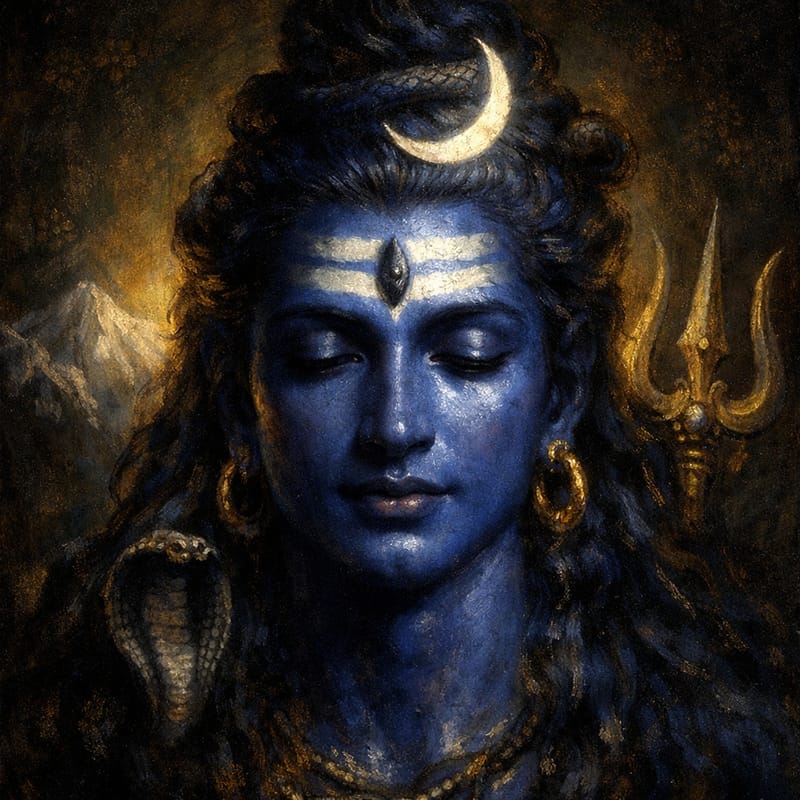
Mahaadeva Mahaakaala Maheshwaraaya Namah Mantra — Telugu Lyrics
Mahaadeva Mahaakaala Maheshwaraaya Namah Mantra is a sacred Sanskrit mantra honoring Shiva, awakening transcendence and dissolving fear of death and impermanence.
This sacred mantra is a direct invocation of Lord Shiva through three of his supreme epithets. Mahaadeva (महादेव) means 'the Great God' or 'the Lord of Lords,' acknowledging Shiva's transcendent position above all other deities. Mahaakaala (महाकाल) literally translates to 'the Great Time' or 'Master of All Times,' representing Shiva's dominion over past, present, and future—he alone stands beyond the cycles of creation and dissolution. Maheshwaraaya (महेश्वराय) means 'to the Great Lord' or 'the Supreme Controller,' emphasizing his role as the ultimate governing consciousness of the universe. Namah (नमः) is a bow of absolute surrender and reverence.
In Shiva Purana and Tantric philosophy, this mantra encapsulates the three-fold power of Shiva: his transcendence as pure consciousness (Mahaadeva), his mastery over temporal cycles and the dissolution of universes (Mahaakaala), and his absolute sovereignty as the supreme reality (Maheshwaraaya). When chanted with sincere devotion, the mantra awakens awareness of Shiva's omnipotence and the seeker's own divine essence. This is not merely petition but recognition—an acknowledgment that consciousness itself is the ultimate lord. The mantra dissolves ego boundaries and opens pathways to self-realization.
Chant this mantra during Shiva-focused spiritual practices, particularly on Mondays, during Shivaratri, or in meditation at dawn and dusk. Begin with 108 repetitions using a mala (prayer beads), or chant until you experience natural stillness. Focus your mind at the third eye center (ajna chakra). This mantra is best practised when preceded by pranayama (breath work) and followed by silent meditation, allowing its effect to settle into your consciousness.
Curated by The Mahakatha Team · Original Composition: Mahakatha · Lyric: Traditional / Shaivite
Mahaadeva Mahaakaala Maheshwaraaya Namah Mantra
Shiva · Preview · 2:00
Preview ended
Ancient sounds for transformation, carried across 3,000 years.
Get the full version — plus 275 more ancient chants. 80% OFF today only.
Get Ancient Chants Bundle — 80% OFF →3000+ happy customers · Lifetime access · All devices
2.2M people trust Mahakatha
Chant daily with reminders — Get the Mahakatha app
Lyrics
महादेव महाकाल महेश्वराय नमः
మహాదేవ మహాకాల మహేశ్వరాయ నమః
ఓ పరమ దేవత, కాలానికి మరియు వినాశనానికి అధిపతి
సర్వ జీవులకు పాలకుడా, మేము నిన్ను గౌరవిస్తున్నాము.
How to Chant Mahaadeva Mahaakaala Maheshwaraaya Namah Mantra
- 1
Find a quiet, clean space
Sit in a comfortable, undisturbed environment. Face east or north if possible. You may light incense or a candle to set a contemplative atmosphere.
- 2
Settle into a comfortable posture
Sit cross-legged on the floor or upright in a chair. Keep the spine erect and place the hands on the knees with palms facing upward.
- 3
Take three cleansing breaths
Inhale slowly through the nose, hold briefly, and exhale completely. Repeat three times to calm the mind and prepare for mantra recitation.
- 4
Begin chanting Mahaadeva Mahaakaala Maheshwaraaya Namah Mantra
Chant the mantra clearly and with devotion — aloud, in a whisper, or silently. Use a mala (108 beads) to count repetitions. Aim for a consistent, unhurried rhythm throughout the session.
- 5
Rest in stillness
After completing your chanting, sit quietly for two to five minutes. Allow the vibration of the mantra to settle within. Close the practice with a moment of gratitude.
Benefits of Mahaadeva Mahaakaala Maheshwaraaya Namah Mantra
-
Awakens inner transcendence and connection to pure consciousness beyond ego and time
Source: Shiva Purana and Tantric Sadhana traditions
-
Dissolves fear of death and impermanence by aligning awareness with the eternal master of time
Source: Upanishadic wisdom and Yoga Sutras of Patanjali
-
Supports meditative depth and spiritual experience through steady chanting of sacred names
Source: Traditional practice and Mantra Yoga texts
-
Devotees chant it to ask for release from karmic blocks and emotional suffering through Shiva's power of cosmic transformation
Source: Shiva Samhita and Kashmir Shaivism
-
Strengthens willpower, discipline, and capacity to overcome obstacles with divine grace
Source: Bhagavata Purana and devotional practice lineages
Story & Symbolism
The epithets Mahaadeva, Mahaakaala, and Maheshwaraaya have roots extending deep into Vedic and Puranic traditions, spanning thousands of years. The Shiva Purana, composed between the 8th and 14th centuries CE, systematically glorifies Shiva through these very names, establishing them as core appellations in devotional practice. The Vedic Rudra hymns (Rudra Sukta from Yajurveda) laid early foundations for this theological framework, identifying the cosmic destroyer-god with transcendent consciousness. Tantric texts, particularly from Kashmir Shaivism (9th–12th centuries CE), elevated these names into sophisticated meditation and mantra practices, recognizing that divine names aren't mere labels but vehicles of consciousness itself.
Shiva's identity as Mahaakaala—Master of Time—crystallized in Tantric cosmology, where he stands beyond the cycles of creation and destruction that govern all other beings. This concept appears nowhere more vividly than in the meditation forms associated with Kali and Mahakali, where time itself becomes visible as Shiva's cosmic play. Maheshwaraaya (Supreme Ruler) connects to the philosophical understanding of Brahman—the non-dual absolute—as the ultimate reality. Mahaadeva (Great God) acknowledges his supremacy within the Hindu theological hierarchy. Together, these three names form a complete invocation: transcendent consciousness, mastery over cosmic time, and absolute sovereignty.
This specific mantra formulation became widely chanted as a complete unit from the medieval period onward, particularly within Shaiva traditions and amongst practitioners of Kundalini Yoga. Modern transmission through authentic teachers, ashrams, and Vedic schools has preserved both the mantra and its proper chanting methodology. Today, it remains one of the most direct and powerful ways to invoke Shiva's presence and grace, crossing all sectarian boundaries within Hindu spirituality.
How to Use in Daily Life
Dawn Awakening
Chant this mantra at sunrise (pre-dawn) facing east. Begin with 3 deep breaths, then recite 27–54 times using a mala. The early morning light amplifies spiritual receptivity and aligns you with Shiva's transcendent consciousness for the day ahead.
Meditation Core
Use this mantra as your primary focus during meditation. After 10 minutes of breath work, begin chanting slowly and inwardly, allowing each word to settle in the heart center. Continue for 20–30 minutes, then sit in silence, observing the mantra's quiet aftereffect.
Evening Devotion
At dusk, chant 108 repetitions in a quiet space with a lit lamp nearby (symbolizing inner light). This evening practice honors the day's completion and invokes Shiva's grace for deep sleep and spiritual dreams. Feel genuine reverence with each bow (Namah).
Night Integration
Before sleep, whisper the mantra 3 times slowly, visualizing Shiva's infinite form dissolving into cosmic consciousness. This practice carries the day's spiritual work into the dream realm and supports the unconscious mind's alignment with divine truth.