

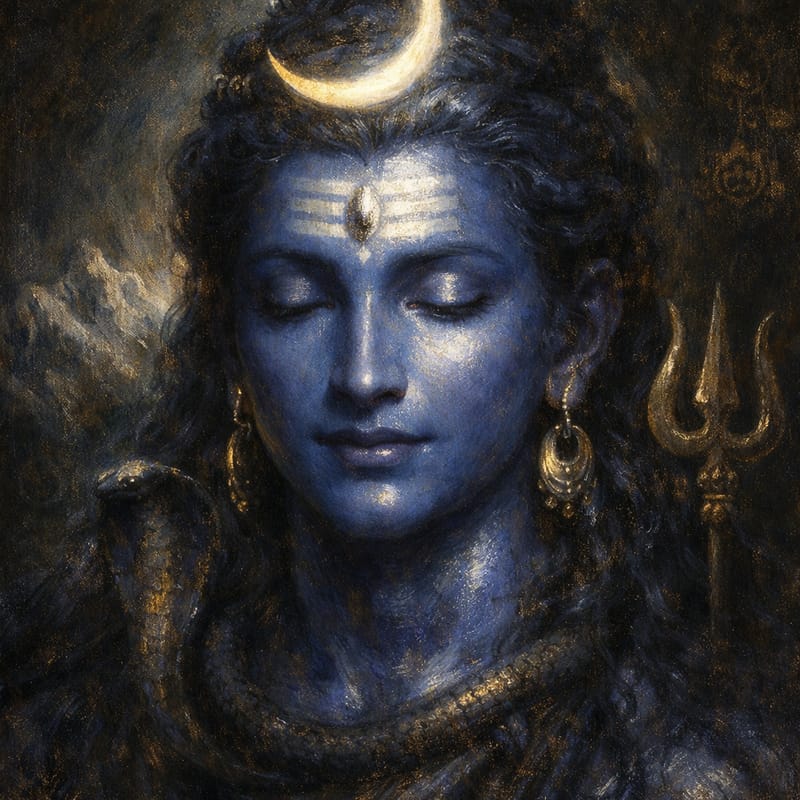
Lingashtakam — German Lyrics
Lingashtakam Mantra is an ancient Sanskrit hymn dedicated to Shiva, chanted to awaken pure devotion and, devotees believe, to loosen ego and karmic impurities.
Lingashtakam is an eight-verse Sanskrit hymn of praise dedicated to Shiva in His manifestation as the Linga—the formless, omnipresent symbol of divine consciousness. Each verse celebrates the Linga's attributes: its worship by celestial beings (Brahma, Vishnu, sages, and gods), its adornments (gold, jewels, serpents, sandalwood, and saffron), and, in the hymn's words, its supreme power to destroy suffering, ego, and karmic bondage. The refrain in each verse—Tat pranamami Sadashiva Lingam (I bow to that eternal Shiva Linga)—anchors the devotee's surrender and reverence to the cosmic form of Shiva.
In Shaivism, the Linga represents the formless, transcendent aspect of Shiva—beyond image, beyond gender, beyond limitation. Unlike idol worship, the Linga symbolizes the pillar of light (jyotir-linga) that emerged from the earth in the Shiva Purana, representing the infinite nature of consciousness itself. By meditating on the Linga's eight aspects—its worship by devas and rishis, its radiance, its grace, its power to dissolve ego and sin—the devotee aligns with Shiva's liberating force. This mantra transforms intellectual understanding into lived devotion, burning away attachments and ignorance.
Chant Lingashtakam during morning meditation, in temples, or at Shiva shrines for the deepest sense of devotion. Begin with respectful intention (sankalpa) toward Shiva. Recite slowly, savoring each Sanskrit syllable, allowing the rhythm to calm the mind and awaken inner devotion. Repetition (108 times or one full round) amplifies benefits. Best chanted on Mondays, Shivaratri, or during lunar eclipses. Even daily chanting—5 to 10 minutes—cultivates profound peace and protects the household.
Curated by The Mahakatha Team · Original Composition: Mahakatha · Lyric: Adi Shankaracharya (8th century CE)
Lingashtakam
Shiva · Preview · 2:00
Preview ended
Ancient sounds for transformation, carried across 3,000 years.
Get the full version — plus 275 more ancient chants. 80% OFF today only.
Get Ancient Chants Bundle — 80% OFF →3000+ happy customers · Lifetime access · All devices
2.2M people trust Mahakatha
Chant daily with reminders — Get the Mahakatha app
ब्रह्ममुरारिसुरार्चितलिङ्गं निर्मलभासितशोभितलिङ्गम् । जन्मजदुःख… जन्मजदुःखविनाशकलिङ्गं तत् प्रणमामि सदाशिवलिङ्गम् ॥ १॥
brahmamurarisurarchitalingam nirmalabhasitashobhitalingam | janmajaduhkha… janmajaduhkhavinashakalingam tat pranamami sadashivalingam || 1||
Das Linga, verehrt von Brahma, Vishnu und allen Göttern,
das Linga, das rein und strahlend ist,
das Linga, das die Leiden dieser sterblichen Geburt zerstört,
vor diesem Sadashiva Linga verneige ich mich demütig.
देवमुनिप्रवरार्चितलिङ्गं कामदहम् करुणाकर लिङ्गम् । रावणदर्प… रावणदर्पविनाशनलिङ्गं तत् प्रणमामि सदाशिव लिङ्गम् ॥ २॥
devamunipravararchitalingam kamadaham karunakara lingam | ravanadarpa… ravanadarpavinashanalingam tat pranamami sadashiva lingam || 2||
Das Linga, verehrt von den Weisen,
der Zerstörer von Kama, dennoch der ewig Mitfühlende,
der Vernichter von Ravanas Arroganz,
vor diesem Sadashiva Linga verneige ich mich demütig.
सर्वसुगन्धिसुलेपितलिङ्गं बुद्धिविवर्धनकारणलिङ्गम् । सिद्धसुरासुर… सिद्धसुरासुरवन्दितलिङ्गं तत् प्रणमामि सदाशिव लिङ्गम् ॥ ३॥
sarvasugandhisulepitalingam buddhivivardhanakaranalingam | siddhasurasura… siddhasurasuravanditalingam tat pranamami sadashiva lingam || 3||
Das Linga, das mit göttlichen Düften angereichert ist,
derjenige, der die Entfaltung des Intellekts bewirkt,
derjenige, der von den Siddhas, Devas und Asuras verehrt wird,
vor diesem Sadashiva Linga verneige ich mich demütig.
कनकमहामणिभूषितलिङ्गं फणिपतिवेष्टित शोभित लिङ्गम् । दक्षसुयज्ञ… दक्षसुयज्ञविनाशनलिङ्गं तत् प्रणमामि सदाशिव लिङ्गम् ॥ ४॥
kanakamahamanibhushitalingam phanipativeshtita shobhita lingam | dakshasuyajna… dakshasuyajnavinashanalingam tat pranamami sadashiva lingam || 4||
Das Linga, geschmückt mit Gold und kostbaren Juwelen,
ewig strahlend, umkränzt vom König der Schlangen,
das Linga, das das heilige Feuer von Daksha zerstörte,
vor diesem Sadashiva Linga verneige ich mich demütig.
कुङ्कुमचन्दनलेपितलिङ्गं पङ्कजहारसुशोभितलिङ्गम् । सञ्चितपाप… सञ्चितपापविनाशनलिङ्गं तत् प्रणमामि सदाशिव लिङ्गम् ॥ ५॥
kunkumachandanalepitalingam pankajaharasushobhitalingam | sanchitapapa… sanchitapapavinashanalingam tat pranamami sadashiva lingam || 5||
Das Linga, bedeckt mit Safran und Sandelholzpaste,
bekränzt mit Lotusblumen, die Glanz bringen,
das Linga, das alle Sünden hinwegwäscht,
vor diesem Sadashiva Linga verneige ich mich demütig.
देवगणार्चित सेवितलिङ्गं भावैर्भक्तिभिरेव च लिङ्गम् । दिनकरकोटि… दिनकरकोटिप्रभाकरलिङ्गं तत् प्रणमामि सदाशिव लिङ्गम् ॥ ६॥
devaganarchita sevitalingam bhavairbhaktibhireva cha lingam | dinakarakoti… dinakarakotiprabhakaralingam tat pranamami sadashiva lingam || 6||
Das Linga, das Verehrung und Opfergaben von den Göttern empfängt,
das Linga, das mit reiner Hingabe verehrt wird,
das Linga, das so strahlend ist wie eine Million Sonnen,
vor diesem Sadashiva Linga verneige ich mich demütig.
अष्टदलोपरिवेष्टितलिङ्गं सर्वसमुद्भवकारणलिङ्गम् । अष्टदरिद्र… अष्टदरिद्रविनाशितलिङ्गं तत् प्रणमामि सदाशिव लिङ्गम् ॥ ७॥
ashtadalopariveshtitalingam sarvasamudbhavakaranalingam | ashtadaridra… ashtadaridravinashitalingam tat pranamami sadashiva lingam || 7||
Das Linga, umgeben von achtfachen Blütenblättern,
das Linga, das die Quelle und Ursache aller Schöpfung ist,
der Zerstörer aller acht Formen der Armut,
vor diesem Sadashiva Linga verneige ich mich demütig.
सुरगुरुसुरवरपूजित लिङ्गं सुरवनपुष्प सदार्चित लिङ्गम् । परात्परं… परात्परं परमात्मक लिङ्गं तत् प्रणमामि सदाशिव लिङ्गम् ॥ ८॥
suragurusuravarapujita lingam suravanapushpa sadarchita lingam | paratparam… paratparam paramatmaka lingam tat pranamami sadashiva lingam || 8||
Das Linga, verehrt vom Meister der Götter und den Gurus,
das Linga, das mit den göttlichen Blumen beladen ist,
das Linga, das höher ist als alles, das höchste Selbst,
vor diesem Sadashiva Linga verneige ich mich demütig.
लिङ्गाष्टकमिदं पुण्यं यः पठेशिवसन्निधौ । शिवलोकमवाप्नोति शिवेन सह मोदते ॥
lingashtakamidam punyam yah patheshivasannidhau | shivalokamavapnoti shivena saha modate ||
Derjenige, der dieses Lingashtakam mit reinem Herzen rezitiert,
wird seine Zuflucht und seinen göttlichen Schutz erhalten.
How to Chant Lingashtakam
- 1
Find a quiet, clean space
Sit in a comfortable, undisturbed environment. Face east or north if possible. You may light incense or a candle to set a contemplative atmosphere.
- 2
Settle into a comfortable posture
Sit cross-legged on the floor or upright in a chair. Keep the spine erect and place the hands on the knees with palms facing upward.
- 3
Take three cleansing breaths
Inhale slowly through the nose, hold briefly, and exhale completely. Repeat three times to calm the mind and prepare for mantra recitation.
- 4
Begin chanting Lingashtakam
Chant the mantra clearly and with devotion — aloud, in a whisper, or silently. Use a mala (108 beads) to count repetitions. Aim for a consistent, unhurried rhythm throughout the session.
- 5
Rest in stillness
After completing your chanting, sit quietly for two to five minutes. Allow the vibration of the mantra to settle within. Close the practice with a moment of gratitude.
Benefits of Lingashtakam
-
Awakens pure devotion and surrender to the divine principle beyond form
Source: Shiva Purana — emphasis on Linga worship as pathway to moksha
-
Dissolves ego, pride, and arrogance (symbolized by Ravana's destruction)
Source: Traditional Shaivite practice and verse 2 symbolism
-
Purifies the mind and, as tradition holds, clears accumulated karmic seeds (papanashana)
Source: Verse 5: Sanchitapapa-vinashana-lingam
-
Enhances intellect, intuition, and spiritual discrimination
Source: Verse 3: Buddhivivardhana-karana-lingam — Traditional practice
-
A prayer for protection against outer and inner obstacles
Source: Verses 2 & 4 — Ravana-darpa and Daksha-yagna destruction symbolism
-
Radiates luminous peace and inner stability, steadying the mind
Source: Verse 6: Dinakara-koti-prabha-kara-lingam — Traditional meditation texts
Story & Symbolism
Lingashtakam emerges from the Shiva Purana's core mythology: when Brahma and Vishnu engaged in cosmic rivalry to determine supremacy, Shiva manifested as an infinite pillar of light (jyotir-linga)—transcending both creator and preserver. This pivotal moment revealed that formless consciousness alone is supreme; all forms are temporary emanations. The eight verses of Lingashtakam encode this revelation into a portable devotional hymn, allowing seekers to access the same liberating truth that Brahma and Vishnu witnessed. This hymn crystallizes Shaivite philosophy—that the Linga is not a mere stone object, but the symbol and gateway to infinite, formless divinity.
Spiritual masters and poets throughout the centuries wove Lingashtakam into temple rituals, household worship, and meditation practice. Each verse of the hymn addresses the Linga's eight sacred attributes: its worship by celestial beings, its radiant purity, its power to destroy karma and ego, its divine ornamentation, its fragrance and grace, its intellect-expanding influence, and its sovereignty as the supreme consciousness. By praising these eight dimensions, the devotee trains the mind to recognize the divine in all manifestations while remaining grounded in formless truth. This balance—form and formlessness, devotion and wisdom—lies at the heart of Shaivite liberation.
Today, Lingashtakam remains a cornerstone of Shaivite worship across India, Nepal, and diaspora communities worldwide. Whether chanted in temples during Shivaratri, in homes during daily meditation, or in the hearts of wandering yogis, this ancient hymn continues to awaken the liberating recognition that Shiva's infinite consciousness dwells beyond all names, forms, and boundaries—and paradoxically, in every atom of existence.
How to Use in Daily Life
Dawn Devotion
Chant Lingashtakam during Brahma muhurta (pre-sunrise) when the mind is naturally peaceful. Sit facing east or north, on a clean mat. Offer flowers, incense, or mental reverence to Shiva. One full recitation (8 verses) takes 5–8 minutes. Best on Mondays and during lunar phases.
Meditation Focus
Use Lingashtakam as your meditation anchor. Chant each verse slowly, visualizing the Linga radiating infinite light. Feel your ego dissolving with each refrain (Tat pranamami). Let Sanskrit syllables dissolve into silence. This bridges mantra and meditation seamlessly, deepening both practices.
Temple & Shrine
Recite Lingashtakam in Shiva temples, especially before or after circumambulating the sanctum. Chanting can feel especially deep in sacred spaces. You may chant with others or silently. Conclude with prostrations and gratitude. This connects you to thousands of past devotees in that lineage.
Evening & Sleep
Chant softly before sleep to purify the mind of daily impressions and invite Shiva's protective grace into dreams. This can ease anxious thoughts before sleep and bring a sense of peace. Many devotees feel the mantra stays with them quietly through the night, supporting their spiritual practice.