

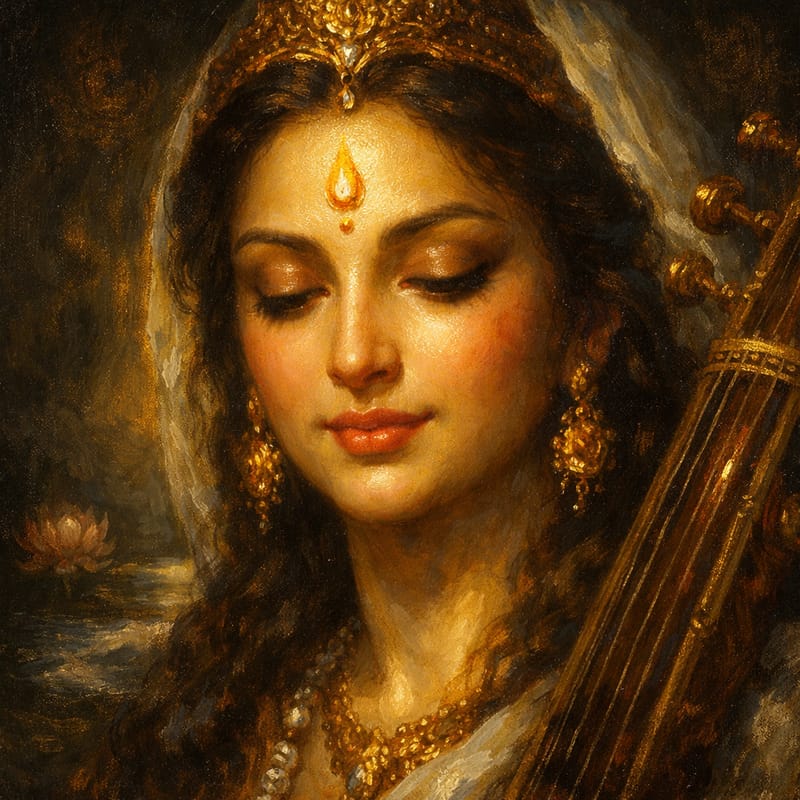
Gayatri Mantra — Kannada Lyrics
The Gayatri Mantra is a 24-syllable Sanskrit hymn structured in three sacred invocations. 'Om Bhur Bhuvah Svah' addresses the three realms of existence—physical consciousness (Bhur), pranic/subtle energy (Bhuvah), and divine mind (Svaha). 'Tat Savitur Varenyam' honors Savitri, the adorable divine essence of the sun—not as a celestial body, but as the universal creative force. 'Bhargo Devasya Dheemahi' means 'I meditate on that divine effulgence,' while 'Dhiyo Yo Nah Prachodayat' is a prayer: 'May that awaken our spiritual intelligence and wisdom.'
Rooted in the Rigveda (Mandala 3, Sukta 62, Verse 10), the Gayatri Mantra honors Savitri—the solar principle embodying creation, sustenance, and transformation. Saraswati, goddess of wisdom and learning, is intrinsically woven into this mantra's power to activate buddhi (spiritual intellect) and vidya (transcendent knowledge). The mantra transcends sectarian boundaries, functioning as a universal prayer for enlightenment. The verse asks for the mind to be illumined, turning it into a vessel for divine knowledge and removing the ignorance that obscures spiritual truth.
Traditionally chanted during Brahma Muhurta (pre-dawn hours), the Gayatri Mantra is recited 108 times on a mala for maximum benefit. Beginners may start with 11 or 21 repetitions. Proper pronunciation with focused intention amplifies its transformative effects—not mechanical recitation, but meditative alignment with universal wisdom. Consistency over months yields profound shifts in mental clarity, intuition, and spiritual awareness. This practice connects individual consciousness to the eternal, immortal divine principle.
Curated by The Mahakatha Team · Original Composition: Mahakatha · Lyric: Traditional / Vedic (Rig Veda 3.62.10)
Gayatri Mantra
Saraswati · Preview · 2:00
Preview ended
Ancient sounds for transformation, carried across 3,000 years.
Get the full version — plus 275 more ancient chants. 80% OFF today only.
Get Ancient Chants Bundle — 80% OFF →3000+ happy customers · Lifetime access · All devices
2.2M people trust Mahakatha
Chant daily with reminders — Get the Mahakatha app
Lyrics
ॐ भूर् भुवः स्वः। तत्सवितुर्वरेण्यं भर्गो देवस्य धीमहि। धियो यो नः प्रचोदयात्।
ಓಂ ಭೂರ್ ಭುವಃ ಸ್ವಃ। ತತ್ಸವಿತುರ್ವರೇಣ್ಯಂ ಭರ್ಗೋ ದೇವಸ್ಯ ಧೀಮಹಿ। ಧಿಯೋ ಯೋ ನಃ ಪ್ರಚೋದಯಾತ್।
ಓಂ, ಭೂಲೋಕ (ಭೂಮಿ), ಭುವರ್ಲೋಕ (ಅಂತರಿಕ್ಷ) ಮತ್ತು ಸ್ವರ್ಲೋಕ (ಸ್ವರ್ಗ)ದ ದಿವ್ಯ ಮಾತೆ
ಅತ್ಯಂತ ಪೂಜ್ಯವಾದ ಸವಿತೃ (ಸೂರ್ಯನ ಸಾರ)
ಆ ದಿವ್ಯ ತೇಜಸ್ಸಿನ ಮೇಲೆ ನಾನು ಧ್ಯಾನಿಸುತ್ತೇನೆ
ಆಕೆ ನಮ್ಮ ಆಧ್ಯಾತ್ಮಿಕ ಬುದ್ಧಿಯನ್ನು ಜಾಗೃತಗೊಳಿಸಲಿ
How to Chant Gayatri Mantra
- 1
Find a quiet, clean space
Sit in a comfortable, undisturbed environment. Face east or north if possible. You may light incense or a candle to set a contemplative atmosphere.
- 2
Settle into a comfortable posture
Sit cross-legged on the floor or upright in a chair. Keep the spine erect and place the hands on the knees with palms facing upward.
- 3
Take three cleansing breaths
Inhale slowly through the nose, hold briefly, and exhale completely. Repeat three times to calm the mind and prepare for mantra recitation.
- 4
Begin chanting Gayatri Mantra
Chant the mantra clearly and with devotion — aloud, in a whisper, or silently. Use a mala (108 beads) to count repetitions. Aim for a consistent, unhurried rhythm throughout the session.
- 5
Rest in stillness
After completing your chanting, sit quietly for two to five minutes. Allow the vibration of the mantra to settle within. Close the practice with a moment of gratitude.
Benefits of Gayatri Mantra
-
Awakens buddhi (spiritual intelligence) and higher reasoning faculties, elevating consciousness beyond conditioned patterns.
Source: Rigveda Mandala 3, Sukta 62; Upanishadic tradition
-
Traditionally believed to calm tamasic (ignorant) and rajasic (restless) patterns of mind, establishing sattva (clarity and peace).
Source: Bhagavad Gita 17.1-18; Traditional Vedantic practice
-
Many people find that sustained, attentive mantra repetition helps their concentration, memory, and mental sharpness.
-
Dissolves existential fear by anchoring consciousness in the eternal, immortal divine principle beyond physical mortality.
Source: Katha Upanishad; Mundaka Upanishad
-
Synchronizes mind with cosmic rhythms and natural cycles, particularly through dawn recitation aligned with solar (Savitri) energy.
Source: Vedic cosmology; Surya Siddhanta tradition
-
Strengthens intention and willpower through steady, focused practice.
Source: Traditional practice
Story & Symbolism
The Gayatri Mantra originates from the Rigveda, specifically Mandala 3, Sukta 62, Verse 10—one of Hinduism's oldest and most revered texts, composed over 4,000 years ago. The mantra is attributed to Sage Viswamitra, the legendary rishi who composed this hymn as an invocation to Savitri, the divine principle of the sun. Rigvedic seers recognized that the sun represented not merely a celestial body, but the universal consciousness illuminating all existence. This 24-syllable mantra embodies perfect structural harmony and is revered as a prayer for the awakening of human consciousness. Throughout millennia, it has remained the cornerstone of Vedic spiritual practice, transmitted from teacher to student in unbroken lineage.
Spiritually, the Gayatri Mantra represents humanity's eternal yearning to align individual consciousness with cosmic intelligence. Saraswati, goddess of wisdom and learning, infuses this mantra with the power to activate buddhi—the faculty of spiritual intelligence that transcends intellectual knowledge. The three realms invoked (Bhur, Bhuvah, Svah) correspond not to external locations but to layers of consciousness: physical awareness, pranic/emotional energy, and divine intellect. By addressing Savitri (the solar creative principle), the mantra acknowledges the universal creative force sustaining all life. The prayer for 'Dhiyo Yo Nah Prachodayat' (awakening of spiritual intelligence) reflects the Vedic insight that human liberation comes through the illumination of consciousness itself.
Today, the Gayatri Mantra transcends sectarian boundaries, serving as a universal spiritual practice embraced by seekers worldwide regardless of faith tradition. Mahatma Gandhi championed it as a prayer for enlightenment. Modern spiritual teachers integrate it into meditation and consciousness-raising practices. Its transmission from ancient seers to contemporary practitioners represents an unbroken thread of wisdom, continuously awakening spiritual seekers to their divine nature and cosmic connection.
How to Use in Daily Life
Dawn Practice
Chant during Brahma Muhurta (pre-dawn hours, 45 minutes before sunrise) when cosmic solar energy peaks and mind is naturally calm. 108 repetitions on a mala anchors your consciousness in divine wisdom before daily activities.
Meditation Anchor
Use the Gayatri Mantra as your primary meditation focus. Close eyes, sit upright, and mentally chant while visualizing divine light permeating your being. Synchronize each syllable with your breath for deeper integration.
Gratitude Ritual
Conclude your morning prayer or yoga practice with 21 recitations to honor the sun's creative power and connect with universal consciousness. Feel gratitude flowing through each syllable.
Evening Reflection
Before sleep, softly chant 11 times to settle the mind after the day. This calms rajasic restlessness, helps you wind down for sleep, and carries a spiritual intention into the night.