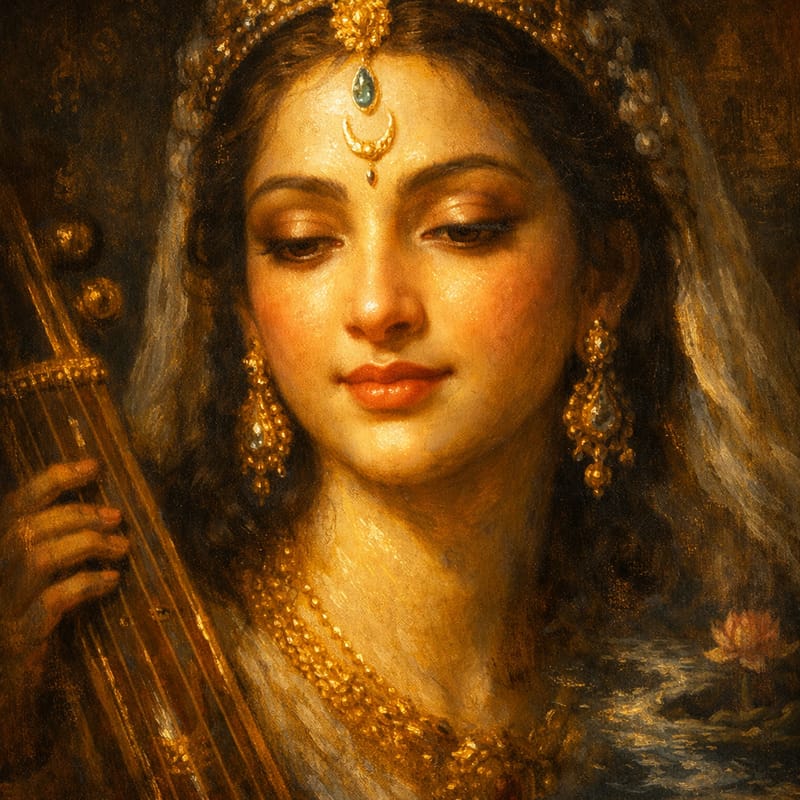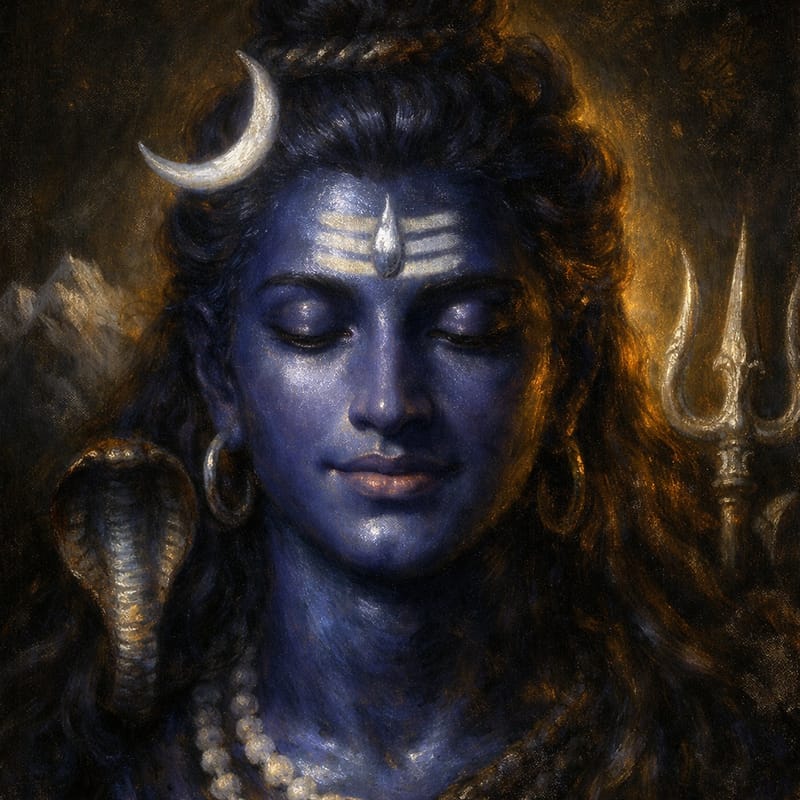


Goddess Saraswati is the goddess of learning and speech in the Hindu tradition. She also watches over music and the arts. In the Rig Veda she was first a great river. Later she became the flowing voice of wisdom itself. She sits in white on a lotus with a veena and a book. A swan rests at her feet.
Who is Goddess Saraswati?
Her name is often read as the one who flows. The word saras can mean a lake or moving water. So the goddess carries the memory of a river in her name.
She is the goddess of vidya, which means knowledge and learning. She is also the goddess of vak, which means speech. Students and teachers bow to her. So do singers, dancers and writers.
Her image is calm and bright. She wears white and sits on a white lotus. In her hands she holds a veena, which is a stringed instrument. She also holds a book and a string of prayer beads.
Vani
The one who is speech. Every word we speak is said to rest on her.
Sharada
A name loved in Kashmir and in Sringeri. Some link it with sharad, the clear autumn season.
Vagdevi
The goddess of the word. Poets call on her before they write.
Bharati
Another name for the goddess of speech. It opens her twelve names in our library.
Brahmi
The power of Brahma the creator. She gives his world its shape and sound.
Hamsavahini
She who rides the swan. The swan is her vahana, which means the creature that carries a deity.
Stories of Goddess Saraswati
These are stories. Each is told in many versions across India. Each one carries an idea worth keeping.
Born from Brahma's mind
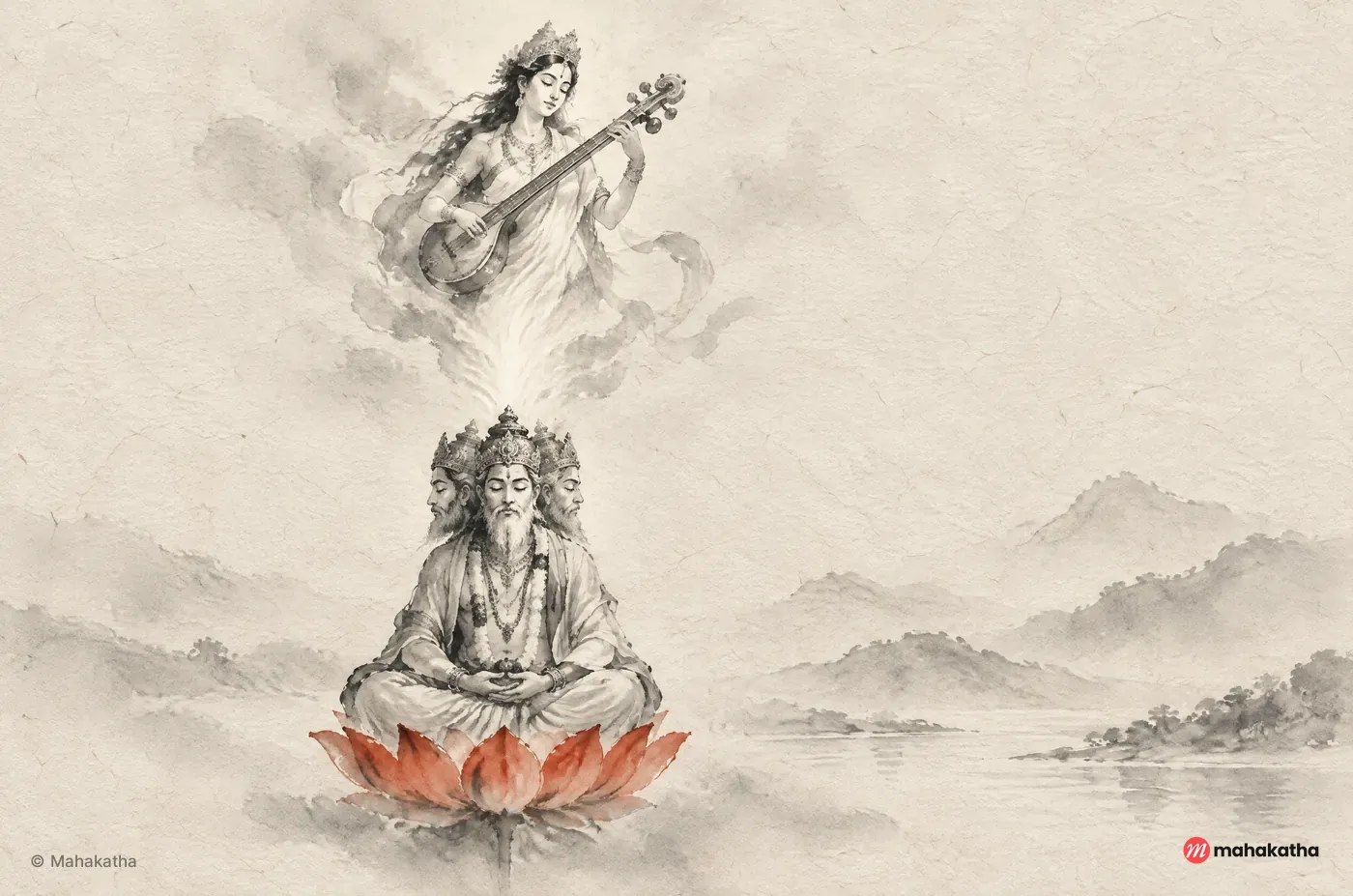
The story says Brahma began to make the world. Yet it lay silent and without form. From his own mind came a shining woman holding a veena. She gave the world order, sound and names. In this telling knowledge is not added to creation. It is what makes creation possible.
The river that went underground
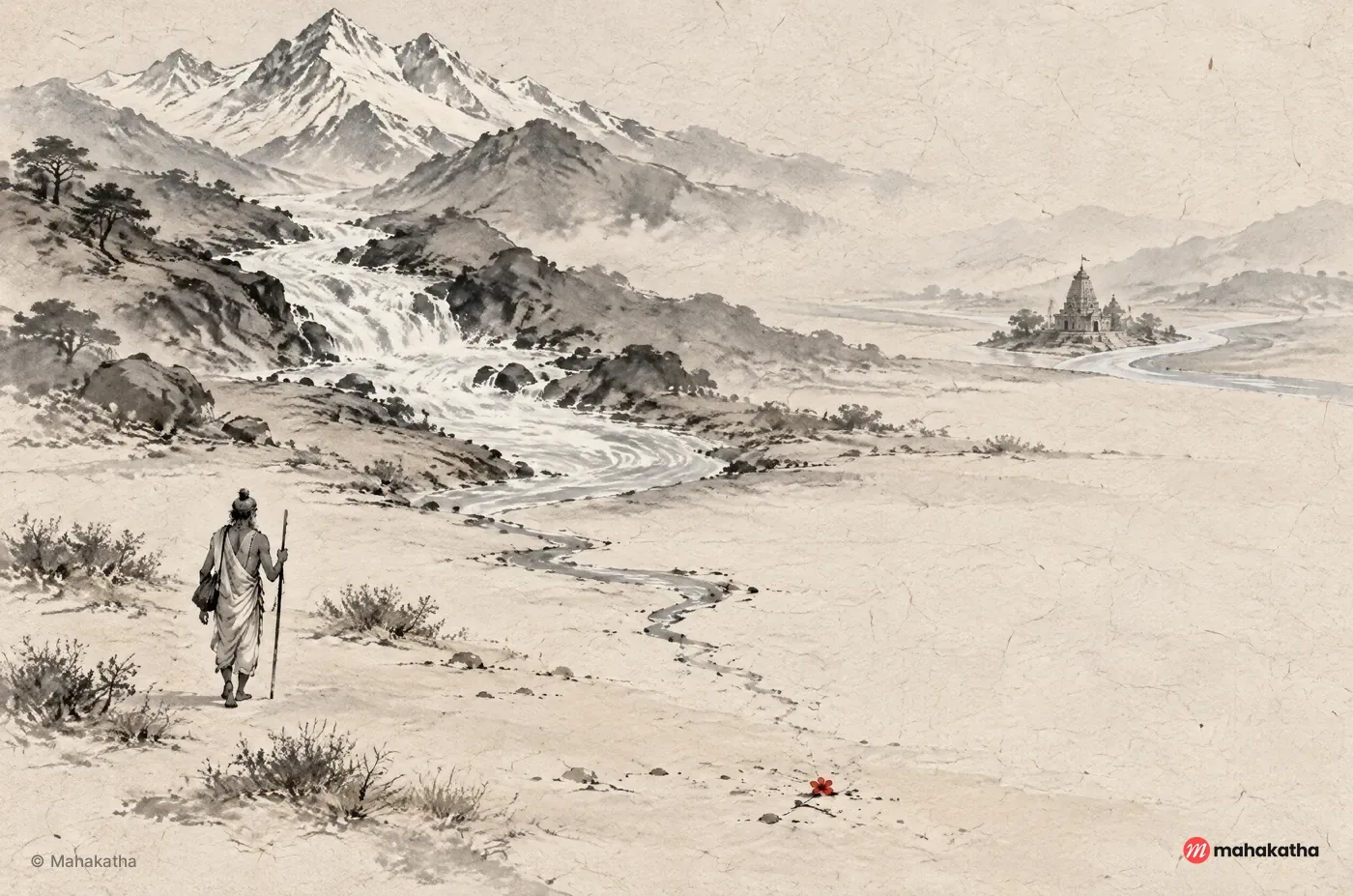
In the Rig Veda Saraswati is a mighty river rushing from the mountains. Later texts say she grew thin and vanished into the desert sand. The Mahabharata tells of Balarama walking her banks on a long pilgrimage. Tradition holds that she still flows unseen at Prayag. There she meets the Ganga and the Yamuna.
The word on Kumbhakarna's tongue
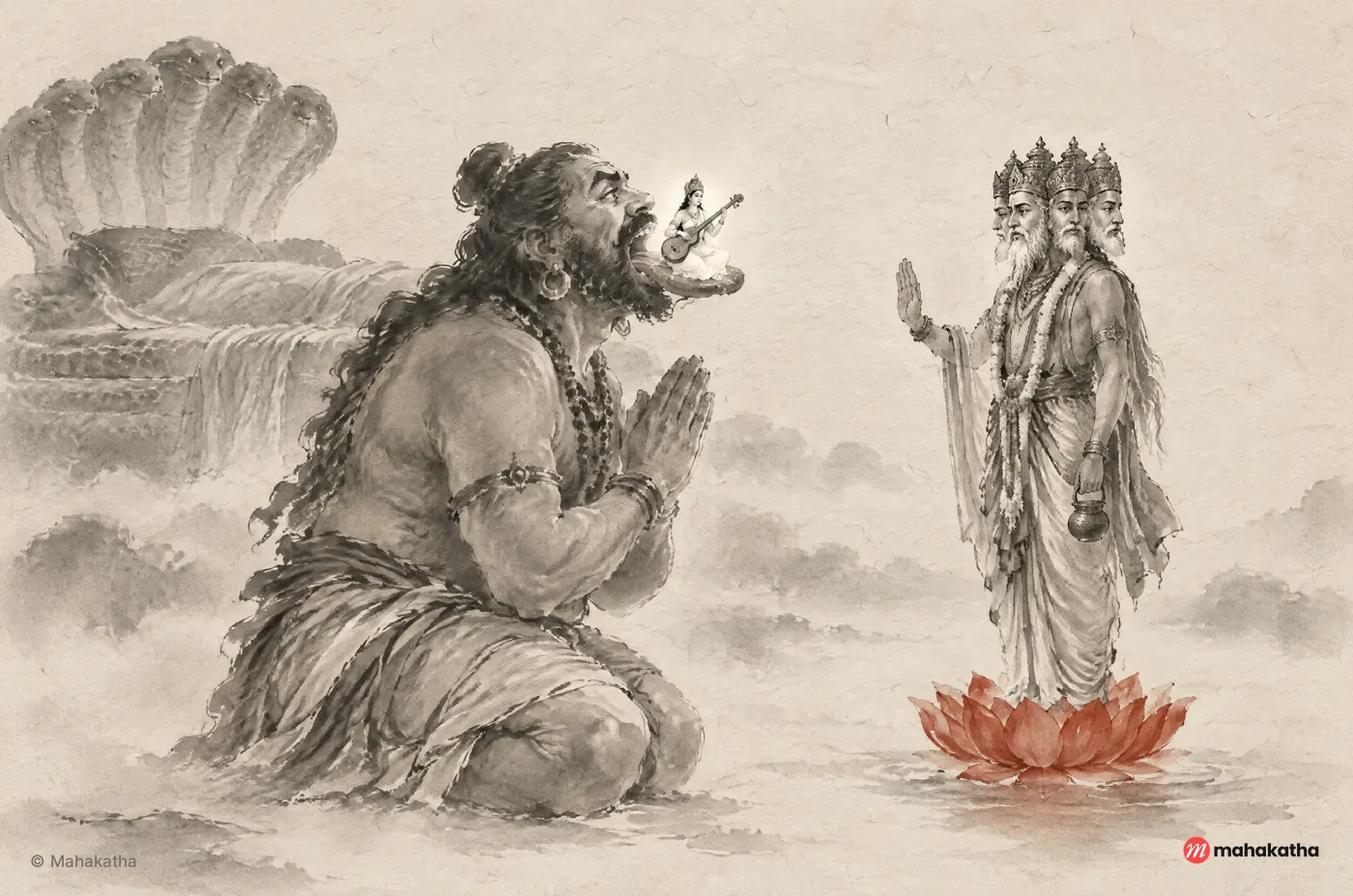
Ravana's giant brother Kumbhakarna did tapas, which means fierce spiritual effort. Brahma came to grant him a wish. The gods feared what he would ask. The story says Saraswati sat on his tongue and turned his words. He meant to ask for Indra's throne. Instead he asked for endless sleep. The tale is a smile and a warning about the power of speech.
The late arrival at Pushkar
One story is told at Pushkar in Rajasthan. Brahma was holding a great fire ritual and needed his wife beside him. She was late. The Padma Purana names her Savitri. Many retellings call her Saraswati. The hour could not wait, so Brahma married Gayatri to finish the rite. His wife arrived and was hurt. She said Brahma would be worshipped at Pushkar alone. Devotees say this is why his temples are so few.
The swan that chooses
A small tale lives in the image of her swan. It is said the swan can sip the milk from a bowl of milk and water. It leaves the water behind. This is the gift Saraswati offers. She helps us keep what is true and let the rest go.
How Saraswati worship grew over time
Saraswati has changed shape more than most deities. She began as water and became the word.
The Vedic hymns
The Rig Veda praises Saraswati as both river and goddess in several hymns. One verse calls her the best of mothers, the best of rivers and the best of goddesses. Most scholars place the oldest hymns in the second millennium BCE.
The lost river debate
Where was this river? Many scholars link it with the Ghaggar-Hakra. This is a seasonal river that runs through Haryana and Rajasthan into Pakistan. Others link it with the Helmand in Afghanistan. The question is still debated. For devotees the river lives on as speech and thought.
Goddess of speech
In later Vedic texts Saraswati is joined with Vak, the goddess of speech. The river of water becomes a river of words. This is the Saraswati most people know today.
The epics and the Puranas
In the Mahabharata her banks are holy ground for pilgrims. In the Puranas she becomes the wife of Brahma. She is the power that gives his creation form and sound.
Beyond one faith
Jains and Buddhists also honour her. Jain artists carved famous marble images of Saraswati. Buddhist traditions carried her to Tibet. In Japan she became Benzaiten, a goddess of music and water.
Seats of learning
Few temples were given to Saraswati alone. She was honoured wherever people studied. Sharada Peeth in Kashmir was famed for centuries as a seat of learning. The old Sharada script of Kashmir carries her name.
Today
Many schools in India open the day with the Saraswati Vandana. Children write their first letters on her festival days. Musicians touch their instruments to their forehead before they play.
Saraswati across India: North and South, East and West
One goddess wears many local colours. Here is how she is loved across India.
North
In the North she is the goddess of Vasant Panchami. Homes and schools wear yellow for the coming spring. Families honour books and pens. In Kashmir she is Sharada. Her old seat still draws prayers from across the border.
East
Bengal keeps the most joyful Saraswati Puja. Clay images of the goddess fill homes and schools. Students place their books at her feet and do not study that day. Many young people dress in yellow. The next day the image is carried to the water. Odisha and Assam keep the day in much the same spirit.
South
In the South her great days come at the end of Navaratri. Families set books and instruments before her for Saraswati Puja. On Vijayadashami small children write their first letters in a plate of rice. Kerala calls this Vidyarambham, which means the beginning of learning.
West
In Maharashtra families honour her during Navaratri. On Dussehra some families draw a simple Saraswati sign on a slate and worship it. In Gujarat students and artists pray to her at Vasant Panchami.
Beyond India
In Bali a day named for Saraswati is kept for books and learning. In Japan Benzaiten holds a lute beside lakes and the sea. The image travels far. The idea stays the same.
Saraswati temples across India
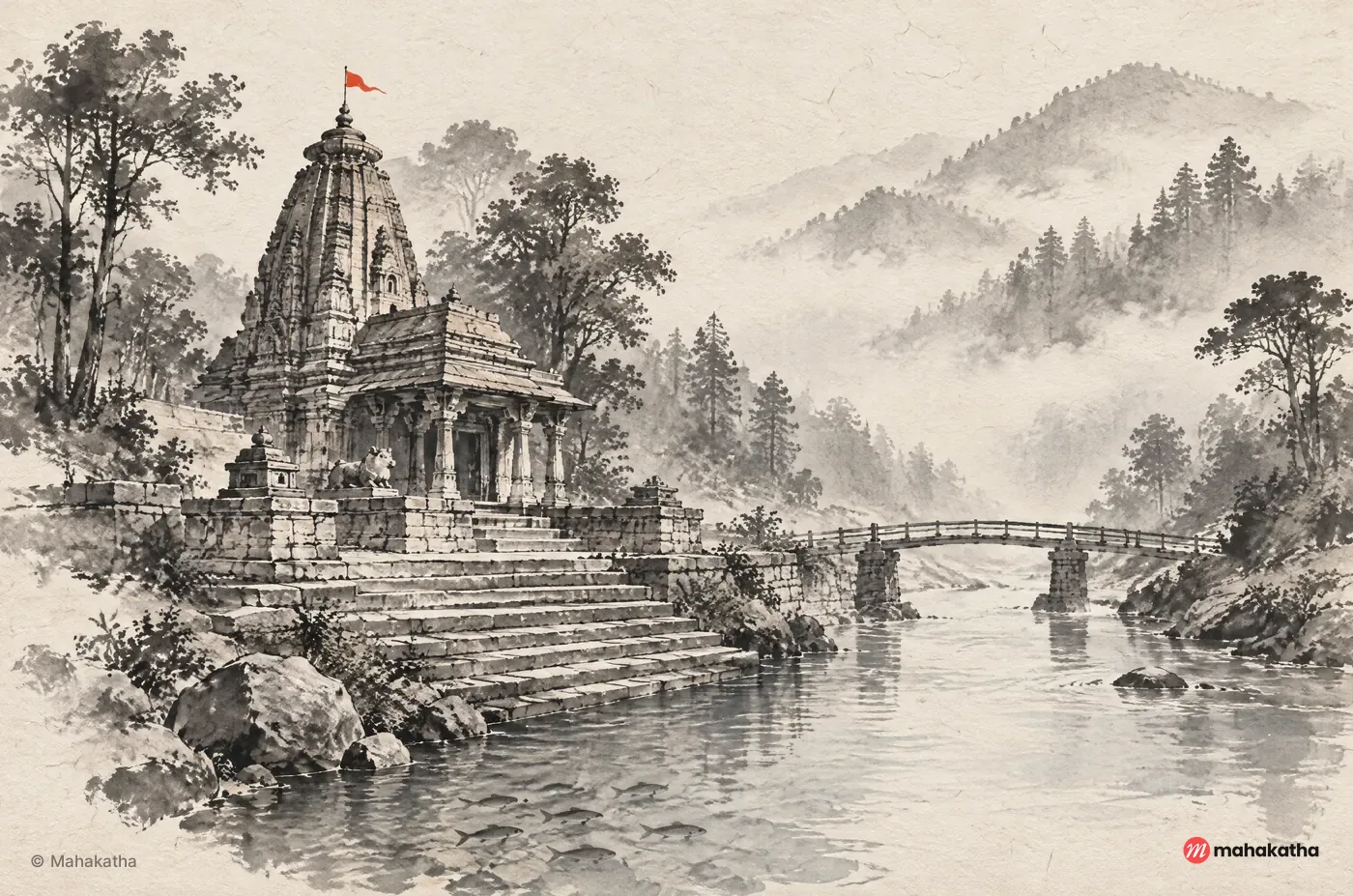
Saraswati temples are rare. Those that exist are much loved by students and their families.
Gnana Saraswati Temple, Basar (Telangana)
On the banks of the Godavari. Families bring small children here for Akshara Abhyasam, the first writing ceremony. Tradition links the temple with the sage Vyasa.
Sringeri Sharadamba Temple, Sringeri (Karnataka)
Beside the Tunga river. Tradition says Adi Shankara set up the seat of Sharada here. It remains a great centre of learning.
Kollur Mookambika Temple, Kollur (Karnataka)
In the green hills of the Western Ghats. Many see Mookambika as the great goddesses in one form. Writers and musicians come here to begin their work.
Dakshina Mookambika Temple, Panachikkad (Kerala)
Near Kottayam. Large numbers of children write their first letters here on Vijayadashami. The goddess sits in a small spring-fed pond. Her image is hidden by creepers.
Koothanur Saraswati Temple, Koothanur (Tamil Nadu)
Often called the only temple in Tamil Nadu where Saraswati is the main deity. Tradition links it with the poet Ottakoothar. Students come with their pens and notebooks.
Sharada Peeth, Sharda (Pakistan-administered Kashmir)
Once one of the great seats of learning in South Asia. Today it lies in ruins. Devotees still remember it in their prayers.
Triveni Sangam, Prayagraj (Uttar Pradesh)
Not a temple but a meeting of waters. Tradition says the hidden Saraswati joins the Ganga and the Yamuna here.
Saraswati's symbols and what they mean
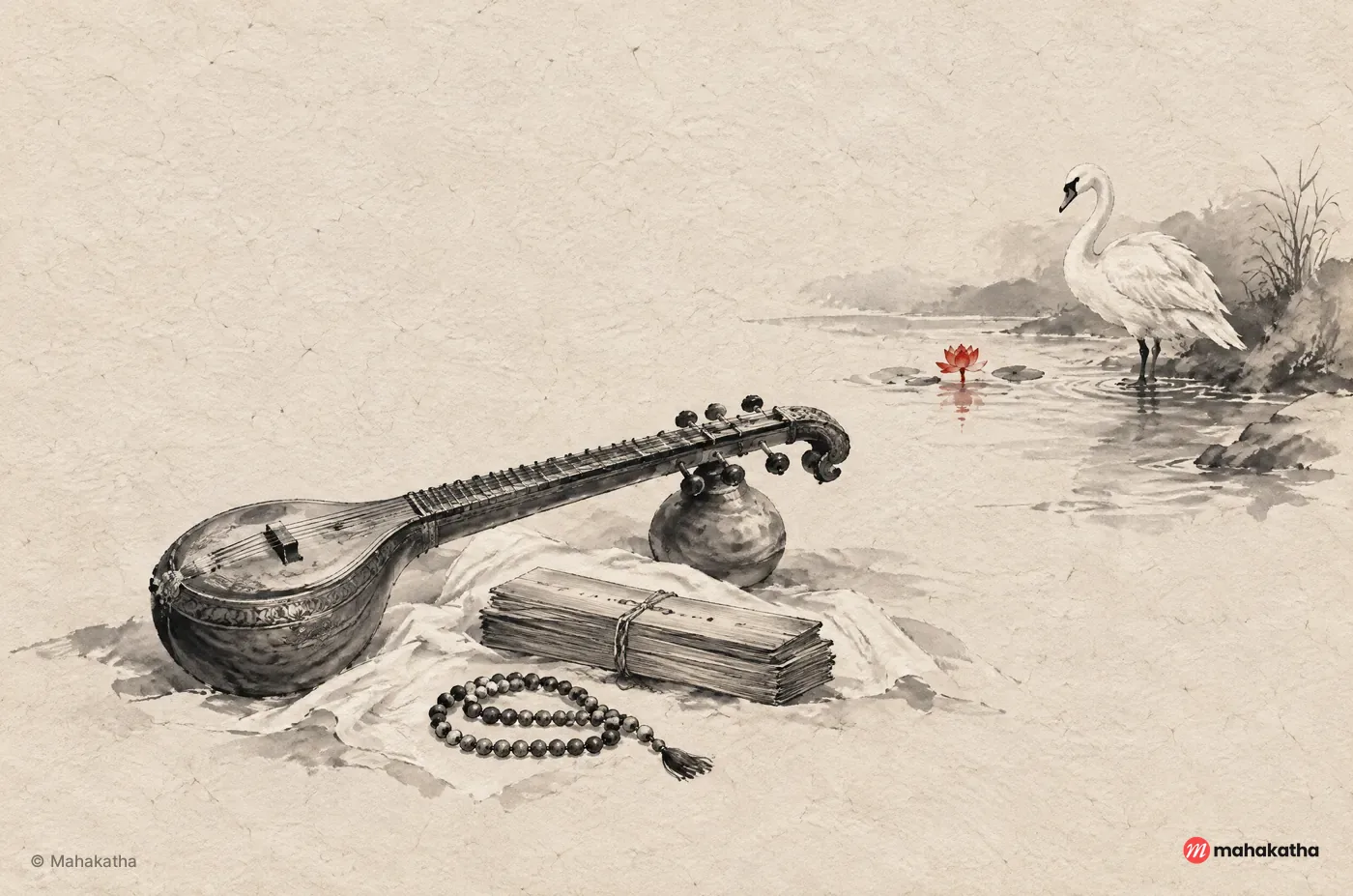
Every part of her image is a small teaching. Here is what each one shows.
White clothes
She wears white and sits on a white lotus. White holds every colour without favouring one. A clear mind is like that.
The veena
Its strings must be neither too tight nor too loose. Learning asks the same balance of us. Push too hard and the music breaks.
The book
The book stands for the Vedas and all written wisdom. It reminds us that knowledge is passed from hand to hand.
The prayer beads
An akshamala is a string of beads used to repeat a mantra. Aksha can also point to the letters of the alphabet. Learning grows by steady repetition.
The swan
Her swan is called a hamsa. It stands for viveka, which means the power to tell the true from the false.
The lotus
The lotus grows from mud yet stays clean. Wisdom can rise from any start in life.
The river
She began as a river. Thought and speech flow best when nothing blocks them.
Saraswati mantras to chant
These mantras come from our library. Each line is quoted as it is sung on the recording.
Saraswati Namasthubhyam Mantra
The best-known prayer before study. It begins “saraswati namastubhyam / varade kamarupini”. It asks for her blessing as learning starts.
Saraswati Mantra before Studies and Practice
“Namaste Shaarade Devi / Veena Pustak Dhaarini”. It greets her as the one who holds a veena and a book.
Saraswati Beeja Mantra
“Om Hreeng Aing Hreeng Saraswatyai Namah”. A beeja is a seed sound. Aing is the seed sound most linked with her.
Saraswati Maha Mantra
“Om Aim Hreem Kleem Maha Saraswati Devyai Namaha”. Many chant it for a calm and focused mind before they speak or write.
Saraswati Kaashmirapura Mantra
“Namaste Shaarade Devi / Kaashmeerapura Vaasini”. It greets her as the goddess who lives in Kashmir. The line keeps the memory of Sharada Peeth alive.
Saraswati Mantra for Confident Speech
“Saraswati Mati Prade Vasatvam Mama Jivhaagre”. It asks her to live on the tip of the tongue.
Saraswati Vandana
The prayer many schools sing at morning assembly. Read it in full on our page.
All Saraswati mantras
Our full set of Saraswati recordings with lyrics and meanings. It includes her twelve names and the Gayatri Mantra.
Saraswati festivals
Her festivals are quiet and joyful. Books rest and children begin.
Vasant Panchami
The spring festival of Saraswati. People wear yellow like the mustard fields in bloom. Small children are given their first lesson. Many homes cook yellow sweets and saffron rice. In Bengal and the East this is the day of Saraswati Puja.
Saraswati Puja in Navaratri
In the South the last days of Navaratri belong to her. Books and instruments rest before her image. No one reads or plays until the puja is complete.
Vidyarambham on Vijayadashami
An elder guides a child's finger to write the first letters in rice. In Kerala many children write Hari Sri first. Temples and homes are full of small hands and proud parents.
Saraswati Aarti
Many families end the day's puja by waving a lamp and singing the Saraswati Aarti.
Bringing Saraswati into your day
You do not need a temple to honour her. A desk and a quiet breath are enough.
Before you study
Sit still for one breath. Say the Vidyarambha Prarthana or the Saraswati Namasthubhyam Mantra once. Then open your book.
Honour your tools
Touch your pen or your instrument to your forehead. It is a small way of saying thank you.
Speak with care
Before an important talk chant her Maha Mantra softly. Then speak slowly. Kind and true words are an offering to her.
Learn one small thing
Each day learn one new word or one line of a song. Daily learning is her daily worship.
Keep a quiet hour
Many students rise before dawn to study. The house is still and the mind is often clear then.
Offer something white
A white flower or a little fresh water is enough. Place it near your books.
What Saraswati can teach us
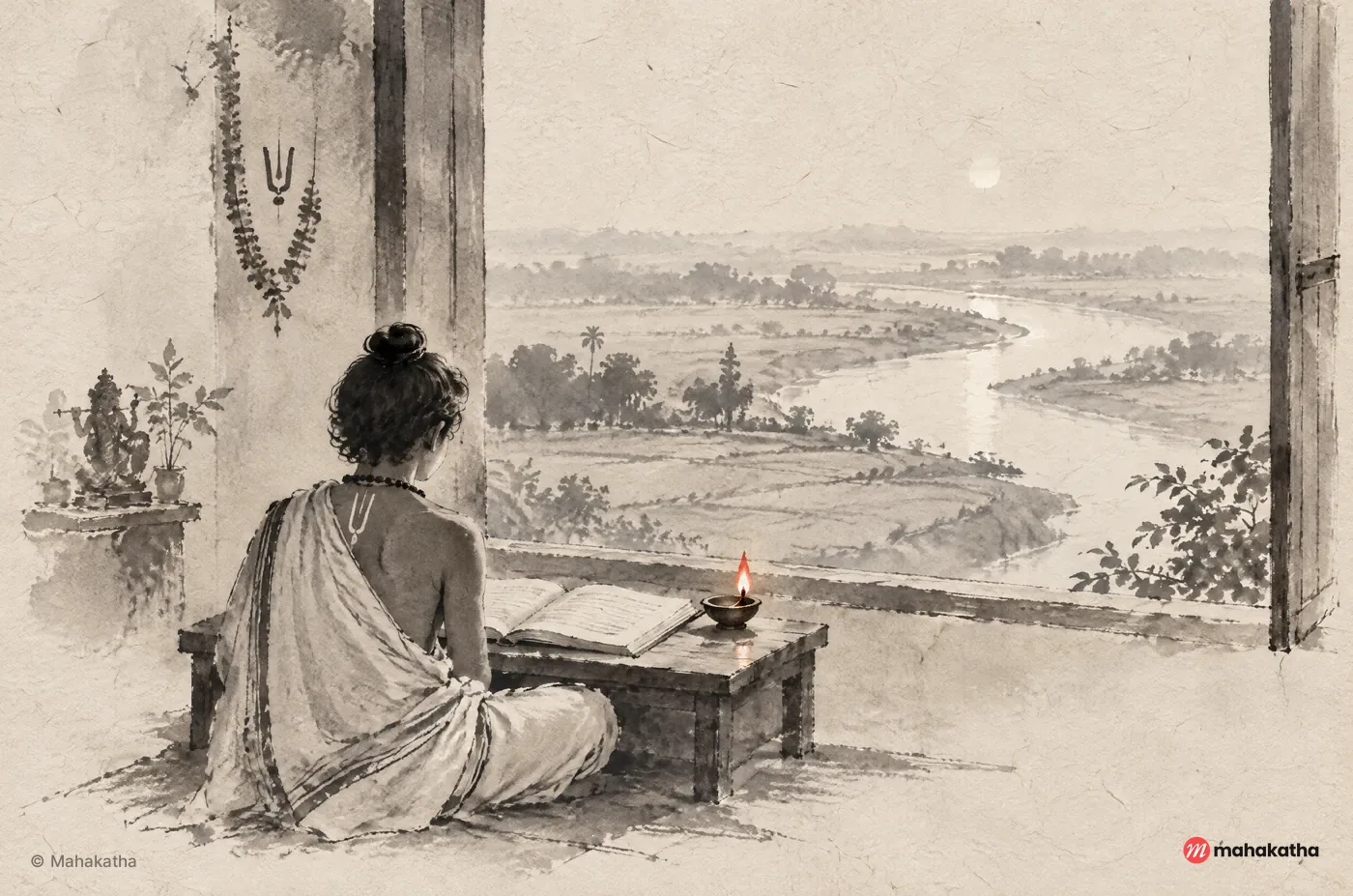
Saraswati began as a river. Rivers do not force their way. They find the path and keep moving. Learning is like that. When you feel stuck in your studies or your work, remember the river. Slow is not the same as stopped.
Her veena is silent until someone plays it. Knowledge sleeps in a book until a mind wakes it up. She asks us to be the hand that plays. Read one page. Practise one scale. Try again tomorrow.
There is also a quiet Saraswati inside each of us. She is the voice that knows when to speak and when to stay silent. Sit for a minute with your eyes closed. Listen to your breath. In that stillness her river is already flowing.
Questions people ask
Who is Goddess Saraswati?
Saraswati is the goddess of learning and speech in the Hindu tradition. She also watches over music and the arts. She is shown in white on a lotus. She holds a veena and a book with prayer beads. A swan sits at her feet. Students and artists pray to her before they begin their work.
Was the Saraswati a real river?
The Rig Veda praises Saraswati as a great river. Many scholars link it with the Ghaggar-Hakra, a seasonal river of Haryana and Rajasthan. Others suggest the Helmand in Afghanistan. The question is still debated. Tradition holds that the river flows unseen and meets the Ganga and Yamuna at Prayag.
Why does Saraswati ride a swan?
Her swan is called a hamsa. Tradition says it can separate milk from water and drink only the milk. This stands for viveka, the power to tell the true from the false. It is the heart of real learning. So the swan carries the goddess of wisdom.
What is the Saraswati mantra for students?
The best-known one is the Saraswati Namasthubhyam Mantra. It begins with the words saraswati namastubhyam. Students say it before opening a book or sitting an exam. Another loved prayer begins Namaste Shaarade Devi. Both ask for her blessing as learning starts. Our library has both with full lyrics and meanings.
Why is Saraswati Puja held on Vasant Panchami?
Vasant Panchami marks the arrival of spring. Tradition honours it as Saraswati's day. People wear yellow like the mustard fields. Children are given their first lesson and books are placed before her image. In Bengal students keep their books at her feet and do not study that day.
Is Saraswati the wife of Brahma?
In the Puranas she is the wife of Brahma, the creator. She is the power that gives his creation form and sound. In one telling she is born from his own mind. Older Vedic hymns knew her first as a river goddess. Her link with Brahma came later.