

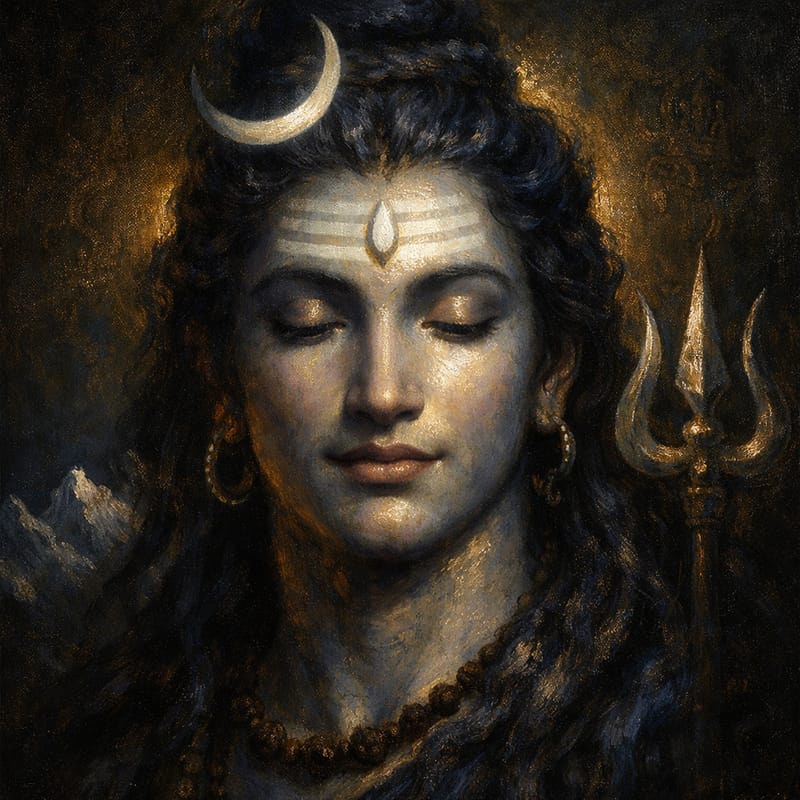
Om Sadashivaya Namah Mantra — Spanish Lyrics
Om Sadashivaya Namah is a powerful invocation that translates as "I bow to the eternal Shiva." The mantra comprises three sacred elements: Om (the primordial sound underlying all existence), Sadashivaya (the eternal, unchanging form of Shiva), and Namah (reverential salutation). This mantra is a direct address to Lord Shiva in his infinite, transcendent aspect—beyond time, change, and limitation. Chanting it establishes a direct communion with the consciousness that sustains all of creation.
Sadashiva represents Shiva in his most exalted state—the absolute, self-luminous consciousness that witnesses all creation without being touched by it. In Shaivite philosophy, Sadashiva is the eternal witness, the supreme stillness from which all dynamic forces emerge. This mantra honors Shiva not as a distant deity but as the innermost Self (Atman) residing within all beings. By invoking Sadashivaya, the practitioner recognizes their own divine nature and aligns consciousness with the supreme reality that transcends duality, ego, and worldly entanglement.
Chant this mantra during meditation, ideally 108 times using a mala, or simply when seeking grounding and spiritual clarity. It works best in early morning (brahma muhurta) or during evening worship. The practice requires no elaborate ritual—sincere intention and focused repetition are sufficient. Beginners may chant audibly; advanced practitioners often internalize the sound. Consistency matters more than speed; even 11 repetitions daily yields profound results over time.
Curated by The Mahakatha Team · Original Composition: Mahakatha · Lyric: Traditional / Shaivite
Om Sadashivaya Namah Mantra
Shiva · Preview · 2:00
Preview ended
Ancient sounds for transformation, carried across 3,000 years.
Get the full version — plus 275 more ancient chants. 80% OFF today only.
Get Ancient Chants Bundle — 80% OFF →3000+ happy customers · Lifetime access · All devices
2.2M people trust Mahakatha
Chant daily with reminders — Get the Mahakatha app
ॐ सदाशिवाय नमः
Om Sadashivaya Namah
Saludos al Señor Shiva, quien es eterno y puro
How to Chant Om Sadashivaya Namah Mantra
- 1
Find a quiet, clean space
Sit in a comfortable, undisturbed environment. Face east or north if possible. You may light incense or a candle to set a contemplative atmosphere.
- 2
Settle into a comfortable posture
Sit cross-legged on the floor or upright in a chair. Keep the spine erect and place the hands on the knees with palms facing upward.
- 3
Take three cleansing breaths
Inhale slowly through the nose, hold briefly, and exhale completely. Repeat three times to calm the mind and prepare for mantra recitation.
- 4
Begin chanting Om Sadashivaya Namah Mantra
Chant the mantra clearly and with devotion — aloud, in a whisper, or silently. Use a mala (108 beads) to count repetitions. Aim for a consistent, unhurried rhythm throughout the session.
- 5
Rest in stillness
After completing your chanting, sit quietly for two to five minutes. Allow the vibration of the mantra to settle within. Close the practice with a moment of gratitude.
Benefits of Om Sadashivaya Namah Mantra
-
Anchors consciousness in the eternal, dissolving fear of change and mortality by connecting the practitioner to Sadashiva's unchanging nature.
Source: Shiva Sutras; Traditional Shaivite practice
-
Traditionally believed to purify mental patterns and past impressions through the sound of Om, clearing the way for spiritual insight and intuition.
Source: Mandukya Upanishad; Tantric texts
-
Activates the third eye and crown chakra, facilitating direct inner vision and communion with divine consciousness.
Source: Traditional Kundalini yoga; Tantric practice
-
Can help release tension in the body as you rest your attention on Shiva's stillness and detachment.
Source: Hatha Yoga Pradipika; Traditional practice
-
Strengthens spiritual resilience and equanimity by repeatedly aligning mind with the witness consciousness that remains untouched by circumstance.
Source: Bhagavad Gita; Advaita Vedanta
Story & Symbolism
Om Sadashivaya Namah emerges from the Vedic tradition, particularly the Rudra Sukta of the Yajurveda, which celebrates Shiva as the supreme cosmic principle. The practice evolved through centuries of Shaivite philosophy, becoming formalized in the Shiva Sutras—a foundational text attributed to the sage Vasugupta. In Kashmir Shaivism and Tantric traditions, Sadashiva became recognized as the transcendent state of consciousness, the eternal witness beyond creation, preservation, and dissolution. The mantra crystallizes this highest understanding into a sacred invocation accessible to practitioners at all levels. Ancient masters recognized that direct communion with Sadashiva liberates consciousness from the illusion of separation and limitation.
The term "Sadashiva" (sada = eternal; Shiva = auspiciousness, pure consciousness) specifically denotes Shiva's state beyond manifestation—the supreme, unchanging awareness from which all phenomenal existence emerges and into which it dissolves. This is not Shiva as a form or symbol, but as the source-consciousness itself. The mantra honors this ultimate reality as one's own deepest nature. Chanting Sadashivaya Namah acknowledges that the eternal, self-luminous principle of consciousness is not separate from the seeker; it is the innermost Self witnessing all experience. In this recognition lies the seed of liberation (moksha).
Today, Om Sadashivaya Namah is chanted in ashrams, temples, and homes worldwide by devotees seeking spiritual awakening and liberation. The mantra has been transmitted through unbroken lineages of realized masters and continues to transform consciousness in those who approach it with sincere devotion. Its value lies not in intellectual understanding but in quiet, direct devotion to the eternal consciousness it invokes.
How to Use in Daily Life
Dawn Meditation
Chant 108 times at sunrise facing east. The early morning mind is naturally receptive; this practice establishes spiritual clarity for the entire day and strengthens your inner connection to Sadashiva.
Chakra Alignment
Use this mantra during meditation to activate the ajna (third eye) and sahasrara (crown) chakras. Visualize the eternal light of Sadashiva descending through these centres, easing the mind.
Devotional Practice
Chant before your altar or in sacred space with sincere intention. Allow each repetition to deepen your surrender and recognition of your own divine nature as an expression of eternal consciousness.
Evening Reflection
Chant 11 or 21 times before sleep to release the day's impressions and anchor awareness in the eternal, unchanging witness consciousness. This cultivates deep, peaceful sleep and spiritual integration.