

Maha Mrityunjaya Mantra — Hindi Lyrics
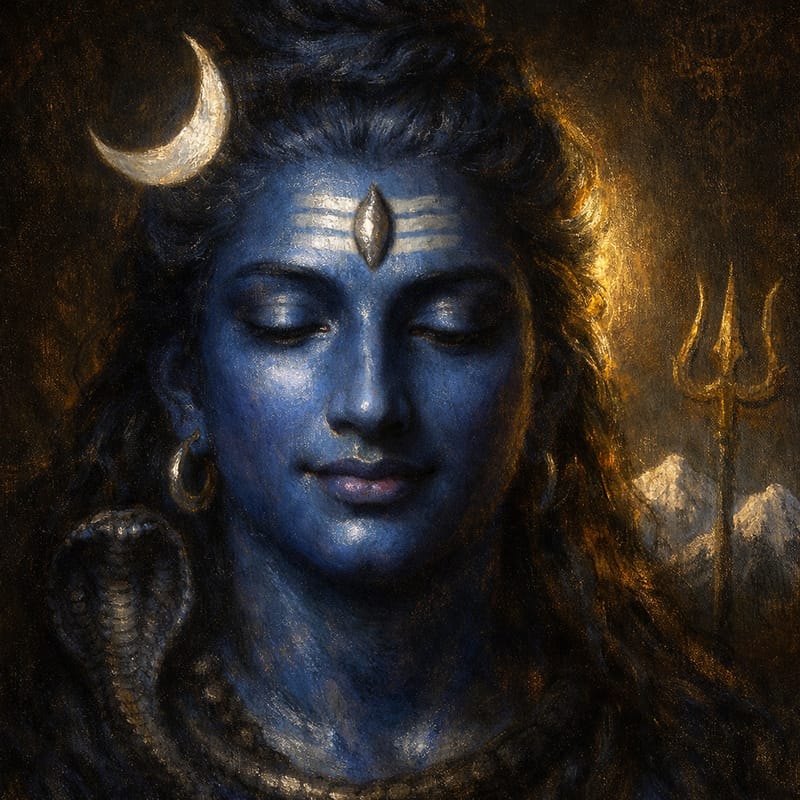
The Maha Mrityunjaya Mantra is a sacred invocation to Lord Shiva, the three-eyed destroyer and transformer. 'Om Trayambakam Yajaamahe' honors Shiva's three eyes—representing sun, moon, and fire—symbols of knowledge, protection, and transformation. 'Sugandhim Pushtivardhanam' calls upon Him as the cosmic sustainer who nourishes all existence with divine fragrance and vitality. The mantra acknowledges our bondage to sickness and suffering ('Oorvarukamiva Bandhanaan'—bound like a cucumber to its vine) and prays for liberation from death and the gift of immortal nectar (amrutaat). This is not only a prayer for physical health but for spiritual freedom.
Shiva, in Vedic philosophy, represents the transcendent consciousness beyond all limitations. The mantra directly addresses death (Mrityu)—not as punishment but as ignorance of our eternal nature. By invoking Shiva's three-fold power, the seeker acknowledges their mortality while simultaneously accessing the divine force that transcends death. This paradox—recognizing human vulnerability while awakening to infinite consciousness—is the mantra's deepest spiritual significance. Chanting it is seen as a bridge between the mortal self and the immortal Self (Atman), gradually easing the fear-based identity that binds us to suffering.
Practitioners traditionally chant this mantra 108 times daily, ideally during Brahma Muhurta (pre-dawn hours) or in evening meditation. Best performed with mala beads, steady breath, and focused intention. Devotees may practice it during sickness, life transitions, or whenever confronting existential fears. The mantra works not through magical intervention but through sustained practice that gradually steadies the mind, replacing death-fear with trust in the eternal. Even beginners benefit from consistent, reverent repetition with proper pronunciation and a sincere heart.
Curated by The Mahakatha Team · Original Composition: Mahakatha · Lyric: Traditional / Vedic
Maha Mrityunjaya Mantra
Shiva · Preview · 2:00
Preview ended
Ancient sounds for transformation, carried across 3,000 years.
Get the full version — plus 275 more ancient chants. 80% OFF today only.
Get Ancient Chants Bundle — 80% OFF →3000+ happy customers · Lifetime access · All devices
2.2M people trust Mahakatha
Chant daily with reminders — Get the Mahakatha app
Lyrics
ॐ त्र्यम्बकं यजामहे सुगन्धिं पुष्टिवर्धनम् | उर्वारुकमिव बन्धनान् मृत्योर्मोक्षीय माऽमृतात् ||
ॐ त्र्यम्बकं यजामहे सुगन्धिं पुष्टिवर्धनम् | उर्वारुकमिव बन्धनान् मृत्योर्मोक्षीय माऽमृतात् ||
हे दिव्य त्रिनेत्रधारी, ब्रह्मांड की अजेय शक्ति, मुझे आशीर्वाद दें
जो आत्मा की सुगंध हैं और सभी प्राणियों की आत्माओं का पोषण करते हैं
बंधनों के जाल से जो हमें बंदी बनाए रखता है, जैसे खीरे अपनी लताओं में उलझे होते हैं
मुझे आशीर्वाद दें ताकि मैं आत्म-जागरूकता प्राप्त कर सकूं और मृत्यु के भय और मृत्यु से मुक्ति पा सकूं, तथा आत्मा की अमरता प्राप्त कर सकूं
How to Chant Maha Mrityunjaya Mantra
- 1
Find a quiet, clean space
Sit in a comfortable, undisturbed environment. Face east or north if possible. You may light incense or a candle to set a contemplative atmosphere.
- 2
Settle into a comfortable posture
Sit cross-legged on the floor or upright in a chair. Keep the spine erect and place the hands on the knees with palms facing upward.
- 3
Take three cleansing breaths
Inhale slowly through the nose, hold briefly, and exhale completely. Repeat three times to calm the mind and prepare for mantra recitation.
- 4
Begin chanting Maha Mrityunjaya Mantra
Chant the mantra clearly and with devotion — aloud, in a whisper, or silently. Use a mala (108 beads) to count repetitions. Aim for a consistent, unhurried rhythm throughout the session.
- 5
Rest in stillness
After completing your chanting, sit quietly for two to five minutes. Allow the vibration of the mantra to settle within. Close the practice with a moment of gratitude.
Benefits of Maha Mrityunjaya Mantra
-
Liberates from fear of death and premature mortality by awakening awareness of the eternal Self beyond physical form.
Source: Rig Veda 7.59.12 (Shukla Yajur Veda); Traditional Shaiva practice
-
Traditionally chanted as a prayer for healing, and slow chanting can help you breathe more slowly and feel calmer.
Source: Traditional practice; validated by modern studies on mantra meditation
-
Strengthens mental focus and clarity by anchoring consciousness in the present moment through rhythmic sound.
Source: Upanishadic philosophy; Nada Brahma principle (sound as ultimate reality)
-
Deepens spiritual resilience by reconnecting the practitioner with Shiva's transformative power over obstacles and limitations.
Source: Shaivite Tantras and Puranas
-
In yoga traditions, sustained chanting is linked with the subtle channels (nadis) and the third eye (Ajna chakra).
Source: Kundalini Yoga and Tantric texts; Traditional practice
Story & Symbolism
The Maha Mrityunjaya Mantra emerges from the Rig Veda, humanity's oldest continuous spiritual text, specifically from the Shukla Yajur Veda (3.60). Attributed to the great rishi Vasishtha, this mantra was preserved within an oral tradition of extraordinary precision, passed from teacher to student across 3,000+ years. Unlike many mantras composed for specific rituals, the Mrityunjaya Mantra addresses the universal human condition—our confrontation with mortality and suffering. The Rig Veda itself does not explicitly describe its origin myth, but later Shaivite scriptures embedded it within the cosmic narrative of Lord Shiva's role as the transformer who dissolves bondage and ignorance.
In Shaivite philosophy, Shiva is not merely a deity but the principle of transcendent consciousness beyond all limitation and illusion. The mantra's genius lies in its paradox: by invoking the god of destruction and death, the seeker paradoxically accesses liberation from death itself. This reflects the non-dual Vedantic understanding that true immortality is not escape from death but awakening to the eternal consciousness that death cannot touch. Shiva's three eyes—representing the sun (gross illumination), the moon (subtle consciousness), and the inner fire (transformation)—become the gateway through which the aspirant recognizes their own infinite nature.
From the medieval period onward, the mantra became central to Tantric and Hatha Yoga traditions, with texts like the Shiva Purana and Tantric commentaries detailing its specific applications for healing, longevity, and spiritual breakthrough. In contemporary times, teachers like Maharishi Mahesh Yogi and numerous modern yoga lineages have validated and popularized the mantra, though its essential power remains unchanged. Today, the Maha Mrityunjaya Mantra continues as a bridge between ancient Vedic wisdom and the modern seeker's deepest need for meaning, healing, and transcendence.
How to Use in Daily Life
Dawn Practice
Chant 108 repetitions during Brahma Muhurta (pre-dawn, 90 minutes before sunrise) when the mind is naturally calm and prana flows strongest. Sit facing east, use mala beads, and let the chanting settle your mind for the day ahead.
Meditation Integration
Incorporate the mantra into your meditation practice by chanting slowly (one repetition per 5–10 breaths), allowing the sound to dissolve into silence. This deepens concentration and opens the Ajna (third eye) chakra for spiritual insight.
Healing Intention
During sickness or emotional distress, chant with focused intention as a prayer for healing or liberation. Slow, steady chanting can ease fear and feel calming; it is a devotional practice, not a substitute for a doctor's care.
Evening Reflection
Chant softly before sleep to process fears and anxieties, surrendering them to Shiva's transformative power. This settles the mind for deeper spiritual work and restful sleep.