

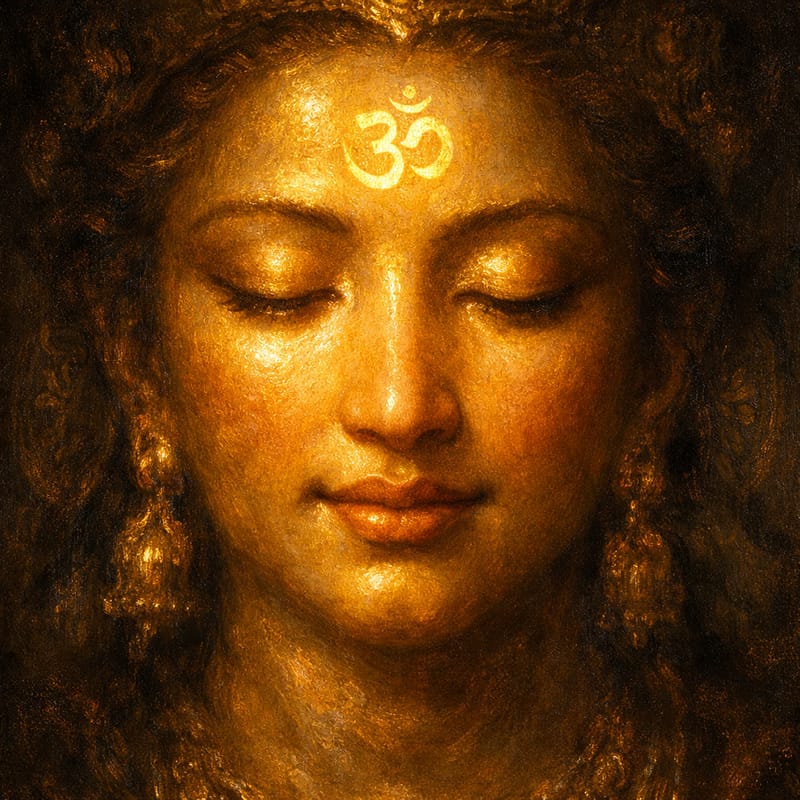
Soothing Om Chant — Russian Lyrics
Soothing Om Chant is a sacred Sanskrit mantra whose slow, steady sound many people find calming, easing stress and promoting deep relaxation.
Om (ॐ) is regarded as the primordial sound of creation itself — the sound from which, in Hindu thought, all existence emerges. In Sanskrit, it is written as a single syllable comprising three phonetic components: 'A' (आ), 'U' (उ), and 'M' (म), which together represent the waking, dreaming, and deep sleep states of consciousness. This universal mantra transcends religious boundaries and serves as a bridge between the finite human soul and infinite cosmic consciousness.
Spiritually, Om embodies the entire universe and represents the ultimate reality (Brahman) described throughout the Upanishads. The Mandukya Upanishad dedicates itself entirely to exploring Om's mystical dimensions, teaching that this sound contains all knowledge, all Vedas, and all spiritual truth. Chanting Om is traditionally seen as attuning the practitioner to the divine, and in yoga traditions it is linked with the spiritual centres (chakras). It is not associated with any single deity but rather encompasses all divine forms — making it the most universal and inclusive of all mantras. Through Om, seekers directly experience the interconnectedness of their individual consciousness (Atman) with universal consciousness (Brahman).
Chant Om at dawn during your spiritual practice or meditation for maximum receptivity. Begin in a comfortable seated position, inhale deeply, then exhale slowly while sounding 'Ooooommmm,' allowing the sound to carry through your whole body. Practitioners typically repeat this 3, 7, 21, or 108 times. You can chant alone for personal transformation or in groups for amplified spiritual energy. Even listening to authentic Om chants during yoga, work, or before sleep activates similar healing benefits without active vocalization.
Curated by The Mahakatha Team · Original Composition: Mahakatha · Lyric: Traditional
Soothing Om Chant
Universal Mantras · Preview · 2:00
Preview ended
Ancient sounds for transformation, carried across 3,000 years.
Get the full version — plus 275 more ancient chants. 80% OFF today only.
Get Ancient Chants Bundle — 80% OFF →3000+ happy customers · Lifetime access · All devices
2.2M people trust Mahakatha
Chant daily with reminders — Get the Mahakatha app
ॐ
Ом
Ом - это изначальный звук вселенной и абсолютная реальность в индуизме; представляет абсолютное сознание (Брахман). Корень: из санскритского 'аум', считается первой вибрацией творения.
How to Chant Soothing Om Chant
- 1
Find a quiet, clean space
Sit in a comfortable, undisturbed environment. Face east or north if possible. You may light incense or a candle to set a contemplative atmosphere.
- 2
Settle into a comfortable posture
Sit cross-legged on the floor or upright in a chair. Keep the spine erect and place the hands on the knees with palms facing upward.
- 3
Take three cleansing breaths
Inhale slowly through the nose, hold briefly, and exhale completely. Repeat three times to calm the mind and prepare for mantra recitation.
- 4
Begin chanting Soothing Om Chant
Chant the mantra clearly and with devotion — aloud, in a whisper, or silently. Use a mala (108 beads) to count repetitions. Aim for a consistent, unhurried rhythm throughout the session.
- 5
Rest in stillness
After completing your chanting, sit quietly for two to five minutes. Allow the vibration of the mantra to settle within. Close the practice with a moment of gratitude.
Benefits of Soothing Om Chant
-
Slow, steady chanting can help you breathe more slowly and settle into deep relaxation for a while.
Source: Traditional yogic practice (common experience of slow chanting)
-
Sustained chanting naturally slows and steadies your breathing, which many people find calming.
-
Many people find that chanting slowly helps them feel clearer and more focused for a while.
Source: Yogic meditation tradition (common experience of slow chanting)
-
Deepens spiritual connection by aligning individual consciousness with universal divine energy described in the Mandukya and Katha Upanishads.
Source: Mandukya Upanishad; Katha Upanishad
-
In yoga traditions, Om is chanted to purify the subtle channels (nadis) and prepare for kundalini and other advanced spiritual practices.
Source: Hatha Yoga Pradipika; Tantra Yoga traditions
Story & Symbolism
Om's origin lies beyond recorded history in the Vedic understanding of creation itself. According to Hindu cosmology, before time, space, or matter existed, there was only pure consciousness and its primordial sound — Om. This sacred sound spontaneously manifested as the universe unfolded. The Rig Veda, Upanishads, and Brahma Sutras all reference Om as the eternal sound of Brahman, the ultimate reality. The Mandukya Upanishad, entirely devoted to Om's mystical dimensions, teaches that this single syllable contains all knowledge, all Vedas, and the complete blueprint of creation. Unlike other mantras associated with specific deities or purposes, Om stands as the supreme, universal mantra transcending all sectarian boundaries. Its antiquity is immeasurable — Om represents not something created at a particular moment but rather the eternal sound through which, in Hindu thought, all creation continuously manifests.
The spiritual significance of Om centers on its nature as a direct gateway to experiencing Brahman — the infinite consciousness underlying existence. The Katha Upanishad describes Om as the ultimate syllable containing all dimensions of reality. Chanting Om aligns the individual consciousness (Atman) with universal consciousness (Brahman), collapsing the illusion of separation between self and cosmos. The mantra's structure itself reveals profound truth: 'A' represents the waking state and gross physical realm, 'U' represents the dreaming state and subtle mental realm, 'M' represents deep sleep and causal existence, while the silence after chanting symbolizes transcendent awareness beyond all states — pure consciousness itself. This four-fold structure mirrors the Upanishadic teaching that Brahman exists in four states simultaneously. Every authentic spiritual path in India — Vedanta, Yoga, Buddhism, Tantra, and Vaishnavism — recognizes Om's supreme importance.
Historically, Om chanting became systematized within classical yoga traditions, particularly as described in Patanjali's Yoga Sutras and later texts like the Hatha Yoga Pradipika. During the medieval period, Hindu, Buddhist, and Jain teachers wove Om practice throughout their meditation systems. In modern times, as yoga and meditation spread globally, Om chanting has become recognized internationally as a powerful tool for stress reduction, spiritual awakening, and inner peace. Today, millions worldwide chant this ancient mantra, perpetuating an unbroken spiritual lineage stretching back to the Vedic seers who first articulated this sacred sound.
How to Use in Daily Life
Dawn Practice
Chant Om during Brahma Muhurta (pre-dawn) when spiritual energy is strongest. Start your day aligned with universal consciousness through 7-21 repetitions of this sacred sound.
Meditation Focus
Use Om as your primary mantra during meditation sessions. Let the sound anchor your awareness, quiet mental chatter, and deepen your connection to inner stillness and divine presence.
Spiritual Connection
Incorporate Om into your yoga, prayer, or worship routine to sanctify your practice space and attune yourself to higher consciousness. Chant before important decisions or spiritual work.
Sleep Enhancement
Listen to gentle Om recordings 10-15 minutes before bed to calm your mind, slow racing thoughts, and ease gently towards restful sleep.