

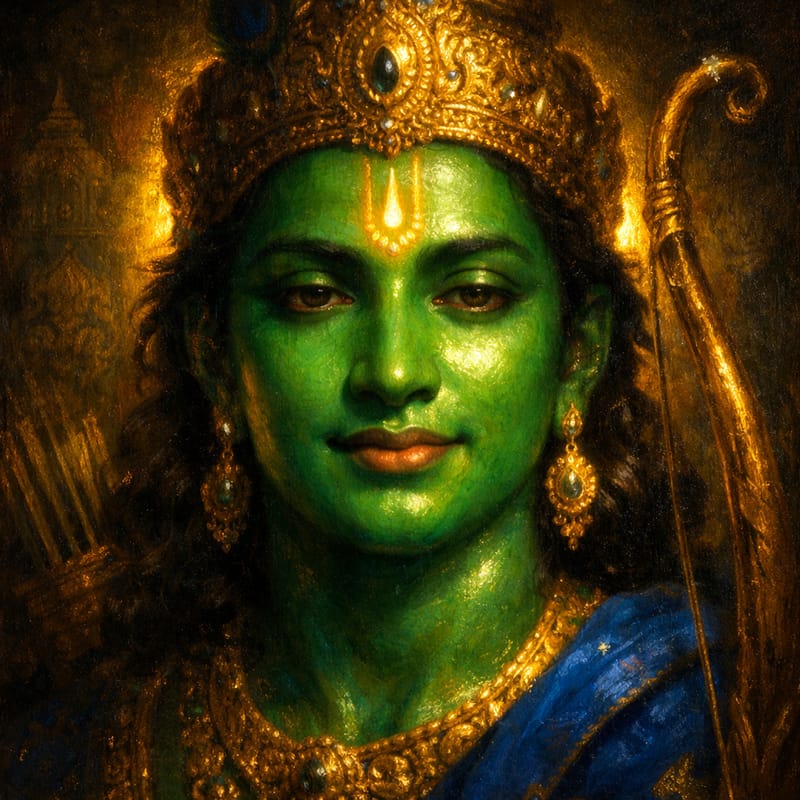
Shri Rama Rameti Rameti Mantra — Telugu Lyrics
Shri Rama Rameti Rameti Mantra is an ancient Sanskrit mantra dedicated to Rama, believed to grant liberation and purify the mind through repetition.
Shri Rama Rameti Rameti literally translates as "Sri Rama, Rama, Rama" — the divine name repeated with reverent intensity. Rame Raame Manorame means "In Rama, in Rama, O mind-enchanting one" — celebrating Rama as the ultimate source of bliss and mental satisfaction. Sahasranama Tat Tulyam declares that this single name equals the Vishnu Sahasranama (thousand divine names). Ramanama Varanane completes the declaration: "The name Rama, O beautiful-faced one." This eight-line mantra from the Padma Purana encapsulates the supreme efficacy of Rama's name as a complete spiritual path.
This mantra emerges from a sacred dialogue in the Padma Purana where Lord Shiva himself affirms to Parvati that he chants only the Rama nama — and that this single utterance possesses the transformative power of all thousand Vishnu names combined. This is not mere poetic embellishment; it reflects the Vedantic principle that the supreme name (paramatman) contains infinite dimensions beyond numerical enumeration. Rama represents the perfect incarnation of dharma (righteousness), mercy, and divine grace. By placing his personal endorsement on this name, Shiva establishes Rama nama as the most direct and accessible path to liberation, transcending complex rituals or lengthy recitations.
Practitioners chant this mantra as a conclusion to Vishnu Sahasranama recitation or as a standalone daily japa (repetition). The most effective approach is continuous nama japa — repeating "Rama Rama Rama" throughout ordinary activities: while walking, working, or before sleep. This accessibility makes it ideal for modern seekers. The mantra's power multiplies through sincere, heartfelt repetition rather than mechanical recitation. Begin with 108 repetitions (one mala) and gradually deepen your practice into spontaneous, continuous remembrance.
Curated by The Mahakatha Team · Original Composition: Mahakatha · Lyric: Traditional / Vaishnava
Shri Rama Rameti Rameti Mantra
Rama · Preview · 2:00
Preview ended
Ancient sounds for transformation, carried across 3,000 years.
Get the full version — plus 275 more ancient chants. 80% OFF today only.
Get Ancient Chants Bundle — 80% OFF →3000+ happy customers · Lifetime access · All devices
2.2M people trust Mahakatha
Chant daily with reminders — Get the Mahakatha app
Lyrics
श्री राम रामेति रामेति रमे रामे मनोरमे। सहस्रनाम तत्तुल्यम् रामनाम वरानने॥
శ్రీ రామ రామేతి రామేతి రమే రామే మనోరమే। సహస్రనామ తత్తుల్యమ్ రామనామ వరాననే॥
నేను శ్రీ రామ నామాన్ని మళ్ళీ మళ్ళీ జపిస్తున్నాను
రామ నామం జపించడం మనస్సుకు ఆనందాన్ని కలిగిస్తుంది
ఆయన నామాన్ని ఒక్కసారి జపించడం విష్ణు సహస్రనామ స్తోత్రం జపించడానికి సమానం
ఓ సుందరీ, దయచేసి రామ నామాన్ని జపించు
How to Chant Shri Rama Rameti Rameti Mantra
- 1
Find a quiet, clean space
Sit in a comfortable, undisturbed environment. Face east or north if possible. You may light incense or a candle to set a contemplative atmosphere.
- 2
Settle into a comfortable posture
Sit cross-legged on the floor or upright in a chair. Keep the spine erect and place the hands on the knees with palms facing upward.
- 3
Take three cleansing breaths
Inhale slowly through the nose, hold briefly, and exhale completely. Repeat three times to calm the mind and prepare for mantra recitation.
- 4
Begin chanting Shri Rama Rameti Rameti Mantra
Chant the mantra clearly and with devotion — aloud, in a whisper, or silently. Use a mala (108 beads) to count repetitions. Aim for a consistent, unhurried rhythm throughout the session.
- 5
Rest in stillness
After completing your chanting, sit quietly for two to five minutes. Allow the vibration of the mantra to settle within. Close the practice with a moment of gratitude.
Benefits of Shri Rama Rameti Rameti Mantra
-
Equivalent to reciting the entire Vishnu Sahasranama (1000 divine names) — single utterance carries the spiritual merit of thousand names.
Source: Padma Purana
-
Helps settle the mind and ease mental turbulence through what the tradition regards as a deeply sattvic (pure) sound.
Source: Traditional practice & Yoga Vasishta
-
Chanted for liberation (moksha) — devotees hold that Rama nama frees one from the karma of many lifetimes.
Source: Padma Purana
-
Establishes constant divine companionship and inner peace when practiced as continuous japa throughout daily life.
Source: Traditional practice & Bhakti texts
-
Invokes the grace and protection of Rama, the embodiment of dharma, righteousness, and cosmic order.
Source: Ramayana & Bhakti tradition
Story & Symbolism
The Shri Rama Rameti Rameti mantra emerges from the Padma Purana's sacred dialogue between Lord Shiva and his consort Parvati Devi. In this exchange, Shiva — the supreme yogi and embodiment of meditation — reveals that among all spiritual practices, he himself chants only the Rama nama. This declaration carries extraordinary spiritual weight: if Mahadeva, the greatest of all yogis, practices only this name, it must represent the pinnacle of spiritual achievement. Shiva further declares that a single utterance of "Rama" equals reciting the entire Vishnu Sahasranama (the thousand divine names of Vishnu). This is not metaphorical exaggeration but a profound Vedantic truth: the supreme name contains within itself infinite dimensions that cannot be enumerated. The mantra crystallizes this teaching into eight verses that can be chanted, contemplated, and lived.
Rama himself represents the perfect incarnation of dharma — cosmic righteousness, moral order, and divine grace made tangible. As the seventh avatar of Vishnu, Rama demonstrated that enlightenment is compatible with ordinary human life: as son, husband, king, and warrior. His name carries the totality of this wisdom. The mantra's genius lies in its accessibility: unlike complex rituals requiring years of preparation, anyone can repeat "Rama" with sincere heart. The repetition naturally purifies the mind, dissolves vasanas (mental impressions), and aligns consciousness with cosmic order. Each utterance is both prayer and meditation, both invocation and transformation.
Over centuries, this mantra became central to bhakti (devotional) traditions across India. Saints, sages, and householders adopted Rama nama as their complete spiritual practice — needing nothing more. The tradition reached its modern zenith when Mahatma Gandhi, facing assassination, whispered "Hey Ram" (Oh Rama) as his final words — a testament to this name's power to anchor consciousness in truth even at death's threshold. Today, millions worldwide chant this mantra as their daily spiritual anchor, trusting Shiva's words in the Purana: liberation through the simple power of Rama's name.
How to Use in Daily Life
Morning Practice
Begin your day with one mala (108 repetitions) of Rama nama using prayer beads, preferably at sunrise. This establishes spiritual grounding and invokes Rama's qualities of courage and dharma for your entire day. Allow the rhythm to calm your mind before engaging daily activities.
Continuous Japa
Throughout the day, repeat "Rama Rama Rama" spontaneously during ordinary moments — while walking, commuting, working, or eating. Let the mantra flow like breathing, transforming mundane activities into meditation. This continuous remembrance is the heart of the practice.
Evening Reflection
Chant one mala in the evening while reviewing your day's actions. Use Rama's example of perfect dharma as a mirror — did you act with righteousness? This practice deepens self-awareness and alignment with cosmic order before sleep.
Sleep Practice
As you lie in bed before sleep, softly repeat Rama nama until consciousness naturally dissolves into rest. The mantra becomes your final conscious thought and a quiet companion as you sleep, a prayer for inner peace through the night.