

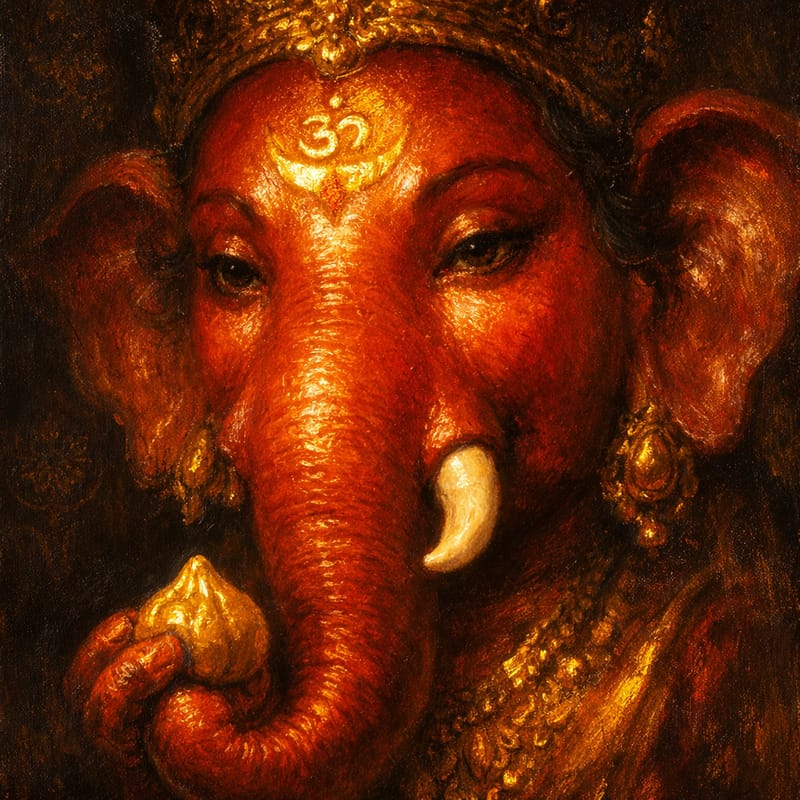
Ganesha Gayatri Mantra — Bengali Lyrics
Ganesha Gayatri Mantra in English: Aum Ekadantaaya Vidmahe / Vakratundaaya Dhimahi / Tanno Danti Prachodayat
It means: we know the one with a single tusk and we think of the one with the curved trunk. May Ganesha guide our mind.
Aum Ekadantaaya Vidmahe honours Ganesha as the one with a single tusk. Vakratundaaya Dhimahi thinks of him as the one with a curved trunk. Tanno Danti Prachodayat asks the tusked one to light up our mind. This is the same three-line pattern as the Gayatri Mantra.
Ganesha is loved as the remover of obstacles and the lord of beginnings. The single tusk is often read as one clear aim. The curved trunk is read as the ease to move around problems. Chanting this mantra turns the mind toward these qualities.
Many people chant it 108 times with a mala in a quiet place. Early morning or before study is a good time. Sit tall and breathe slowly. Even 11 or 21 times a day is a good start.
Curated by The Mahakatha Team · Original Composition: Mahakatha · Lyric: Traditional / Vedic
Ganesha Gayatri Mantra
Ganesha · Preview · 2:00
Preview ended
Ancient sounds for transformation, carried across 3,000 years.
Get the full version — plus 275 more ancient chants. 80% OFF today only.
Get Ancient Chants Bundle — 80% OFF →3000+ happy customers · Lifetime access · All devices
2.2M people trust Mahakatha
Chant daily with reminders — Get the Mahakatha app
Ganesha Gayatri Mantra Lyrics in Bengali
ॐ एकदन्ताय विद्महे वक्रतुण्डाय धीमहि तन्नो दन्ति प्रचोदयात्
ওঁ একদন্তায় বিদ্মহে বক্রতুণ্ডায় ধীমহি তন্নো দন্তি প্রচোদয়াত্
আমি একদন্ত বিশিষ্ট সর্বব্যাপী পরমসত্তার কাছে প্রণাম জানাই।
আমি বিনীতভাবে তাঁর কাছে উচ্চতর বুদ্ধি প্রার্থনা করি যিনি বক্র গজশুণ্ড বিশিষ্ট।
আমি সেই মহিমাময় সত্তার কাছে প্রণাম জানাই যিনি আমার জীবনকে প্রজ্ঞার আলোতে উদ্ভাসিত করেন।
How to Chant Ganesha Gayatri Mantra
- 1
Find a quiet, clean space
Sit in a comfortable, undisturbed environment. Face east or north if possible. You may light incense or a candle to set a contemplative atmosphere.
- 2
Settle into a comfortable posture
Sit cross-legged on the floor or upright in a chair. Keep the spine erect and place the hands on the knees with palms facing upward.
- 3
Take three cleansing breaths
Inhale slowly through the nose, hold briefly, and exhale completely. Repeat three times to calm the mind and prepare for mantra recitation.
- 4
Begin chanting Ganesha Gayatri Mantra
Chant the mantra clearly and with devotion — aloud, in a whisper, or silently. Use a mala (108 beads) to count repetitions. Aim for a consistent, unhurried rhythm throughout the session.
- 5
Rest in stillness
After completing your chanting, sit quietly for two to five minutes. Allow the vibration of the mantra to settle within. Close the practice with a moment of gratitude.
Benefits of Ganesha Gayatri Mantra
-
Traditionally chanted to ask Ganesha to clear obstacles from your path.
Source: Traditional practice
-
Students often chant it before study to settle the mind and focus.
Source: Traditional practice
-
Builds humility and a steady daily practice.
Source: Traditional practice
-
Many people find it brings a calm and hopeful mood.
Source: Traditional practice
-
Chanted at the start of new work as a prayer for a good beginning.
Source: Traditional practice
Story & Symbolism
The Gayatri pattern is one of the oldest forms of Sanskrit prayer. It comes from a verse in the Rigveda (3.62.10). Over time devotees used the same three lines to pray to many deities. The Ganesha Gayatri is one of them.
Ganesha has a single tusk (ekadanta) and a curved trunk (vakratunda). Many teachers read the tusk as one clear aim. They read the trunk as the ease to work around problems. The mantra names both.
Today families chant it before study or rituals. Many people also chant it at the start of new work as a prayer for a good beginning.
How to Use in Daily Life
Morning Ritual
Chant it 108 times in the early morning with a calm breath. This sets a clear intention for the day ahead.
Before Study
Recite it 11 times before study or important work. Many students find it helps them settle and focus.
Starting New Work
Chant it before a new project or a change at work. It is a prayer for Ganesha's blessing on a good start.
Evening Reflection
Chant it softly 21 times before sleep. It can help you let go of the day and rest.