

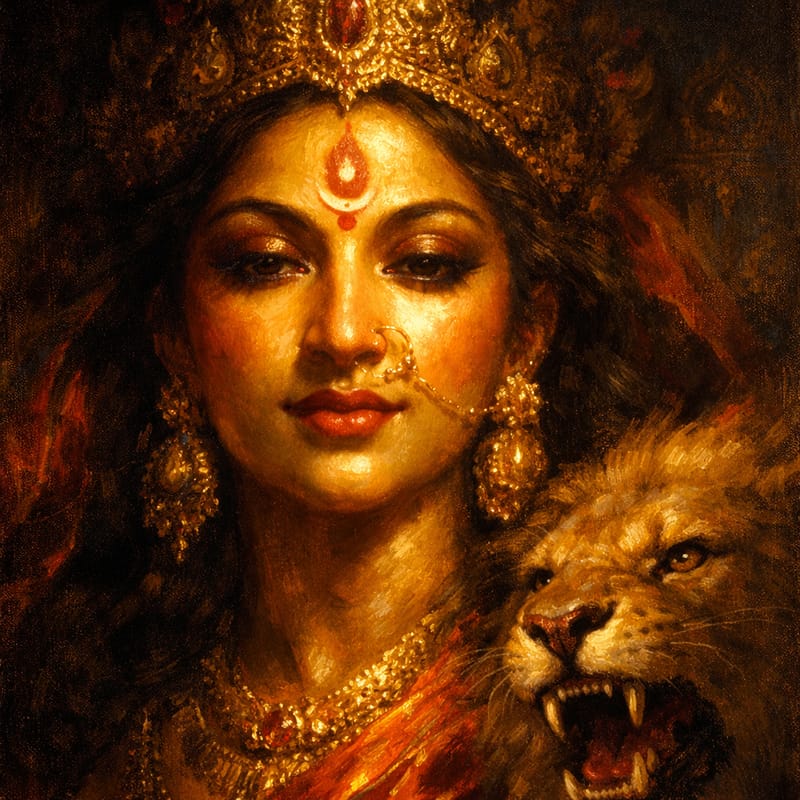
Siddhidaatri Devi Mantra — German Lyrics
Siddhidaatri Devi Mantra is a sacred Sanskrit invocation honoring Durga as the giver of siddhis, the spiritual powers named in tradition. Om Hreem Sah Siddhidatryai Namah is a sacred invocation to Siddhidaatri Devi, the ninth and final manifestation of Goddess Durga venerated during Navratri. 'Om' is seen as a link with infinite consciousness, the primordial sound underlying all existence. 'Hreem' activates the divine feminine creative force (Shakti) within the seeker. 'Sah' invokes supreme spiritual authority and transcendent wisdom. 'Siddhidatryai' directly addresses the Goddess as the eternal bestower of siddhis—the eight spiritual powers described in tradition. 'Namah' means 'I bow' or 'I surrender,' completing the sacred offering of the self to divine grace. Siddhidaatri embodies the culmination of all spiritual mastery, representing perfection of the eight siddhis: anima (subtlety), mahima (expansion), garima (heaviness), laghima (lightness), prapti (attainment), prakamya (wish-fulfillment), ishatva (supremacy), and vashatva (control). According to the Devi Mahatmya and Markandeya Purana, she symbolizes the power to transcend material limitations and manifest one's highest potential. Traditionally chanted on the ninth day of Navratri, when the veil between material and spiritual realms is said to thin, this mantra is a prayer not only for siddhis but also for steady confidence, wisdom, and freedom from fear and self-doubt. Chant this mantra 108 times daily, ideally during brahma muhurta (pre-dawn) or evening meditation at sunset. Sit facing east with a sattvic mindset—pure intention and humble devotion. Place your palm on your heart chakra and visualize golden or violet light radiating from the Goddess, infusing you with divine strength and clarity. This practice yields deeper results when combined with asana, pranayama, and ethical living (Yama and Niyama).
Curated by The Mahakatha Team · Original Composition: Mahakatha · Lyric: Traditional / Shakta
Siddhidaatri Devi Mantra
Durga · Preview · 2:00
Preview ended
Ancient sounds for transformation, carried across 3,000 years.
Get the full version — plus 275 more ancient chants. 80% OFF today only.
Get Ancient Chants Bundle — 80% OFF →3000+ happy customers · Lifetime access · All devices
2.2M people trust Mahakatha
Chant daily with reminders — Get the Mahakatha app
ॐ ह्रीं सः सिद्धिदात्र्यै नमः
Om Hreem Sah Siddhidatryai Namah
Segne mich, oh Göttin Siddhidatri, mit allem Glück und Überfluss. Durch diese Klänge rufe ich deine Segnungen an.
How to Chant Siddhidaatri Devi Mantra
- 1
Find a quiet, clean space
Sit in a comfortable, undisturbed environment. Face east or north if possible. You may light incense or a candle to set a contemplative atmosphere.
- 2
Settle into a comfortable posture
Sit cross-legged on the floor or upright in a chair. Keep the spine erect and place the hands on the knees with palms facing upward.
- 3
Take three cleansing breaths
Inhale slowly through the nose, hold briefly, and exhale completely. Repeat three times to calm the mind and prepare for mantra recitation.
- 4
Begin chanting Siddhidaatri Devi Mantra
Chant the mantra clearly and with devotion — aloud, in a whisper, or silently. Use a mala (108 beads) to count repetitions. Aim for a consistent, unhurried rhythm throughout the session.
- 5
Rest in stillness
After completing your chanting, sit quietly for two to five minutes. Allow the vibration of the mantra to settle within. Close the practice with a moment of gratitude.
Benefits of Siddhidaatri Devi Mantra
-
Chanted to honour the giver of siddhis (spiritual powers), as a prayer for higher consciousness and self-mastery.
Source: Devi Mahatmya; Traditional Tantric Practice
-
Helps ease self-doubt, fear, and limiting beliefs, so you can grow steadier inner confidence and authentic personal power.
Source: Durga Saptashati; Shakti Upanishad
-
Traditionally chanted for spiritual growth toward moksha (liberation) and realization of one's divine nature.
Source: Mandukya Upanishad; Yoga Vashishtha
-
Grants clarity of life purpose, removes obstacles blocking success in both material and spiritual endeavors.
Source: Traditional practice; Navratri scriptures
-
Cultivates divine feminine wisdom (Shakti) manifesting as intuition, healing ability, and authentic power grounded in dharma.
Source: Bhagavad Gita (10.34); Tantra tradition
Story & Symbolism
Siddhidaatri emerges from the Markandeya Purana's Devi Mahatmya (Durga Saptashati), the foundational text detailing the nine forms of Goddess Durga worshipped during Navratri. Her name literally translates to 'the giver of siddhis'—spiritual powers that, in tradition, represent stages of spiritual mastery. While the Vedas reference Shakti as primordial creative power, the Puranic tradition crystallized this understanding into nine distinct feminine forms, each embodying a facet of the goddess's power to overcome ignorance, fear, and limitation. Siddhidaatri represents the final and most exalted form: the complete activation of spiritual potential and liberation from all bondage.
Spiritual significance of Siddhidaatri lies in her embodiment of perfected consciousness—the state where the individual soul (Atman) fully realizes its identity with universal consciousness (Brahman). She is believed to grant the eight siddhis not as tools for ego gratification, but as natural byproducts of enlightenment. Unlike earlier Durga forms (Shailaputri through Saraswati) that emphasize destruction of obstacles and cultivation of virtues, Siddhidaatri represents the positive culmination: the flowering of divine abilities within a purified, devoted heart. In yogic texts, siddhis are said to arise naturally when consciousness transcends material identification.
Today, the Siddhidaatri mantra is chanted primarily on the ninth day of Navratri (autumn and spring cycles) as the culminating worship of the goddess. Many devotees in Shakta traditions turn to this mantra for spiritual awakening and for clearing the blocks to reaching one's highest potential. Its popularity has grown as seekers worldwide recognize the need for spiritual mastery alongside worldly well-being—a teaching embodied in Siddhidaatri's grace.
How to Use in Daily Life
Morning Practice (Brahma Muhurta)
Chant 54 repetitions at dawn (pre-dawn) facing east, sitting upright on a mat. Visualize violet or golden light descending from the goddess into your heart chakra, awakening divine abilities and clarity for the day ahead.
Meditation Integration
During evening meditation, chant the remaining 54 repetitions slowly with closed eyes. Focus on the heart center, feeling the goddess's presence as infinite strength, wisdom, and compassionate power easing fear and doubt.
Navratri Intensification
On the ninth day of Navratri, chant 1,008 repetitions (10 malas) with full devotion. This multiplies the mantra's potency exponentially, marking the completion of the goddess's nine transformative forms within your consciousness.
Before Sleep Anchoring
Chant 27 repetitions before bed to let the day's spiritual work settle quietly in your mind. This is a quiet way to end the day, asking for the goddess's divine grace and protection through the night.