

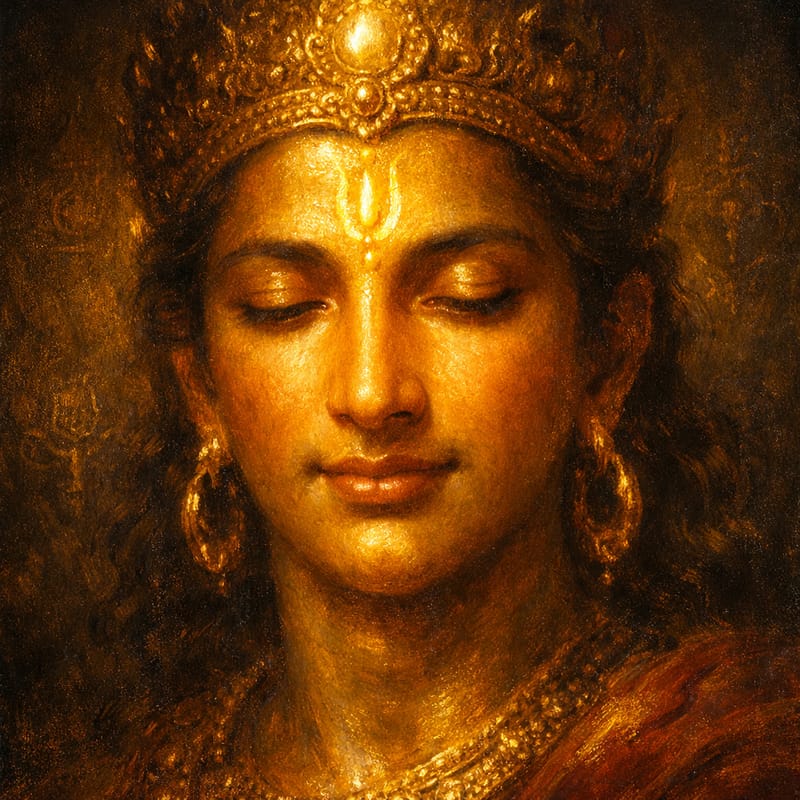
Dhanavantri Japa Mantra — Bengali Lyrics
Dhanavantri Japa Mantra is a sacred Sanskrit mantra dedicated to Dhanavantri, the Hindu deity of healing and medicine.
Om Shree Dhanvantaraye Namah translates literally as 'Om, I bow to the auspicious Lord Dhanavantari.' Om represents the primordial sound underlying all existence, from which creation is said to emerge. Shree denotes prosperity, wholeness, and divine grace. Dhanvantaraye refers to Dhanavantari, the celestial physician and avatar of Vishnu who emerged from the cosmic ocean holding the nectar of immortality (amrita). Namah means a complete surrendering of the ego—a gesture of reverence and openness to receive blessings.
Dhanavantari is venerated as the founding father of Ayurveda, the ancient system of holistic healing. In Hindu tradition, he represents not merely good health, but full vitality—the state where mind, body, and spirit exist in harmonious balance. Chanting this mantra invokes his presence as a prayer for health and healing. The mantra links physical and spiritual wellbeing: it reflects the belief that true health extends beyond the body into the mind and spirit. By repeating his name with reverence, one taps into an ancient lineage of wisdom about what genuine wellness means.
This mantra is traditionally chanted 108 times using a mala (prayer beads), though any multiple of 12 is beneficial. Early morning (brahma muhurta) or before meals are ideal times. Practitioners should sit upright in a calm space, focus on the heart chakra, and intone each syllable with clear intention. Begin with 21 or 40 days of consistent practice to establish a healing rhythm. The mantra works best when combined with conscious lifestyle choices—proper nutrition, rest, and positive thought.
Curated by The Mahakatha Team · Original Composition: Mahakatha · Lyric: Traditional / Vaishnava
Dhanavantri Japa Mantra
Dhanavantri · Preview · 2:00
Preview ended
Ancient sounds for transformation, carried across 3,000 years.
Get the full version — plus 275 more ancient chants. 80% OFF today only.
Get Ancient Chants Bundle — 80% OFF →3000+ happy customers · Lifetime access · All devices
2.2M people trust Mahakatha
Chant daily with reminders — Get the Mahakatha app
Lyrics
ॐ श्री धन्वन्तरये नमः
ওঁ শ্রী ধন্বন্তরয়ে নমঃ
হে ভগবান ধন্বন্তরি, আমি আপনার আশীর্বাদ গ্রহণ করতে আমার মনোনিবেশ করি, যা আমাকে নিরাময় করে এবং শক্তি প্রদান করে।
How to Chant Dhanavantri Japa Mantra
- 1
Find a quiet, clean space
Sit in a comfortable, undisturbed environment. Face east or north if possible. You may light incense or a candle to set a contemplative atmosphere.
- 2
Settle into a comfortable posture
Sit cross-legged on the floor or upright in a chair. Keep the spine erect and place the hands on the knees with palms facing upward.
- 3
Take three cleansing breaths
Inhale slowly through the nose, hold briefly, and exhale completely. Repeat three times to calm the mind and prepare for mantra recitation.
- 4
Begin chanting Dhanavantri Japa Mantra
Chant the mantra clearly and with devotion — aloud, in a whisper, or silently. Use a mala (108 beads) to count repetitions. Aim for a consistent, unhurried rhythm throughout the session.
- 5
Rest in stillness
After completing your chanting, sit quietly for two to five minutes. Allow the vibration of the mantra to settle within. Close the practice with a moment of gratitude.
Benefits of Dhanavantri Japa Mantra
-
A prayer for good health and strength, offered to the deity of healing
Source: Traditional Ayurvedic practice; Bhava Prakasha Nighantu
-
Slow chanting can ease stress and help you feel calmer, aiding emotional resilience
Source: Traditional practice (Dhanvantari worship tradition)
-
A prayer for getting well, chanted with sincere intention alongside a doctor's care
Source: Dhanavantari Stotra; Ayurvedic healing traditions
-
In Ayurvedic tradition, linked with the subtle channels (nadis) and the balance of the three doshas (Vata, Pitta, Kapha)
Source: Charaka Samhita; traditional Ayurvedic texts
-
Cultivates mental clarity, positive outlook, and spiritual alignment with universal healing energy
Source: Traditional practice
Story & Symbolism
Dhanavantari emerges from Hindu cosmology as a divine healer whose legend is chronicled across multiple Puranas, particularly the Bhagavata Purana. According to the Samudra Manthan narrative, when the Devas (gods) and Asuras (demons) churned the cosmic ocean to obtain amrita (immortal nectar), Dhanavantari arose from its depths holding a vessel of this life-giving elixir. He represents the ultimate healing principle—the intersection of divine wisdom and medicine. Designated as the founder and patron deity of Ayurveda, the traditional Indian system of healing, Dhanavantari is said to have gathered healing knowledge going back to the Rig Veda itself. His emergence symbolizes medicine's sacred origin: healing is not merely empirical but fundamentally divine in nature.
Dhanavantari embodies multiple dimensions of wellbeing beyond simply treating sickness. He represents Sattvic consciousness—the purest, most luminous state of mind from which true healing flows. In Ayurvedic philosophy, he signifies the doctor's ideal: one who has transcended ego and personal ambition to become a pure channel for healing energy. By invoking his name, practitioners align themselves with this sacred archetype. The mantra acknowledges that healing begins not with suppressing symptoms but with restoring balance to the entire person—body, mind, and spirit. Dhanavantari's blue complexion symbolizes the cooling, calming quality of perfect health.
Today, this mantra remains central to Ayurvedic practice worldwide. Practitioners chant it in clinics before consultations, patients use it as a prayer while they get better, and spiritual seekers use it as a gateway to understanding wellness as sacred. The mantra persists because it is experiential—many who chant sincerely for 40 days say they feel more vital and clear, keeping the ancient wisdom alive across generations.
How to Use in Daily Life
Morning Invocation
Chant 21–54 times at sunrise before breakfast. This sets your intention for health at the start of the day. Face east, sit upright, and visualize golden healing light filling your body with each repetition.
Meditation Practice
Use the mantra as your meditation anchor for 15–20 minutes. Combine chanting with breath: inhale Om, exhale Shree Dhanvantaraye Namah. This deepens focus and helps the mantra settle more fully in your mind.
Before Meals
Whisper the mantra 3 times before eating to sanctify food and offer thanks for nourishment. This transforms eating into a ritual that acknowledges nourishment as medicine and divine grace.
Evening Gratitude
Chant softly 21 times before sleep to process the day's experiences and invite restorative rest. This calms the mind and, in Ayurvedic terms, is said to settle Vata, helping you rest more easily.