

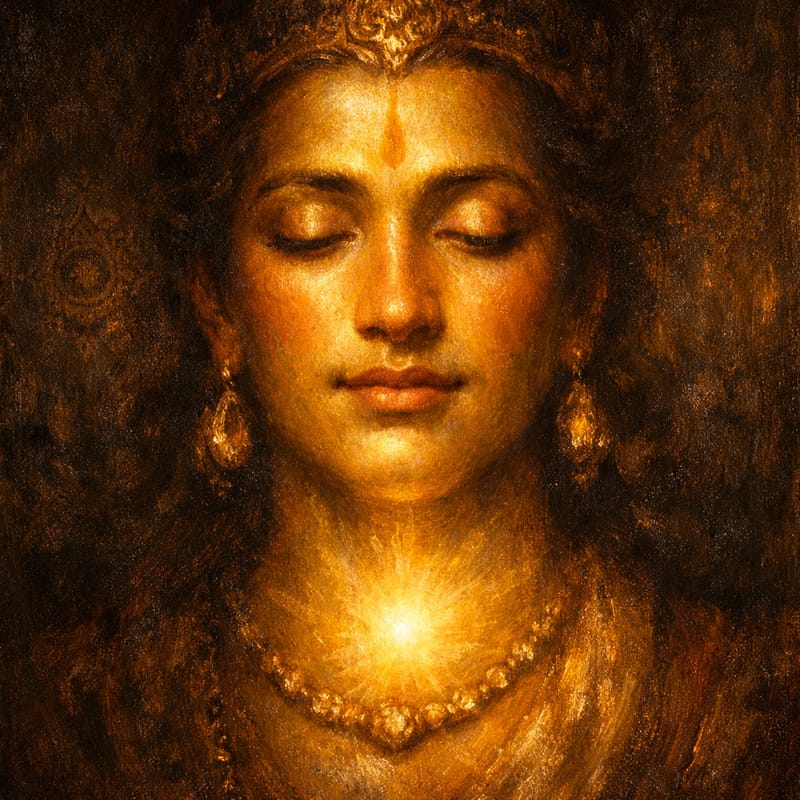
Vishuddha Mantra for Throat Chakra — Hindi Lyrics
Vishuddha Mantra for Throat Chakra is a sacred Sanskrit mantra dedicated to the Chakra, enhancing authentic communication and removing blockages to creative expression.
Ham (हं) is the bija or 'seed' mantra of the Vishuddha chakra, the fifth energy center located at the throat. Unlike full mantras invoking deities, Ham is a single seed sound—a syllable that tradition links directly with the subtle throat chakra. In Sanskrit, 'Ha' represents Shiva (pure consciousness) and 'M' represents Shakti (primordial energy). Together, Ham embodies the union of consciousness and energy, and is traditionally chanted to awaken and purify the throat centre. The nasal 'M' sound is given special weight in this chakra practice.
The Vishuddha chakra governs communication, creative expression, listening, and authentic speech. When functioning harmoniously, it enables you to speak truth, listen deeply, and express your unique voice without fear or constriction. Tantric and chakra traditions teach that chanting Ham opens the throat centre, helping you release unexpressed emotions and limiting beliefs held there. Regular chanting is a way to focus on the Vishuddha chakra and bring thought, word, and action into closer agreement. This alignment naturally strengthens your ability to manifest intentions into reality through conscious speech and creative expression.
Chant Ham during early morning meditation (brahma muhurta) or whenever you need to communicate authentically. Sit upright, touch your chin to chest slightly, and vocalize the mantra aloud for 11, 21, or 108 repetitions. You should feel the nasal hum of 'M' in your throat and head. Practice before important conversations, creative work, or whenever you feel speech anxiety. Coordinate with the element of ether and the color blue to deepen the practice's effect on your Vishuddha chakra.
Curated by The Mahakatha Team · Original Composition: Mahakatha · Lyric: Traditional / Shaivite
Vishuddha Mantra for Throat Chakra
Chakra · Preview · 2:00
Preview ended
Ancient sounds for transformation, carried across 3,000 years.
Get the full version — plus 275 more ancient chants. 80% OFF today only.
Get Ancient Chants Bundle — 80% OFF →3000+ happy customers · Lifetime access · All devices
2.2M people trust Mahakatha
Chant daily with reminders — Get the Mahakatha app
Lyrics
हं
हं
विशुद्ध (कंठ) चक्र का बीज मंत्र, जो आकाश/अंतरिक्ष तत्व तथा संवाद और अभिव्यक्ति की शक्ति का प्रतिनिधित्व करता है। कंठ केंद्र की कंपन आवृत्ति से संबद्ध संस्कृत मूल से व्युत्पन्न।
How to Chant Vishuddha Mantra for Throat Chakra
- 1
Find a quiet, clean space
Sit in a comfortable, undisturbed environment. Face east or north if possible. You may light incense or a candle to set a contemplative atmosphere.
- 2
Settle into a comfortable posture
Sit cross-legged on the floor or upright in a chair. Keep the spine erect and place the hands on the knees with palms facing upward.
- 3
Take three cleansing breaths
Inhale slowly through the nose, hold briefly, and exhale completely. Repeat three times to calm the mind and prepare for mantra recitation.
- 4
Begin chanting Vishuddha Mantra for Throat Chakra
Chant the mantra clearly and with devotion — aloud, in a whisper, or silently. Use a mala (108 beads) to count repetitions. Aim for a consistent, unhurried rhythm throughout the session.
- 5
Rest in stillness
After completing your chanting, sit quietly for two to five minutes. Allow the vibration of the mantra to settle within. Close the practice with a moment of gratitude.
Benefits of Vishuddha Mantra for Throat Chakra
-
Enhances authentic communication and removes fear of public speaking, allowing your true voice to emerge without constriction.
Source: Chakra Meditation tradition; Sat Chakra Nirupana
-
Clears mental fog and enhances clarity of thought, enabling better decision-making rooted in inner wisdom.
Source: Tantric philosophy; Traditional chakra practice
-
Activates creative expression and removes blockages that suppress artistic or verbal gifts.
Source: Traditional Kundalini Yoga practice
-
Strengthens listening capacity and deepens spiritual perception beyond ordinary hearing.
Source: Upanishadic meditation texts; Yoga Sutras
-
Harmonizes past, present, and future by integrating all dimensions of time through throat chakra activation.
Source: Traditional chakra teachings
Story & Symbolism
The bija mantra system emerged from ancient Tantric texts and the Vedic understanding of Nada Brahman—the principle that reality itself is sound. While the Vedas contain sacred syllables like Om, the systematic codification of bija mantras for each chakra developed primarily through Tantric schools between the 10th and 16th centuries CE. The Sat Chakra Nirupana, authored by Swami Sat-Ananda during the 16th century, formally mapped Ham to the Vishuddha chakra. This text synthesized centuries of oral transmission and yogic practice into written form, establishing Ham as the throat chakra's seed mantra. Later Tantric tradition further describes bija mantras as working on the subtle chakras without requiring deity visualization.
The Vishuddha chakra itself holds significance across Indian spiritual traditions. In Vedic thought, the throat is the seat of Saraswati, goddess of speech, learning, and divine knowledge. In Tantric understanding, Vishuddha represents the purification point where lower energies are refined into higher consciousness. Ham's structure—'Ha' (Shiva) and 'M' (Shakti)—embodies non-dual philosophy central to Advaita Vedanta and Tantra. The mantra doesn't invoke a specific deity but rather activates the chakra's inherent divine energy. This approach made bija mantras accessible to practitioners of varying traditions and backgrounds, as the practice requires no belief system beyond openness to sacred sound.
In modern times, Swami Vivekananda, Sri Aurobindo, and contemporary teachers like Yogi Bhajan brought Tantric chakra knowledge into global spiritual consciousness. Western Kundalini Yoga and holistic healing practices have further popularized Ham, integrating it with contemporary understanding of energy anatomy. Today, Ham is chanted widely—from traditional tantric practitioners in India to yoga studios across North America, Europe, and beyond—keeping this ancient sound practice alive.
How to Use in Daily Life
Dawn Activation
Chant Ham 21 times during brahma muhurta (pre-dawn) as the sun rises. Sit upright facing east, close your eyes, and let the morning silence carry each sound. This seeds your day with authentic communication and creative clarity.
Pre-Meeting Practice
Before important conversations, presentations, or creative work, chant Ham 11 times mindfully. Feel the sound settle into your throat. This can ease nervousness and center you in authentic self-expression, so your words come from truth.
Meditation Session
In dedicated spiritual practice, chant Ham 108 times as your full chakra meditation. Coordinate with visualizing blue light at your throat center. This deepens purification and aligns your entire communication channel with divine consciousness.
Evening Integration
Before sleep, chant Ham 11 times softly to integrate the day's learnings and release any unexpressed words or emotions stored in your throat. This promotes restful sleep and emotional healing.