

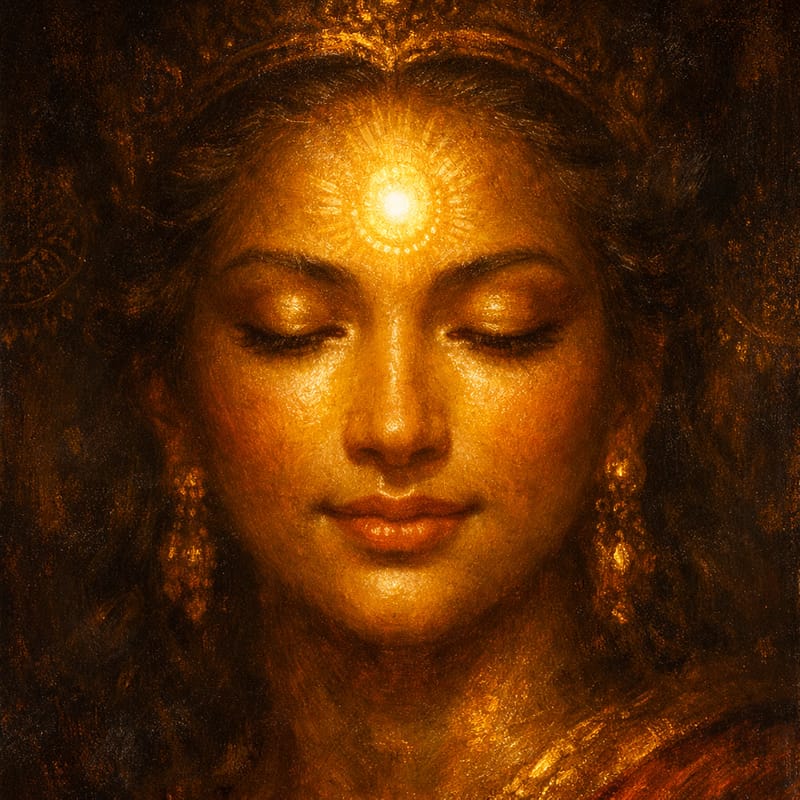
Ajna Mantra for Third Eye Chakra — Hindi Lyrics
Ajna Mantra for Third Eye Chakra is a sacred Sanskrit mantra dedicated to awakening intuitive perception and accessing higher consciousness beyond ordinary awareness.
Om (ॐ) is the primordial sound of the universe, recognized across Vedic traditions as the fundamental sound from which all creation emerges. Composed of three syllables—A, U, M—Om represents the past, present, and future in a single sound. When chanted in relation to the Ajna chakra, located between the eyebrows, Om becomes a direct channel to activate the third eye's dormant potential. This sacred sound transcends language and concept, operating at the level of pure consciousness itself.
The Ajna chakra, the command center of intuition and inner vision, governs our ability to perceive subtle truths beyond ordinary sight. As described in the Upanishads, particularly the Yoga Upanishad, Om serves as the gateway to higher perception and self-realization. In yoga traditions, chanting Om with focused intention at the Ajna point is believed to purify the nadis (subtle channels) and awaken dormant spiritual faculties. The mantra doesn't invoke a specific deity but rather aligns individual consciousness with universal consciousness, dissolving the boundary between inner and outer worlds.
Chant Om during early morning meditation or evening practice for 5-15 minutes, focusing attention between the eyebrows. Sit in a comfortable upright position, inhale deeply, and vocalize Om on the exhale, letting your attention rest at the center of your forehead. Begin with 10-20 repetitions and gradually increase. Consistency matters more than duration—daily practice gradually builds a habit of stillness and clarity. Ideal times include dawn (Brahmamuhurta) and twilight hours when the mind is naturally more receptive.
Curated by The Mahakatha Team · Original Composition: Mahakatha · Lyric: Traditional / Shaivite
Ajna Mantra for Third Eye Chakra
Chakra · Preview · 2:00
Preview ended
Ancient sounds for transformation, carried across 3,000 years.
Get the full version — plus 275 more ancient chants. 80% OFF today only.
Get Ancient Chants Bundle — 80% OFF →3000+ happy customers · Lifetime access · All devices
2.2M people trust Mahakatha
Chant daily with reminders — Get the Mahakatha app
Lyrics
ॐ
ॐ
ॐ ब्रह्मांड की आदि ध्वनि और हिंदू धर्म में परम सत्य है; यह परम चेतना (ब्रह्म) का प्रतिनिधित्व करता है। मूल: संस्कृत 'औम्' से, जिसे सृष्टि का प्रथम कंपन माना जाता है।
How to Chant Ajna Mantra for Third Eye Chakra
- 1
Find a quiet, clean space
Sit in a comfortable, undisturbed environment. Face east or north if possible. You may light incense or a candle to set a contemplative atmosphere.
- 2
Settle into a comfortable posture
Sit cross-legged on the floor or upright in a chair. Keep the spine erect and place the hands on the knees with palms facing upward.
- 3
Take three cleansing breaths
Inhale slowly through the nose, hold briefly, and exhale completely. Repeat three times to calm the mind and prepare for mantra recitation.
- 4
Begin chanting Ajna Mantra for Third Eye Chakra
Chant the mantra clearly and with devotion — aloud, in a whisper, or silently. Use a mala (108 beads) to count repetitions. Aim for a consistent, unhurried rhythm throughout the session.
- 5
Rest in stillness
After completing your chanting, sit quietly for two to five minutes. Allow the vibration of the mantra to settle within. Close the practice with a moment of gratitude.
Benefits of Ajna Mantra for Third Eye Chakra
-
Traditionally chanted to deepen intuition and inner vision, helping you notice subtle patterns in your own mind that are easy to miss.
Source: Yoga Upanishad
-
In yoga traditions, Om is linked with the Ajna chakra and chanted as a way into higher states of consciousness and spiritual insight beyond rational thought.
Source: Traditional tantric practice
-
Reduces mental fog and anxiety by stabilizing scattered thought patterns, creating a centered, clear mind resistant to external disturbances.
Source: Traditional practice
-
Deepens meditation practice by serving as an anchor for attention, reducing mind-wandering and easing entry into contemplative states.
Source: Mandukya Upanishad
-
Elevates perspective by shifting awareness from ego-driven concerns to universal consciousness, fostering detachment from petty worries.
Source: Traditional practice
Story & Symbolism
Om's origins trace to the earliest Vedic hymns, where it appears as the foundational sound underlying all creation. The Rigveda references Om as the sacred utterance through which Brahman manifests the universe. The Mandukya Upanishad, one of the principal Upanishads, provides the most comprehensive philosophical explanation, describing Om as consisting of three syllables (A, U, M) that represent the waking, dreaming, and deep sleep states of consciousness, with a fourth dimension of silence representing pure transcendental awareness. Vedic rishis (seers) discovered that chanting Om attunes individual consciousness to cosmic consciousness, making it the supreme mantra across all Hindu and Buddhist traditions. As tantric spirituality developed, spiritual teachers came to link Om specifically with the Ajna chakra. The chakra system, elaborated in texts like the Sat-Chakra-Nirupana and Kundalini Upanishad, identified the third eye as humanity's gateway to higher perception. Tantric practitioners came to associate Om—particularly when chanted with concentrated focus at the Ajna point—with the third eye center. This alignment became understood not as coincidence but as the inherent design of cosmic sound meeting human physiology. Today, Om chanting for Ajna activation continues across yoga studios, meditation centers, and ashrams worldwide. Today, many people simply find that slow, steady Om chanting is a calming way to settle the mind before meditation. The mantra has transcended cultural boundaries, becoming recognized as a universal key to inner vision and spiritual awakening, fulfilling its original purpose as the sound bridge between individual and infinite consciousness.
How to Use in Daily Life
Dawn Practice
Chant Om for 5-15 minutes during Brahmamuhurta (hour before sunrise) when mental receptivity peaks. Sit facing east, focus between eyebrows, and complete 20-108 repetitions. This establishes your day with clarity and intuitive alignment.
Meditation Integration
Use Om as your meditation anchor. After settling into stillness, silently or vocally repeat Om, synchronizing each chant with your natural breath rhythm. This can deepen concentration and ease you into quieter meditative states.
Evening Ritual
During twilight hours, practice Om chanting for 10-20 minutes to close your day with spiritual centering. This releases accumulated mental tension and prepares your consciousness for restorative sleep while activating third eye activity.
Before Sleep
Chant Om 7-21 times before sleep while lying down, focusing between eyebrows. This activates the third eye during the dream state, often producing vivid, spiritually significant dreams and enhanced dream recall.