

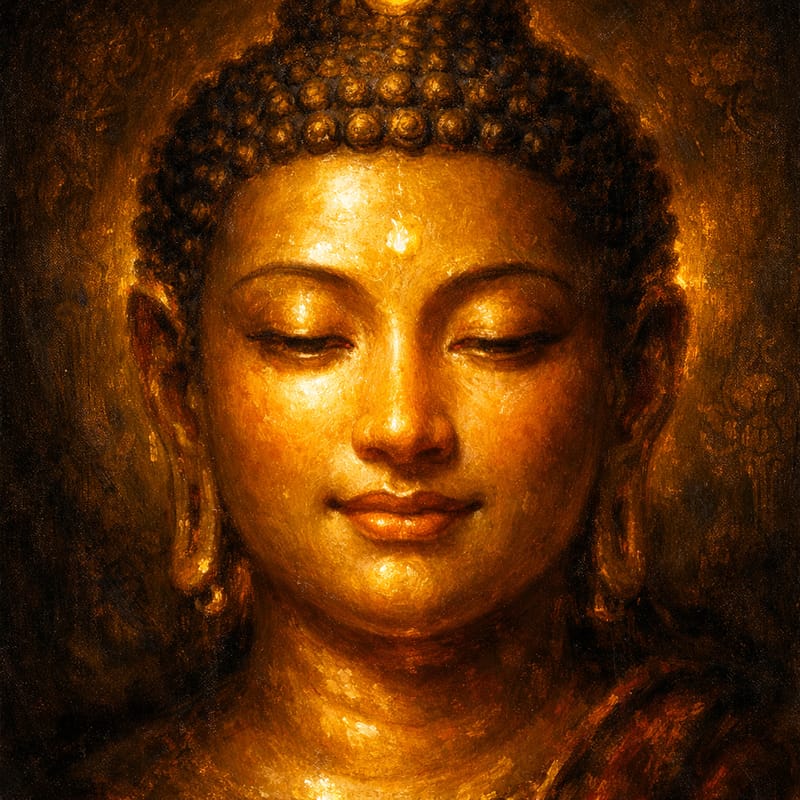
Tayata Om Mantra — Kannada Lyrics
Tayata Om Mantra is a Tibetan Buddhist healing mantra honoring the Medicine Buddha, chanted to purify karma and to bring comfort in the dying process.
Tayata Om Bekandze is a Buddhist healing mantra invoking the Medicine Buddha (Bhaisajyaguru), one of the most revered figures in Mahayana and Vajrayana Buddhism. The Buddha of Medicine is believed to have made twelve great vows to relieve all beings of their physical and spiritual afflictions.
Tayata Om Bekandze Bekandze Mahabekandze Radza Samudgate Soha is the sacred mantra of Sangye Menla, the Medicine Buddha, revered throughout Tibetan Buddhism as Lord Buddha of healing wisdom. This powerful invocation originates from Tibetan Buddhist tradition and calls upon the Medicine Buddha's transformative presence. Tayata means "thus it is," Om is the primordial universal sound, while Bekandze is commonly translated as "eliminating illness." Mahabekandze intensifies this as "greatly eliminating," Radza means "supreme king," Samudgate means "perfectly arisen," and Soha (Svaha) seals the offering with "may it be so."
The Medicine Buddha embodies the union of wisdom and compassion, his body radiating the luminous deep blue of lapis lazuli—symbolizing a mind free from ignorance. He holds a healing bowl and the arura plant, king of medicinal herbs in Tibetan medicine. Buddhists chant this mantra as a prayer for both physical and spiritual well-being, believing the two are closely linked. Through sincere intention and consistent chanting, practitioners pray not merely for physical recovery but for freedom from ignorance itself, which Buddhism sees as the deepest root of suffering.
Chant this mantra 108 times on a mala for personal healing, before taking medicine, or for those facing death. Visualize the Medicine Buddha's luminous blue form radiating healing nectar-light throughout your entire being. The practice requires no special prerequisites—only sincere dedication activates its transformative potential across physical, emotional, and spiritual dimensions of your existence.
Curated by The Mahakatha Team · Original Composition: Mahakatha · Lyric: Traditional / Buddhist
Tayata Om Mantra
Buddha · Preview · 2:00
Preview ended
Ancient sounds for transformation, carried across 3,000 years.
Get the full version — plus 275 more ancient chants. 80% OFF today only.
Get Ancient Chants Bundle — 80% OFF →3000+ happy customers · Lifetime access · All devices
2.2M people trust Mahakatha
Chant daily with reminders — Get the Mahakatha app
Lyrics
तयता ॐ बेकण्डजे बेकण्डजे महाबेकण्डजे राज समुद्गते स्वाहा
ತಯತಾ ಓಂ ಬೇಕಂಡ್ಜೇ ಬೇಕಂಡ್ಜೇ ಮಹಾಬೇಕಂಡ್ಜೇ ರಾಜ ಸಮುದ್ಗತೇ ಸ್ವಾಹಾ
ರೋಗಿಗಳಾಗಿರುವ ಅನೇಕ ಸಂವೇದನಾಶೀಲ ಜೀವಿಗಳು ರೋಗದಿಂದ ಶೀಘ್ರವಾಗಿ ಮುಕ್ತರಾಗಲಿ.
ಮತ್ತು ಜೀವಿಗಳ ಎಲ್ಲಾ ರೋಗಗಳು ಮತ್ತೆ ಎಂದಿಗೂ ಉಂಟಾಗದಿರಲಿ.
How to Chant Tayata Om Mantra
- 1
Find a quiet, clean space
Sit in a comfortable, undisturbed environment. Face east or north if possible. You may light incense or a candle to set a contemplative atmosphere.
- 2
Settle into a comfortable posture
Sit cross-legged on the floor or upright in a chair. Keep the spine erect and place the hands on the knees with palms facing upward.
- 3
Take three cleansing breaths
Inhale slowly through the nose, hold briefly, and exhale completely. Repeat three times to calm the mind and prepare for mantra recitation.
- 4
Begin chanting Tayata Om Mantra
Chant the mantra clearly and with devotion — aloud, in a whisper, or silently. Use a mala (108 beads) to count repetitions. Aim for a consistent, unhurried rhythm throughout the session.
- 5
Rest in stillness
After completing your chanting, sit quietly for two to five minutes. Allow the vibration of the mantra to settle within. Close the practice with a moment of gratitude.
Benefits of Tayata Om Mantra
-
Buddhists chant it to ask for purification of karma linked with sickness, invoking the Medicine Buddha's blessing for the spiritual side of suffering
Source: Tibetan Buddhist tradition
-
Often chanted before or during treatment as a calming prayer; slow chanting can help some people relax and feel more at ease
Source: Traditional practice; Tibetan Buddhist tradition
-
Eases the dying process and facilitates conscious transition, serving as the primary death-preparation mantra in Tibetan Buddhist practice
Source: Tibetan Book of the Dead (Bardo Thodol) and Mahayana Buddhist traditions
-
Traditionally chanted to purify negative karma that Buddhists believe ripens as obstacles or suffering, as a prayer for the well-being of body, mind, and spirit
Source: Traditional Tibetan Buddhist practice
-
Cultivates compassion and healing intention for self and all sentient beings, transforming suffering into the path of spiritual awakening
Source: Bodhisattva Path teachings, Mahayana Buddhism
Story & Symbolism
The Tayata Om mantra emerges from the Bhaisajyaguru Sutra, a canonical Mahayana text describing how the Medicine Buddha—called Bhaisajyaguru in Sanskrit and Sangye Menla in Tibetan—took twelve great vows to relieve all beings' suffering. According to the sutra, this mantra was taught by Buddha Shakyamuni to his disciples as the direct invocation of Bhaisajyaguru's healing blessings. The text exists in multiple Sanskrit, Chinese, Tibetan, and Japanese translations, each preserving the mantra's syllables with reverent accuracy across centuries and cultures. This widespread transmission across Buddhist traditions testifies to the mantra's timeless power and authenticity.
Bhaisajyaguru embodies the integration of wisdom and compassion into healing action. His lapis-lazuli blue skin symbolises the luminous, untainted mind free from ignorance. The mantra's syllables—each precisely chosen—encode his healing presence: Bekandze ('eliminating suffering'), Mahabekandze ('greatly eliminating'), and Radza Samudgate ('the king supremely arisen'). In Tibetan Buddhist philosophy, sickness is seen as having karmic dimensions alongside physical symptoms. The Medicine Buddha's mantra is chanted for both together, as a prayer to purify the spiritual imbalances believed to underlie bodily sickness. This holistic healing framework distinguishes the mantra's power.
In Tibetan practice, this mantra became inseparable from Tibetan medicine itself (Sowa Rigpa). Physicians would recite it while preparing medicines, and patients would chant while receiving treatment, multiplying the healing effect. Tibetan Buddhist lamas transmitted this mantra unbroken through monasteries and meditation communities for over 1,000 years. Today, the Tayata Om mantra remains central to Tibetan Buddhist healing work, death preparation practices, and global contemplative wellness traditions.
How to Use in Daily Life
Morning Prevention
Begin each morning with 21 repetitions to invoke the Medicine Buddha's preventive healing energy. This is practised as protective spiritual medicine, a prayer for good health and, in Buddhist belief, for purifying accumulated karma.
Before Medicine
Chant 3-7 times before taking any medication, visualising the Medicine Buddha blessing the medicine with enhanced healing power. This practice can sit alongside your treatment as a prayer, never as a replacement for a doctor's care.
Deep Meditation
Sit quietly and chant 108 repetitions with full visualisation of the Medicine Buddha's blue form radiating healing light. Pair this with rhythmic breathing—one repetition per breath cycle for deep healing on physical, emotional, and spiritual levels.
Evening Purification
End your day with 27 repetitions as a prayer to purify karma related to sickness or suffering gathered that day. This prepares your mind for restorative sleep and aligns you with the Medicine Buddha's healing compassion through the night.