

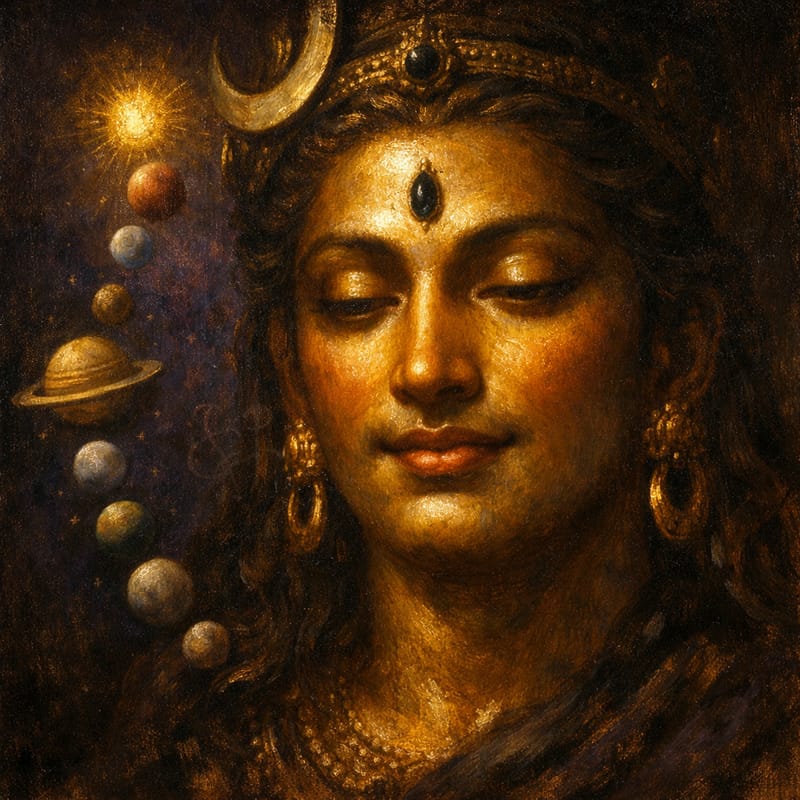
Shani Mantra — Telugu Lyrics
The Shani Mantra 'Om Praam Preem Praum Sah Shanaishcharaaye Namah' is a sacred invocation to Shani, the Vedic deity of Saturn. The syllables 'Praam, Preem, Praum' are bija (seed) sounds traditionally associated with Saturn, while 'Sah' represents the individual soul. 'Shanaishcharaaye Namah' means 'I bow to Shani the slow-moving one.' Together, this mantra creates a bridge between human consciousness and Saturn's disciplinary, stabilizing force in the Navagraha (nine planetary) system.
In Vedic astrology (Jyotish), Shani is not merely feared but revered as a divine teacher who enforces karma and bestows wisdom through trials. The Surya Siddhanta and Brihat Parashara Hora Shastra identify Shani as the planet of discipline, longevity, and spiritual maturation. This mantra acknowledges Shani's role as a cosmic force that removes illusions, strips away ego, and leads sincere practitioners toward authentic growth. Chanting this mantra invites Shani's blessings—transforming perceived hardship into spiritual opportunity.
Practitioners typically chant this mantra 108 times on Saturdays (Shani's day), ideally in the morning or evening during meditation. The practice works best when approached with sincere intention rather than fear. Begin by establishing a steady breath rhythm, visualize deep indigo or black light (Shani's color), and allow the mantra's sound to settle into your awareness. Even 10-15 minutes of consistent practice can help you build discipline and inner resilience over time.
Curated by The Mahakatha Team · Original Composition: Mahakatha · Lyric: Traditional / Vedic
Shani Mantra
Shani · Preview · 2:00
Preview ended
Ancient sounds for transformation, carried across 3,000 years.
Get the full version — plus 275 more ancient chants. 80% OFF today only.
Get Ancient Chants Bundle — 80% OFF →3000+ happy customers · Lifetime access · All devices
2.2M people trust Mahakatha
Chant daily with reminders — Get the Mahakatha app
Lyrics
ॐ प्राम् प्रीम् प्रौं सः शनैश्चराये नमः
ఓం ప్రాం ప్రీం ప్రౌం సః శనైశ్చరాయే నమః
తన పేరును స్మరించే వారికి సంతులనం మరియు స్థిరత్వం తెచ్చే శని భగవానుకు నమస్కరిస్తున్నాను
How to Chant Shani Mantra
- 1
Find a quiet, clean space
Sit in a comfortable, undisturbed environment. Face east or north if possible. You may light incense or a candle to set a contemplative atmosphere.
- 2
Settle into a comfortable posture
Sit cross-legged on the floor or upright in a chair. Keep the spine erect and place the hands on the knees with palms facing upward.
- 3
Take three cleansing breaths
Inhale slowly through the nose, hold briefly, and exhale completely. Repeat three times to calm the mind and prepare for mantra recitation.
- 4
Begin chanting Shani Mantra
Chant the mantra clearly and with devotion — aloud, in a whisper, or silently. Use a mala (108 beads) to count repetitions. Aim for a consistent, unhurried rhythm throughout the session.
- 5
Rest in stillness
After completing your chanting, sit quietly for two to five minutes. Allow the vibration of the mantra to settle within. Close the practice with a moment of gratitude.
Benefits of Shani Mantra
-
Helps build steady discipline and willpower to work through procrastination and self-destructive patterns.
Source: Brihat Parashara Hora Shastra & Traditional Jyotish practice
-
Traditionally chanted to ask for obstacles in work, home life, and relationships to be cleared.
Source: Surya Siddhanta & Vedic astrological texts
-
Cultivates emotional stability and fearlessness by transforming Saturn's challenging influence into wisdom.
Source: Traditional practice & Upanishadic philosophy
-
Extends lifespan and vitality by aligning with Saturn's protective, longevity-granting energies.
Source: Brihat Samhita & classical Jyotish traditions
-
Supports spiritual maturity and self-realization through Saturn's testing and refining fire.
Source: Vedic spiritual practice
Story & Symbolism
The Shani Mantra originates in the Vedic era, when sages recognized nine primary celestial bodies (Navagraha) as divine forces governing human destiny and karma. The Surya Siddhanta, composed around 400 CE, systematized these planetary deities and their associated mantras. Shani, identified as Saturn, held special significance—not as a planet to fear, but as a cosmic teacher enforcing dharma and guiding souls through purification. The bija sounds 'Praam, Preem, Praum' come from the Tantric tradition, where they are associated with Saturn itself. 'Shanaishcharaaye Namah' became the reverent invocation acknowledging Shani's slow but inevitable journey through our lives.
In deeper tradition, Shani represents the consequence of our actions, the weight of unresolved karma, and the discipline required for genuine transformation. Vedic texts like the Brihat Parashara Hora Shastra reveal that Shani is not punitive but pedagogical—a divine mirror reflecting our inner fragmentation and calling us toward wholeness. Ancient practitioners understood that fearing Shani created resistance; instead, they cultivated respect and devotion. This mantra became a sacred technology for converting Saturn's testing fire into spiritual gold, transforming hardship into wisdom and delay into preparation for worthy achievement.
Over centuries, this mantra spread across Hindu, Buddhist, and Vedic communities, becoming a cornerstone of Jyotish practice. Today, seekers worldwide chant it during Saturn transits, personal crises, or when building discipline and integrity. The mantra's enduring power lies in its honesty—it does not praumise escape from challenges, but rather wisdom to navigate them with strength and grace.
How to Use in Daily Life
Saturday Dawn
Chant Shani Mantra 108 times on Saturday morning before sunrise. Face east, sit upright, and use a mala for counting. This leverages Saturn's dominant energy on its ruling day for maximum potency and spiritual alignment.
Meditation Practice
Incorporate the mantra into 20-minute meditation sessions. Visualize deep indigo or black light descending from the cosmos into your root chakra. Feel Saturn's stabilizing, grounding energy dissolving fear and ego, replacing them with calm discipline.
Evening Reflection
Chant softly in the evening (6-8 PM) after reflection on your day's actions and choices. This anchors accountability and integrity. Pair with journaling to track patterns of procrastination or self-sabotage the mantra is dissolving.
Before Sleep
Whisper the mantra 21 times before bed to calm anxious thoughts and ask for Saturn's protective, stabilizing influence as you fall asleep. This makes the evening a time for quiet reflection before sleep.