

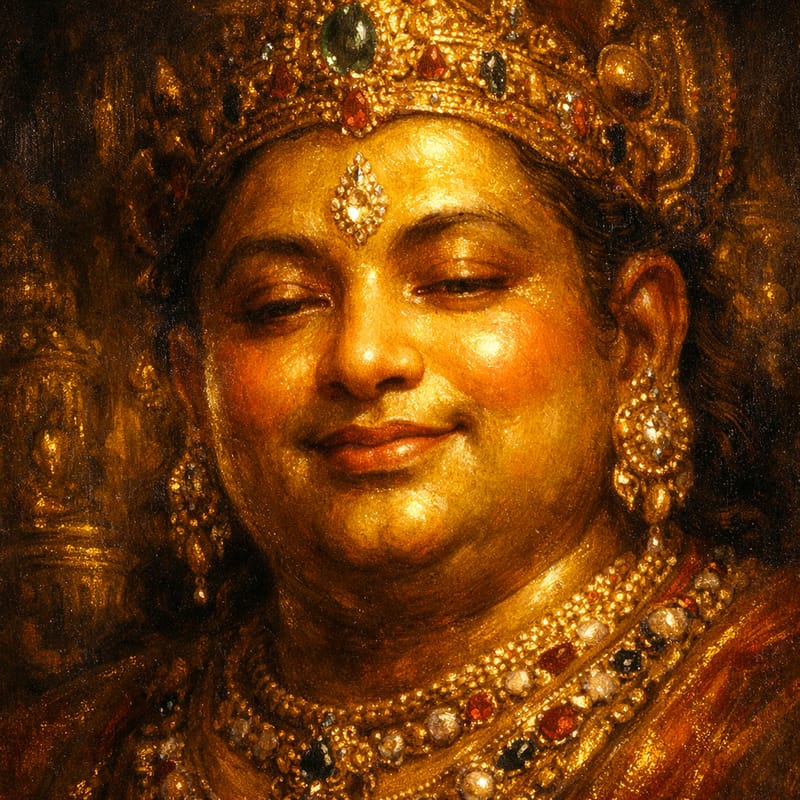
Kubera Diwali Mantra — German Lyrics
Kubera Diwali Mantra is a sacred Sanskrit mantra honoring Kubera, the Hindu deity of wealth, chanted as a prayer for prosperity and to ease a scarcity mindset.
This sacred mantra invokes Kubera, the celestial treasurer of the gods and lord of all wealth. The mantra opens with 'Om Yakshaya Kuberaya Vaishravanaya'—bowing to Kubera as the supreme Yaksha (nature spirit) and Vaishravana (the all-knowing witness). 'Dhanadhanyadhipataye' addresses him as the sovereign lord of both monetary wealth (dhana) and grain/nourishment (dhanya). The closing 'Dhanadhanyasamriddhim me dehi'—'bestow upon me prosperity of wealth and grain'—is a sincere prayer for material and spiritual abundance, sealed with 'Svaha,' the sacred affirmation that seals the offering.
Kubera holds a unique place in Hindu cosmology as the only mortal-born deity to achieve immortal status through devotion. He embodies the principle that wealth is not sinful when earned with integrity and shared with compassion. During Diwali, the festival of lights symbolizing victory of light over darkness, Kubera's worship becomes especially potent—it represents illuminating our path toward righteous prosperity. This mantra reconnects the seeker with the cosmic law of circulation: abundance flows to those who align themselves with generosity, dharma (duty), and service. Kubera is not a god of hoarding, but of wise stewardship.
Chant this mantra 108 times during Diwali morning, ideally facing north (Kubera's direction) with a focused mind. Many practitioners recite it while performing puja (worship) near symbols of wealth—account books, business tools, or the place where accounts are kept. Begin on Diwali day or the preceding Dhanteras (the 'wealth day' in the lunar calendar). Consistency matters more than intensity; even 27 repetitions daily for 40 days yields transformative results. Combine with acts of charity—Kubera's grace flows most freely to generous hearts.
Curated by The Mahakatha Team · Original Composition: Mahakatha · Lyric: Traditional / Vaishnava
Kubera Diwali Mantra
Kubera · Preview · 2:00
Preview ended
Ancient sounds for transformation, carried across 3,000 years.
Get the full version — plus 275 more ancient chants. 80% OFF today only.
Get Ancient Chants Bundle — 80% OFF →3000+ happy customers · Lifetime access · All devices
2.2M people trust Mahakatha
Chant daily with reminders — Get the Mahakatha app
ॐ यक्षाय कुबेराय वैश्रवणाय धनधान्याधिपतये धनधान्यसमृद्धिं मे देहि दापय स्वाहा
om yakshaya kuberaya vaishravanaya dhanadhanyadhipataye dhanadhanyasamriddhim me dehi daapaya svaha
Ich verneige mich vor dem göttlichen Yaksha Kubera
dem Hüter allen Reichtums und Überflusses,
Bitte segne mich mit dem Reichtum von Wohlstand, Getreide und Wohlergehen, ich bete.
How to Chant Kubera Diwali Mantra
- 1
Find a quiet, clean space
Sit in a comfortable, undisturbed environment. Face east or north if possible. You may light incense or a candle to set a contemplative atmosphere.
- 2
Settle into a comfortable posture
Sit cross-legged on the floor or upright in a chair. Keep the spine erect and place the hands on the knees with palms facing upward.
- 3
Take three cleansing breaths
Inhale slowly through the nose, hold briefly, and exhale completely. Repeat three times to calm the mind and prepare for mantra recitation.
- 4
Begin chanting Kubera Diwali Mantra
Chant the mantra clearly and with devotion — aloud, in a whisper, or silently. Use a mala (108 beads) to count repetitions. Aim for a consistent, unhurried rhythm throughout the session.
- 5
Rest in stillness
After completing your chanting, sit quietly for two to five minutes. Allow the vibration of the mantra to settle within. Close the practice with a moment of gratitude.
Benefits of Kubera Diwali Mantra
-
A prayer for material and spiritual well-being in line with dharmic principles, and for a way through periods of stagnation.
Source: Padma Purana — Kubera Khanda (Kubera section)
-
Removes mental blocks and scarcity mindset, replacing fear-based thoughts with confidence in cosmic abundance.
Source: Traditional Tantric practice
-
Strengthens business acumen and decision-making clarity, helping practitioners identify wealth opportunities.
Source: Skanda Purana — accounts of Kubera's role as divine advisor
-
Cultivates generosity and ethical wealth-building, encouraging prosperity that brings fulfillment rather than restlessness.
Source: Bhagavata Purana — teachings on righteous prosperity
-
Harmonizes household finances and removes obstacles in inheritance, loans, and business partnerships.
Source: Traditional Diwali practice and Jyotish (Vedic astrology)
Story & Symbolism
Kubera's ascension to divine status forms the core mythology underlying this mantra. Originally born as a mortal prince—variously named Yaksharaj or Kuber—he was the son of the sage Pulastya (one of Brahma's mind-born sons). Recognizing the spiritual potential within material stewardship, the young prince undertook intense tapasya (ascetic discipline) dedicated to Lord Shiva. For millennia, he meditated in the Himalayas, subsisting on minimal food and water, his singular focus: to transform wealth itself into a sacred tool for dharma. Shiva, pleased with his unwavering devotion and righteous intentions, blessed him with immortality and appointed him Lokapala—the divine guardian of the northern direction—and sovereign custodian of all treasures, gems, and grain. This mythology encodes a profound truth: abundance is not the opposite of spirituality, but its natural fruit when pursued with integrity and generative purpose.
Kubera's symbolism deepens across Vedic texts. In the Atharva Veda and later Puranas, he embodies the principle of righteous circulation—wealth flows through him not to hoard, but to distribute. He lives in Alaka, a celestial city of incomparable richness, yet he is described as the cosmic accountant, guiding resources to those whose karma (action) and intention align with dharma (universal law). This duality—abundance without attachment—makes him uniquely powerful. Unlike deities of warfare or asceticism, Kubera offers blessings to householders, merchants, and farmers: his domain is the practical spiritual life. The mantra itself crystallizes this wisdom; it doesn't ask for renunciation or transcendence, but for intelligent prosperity—wealth that nourishes family, community, and dharmic purpose.
By the medieval period (1200-1700 CE), Kubera worship became inseparable from Diwali, the festival celebrating light's victory over darkness. Merchants and householders began reciting this mantra on Diwali morning and Dhanteras (the lunar day dedicated to wealth). The practice standardized across North India, and gradually spread throughout the Hindu diaspora. Today, the Kubera Diwali Mantra represents a reclamation of prosperity as a legitimate spiritual path—not a compromise with materialism, but an expression of it, grounded in ancient Vedic wisdom that honors both the sacred and the practical dimensions of human flourishing.
How to Use in Daily Life
Diwali Dawn Ritual
Begin Diwali morning (or Dhanteras) facing north. Sit in front of a lamp or candle. Light incense. Chant the mantra 108 times with focused intention. This turns your attention to Kubera at the festival's most auspicious moment.
Daily 40-Day Practice
After your morning meditation, chant 27 repetitions of the mantra. Use a mala (prayer beads) to track repetitions. Maintain this discipline for 40 days post-Diwali. This extended cycle transforms scarcity patterns and anchors abundance consciousness into your psyche.
Wealth Space Blessing
Chant the mantra in your workspace, near account books, business tools, or important papers. Repeat 11 times while visualizing golden light blessing these spaces. This sanctifies your livelihood and invites Kubera's guidance into daily decisions.
Evening Gratitude Close
Before sleep, chant 27 repetitions while reflecting on the day's blessings—earnings received, opportunities recognized, generosity practiced. This trains your mind to recognize prosperity and gratefully receive more. End with sincere thanks to Kubera.