

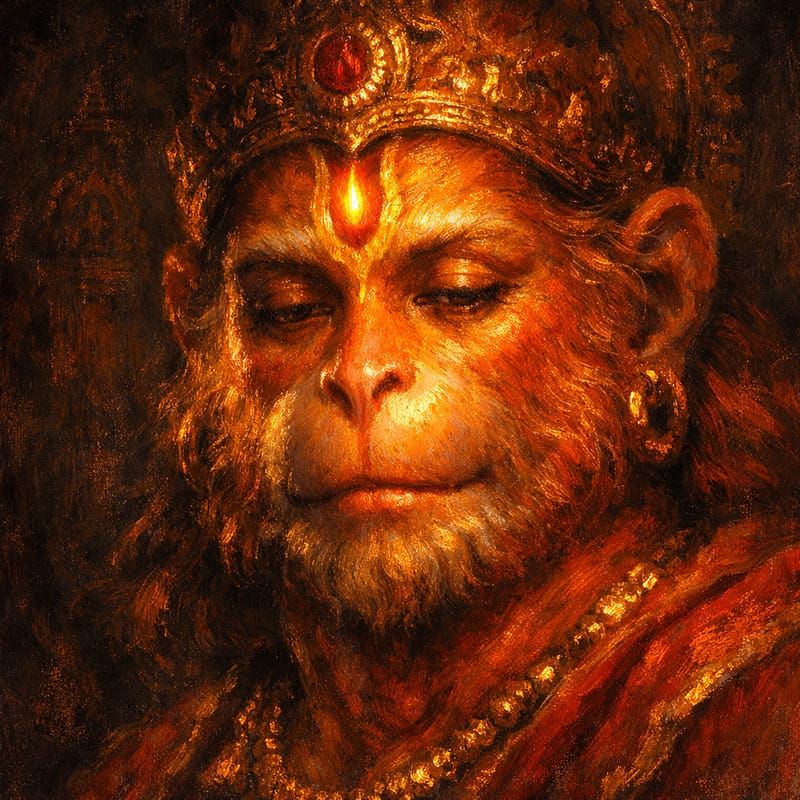
Hanuman Gayatri Mantra — Bengali Lyrics
Hanuman Gayatri Mantra is a powerful Sanskrit mantra honoring Hanuman, awakening courage, clarity, and spiritual protection.
Om Anjaneyaya Vidmahe invokes Hanuman as the son of Anjana, acknowledging his earthly birth through the devoted mother blessed by Shiva. Vayuputraya Dhimahi calls upon his divine paternity—Vayu, the wind god—reminding us that Hanuman embodies prana, the universal life-force itself. Tanno Hanumat Prachodayat is the closing prayer: 'May Lord Hanuman inspire and illuminate our minds.' This three-part structure mirrors the Gayatri Mantra's sacred framework of invocation, meditation, and illumination.
The Hanuman Gayatri follows the classical Gayatri format—the most refined and psychologically potent invocation of any deity in Hindu tradition. By invoking Hanuman as both Anjaneya (earthly devotion) and Vayuputra (divine vitality), the mantra taps into his dual nature: the perfected human and the embodied cosmic force. Hanuman represents supreme courage, unwavering devotion, and mental mastery. Chanting this mantra channels his qualities directly into the practitioner's consciousness, awakening the dormant strength of prana and clarity of purpose that define his legacy in the Ramayana.
Chant the Hanuman Gayatri at sunrise, the traditional hour for all Gayatri mantras, when solar energy peaks. Use a red rudraksha mala (108 beads) and recite 108 times. Tuesday and Saturday are especially auspicious for Hanuman practice. This mantra is often chosen by those seeking courage before challenges, mental clarity in confusion, or a prayer for protection. Even 11 repetitions daily yields noticeable shifts in confidence and vitality within weeks of consistent practice.
Curated by The Mahakatha Team · Original Composition: Mahakatha · Lyric: Traditional / Vaishnava
Hanuman Gayatri Mantra
Hanuman · Preview · 2:00
Preview ended
Ancient sounds for transformation, carried across 3,000 years.
Get the full version — plus 275 more ancient chants. 80% OFF today only.
Get Ancient Chants Bundle — 80% OFF →3000+ happy customers · Lifetime access · All devices
2.2M people trust Mahakatha
Chant daily with reminders — Get the Mahakatha app
Lyrics
ॐ अञ्जनेयाय विद्महे वायुपुत्राय धीमहि। तन्नो हनुमत् प्रचोदयात्॥
ওঁ অঞ্জনেযায বিদ্মহে বাযুপুত্রায ধীমহি। তন্নো হনুমত্ প্রচোদযাত্॥
হে অঞ্জনার পুত্র,
হে বায়ুর পুত্র, আমি তোমার কাছে আত্মসমর্পণ করি,
অনুগ্রহ করে আমার বুদ্ধিকে দিব্য জ্ঞানের দিকে পরিচালিত করুন।
How to Chant Hanuman Gayatri Mantra
- 1
Find a quiet, clean space
Sit in a comfortable, undisturbed environment. Face east or north if possible. You may light incense or a candle to set a contemplative atmosphere.
- 2
Settle into a comfortable posture
Sit cross-legged on the floor or upright in a chair. Keep the spine erect and place the hands on the knees with palms facing upward.
- 3
Take three cleansing breaths
Inhale slowly through the nose, hold briefly, and exhale completely. Repeat three times to calm the mind and prepare for mantra recitation.
- 4
Begin chanting Hanuman Gayatri Mantra
Chant the mantra clearly and with devotion — aloud, in a whisper, or silently. Use a mala (108 beads) to count repetitions. Aim for a consistent, unhurried rhythm throughout the session.
- 5
Rest in stillness
After completing your chanting, sit quietly for two to five minutes. Allow the vibration of the mantra to settle within. Close the practice with a moment of gratitude.
Benefits of Hanuman Gayatri Mantra
-
Awakens courage, mental clarity, and confidence in facing life's challenges
Source: Hanuman Chalisa tradition & Ramayana characterization
-
Channels Vayuputra energy to enhance physical vitality, breath control, and prana flow throughout the body
Source: Yogic and Tantric practice lineages
-
A prayer for fierce spiritual protection and a steady, untroubled mind
Source: Traditional Hanuman worship practice
-
Activates selfless service (seva) and devotion as spiritual paths, embodying Hanuman's greatest gift to consciousness
Source: Bhakti tradition and Ramayana teachings
-
Strengthens focus, willpower, and mental discipline through direct invocation of the mind's highest potential
Source: Mantra Shastra tradition
Story & Symbolism
The Hanuman Gayatri Mantra emerges from the ancient Vedic tradition of Gayatri mantras—the most concentrated and spiritually potent forms of deity invocation. While the primary Gayatri Mantra appears in the Rigveda addressed to Surya (the sun god), the spiritual masters of subsequent centuries recognized that every major deity could be invoked through the Gayatri meter to unlock their highest power. The Hanuman Gayatri was developed and transmitted through guru-disciple lineages in both Vedantic and Bhakti schools, becoming a cornerstone of Hanuman worship alongside the more narrative Hanuman Chalisa. Its preservation reflects the principle that ultimate spiritual power is not stored in long narratives alone, but in concentrated syllabic formulas that align consciousness with cosmic forces.
Hanuman himself—as depicted in the Ramayana and Mahabharata—embodies the perfect synthesis of human devotion and divine power. By invoking him as Anjaneya (son of the devoted mother Anjana) and Vayuputra (son of Vayu, the cosmic life-force), the mantra taps into his dual nature: the perfected human who achieved immortality through seva (selfless service), and the embodiment of prana itself. Vayu, Hanuman's divine father, is not merely the wind god but the principle of movement, breath, life-force, and consciousness. This genealogy encodes the teaching that courage, clarity, and vitality are not external gifts but dormant powers within every practitioner, awakened through sincere invocation.
Today, the Hanuman Gayatri remains a living practice in homes and temples across India and the diaspora, especially among practitioners of Vedantic meditation and Bhakti yoga. Its transmission has been safeguarded by lineages of Hanuman devotees—from traditional temple priests to contemporary yoga teachers—who recognize that this mantra's power lies not in its age, but in its direct alignment with Hanuman's timeless qualities: unwavering courage, mental mastery, and the capacity to transform devotion into spiritual realization.
How to Use in Daily Life
Sunrise Chanting
Chant 108 repetitions at sunrise using a red rudraksha mala. This is the most auspicious time for Gayatri mantras, when solar and cosmic energy peak. Face east or north for maximum benefit.
Before Challenges
Chant 11 times before facing a difficult conversation, important decision, or physical challenge. This calls up Hanuman's courage within you, grounding you in clarity and steady confidence.
Tuesday & Saturday
On Hanuman's auspicious days (Mangal/Tuesday and Saturday), increase your practice to 108 repetitions. These days amplify the mantra's protective and strength-building effects significantly.
Evening Meditation
Chant 11-21 times in the evening before sleep to calm mental turbulence, release fear, and invite Hanuman's protective presence as you rest.