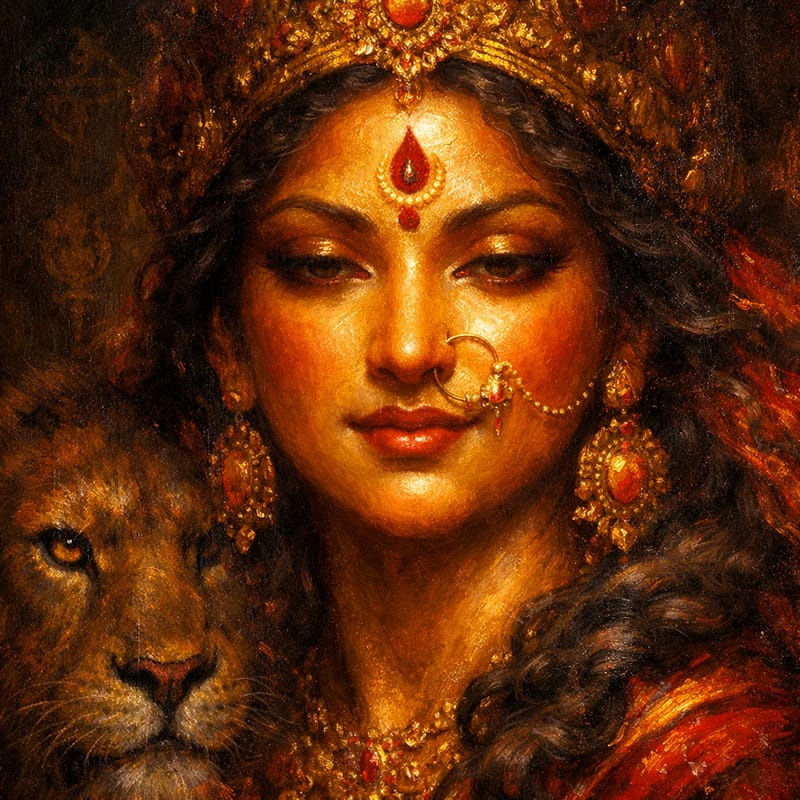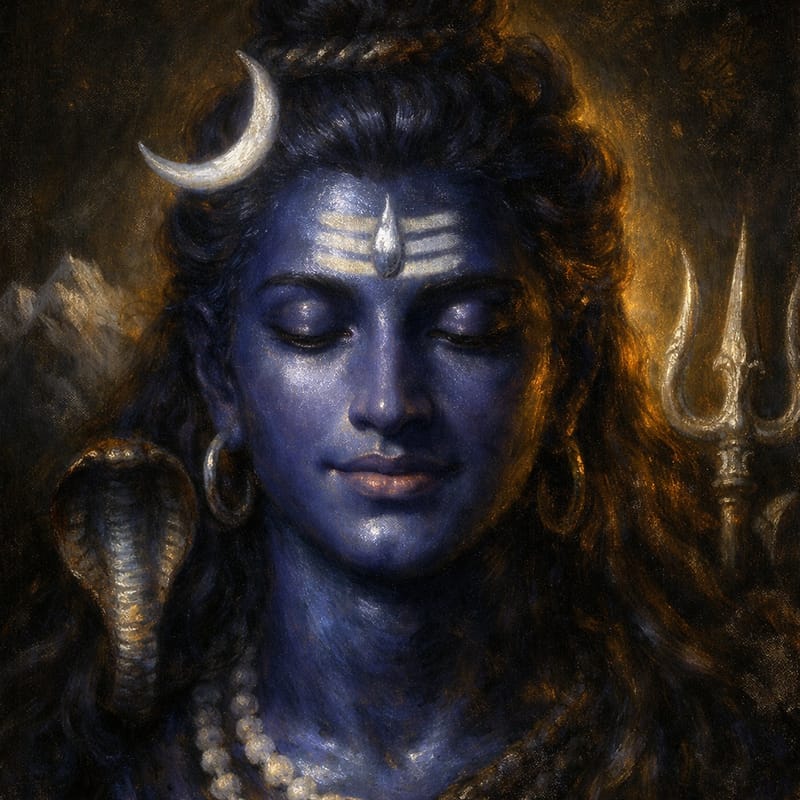


Goddess Kali is the fierce dark form of the Divine Mother. Her name is linked to kala, which means time. In the Devi Mahatmya she springs from Durga's brow to fight the hardest battle. Her wild image can look frightening. Devotees see a loving mother who cuts away fear and pride. Bengal and Kerala hold her especially dear.
Who is Goddess Kali?
Kali is the Mother in her most fierce form. She is dark like the night sky. Her hair is loose and her tongue is red. Yet her devotees simply call her Ma.
Her name is linked to kala. Kala means both time and black. So Kali is the one who is time itself. Everything is born in time and returns to it.
Her look is meant to shake us awake. Behind it devotees find a mother who protects her children from every fear.
Mahakali
The great Kali. She is often shown with Mahalakshmi and Mahasaraswati as one of three great forms of the goddess.
Bhadrakali
Bhadra means blessed or kind. This is the name Kerala loves most.
Shyama
The dark one. Bengal's autumn worship of Kali is often called Shyama Puja.
Dakshina Kali
The form most often seen in Bengal. She usually stands with her right foot forward on Shiva.
Adya Kali
Adya means first. She is the first power from which all forms come.
Chamunda
The name she earned by defeating the demons Chanda and Munda.
Stories of Goddess Kali
Kali's stories are told in many ways. Some come from old Sanskrit texts. Others come from village songs and temple towns. All of them show a love that is fierce.
Kali springs from Durga's brow
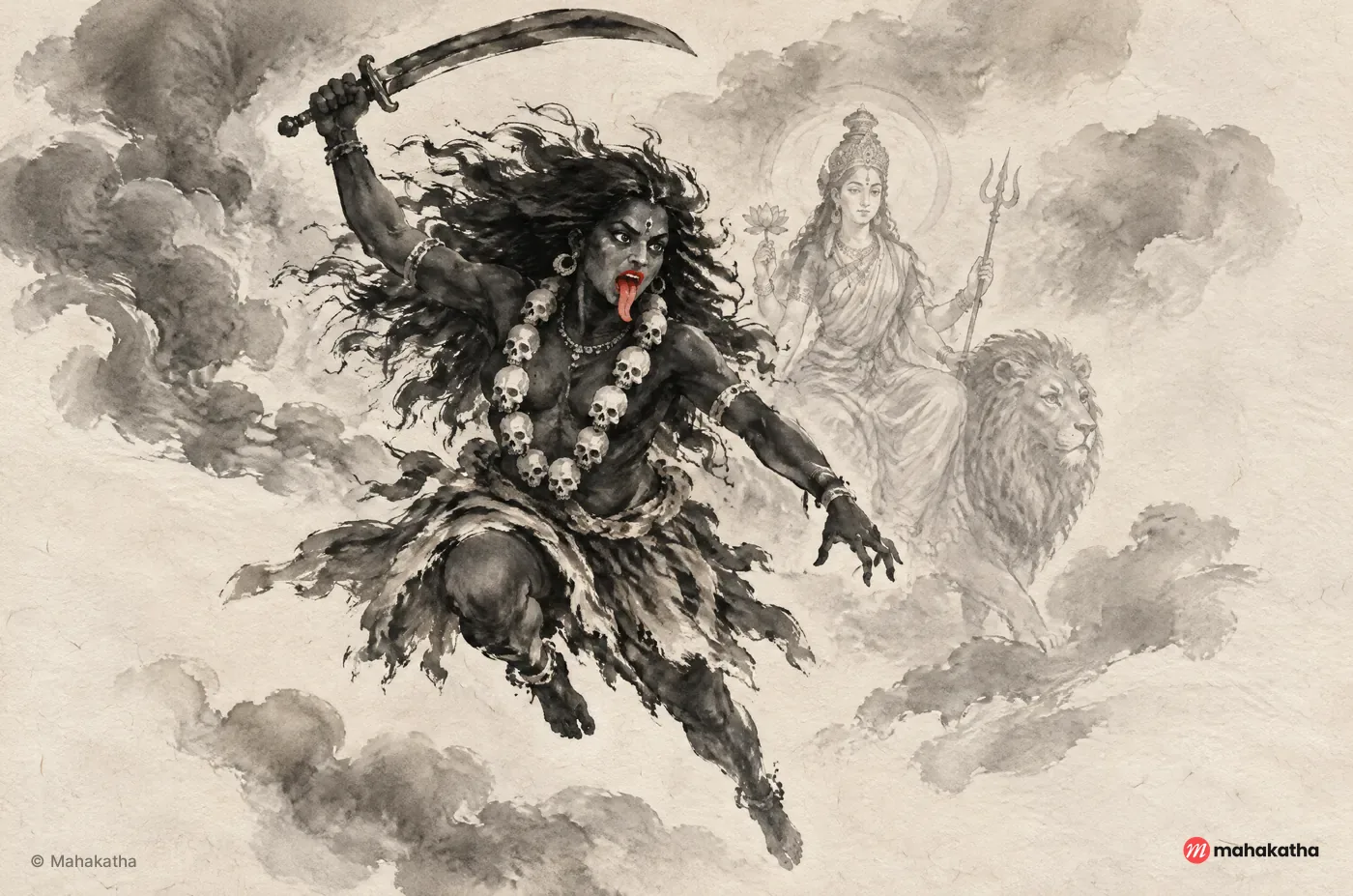
The Devi Mahatmya tells of two demon generals named Chanda and Munda. They marched against the goddess Ambika. Her face darkened with anger. From her brow sprang Kali with a roar. She defeated both generals. Ambika then named her Chamunda.
Raktabija and the drops of blood
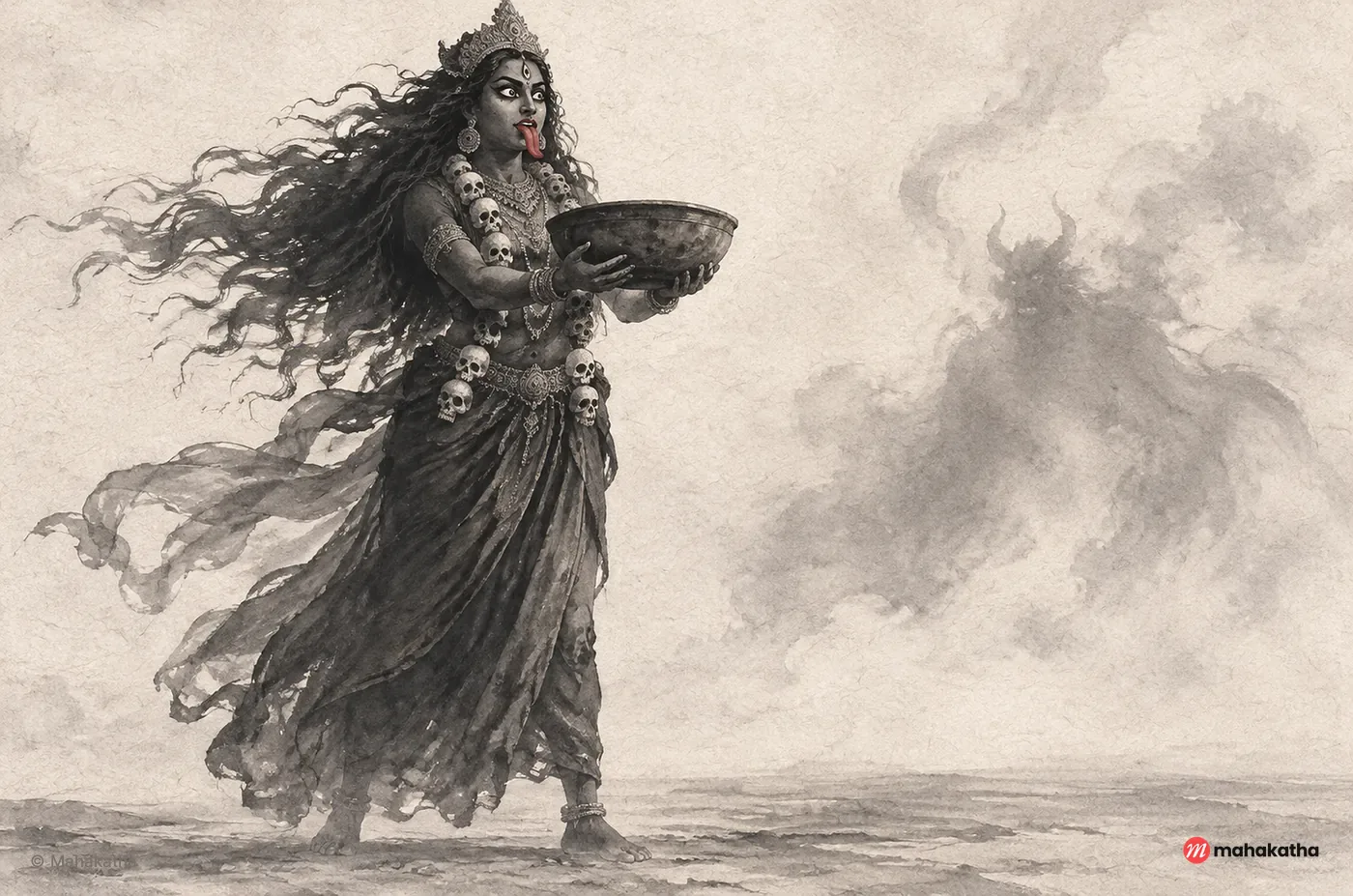
The demon Raktabija had a strange gift. Every drop of his blood that touched the ground became a new demon. The battle seemed endless. Kali spread her tongue wide and caught every drop. No new demons could rise. Many read this as a lesson about anger. Feed it and it multiplies.
Kali steps on Shiva
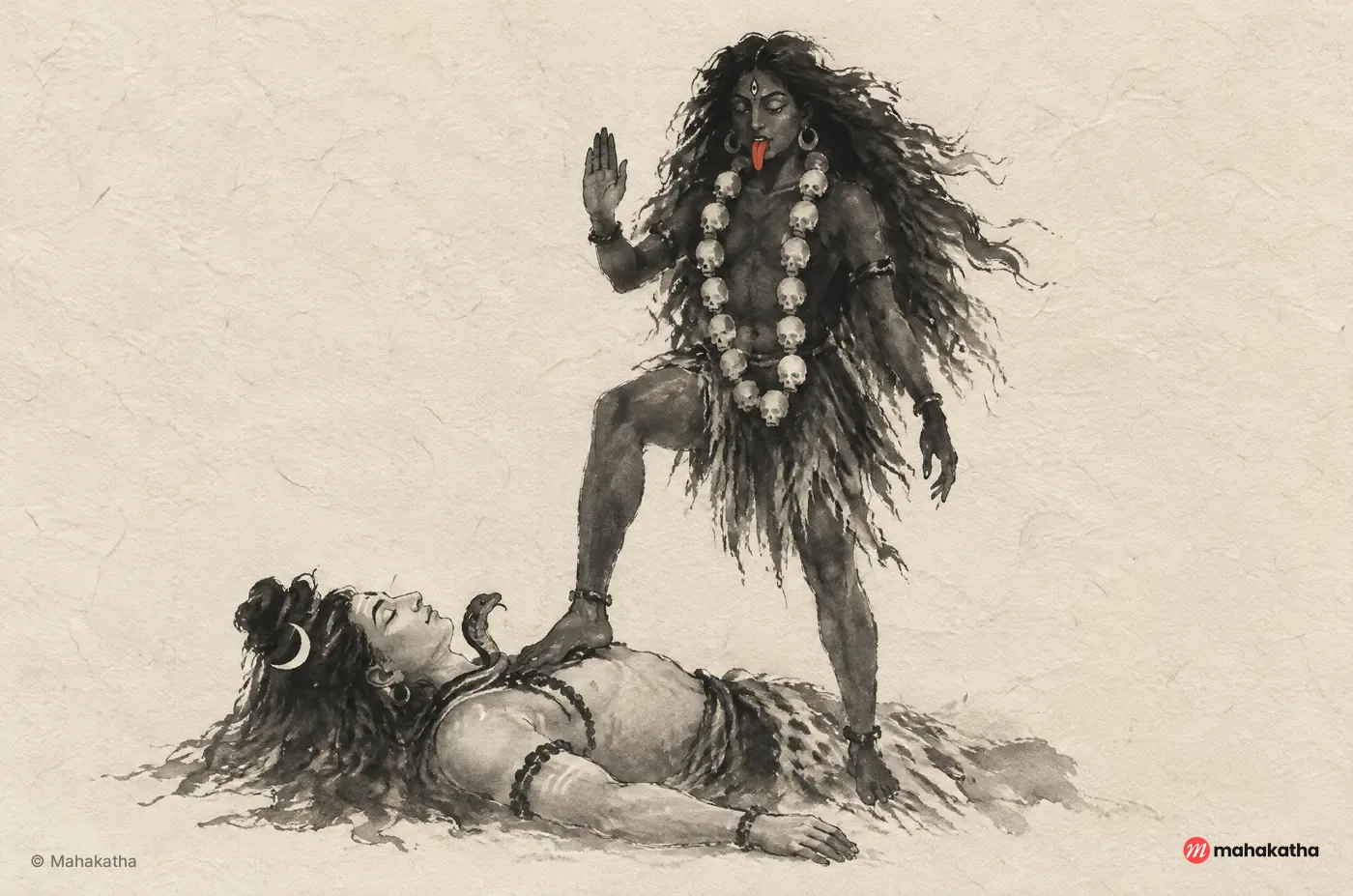
A popular Bengali telling follows that battle. Kali danced in victory and the worlds began to shake. Shiva lay down in her path. When her foot touched him she stopped. Her tongue came out in shame and surprise. Another reading goes deeper. Shiva is pure awareness and Kali is its power. Without Shakti it is said Shiva is shava, a still body.
The dance at Chidambaram
A Tamil story tells of a dance contest between Kali and Shiva at Chidambaram. They matched each other step for step. Then Shiva lifted one leg high above his head. The story says Kali would not raise her leg so high. Tellings differ on why. She settled at the edge of the town. Her shrine there is loved as Thillai Kali.
Kali and the poet Kalidasa
A popular legend linked to Ujjain tells of a simple young man. His learned wife laughed at his ignorance. He prayed to Kali in despair. The story says she blessed his tongue and he became the poet Kalidasa. His name means servant of Kali.
How the worship of Kali grew
Kali's worship grew slowly from the name of a tongue of fire to a beloved Mother. Here are the broad steps.
The Upanishads
The Mundaka Upanishad names seven flickering tongues of the sacred fire. One of them is called Kali. It is not yet the goddess we know.
The Devi Mahatmya
This text inside the Markandeya Purana gives Kali her great entrance. Scholars often place it around the 5th or 6th century. Dates are debated.
Temples in stone
Medieval temples in Odisha and central India hold striking images of Chamunda. She is thin and fearless. Her stone faces still watch over old temple walls.
The Bengal poets
In 18th century Bengal the poet Ramprasad Sen sang to Kali like a child to his mother. His songs are called Shyama Sangeet. They turned the fierce goddess into a tender parent. The poet Kamalakanta followed in the same spirit.
Dakshineswar
In the 19th century Rani Rashmoni built the Dakshineswar temple near Kolkata. Sri Ramakrishna served there as priest. He saw Kali as the living Mother of the universe. His disciple Swami Vivekananda carried this vision to the world.
Today
Kali is loved in Bengal and Assam. She is loved in Odisha and Kerala too. Her temples now stand from Kathmandu to Singapore.
Kali across the regions of India
The same Mother wears many faces across India. Each region knows her a little differently.
East
Bengal is Kali's heartland. Kali Puja falls on the new moon night of Diwali. Homes and neighbourhoods set up clay images of the dark Mother. The night glows with lamps. Assam and Tripura keep the same night.
South
In Kerala she is Bhadrakali, the blessed Kali. Temple arts tell how she defeated the demon Darika. Mudiyettu is one such ritual drama, played in village temples. Tamil Nadu has many Kali Amman shrines that guard villages.
North
In the North Kali often stands beside Mahalakshmi and Mahasaraswati. Kalkaji Mandir in Delhi is a much-loved shrine. In Ujjain the old Gadkalika temple keeps the Kalidasa legend alive.
West
In Gujarat pilgrims climb Pavagadh hill to Kalika Mata. The hill is part of a UNESCO World Heritage Site. In Mumbai the Mahalakshmi Temple holds Mahakali beside Lakshmi.
Beyond India
Nepal worships Dakshinkali at Pharping near Kathmandu. Singapore's Little India has the Sri Veeramakaliamman Temple. In Trinidad and Guyana families of Indian descent honour her as Kali Mai.
Kali temples in India and Nepal
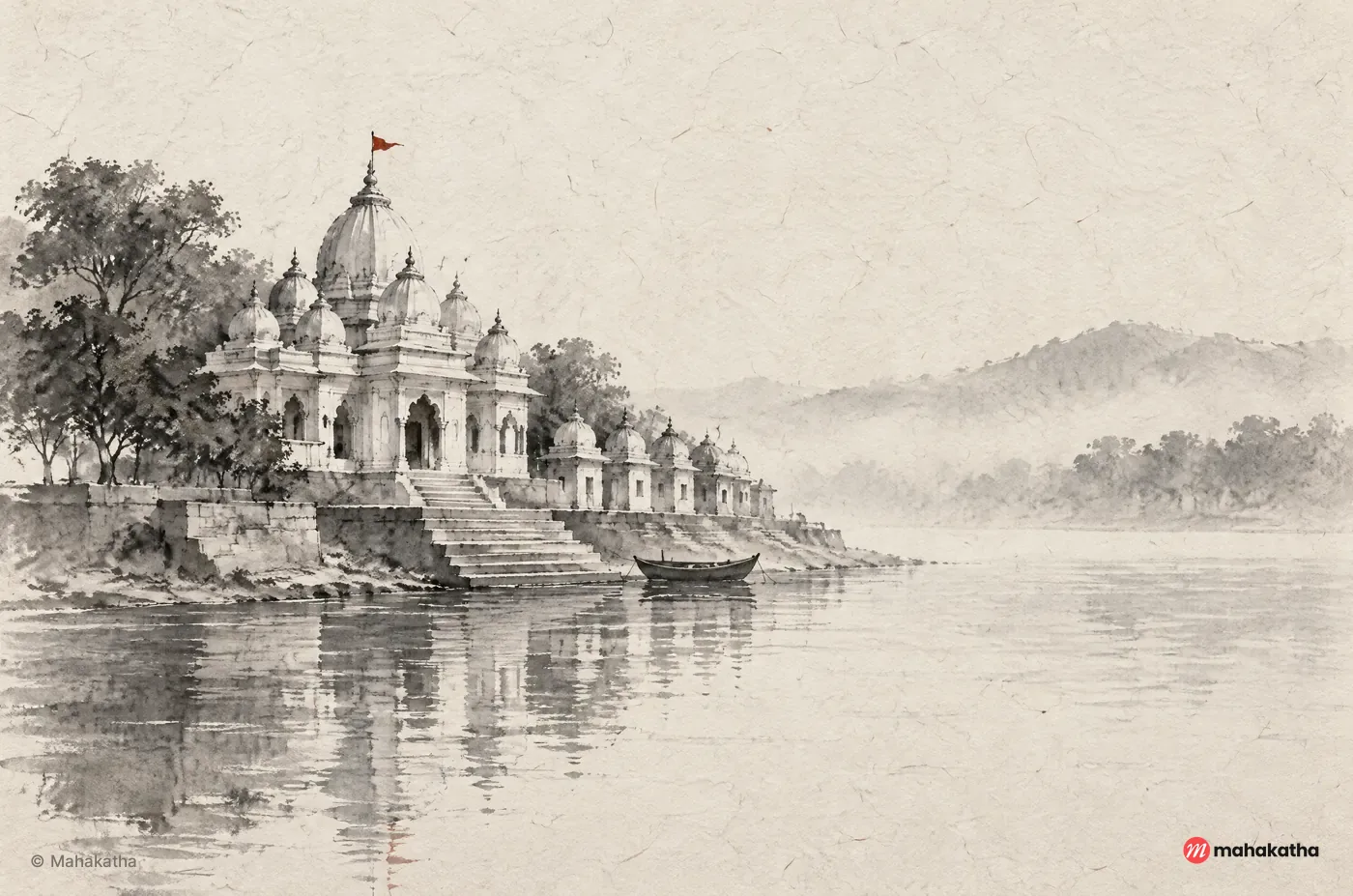
These are some of the best-known shrines where Kali is the heart of worship.
Kalighat Kali Temple, Kolkata (West Bengal)
One of the best-known Shakti Peethas. Tradition holds that the toes of Sati's right foot fell here. The image has three large eyes and a long golden tongue.
Dakshineswar Kali Temple, Dakshineswar (West Bengal)
It stands on the bank of the Hooghly near Kolkata. Sri Ramakrishna served here as priest. The goddess here is called Bhavatarini. The name means she who carries us across the ocean of life.
Thillai Kali Amman Temple, Chidambaram (Tamil Nadu)
The shrine of the dance story. Many pilgrims visit her as well as Nataraja in the great temple.
Kalkaji Mandir, New Delhi (Delhi)
An old and busy shrine in south Delhi. It is crowded with devotees during Navratri.
Kalika Mata Temple, Pavagadh (Gujarat)
It sits on top of Pavagadh hill. Pilgrims climb the steps or take a ropeway.
Gadkalika Temple, Ujjain (Madhya Pradesh)
An old shrine linked in legend to the poet Kalidasa.
Kodungallur Bhagavathy Temple, Kodungallur (Kerala)
One of the great Bhadrakali shrines of Kerala.
Dakshinkali Temple, Pharping (Nepal)
A shrine in a wooded gorge south of Kathmandu. Crowds come on Tuesdays and Saturdays.
Kali's symbols and what they mean
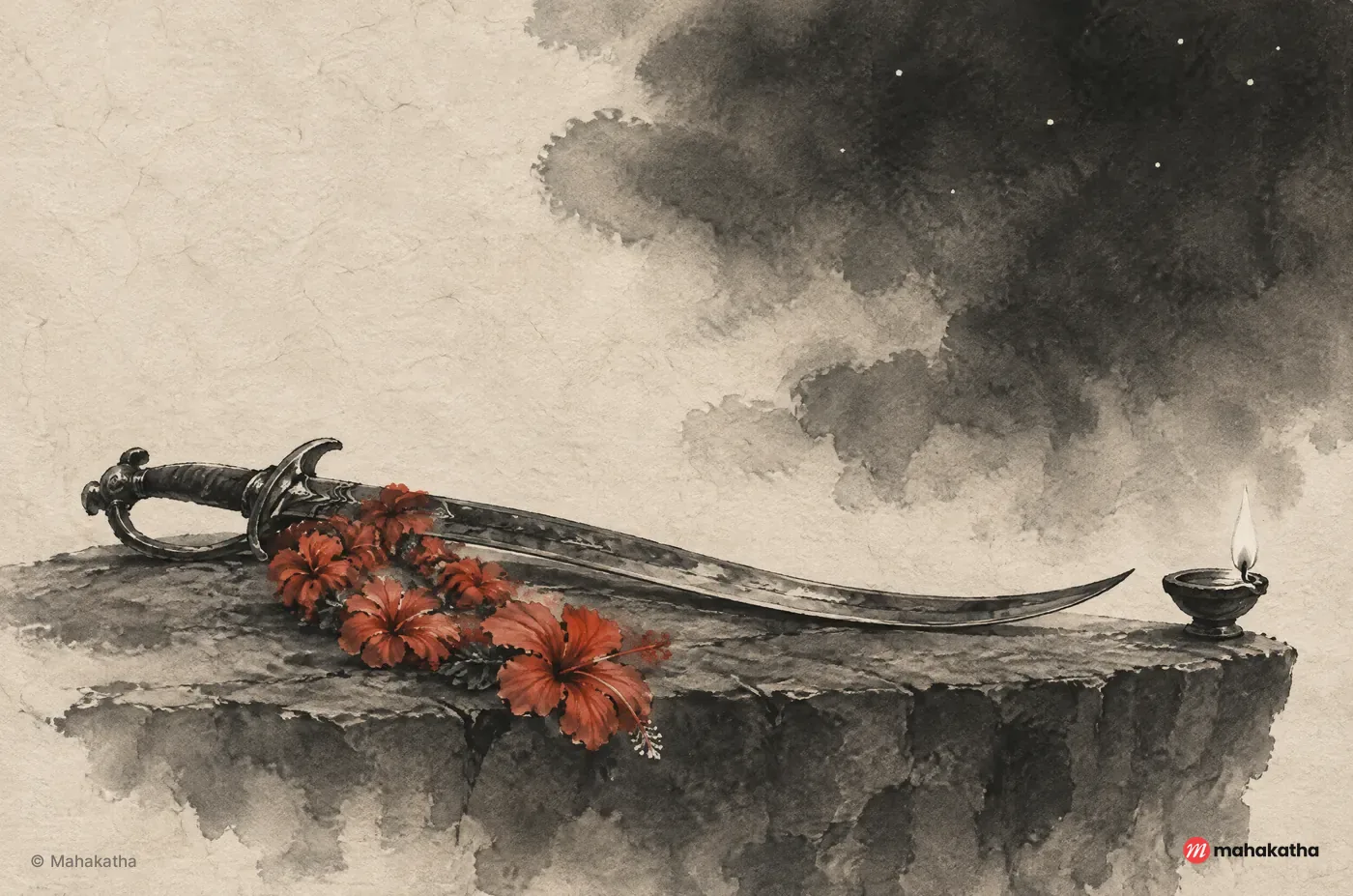
Each fierce detail of Kali has a gentle meaning in devotion. Look slowly and fear gives way to wonder.
Dark skin
Black or deep blue holds all colours within it. Like the night sky it has no edge. Kali is the vast space in which everything rests.
Loose hair
Her hair falls free. It shows freedom from every rule the mind makes.
The red tongue
Several meanings are told. In one she bites it in shame at touching Shiva. In another it shows she has tasted all of life.
The garland of heads
Many teachers explain the heads as the ego in its many forms. Some count fifty and link them to the letters of the Sanskrit alphabet. Every name and sound returns to her.
The sword
Her sword is wisdom. It cuts through the false idea that we are small and alone.
The raised hands
One right hand shows abhaya. Abhaya means do not fear. The other right hand offers a blessing. The fierce Mother is still giving.
The cremation ground
Our Kali Gayatri sings “Smashaana Vasinyai Cha Dhimahi”. It calls her the one who lives at the cremation ground. That is where all pride ends. Devotees see it as a place of truth.
Standing on Shiva
Awareness lies still and power dances upon it. Life needs both.
Kali mantras and hymns
These lines come from our own recordings. They are prayers of devotion and courage. Chant slowly and with love.
Kalika Mantra
A short and loved chant: “Om Kreem Kalikaye Namaha”. Kreem is her seed sound. It bows to the Mother who cuts through ignorance.
Ekakshari Kali Mantra
Ekakshari means one syllable. This mantra is the single seed sound “Krim”. Repeat it softly and rest in the silence after it.
Kali Gayatri Mantra
It begins “Om Kaalikayai Cha Vidmahe” and ends “Tanno Kaali Prachodayat”. It asks Kali to light up the mind.
Jayanti Mangala Kali
This verse opens the Argala Stotram. Many chant that hymn before the Devi Mahatmya. It begins “jayanti mangala kali” and goes on “bhadrakali kapalini”. Kapalini means she who carries a skull.
Mahakali Dhyana Mantra
A dhyana is a meditation verse that paints the deity's form. This one begins “Om Dhyaayet Mahaakaali Mahaamaayaam Trinetraam Bahuroopineem”. It sees her with three eyes and many forms.
Adya Kali Mantra
It honours her as the first power. The chant is “Om Hreem Shreem Kreem Adya Kalika Parameshwari Swaha”.
Shadakshari Kali Mantra
A six-syllable chant: “Om Kreem Kalike Svah”. It is short enough to repeat on every breath.
Kali festivals
Kali's great nights are dark nights. Her devotees fill them with light.
Kali Puja
On the new moon night of Diwali Bengal worships Kali. Images stand in homes and pandals. Many devotees stay awake through the night with song.
Navratri
On the seventh night of Navratri the goddess is honoured as Kalaratri. Kalaratri means the dark night of time.
Phalaharini Kali Puja
A Bengal puja kept with love at Dakshineswar. Sri Ramakrishna is said to have worshipped his wife Sarada Devi as the goddess on this night.
Temple festivals of Kerala
Bhadrakali temples hold festivals with drums and lamps. Ritual theatre retells her victory over Darika.
Ways to bring Kali into your day
Kali is a Mother to turn to when you are afraid. These practices are simple and gentle.
Name the fear
Write one fear on a slip of paper. Sit before a lamp. Chant Om Kreem Kalikaye Namaha slowly a few times. Offer the fear to her and let it go.
Talk to her like a child
Ramprasad sang to Kali as a child calls its mother. Speak to her plainly about what weighs on you.
Sit with endings
When something ends remember that Kali is time. Every ending makes room. Breathe out fully and rest in the pause after the breath.
Sing the evening aarti
Light a lamp at dusk and sing the Kali Aarti.
A prayer for protection
The Kali Kavach asks the Mother to guard you from fear and harm. Kavach means armour.
What Kali can teach us
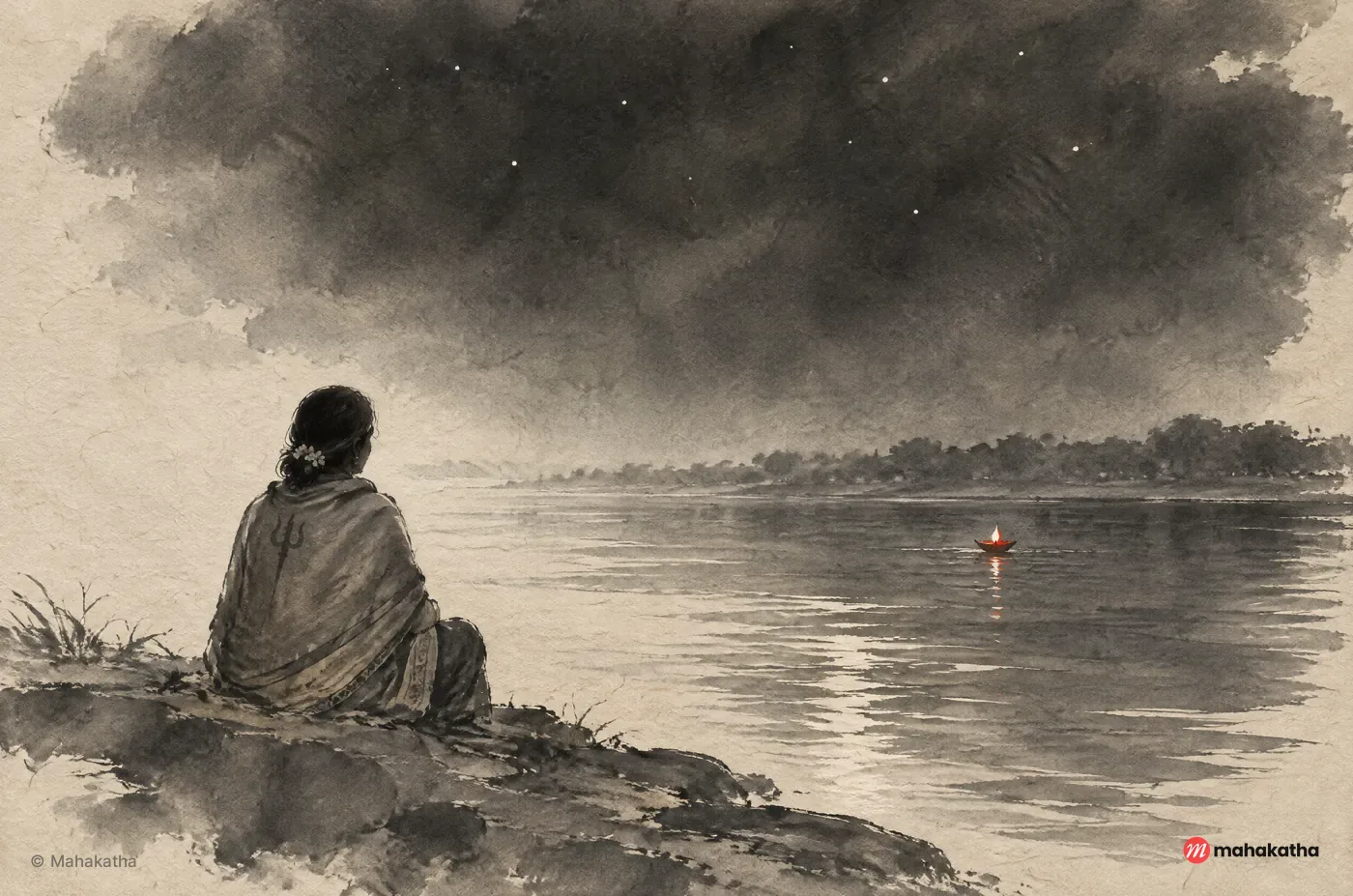
Kali wears the face of what we fear most. Time and loss and change. Her devotees do not run from that face. They climb into her lap like children.
She teaches that endings are part of love. A mother clears away what can harm her child. Kali clears away pride and false hopes. Then the real self can breathe.
The yogis rest at the end of the out-breath. In that small pause there is nothing to hold. That stillness is like Kali's dark sky. Rest there for a moment and let fear loosen.
When life feels wild you need not pretend to be calm. Kali is wild too. She shows that fierce feeling can be holy when it serves truth and guards the weak.
Questions people ask
Who is Goddess Kali?
Kali is the fierce dark form of the Divine Mother. Her name is linked to kala, which means time. The Devi Mahatmya tells how she sprang from Durga's brow to defeat the demons Chanda and Munda. Her look is wild but devotees call her Ma. They see a mother who protects them from fear.
Why is Kali shown with her tongue out?
Several meanings are told. A popular Bengali story says her foot touched Shiva after battle. She stopped and her tongue came out in shame and surprise. Another story links it to the demon Raktabija. Kali caught every drop of his blood so no new demons could rise. Some teachers say the red tongue shows she has tasted all of life.
Why does Kali stand on Shiva?
In one telling Kali danced in victory and the worlds shook. Shiva lay in her path to calm her. When her foot touched him she stopped. A deeper reading sees Shiva as still awareness and Kali as its power. It is said that without Shakti Shiva is shava, a still body. Both are needed for life.
Is it safe to worship Goddess Kali?
Yes. For millions of families Kali is a loving Mother. Her fierce look is aimed at ego and fear and never at her children. Ramprasad and Sri Ramakrishna loved her with the trust of a child. Simple devotion is enough. Light a lamp and chant her name with a calm and kind heart.
What is the difference between Kali and Durga?
In the Devi Mahatmya Kali springs from Durga's brow during battle. Durga is the calm warrior who rides a lion. Kali is her fierce dark form who rises when the fight is hardest. Many devotees see them as one Mother. Bengal honours Durga in autumn and Kali on the new moon of Diwali.
Which mantra is chanted for Goddess Kali?
Om Kreem Kalikaye Namaha is one of the most loved Kali mantras. Kreem is her seed sound. The Kali Gayatri Mantra asks her to light up the mind. Jayanti Mangala Kali is often chanted before the Devi Mahatmya. Choose one and repeat it slowly before a lamp.